
Furniture ecommerce brands grow in 2027 by making the big purchase feel safe, not by buying more clicks. People still want to buy sofas, sectionals, bar stools and dining sets online. What stops them is three doubts. Will it fit? What will it really cost to get here? Will it hold up? The stores answering those questions on the page, in their product data and in the answers AI assistants give are the ones growing. The stores pouring money into ads that land on thin product pages are paying more every year just to stand still.
That’s also where furniture store SEO starts to pay off, because a shopper who’s ready to decide usually searches for something very specific: a 30-inch swivel stool, a sectional for a 9-foot wall, a dining table that seats eight.
This guide covers what’s confirmed for 2027 and what’s still a guess, how furniture buyers actually decide, the page, delivery, search and retention fixes that move revenue, a real example from a commercial seating store we work with, and a quarter-by-quarter plan you can start now.
What Growth Should Mean for a Furniture Brand in 2027
Let’s get one thing straight first. More sessions isn’t growth. A furniture store can double its traffic and still lose money if the new orders come with freight losses, damage claims and returns. The useful definition for 2027 is simpler and stricter. Growth means more profit per order and more customers who come back for the next room.
Traffic and conversion rate are inputs. Contribution margin and repeat buyers are the scoreboard. If you want the wider version of this idea across every channel, our guide to digital business growth strategies explains why fixing the weakest layer first beats adding another channel.
The market is shifting online steadily, not booming
The tailwind is real, but it isn’t dramatic. The U.S. Census Bureau’s quarterly ecommerce report put ecommerce at 17.1 percent of total U.S. retail sales in the second quarter of 2026, with online sales up 12.2 percent year over year against 6.7 percent for retail overall. That covers all of retail, not furniture alone, but it shows where buying keeps moving.
Inside furniture, the clearest signals come from company filings, not market-size reports. Wayfair’s second-quarter 2026 results show net revenue of $3.5 billion, up 7.5 percent, with 21.7 million active customers. Two other numbers in that release matter more for smaller brands. Repeat customers placed 80.2 percent of orders, and 64.1 percent of orders were placed on a mobile device.
Read that again. Even the biggest online furniture retailer grows mostly through people who already bought from it, and most of those orders happen on a phone. That’s most of the game in two numbers.
Growth in furniture is share you take from competitors and customers you keep. Nobody is handing out a rising tide.
What’s confirmed for 2027 and what’s still a forecast
Because this guide has 2027 in the title, here’s the honest split. The first four rows are on the record today. The last two are predictions, so plan for them without betting the year on them.
| Topic | Status | What it means for you |
| Section 232 tariff on imported upholstered wooden furniture, kitchen cabinets and vanities | Confirmed. 25 percent now, rising to 30 percent (upholstered) and 50 percent (cabinets and vanities) on January 1, 2027 | Model landed cost at both rates before January |
| Google AI Overviews and AI Mode | Confirmed. Built on the regular Search index, with no special markup or AI files needed | Your AI search plan is your SEO and product data plan |
| What furniture buyers need to judge fit | Confirmed. Baymard’s May 2026 survey of 1,598 U.S. online shoppers | Dimensions, dimension images and reviewer photos come first |
| Online return rate | Confirmed estimate. 19.3 percent of U.S. online sales vs 15.8 percent across all retail (NRF and Happy Returns, 2025) | Every avoidable return is a freight bill |
| AI assistants buying on the shopper’s behalf | Forecast | Keep product data clean so you’re ready, but don’t build the year around it |
| Furniture market-size projections for 2027 | Forecast, varies by analyst | Manage to your own sales trend, not a modeled market number |
How Furniture Buyers Actually Decide: Fit, Delivery and Durability
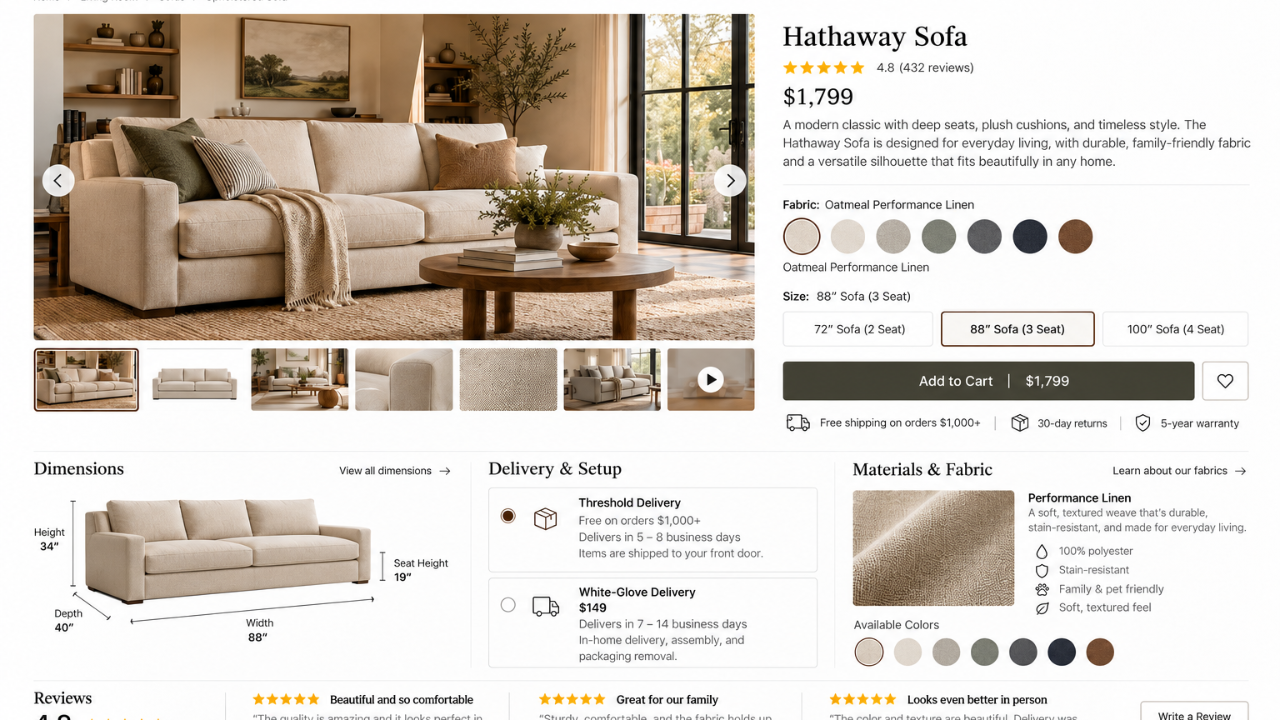
Everything else in this guide follows from one fact. Buying a sofa online is a high-stakes guess that’s hard to undo. Baymard Institute’s 2026 furniture and home decor study found that written dimensions (49 percent) and dimension images (42 percent) are among the most essential content for helping shoppers decide whether something will fit. Reviewer photos and lifestyle or in-scale images followed at 38 percent.
The same research found two more things worth building around. Delivery details, such as cost, timing and whether it’s threshold or white-glove service, enter the decision much earlier than in other categories. And most shoppers read reviews to judge long-term durability and comfort, not just the star rating.
So your product page is doing the job a showroom floor used to do. It has to answer three questions the shopper can’t ask a salesperson. Will it fit through my door and in my room? What will it cost delivered? Will it still look good in three years? If the page can’t answer those, a discount rarely saves the sale. The shopper just keeps researching, often on a competitor’s site or inside an AI assistant.
Is AR worth it? Sometimes.
AR and 3D viewers get pitched hard, and the evidence supports a narrower claim than the sales decks. Research by Pfaff and Spann in the Journal of Retailing and Consumer Services (2025) found AR is most effective for larger products, where spatial fit is most uncertain. Conference research presented at EMAC 2025 adds a warning. AR only reduces returns when it renders size accurately. Get the scale wrong and you raise expectations the product can’t meet.
The practical read is to test it on sofas, sectionals and dining tables where you can build accurate models, then track the return rate on those SKUs. On small decor, it rarely pays back.
Build Product and Collection Pages That Answer the Fit Question
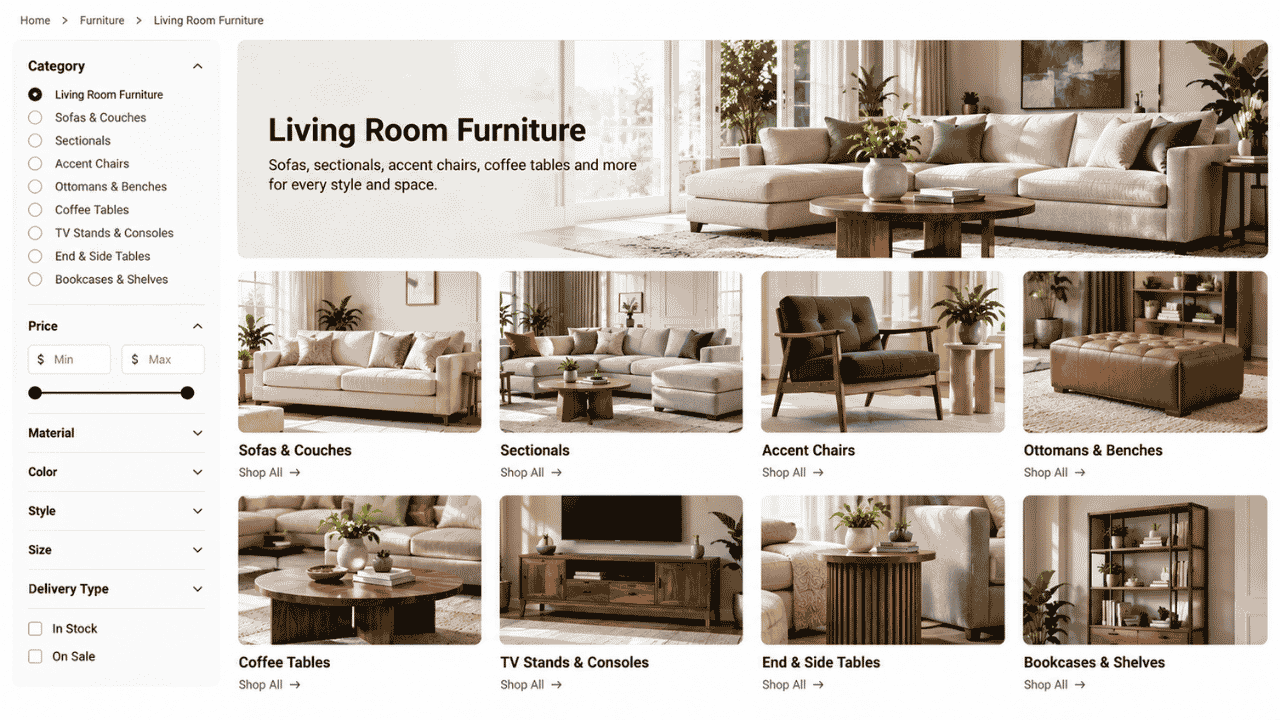
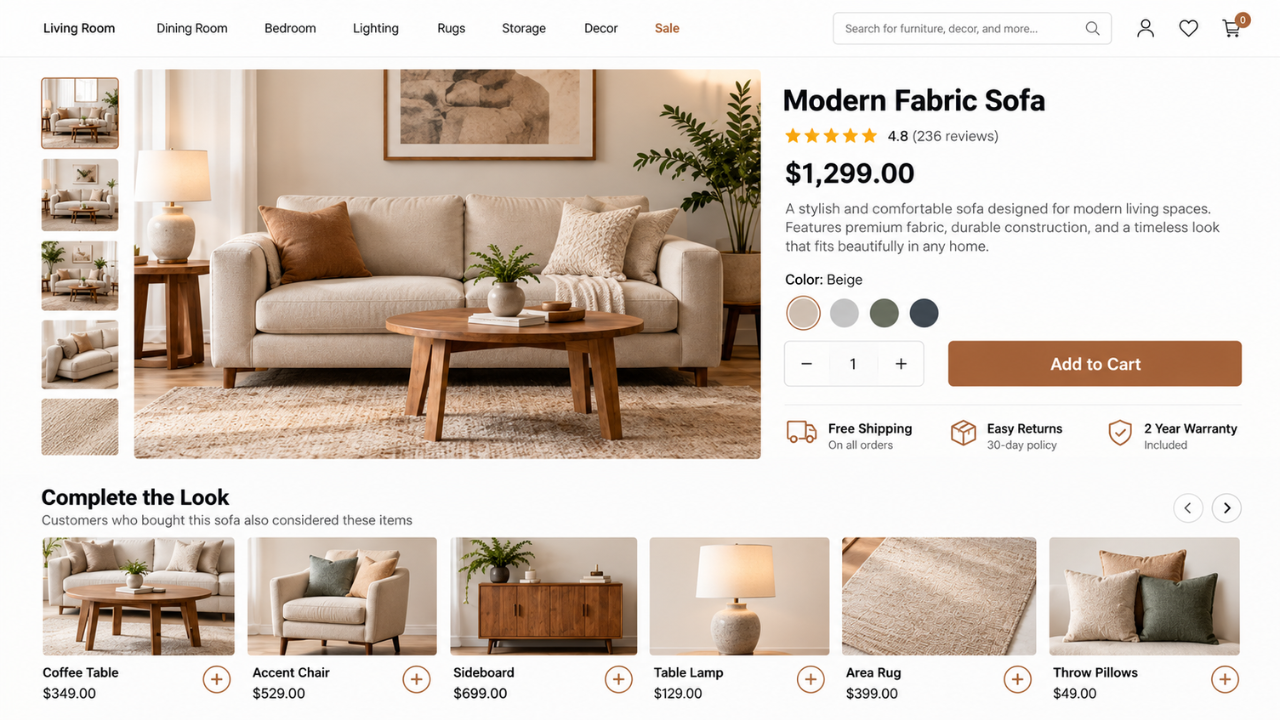
For most furniture stores, the catalog is where the biggest untapped growth sits. Complete, consistent product data lifts conversion, cuts returns, and feeds Google, Merchant Center and AI assistants at the same time.
What every furniture product page needs
A shopper should be able to answer four questions without leaving the page. This is the checklist we’d run on any best-seller before touching ad spend.
| Shopper question | What to show | Detail most stores miss |
| Will it fit? | Overall dimensions plus seat height, seat depth and arm height, with a dimension image | Size of the largest box, so buyers can check doorways and stairs |
| What’s it made of? | Frame, fill, fabric or finish, weight capacity and care | Commercial or residential grade, stated plainly |
| Will it last? | Reviews with customer photos | Search inside reviews for words like “pets”, “sagging” or “scratches” |
| What will it cost delivered? | ZIP-based delivery estimate and delivery type | Return terms for freight items, shown above the add-to-cart button |
The on-page basics still sit underneath all of this, from clean URLs to structured data and a clear call to action. Our walkthrough on optimizing an ecommerce product page covers that foundation. Furniture brands then layer fit, material and delivery content on top.
Build collections around rooms, jobs and limits
Furniture shoppers rarely search for a SKU. They search for a fix to a space, like a sectional for a small apartment, a dining set for eight or bar stools for a 36-inch counter. Collections built around those jobs, with filters for what actually limits the choice (seat height, width, material, indoor or outdoor, delivery type), work for shoppers and search engines alike.
Go fewer and deeper. Google’s spam policies warn against mass-producing near-duplicate pages for every keyword variation, so one strong counter-height stools collection with a short buying guide beats twenty thin pages. When you pick which collections to build first, favor the terms that show a buyer narrowing a decision, the kind covered in our guide to high-intent keywords for online stores.
Handle variants without splitting your rankings
A sofa with 12 fabrics, three leg finishes and two sizes is one product to the shopper. To a badly set-up store, it can be 72 separate URLs. Aim for one indexable page per product a shopper would recognize, with variants chosen on the page, canonical tags that consolidate signals, and a feed that matches price and stock for every variant. On large catalogs this often matters more than any campaign, because it decides whether Google can list your products at all.
Make Delivered Cost and Returns Part of the Product
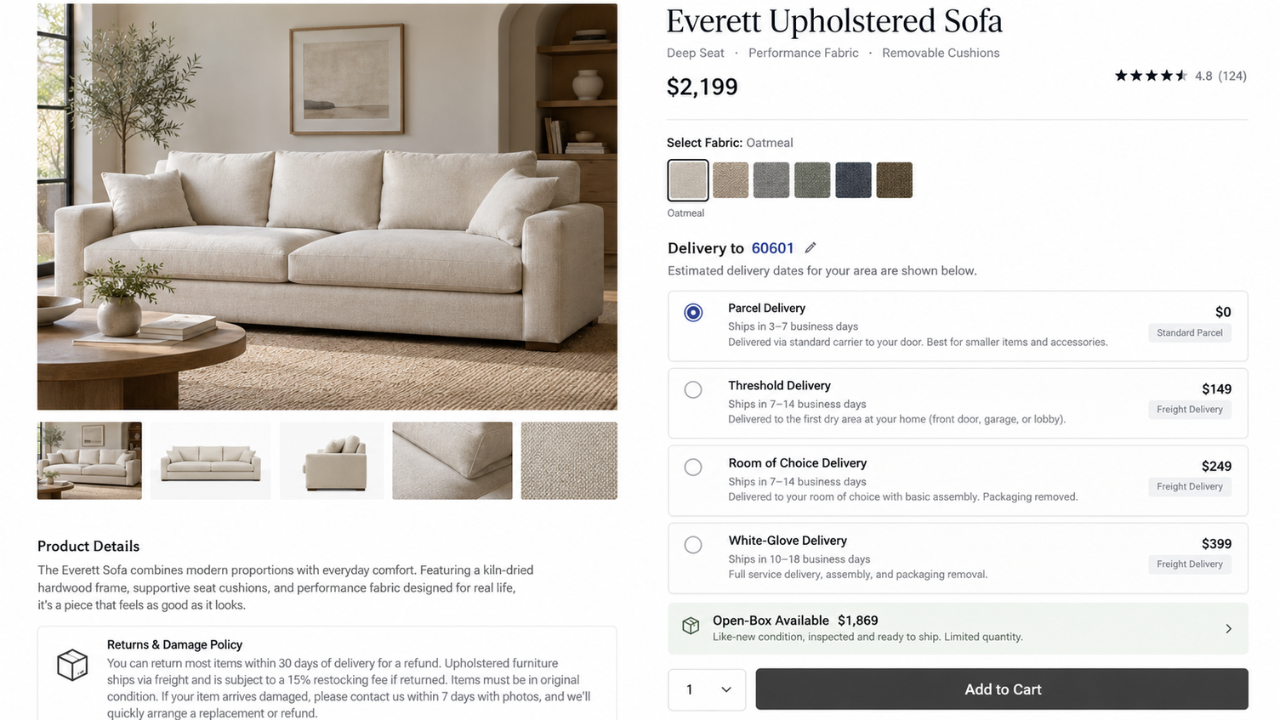
Freight is the most expensive thing a furniture store can hide. Baymard’s cart abandonment research found that extra costs such as shipping and fees are the top reason U.S. shoppers abandon checkout, and that hits harder when delivery runs to hundreds of dollars and several weeks.
The fix is to move delivery information to where the decision happens.
- A ZIP-code delivery estimate on the product page, not just in the cart
- The delivery type in plain words (parcel, threshold, room of choice or white glove) with an honest lead time
- A clear label on product cards that separates parcel items from freight items, so nobody assumes free shipping and then meets a freight quote at checkout
- Cheap or free fabric and finish samples for upholstered pieces
Returns need the same honesty. NRF and Happy Returns estimated that 19.3 percent of U.S. online sales would be returned in 2025, against 15.8 percent across all retail. A returned sofa doesn’t go back on a shelf. It rides a truck, often comes back damaged, and may be sold at a discount or written off.
Don’t make returns punitive, because that kills conversion. Prevent the avoidable ones upstream with better fit content, and make the unavoidable ones efficient with clear restocking terms for freight, photo-based damage claims and an open-box channel. This is usually where conversion rate optimization pays back fastest for high-ticket stores, well before any redesign.
A freight quote that shows up for the first time at checkout is the most expensive sentence on your site.
Get Found in Search and AI Answers
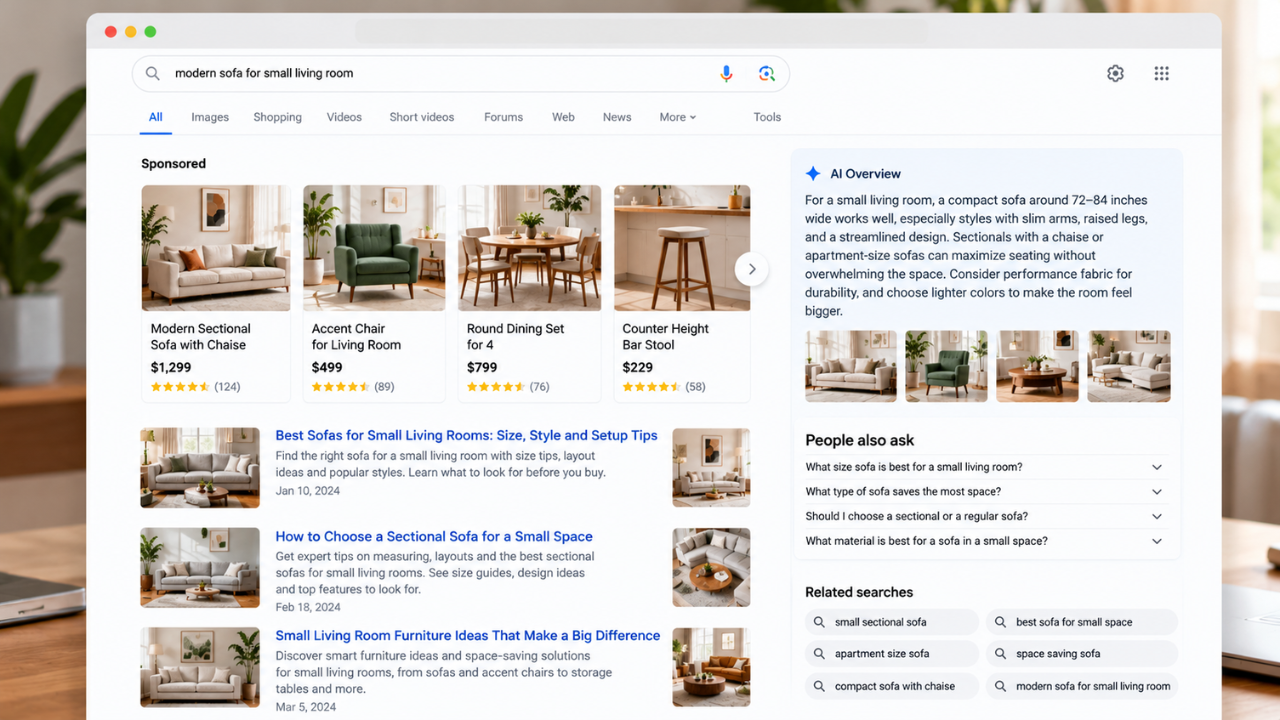
Furniture is a research-heavy purchase, so organic discovery is worth more here than in most categories. Someone who has spent a week comparing sectionals arrives with high intent and a list of very specific questions. In 2027 they ask those questions in three places: classic Google results, Google’s AI Overviews and AI Mode, and standalone assistants like ChatGPT. The good news is that one body of work covers all three.
Match each search to the right page
Room and use-case searches belong on collections. Model and spec searches belong on product pages. Comparison and care questions belong in guides that link back into the catalog. Then fix the technical problems that hold furniture sites back, such as faceted filters that create thousands of crawlable URLs, variant pages competing with each other, discontinued products left live with no redirect, and slow mobile templates. An audit sorted by revenue impact, followed by collection rebuilds and best-seller rewrites, is the standard sequence in a serious ecommerce SEO program. Expect results over months, not weeks, which is why it should start early in the year.
What Google actually says about AI Overviews
A lot of guesswork gets sold as AI SEO. Google’s documentation on AI features is blunt about it. There are no extra requirements to appear in AI Overviews or AI Mode. A page needs to be indexed and eligible to show a snippet, and you don’t need special AI files or schema. Google also says to keep structured data matching the visible page and to keep Merchant Center and Business Profile details current. Clicks from these features show up in Search Console’s regular Web search type.
For a furniture brand, that means your AI search strategy is your content and product data strategy. Pages that state dimensions and materials as plain facts, answer one question per section, and are backed by reviews and outside mentions are the ones most likely to be pulled into an answer. For how the pieces fit together, see our breakdown of how SEO, AEO and GEO work as one system.
Keep product data consistent everywhere
Merchant Center free listings can put your products across Google Search, Shopping and Images without ad spend, as long as the feed is complete and matches your site. When price, stock or ratings differ between the page, the schema and the feed, you have a visibility problem as well as a trust problem. Assistants outside Google use their own crawlers and sources, and this GEO checklist ranks the steps that actually earn citations there.
Speed on the shopper’s phone
Furniture pages are image-heavy and often slow on mobile, and mobile is where the orders are. Wayfair’s 64.1 percent mobile share is a good reminder. Measure real-user field data by page template, not a desktop lab score. On stores with years of installed apps, pricing each script in milliseconds and removing the ones that don’t earn their keep is often the quickest win, which is the approach behind our Shopify speed optimization work.
Don’t lose your rankings in a replatform
Most big SEO losses in furniture don’t come from the platform itself. They come from a migration that changes every URL without a redirect map, drops metadata or restructures collections in the same release. Migrate at parity first, check redirects and feeds on launch day, and redesign after that. If a move to Shopify is on your 2027 list, here’s how a migration that keeps your rankings is sequenced. Schedule it away from peak season and budget for 90 days of monitoring.
Run Paid Media on Margin, Not ROAS
Paid search and social are still the fastest way to test demand while organic work matures. But in furniture, a high-ROAS campaign that sells freight-heavy pieces at a loss after delivery and returns is still a losing campaign.
Three habits keep it honest. Let the feed do the targeting, because Shopping and Performance Max inherit their quality from your product data. Use custom labels to split the catalog by margin tier, freight class and return risk, then bid by tier. And send cost of goods into the platform so it optimizes for profit, not revenue. We go deeper on feed-driven media and margin tracking in our guide to home improvement ecommerce marketing in 2027, and it carries over to furniture almost one to one.
Marketplaces deserve the same test. List a defined slice of the catalog, compare contribution margin per order against your own store, and only expand where the numbers hold up.
Win the Second Order
Furniture is bought less often, so plenty of brands quietly ignore retention. The numbers say that’s a mistake. Repeat customers placed 80.2 percent of Wayfair’s orders in the second quarter of 2026. Retention is what makes a high acquisition cost affordable, and in furniture it’s driven by the next project, not the next month.
Think in projects. Someone who bought a dining table needs chairs, a sideboard, lighting and a rug next. A bar that bought stools will reorder when it opens a second location or when the seats wear out. Build post-purchase flows around those cycles with assembly help, care guides and matching pieces instead of generic discount blasts.
Trade and business buyers are the other big lever. Designers, restaurants, hotels and property managers buy far more often than households do. Saved lists, quote requests, financing or net terms and fast reorder paths serve them better than a 10 percent coupon. Weak retention is one of the most common reasons otherwise good stores stall, which we cover in our piece on why ecommerce businesses fail.
Case Study: What a Commercial Seating Store Shows About Furniture Growth
Wholesale Bar Stool Club is a U.S. Shopify store based in Nashville, Tennessee, and one of the furniture brands we work with. It sells commercial-grade bar stools, restaurant chairs, tables and table sets to bars, restaurants, cafés and venues, plus homeowners who want seating that lasts.
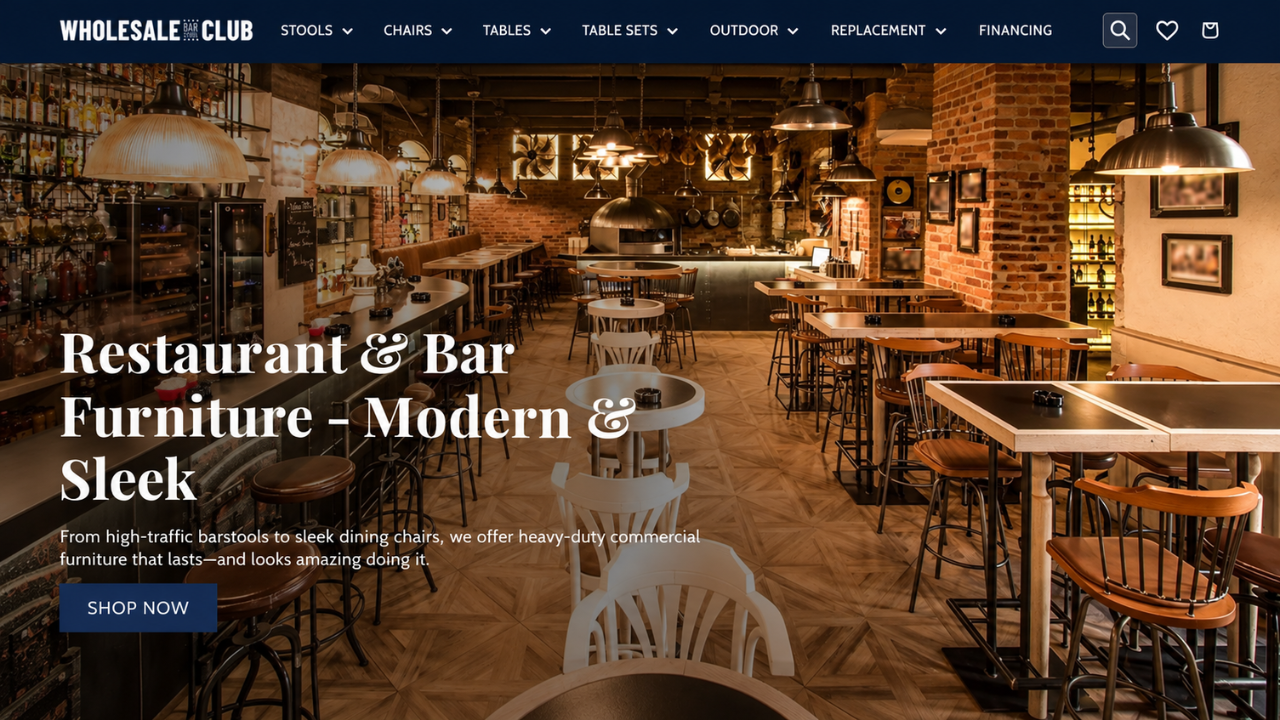
The numbers. The store’s Shopify Analytics for March 1 to 31, 2026 show $206,546 in total store sales from 173 orders, an average order of $1,017. That figure covers every channel. It isn’t an SEO-attributed number, and we don’t present it as one. You can watch the dashboard walkthrough and a video from CEO Timothy Bryant on our client results page.
The challenge. Commercial seating carries the same doubts as any furniture, just sharper. A bar owner ordering 20 stools needs the right seat height for the counter, a frame that survives daily use, and confidence the order arrives on time and in one piece. Get one spec wrong and it’s 20 returns, not one.
What the store does about it. Looking at the live site, a few choices stand out.
- Collections are split by the limits buyers actually shop by, such as bar height or counter height, metal or wood, swivel, backless, stackable and indoor-outdoor.
- Matching table and stool sets turn a whole-room order into one decision instead of five.
- Replacement seat tops and cushions give past buyers a reason to come back.
- Business financing supports larger orders.
- Store reviews are shown across the site, with a 4.7 average from more than 750 reviews at the time of writing.
The lessons. An average order above $1,000 means one lost sale costs a lot, and one avoidable return costs even more. Filtering by real constraints, selling the set rather than the single piece, and stocking replacement parts are all cheap ways to protect that value. None of it needs a showroom. It needs a catalog that thinks like the buyer.
A fair caveat. One month of total sales doesn’t prove what caused growth, because seasonality, promotions and other channels all play a part. The point of the example is the setup, not a promise that your store will see the same numbers.
Plan for the 2027 Tariff Change Now
The tariff schedule is the most concrete 2027 item in this guide. Under the September 2025 Section 232 proclamation, imported upholstered wooden furniture, kitchen cabinets and vanities carry a 25 percent tariff. A December 31, 2025 proclamation pushed the scheduled increases back a year, so on January 1, 2027 the rate is set to rise to 30 percent for upholstered furniture and 50 percent for cabinets and vanities. Imports from the UK are capped at 10 percent, and the combined rate for the EU and Japan is capped at 15 percent. Scope and dates can still change, so treat this as a scenario to model, not a settled cost.
Four responses are worth working through before January.
- Reprice selectively. Protect the hero SKUs that drive search and reviews, and move price on items with less competition.
- Re-source where a lower-tariff origin exists, and budget for the lead-time and quality risk of a new supplier.
- Redesign for freight. Flat-pack and modular formats cut shipping cost and damage.
- Explain it. A short, honest note about a price change builds more trust than a silent increase.
Whatever you change, push it to the feed and structured data the same day it changes on the page.
The Growth Scorecard: Numbers Worth Watching
The metrics that matter in furniture are the ones that capture order quality. Each one below can be reported monthly from your analytics, order system and accounting.
| Metric | Why it matters in furniture | What a good trend looks like |
| Contribution margin per order | Captures freight, returns, tariffs and payment costs that revenue hides | Rising while order volume holds or grows |
| Return rate by SKU and reason | Fit and damage returns are preventable with content and packaging fixes | Falling on SKUs with improved dimension and material content |
| Revenue per visitor by device | More stable than conversion rate when the traffic mix changes | Mobile closing the gap with desktop |
| Delivered-cost accuracy | Gap between quoted and actual freight cost per order | Narrowing, with checkout surprises near zero |
| Repeat purchase rate at 12 and 24 months | Furniture repeat cycles are long, so a 30-day window misleads | Rising, especially among trade and business accounts |
| Blended acquisition cost and payback | Attribution is unreliable, while blended cost against margin is honest | Payback shortening as organic share grows |
| Organic and AI-referred sessions to commercial pages | Shows whether catalog and content work is compounding | A growing share of revenue from unpaid discovery |
Two cautions. Published furniture conversion benchmarks vary wildly and are mostly vendor-made, so your own trend by device and channel is the only benchmark worth managing to. And A/B tests need volume. A page with a few hundred conversions a year can’t produce a trustworthy result, so smaller stores do better with session recordings, customer surveys and clear, research-led fixes.
A 12-Month Growth Plan for 2027
This order assumes an established store with steady traffic. A brand starting from zero would spend longer on product and positioning before any of this applies.
| Quarter | Focus | What to ship | How you’ll know it worked |
| Q1 | Fix the foundation | Audit the top 50 SKUs for fit, material and delivery gaps. Crawl for variant and filter bloat. Reconcile feed, schema and pages. Model the 2027 tariff rates. | Feed errors down and a baseline for margin per order |
| Q2 | Rebuild decision pages | Rewrite best-seller product pages. Rebuild 5 to 10 collections around rooms and jobs. Add delivered-cost estimates. Launch project-based post-purchase flows. | Revenue per visitor up on rebuilt pages |
| Q3 | Expand discovery and retention | Publish comparison and care guides. Test AR on large SKUs. Launch or refine a trade program. Run a controlled marketplace test. | Return rate down on improved SKUs and repeat orders up |
| Q4 | Scale what works | Extend collection and guide work to the next categories. Move paid budget to profitable margin tiers. Lock in speed and data checks before peak season. | Organic share of revenue rising and payback shortening |
Budget for the search side varies with catalog size and competition. Our guide to SEO costs for furniture stores lays out realistic ranges and what drives them.
Conclusion
The furniture brands that grow in 2027 will make the big purchase easy to say yes to. That means complete and consistent product data, honest delivered cost, real proof of durability, and content that answers the exact question wherever the shopper asks it. Tariffs will squeeze margins, AI search will reward clarity over tricks, and repeat customers will matter more than most furniture brands assume. You don’t need to predict the future. You need to do the work in the right order, so each fix makes the next one cheaper.
At EcomOptix, that order usually starts with the pages closest to the sale, because that’s where a furniture store’s margin is won or lost.
If you’d like an outside read on where your catalog, delivery experience and search visibility stand before you lock in a 2027 plan, book a free growth analysis and bring your store URL.
Frequently Asked Questions
What should a furniture store fix first?
Start with your top-selling product pages. Add full dimensions with a dimension image, plain material details, searchable reviews and a delivered-cost estimate. Those fixes help conversion, returns and search visibility at the same time.
Do furniture brands need special optimization for Google’s AI Overviews?
No. Google says there are no extra requirements beyond being indexed and eligible for a snippet. Clear, factual pages and an accurate Merchant Center feed are the practical levers.
Is AR worth it for a smaller furniture store?
Only on large, high-uncertainty items where you can render size accurately, like sofas and dining tables. Track the return rate on those SKUs to judge whether it’s paying back.
How will the 2027 tariff change affect furniture prices?
The 25 percent Section 232 tariff on imported upholstered furniture, cabinets and vanities is scheduled to rise on January 1, 2027, to 30 and 50 percent respectively, with caps for the UK, EU and Japan. Importers should model landed cost at both rates and decide on pricing and sourcing before the change.
How long does SEO take to grow a furniture store?
Technical and product page fixes can lift existing traffic within weeks. New rankings usually take several months, depending on competition, catalog size and how quickly changes go live. Anyone promising guaranteed rankings on a set timeline is overpromising.