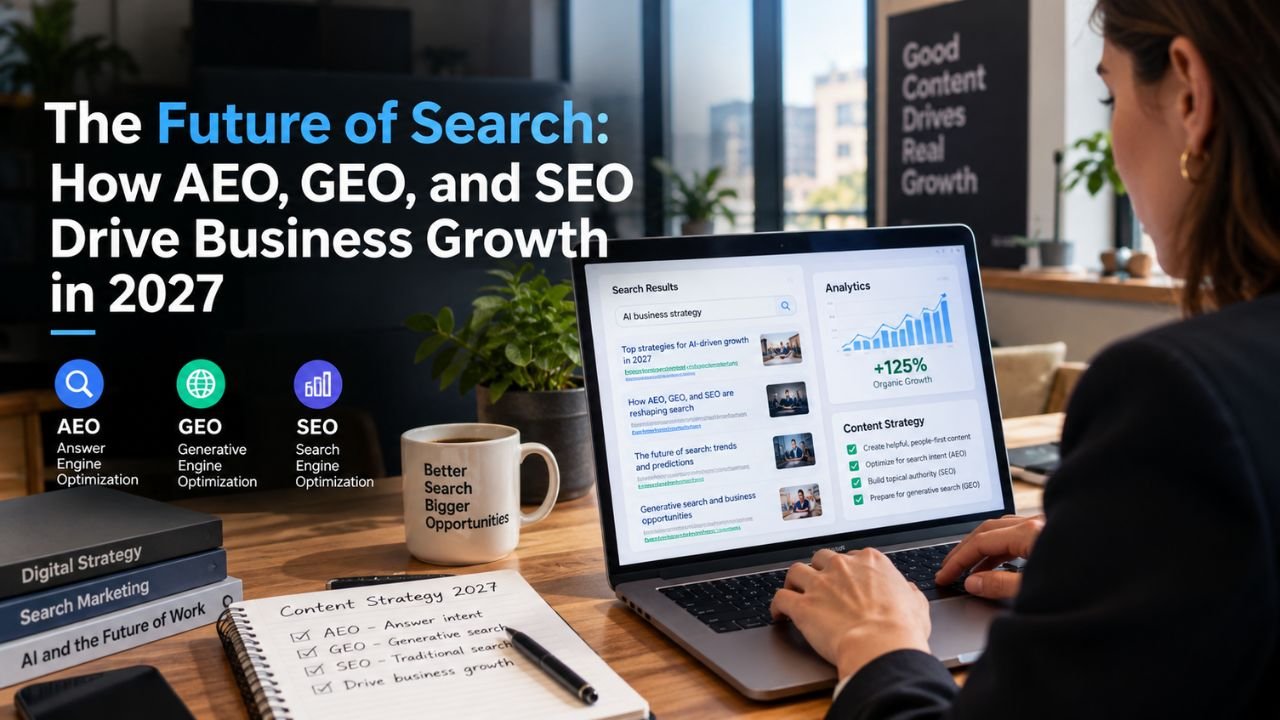
SEO, AEO, and GEO are not three competing strategies. In 2027 they are three checkpoints on the same path to a customer.
SEO decides whether search engines can find and trust your pages.
AEO (answer engine optimization) decides whether your content becomes the answer people read.
GEO (generative engine optimization) decides whether AI assistants such as ChatGPT, Gemini, Copilot, and Google’s AI Mode name your business when someone asks who to hire.
The businesses growing from search this year run all three as one system and measure it differently than they did two years ago.
Picture a moving company that still ranks third for “movers in Denver.” Its rank tracker looks healthy.
Its phone is quieter.
A growing share of its customers never scroll to that ranking.
They ask Google’s AI Mode which long-distance movers are trustworthy, read a short list of names, check the reviews of two of them, and book one.
If the company is not on that list, the third-place ranking is a trophy nobody sees.
The numbers behind that scene are no longer speculative. At I/O 2026, Google reported that AI Overviews have more than 2.5 billion monthly users and AI Mode has passed 1 billion.
BrightLocal’s 2026 Local Consumer Review Survey found that 45% of US consumers used AI tools for local business recommendations, up from 6% a year earlier.
A strategy that only tracks rankings is now measuring the part of search that matters least.
The short version:
SEO earns eligibility.
AEO earns the answer.
GEO earns the recommendation.
Growth comes from connecting all three to a page that converts the customer who comes to verify.
Where Search Stands in 2027
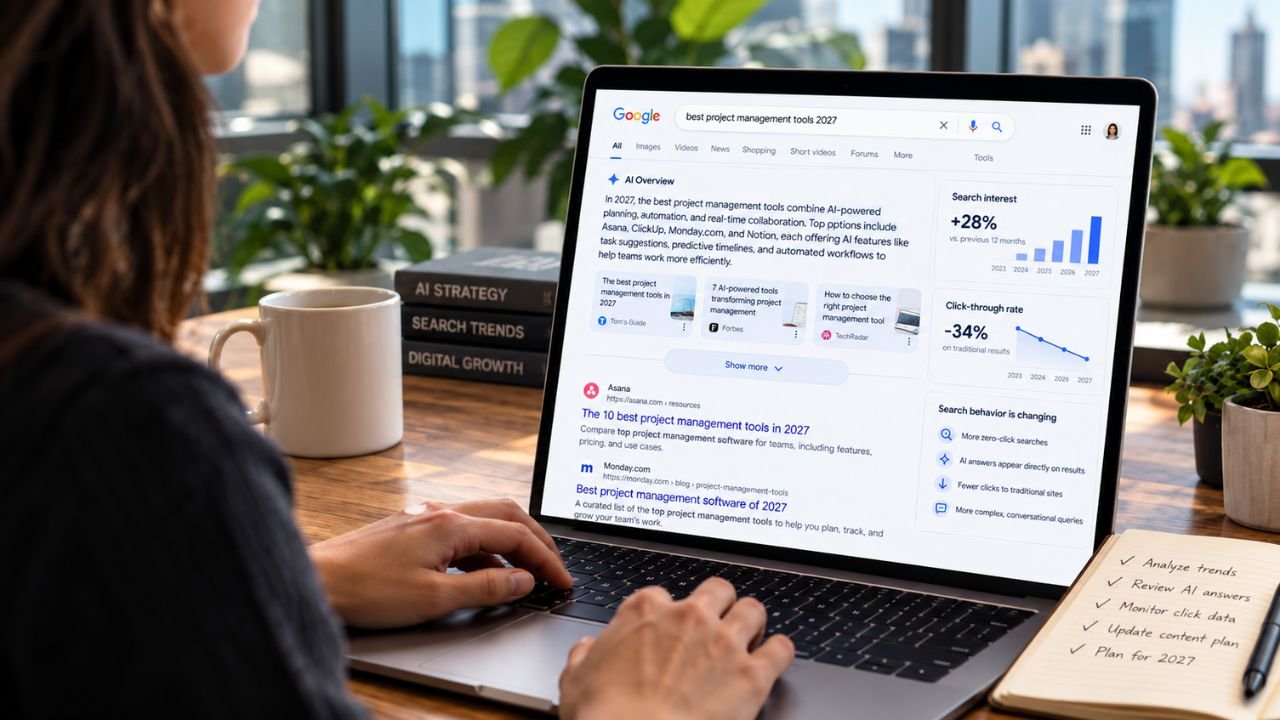
Search in 2027 is bigger than ever and sends fewer clicks per query.
Both statements are true at the same time, and most bad strategy starts from believing only one of them.
In February 2024, Gartner predicted that traditional search engine volume would drop 25% by 2026 as AI chatbots absorbed queries.
Two years later, Google told a different story at I/O: AI Mode queries have more than doubled every quarter since launch, and overall Search queries reached an all-time high last quarter.
Google’s figures are self-reported, but they point to the real shift.
People did not stop searching.
The answer moved onto the results page.
The click data shows what that costs. Pew Research Center tracked the real browsing of 900 US adults and found that people clicked a traditional result in 8% of visits when an AI summary appeared, compared with 15% when it did not.
Links inside the summary were clicked in about 1% of visits.
Ahrefs, using December 2025 data across 300,000 keywords, found that an AI Overview now correlates with a 58% lower click-through rate for the top-ranking page, up from 34.5% in its earlier study.
Search didn’t shrink. The click did.
2026 also brought the first official measurement tools for AI visibility.
Google’s Generative AI performance report in Search Console reached all websites worldwide on August 31, 2026, showing impressions from AI Overviews and AI Mode by page, country, and device.
Microsoft launched AI Performance in Bing Webmaster Tools in February 2026, showing how often a site is cited across Copilot and Bing’s AI summaries, plus the “grounding queries” the AI used to find that content.
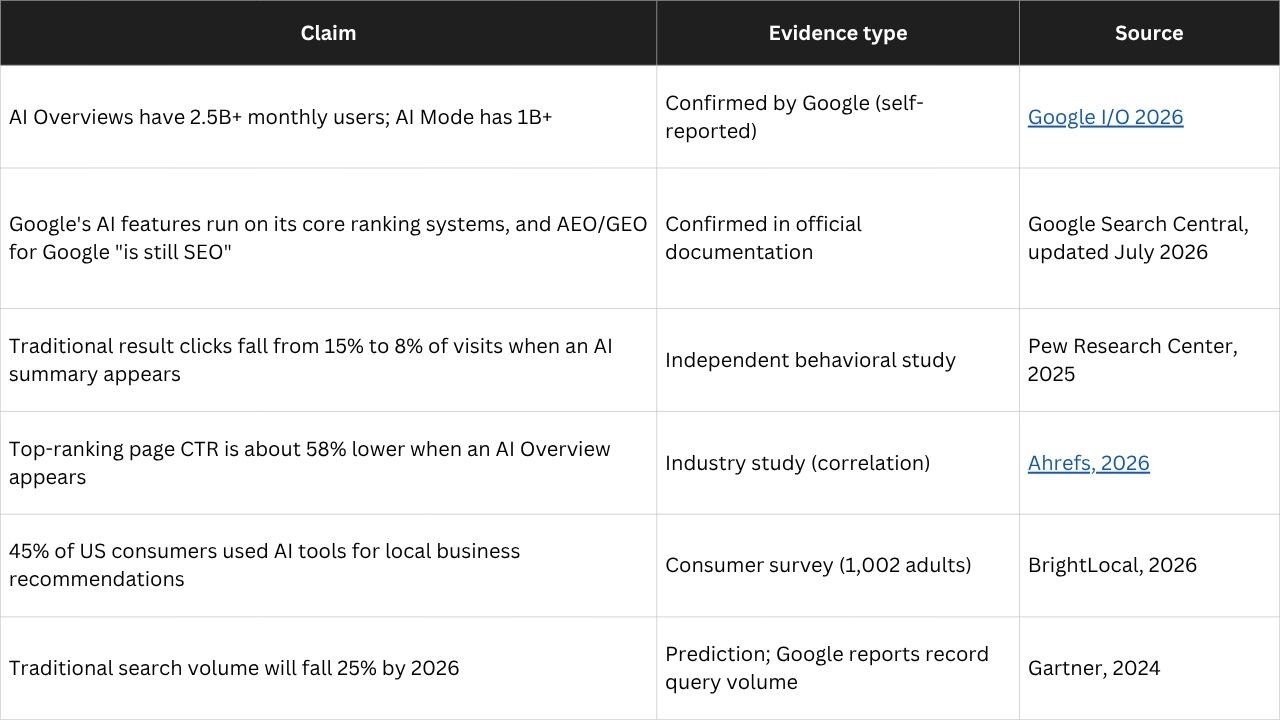
What is confirmed, what is measured, and what is still a prediction
Much of the AI search conversation blends Google documentation, third-party studies, and vendor opinion into one confident voice. Separating them changes decisions.
Does SEO Still Matter in 2027? Yes, but Its Job Has Changed
SEO still matters in 2027 because Google’s AI features are built on top of it.
Google’s own guide on optimizing for generative AI features says these features are rooted in its core Search ranking and quality systems, and that a page must be indexed and eligible to show with a snippet before it can appear in AI Overviews or AI Mode.
No index, no answer.
What changed is the unit of competition.
Classic SEO competed page against page for a position.
AI search retrieves pages and then uses specific information from them.
A page ranking fourth can supply the sentence an AI answer is built on, while the page ranking first gets summarized without a click.
Google describes two mechanisms that explain this.
The first is retrieval-augmented generation, where the model pulls relevant pages from the Search index before writing a response.
The second is query fan-out, where the model runs several related searches at once to cover a question from different angles.
One question becomes five searches.
A business that covers the real subtopics of a customer’s problem gets more chances to be pulled in.
Queries are also getting longer.
Pew found that longer, more natural-language searches are more likely to produce an AI summary.
A homeowner no longer types “movers Chicago.” They type the whole situation, with dates, distance, and the piano.
The tempting response to fan-out is to publish a separate page for every variation of a question.
Google names that directly in its guide: creating pages for fan-out variations mainly to manipulate rankings or AI responses violates its scaled content abuse policy.
What holds up is the opposite.
Fewer, deeper pages, each built around a real customer problem and the next three questions that problem creates.
What has not changed matters just as much: crawlable pages, clear site structure, helpful people-first content, fast pages, and internal links that show how topics connect.
SEO in 2027 is not replaced.
It is stricter.
What Is AEO, and How Is AEO Different From SEO in 2027?
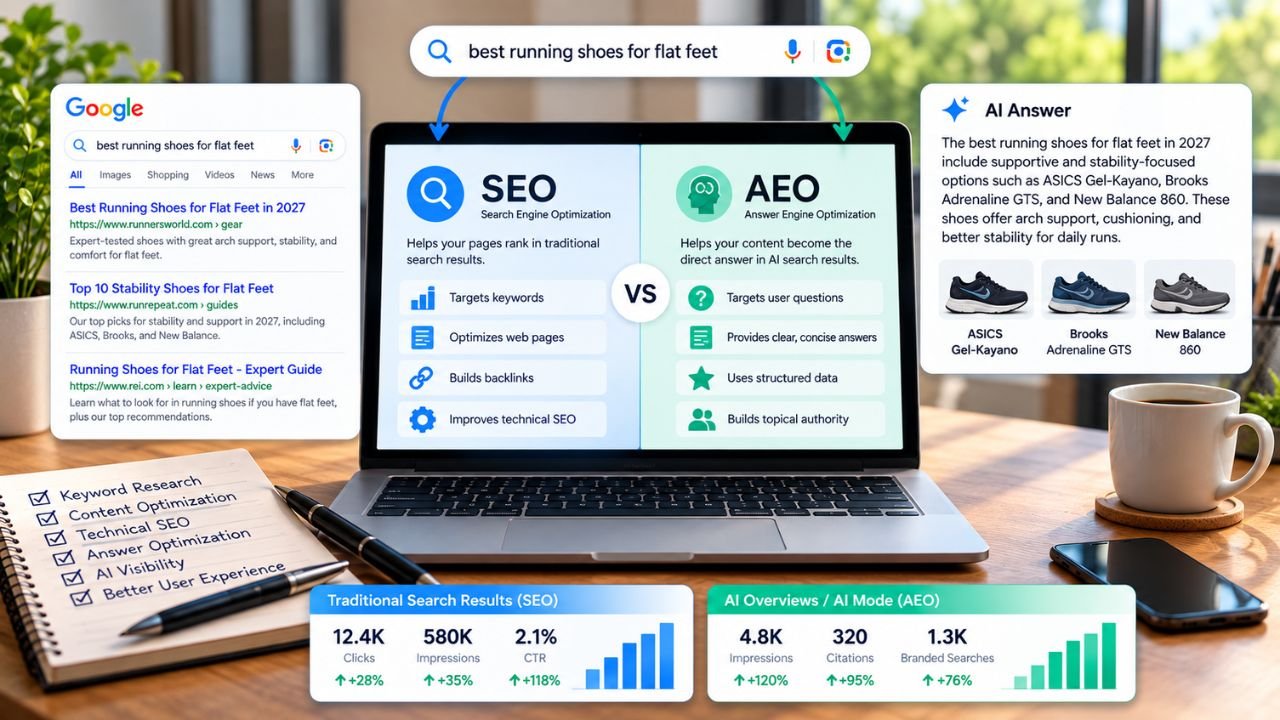
AEO, or answer engine optimization, is the practice of making content easy to select as a direct answer.
Its targets are featured snippets, People Also Ask boxes, citations inside AI Overviews, and the single reply a voice assistant reads aloud.
The difference between AEO and SEO in 2027 comes down to the test each one passes.
SEO asks whether a page deserves a position.
AEO asks whether one passage from that page can be lifted out and trusted on its own.
The same page can pass the first test and fail the second.
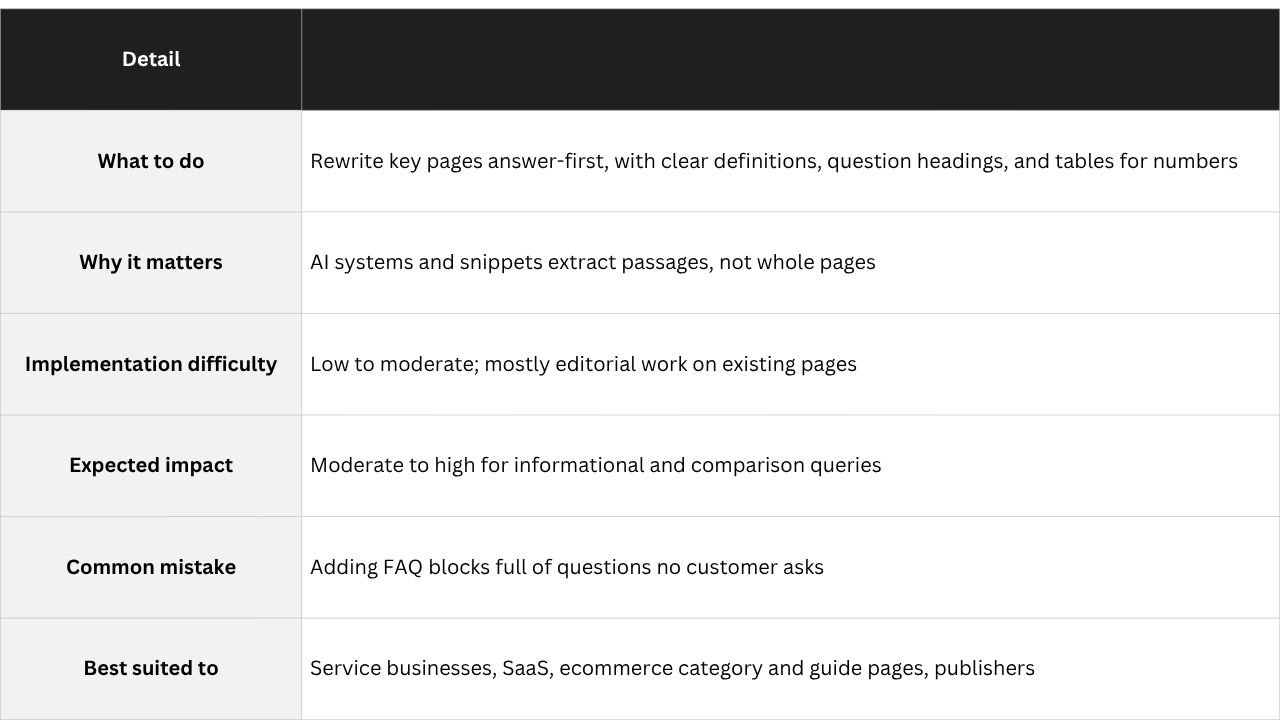
Content that passes the AEO test tends to share a few habits:
- Each section opens with the answer, then earns the detail.
- Key terms get a plain, one-sentence definition.
- Headings mirror how people actually ask questions.
- Prices, ranges, steps, and comparisons sit in tables or lists, not buried in paragraphs.
- Facts carry a date and get updated when they change.
Google adds an important correction to much of the AEO advice online.
Its guide says there is no need to break content into tiny “chunks,” no need to rewrite pages in a special style for AI, and no special schema required for AI features.
Structured data still helps pages qualify for rich results, so it stays worth doing, but it is not a secret key.
Most AEO advice fails because it optimizes the format and ignores the substance.
A perfectly structured answer that says the same thing as fifty other pages gives an AI system no reason to choose it.
Google’s guide calls this “commodity content” and contrasts it with non-commodity content that adds first-hand experience or original insight.
Format helps a good answer get extracted.
It cannot make an ordinary answer worth extracting.
AEO at a glance
What Is GEO, and How Should Businesses Prepare?
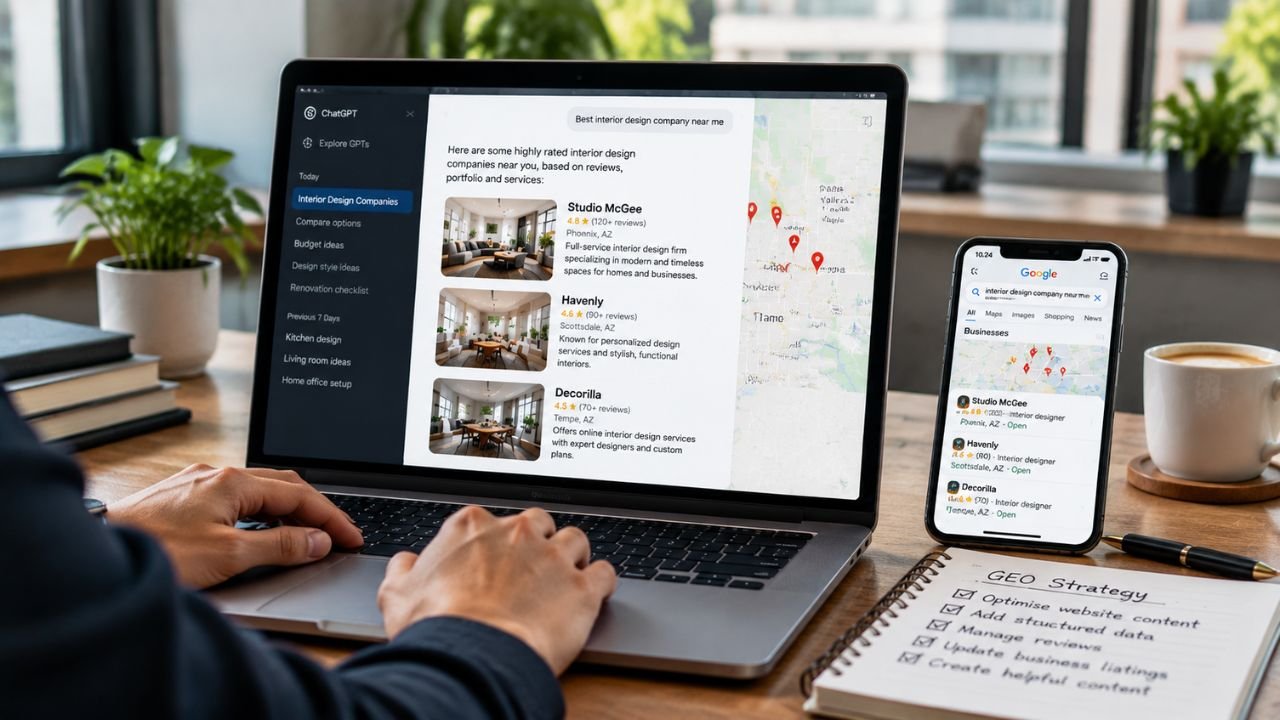
GEO, or generative engine optimization, is the work of increasing how often and how accurately a business or its content appears inside answers generated by AI systems such as ChatGPT search, Perplexity, Microsoft Copilot, Gemini, and Google’s AI Mode.
SEO competes for a place in a list.
GEO competes for a place in a sentence.
What is GEO marketing?
GEO marketing is the wider set of activities that feed those AI answers from outside your own website: customer reviews, press coverage, expert quotes, industry directories, community discussion, and consistent business information everywhere it appears.
AI systems build answers from many sources at once, so what other sites say about a business often carries more weight than what the business says about itself.
AI doesn’t recommend the best business. It recommends the business the web agrees about.
What the original GEO research actually found
The term comes from a paper by researchers from Princeton and other institutions, published at the KDD 2024 conference.
It reported that content changes such as citing sources, adding quotations, and adding statistics could boost visibility in generative engine responses by up to 40%.
Two details usually get dropped when that number is repeated.
First, the gains were measured in a controlled setup where a fixed set of sources competed for space inside a generated answer.
Visibility there is a shared pie, so one source’s gain is another’s loss.
Second, the paper found that lower-ranked sources benefited most.
Its “Cite Sources” method lifted visibility by 115.1% for websites ranked fifth in the search results.
That second finding is the most useful idea in GEO for smaller businesses.
In a traditional ranked list, position five stays position five.
Inside a generated answer, an evidence-rich page from a smaller site can take share from bigger ones.
The “40% boost” is not a guarantee of anything.
It is evidence that proof beats size inside AI answers more often than it does in blue links.
Google calls it SEO. Other AI engines play by their own rules.
Google is clear about its own platform.
Its guide states that optimizing for generative AI search is, from Google’s point of view, still SEO.
It also lists tactics to ignore for Google Search, including llms.txt files, content “chunking,” rewriting pages for AI, and chasing inauthentic mentions.
That guidance covers Google, not every AI engine.
ChatGPT, Copilot, and Perplexity use their own crawlers, their own retrieval, and in some cases third-party search providers.
This is where GEO earns a separate line in the plan.
How to get cited by ChatGPT
No one can guarantee a ChatGPT citation, but OpenAI documents the basics:
- Let OpenAI’s search crawler in. OpenAI’s publisher FAQ says any public website can appear in ChatGPT search, provided it isn’t blocking OAI-SearchBot.
- Separate search from training. OpenAI’s crawler documentation explains that OAI-SearchBot (search) and GPTBot (model training) are independent settings. A site can allow search visibility while opting out of training.
- Be findable beyond Google. OpenAI notes it can learn about pages from third-party search providers, so verifying the site in Bing Webmaster Tools and keeping it well indexed is a sensible step.
- Track the traffic. ChatGPT adds utm_source=chatgpt.com to referral links, so those visits show up clearly in Google Analytics.
- Give it something worth citing. Original data, specific numbers, clear definitions, and facts that match what reviews and other sites say.
Microsoft’s own advice for Copilot citations lines up with this: strengthen depth and expertise, support claims with evidence, keep content fresh, and keep text, images, and video consistent about the same entities.
For a longer version of these steps ranked by likely impact, from crawler access through evidence density and third-party trust, this GEO checklist for 2026 works as a practical audit sheet.
AEO vs GEO vs SEO: the difference at a glance
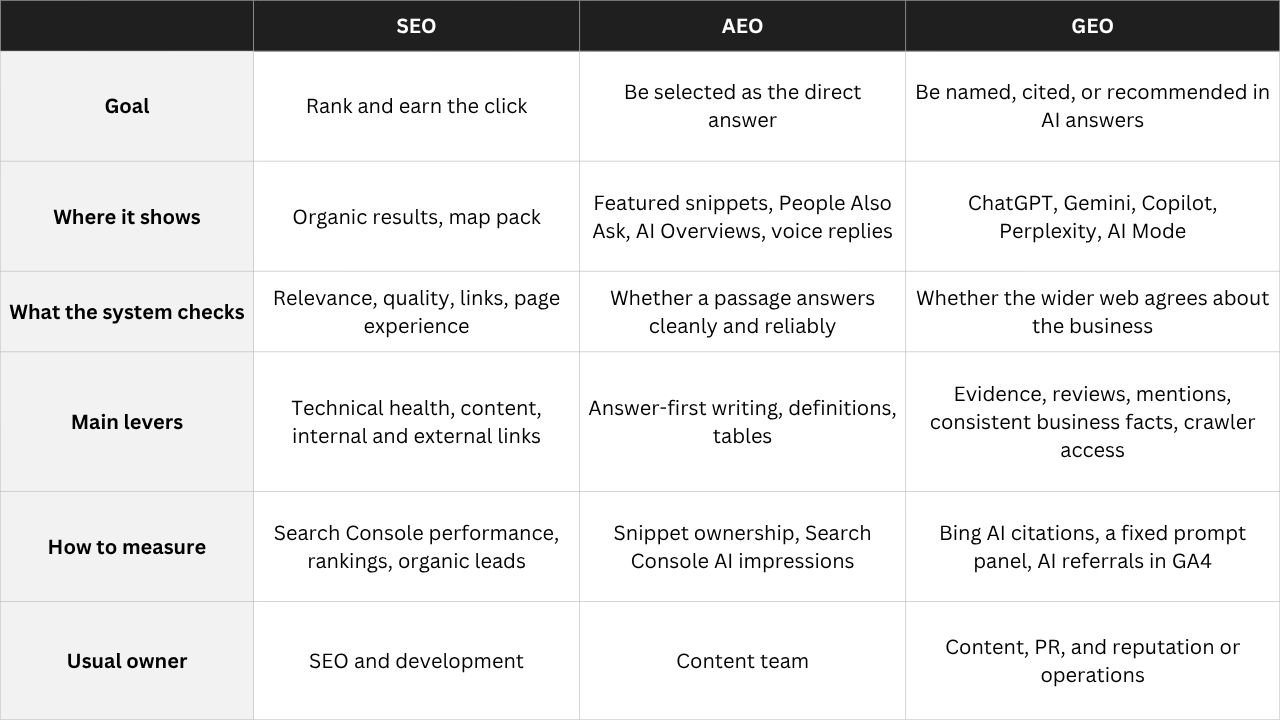
The overlap is bigger than the differences. Treating them as three vendors or three projects is how businesses end up with conflicting changes on the same page.
How AI Search Changes Customer Discovery
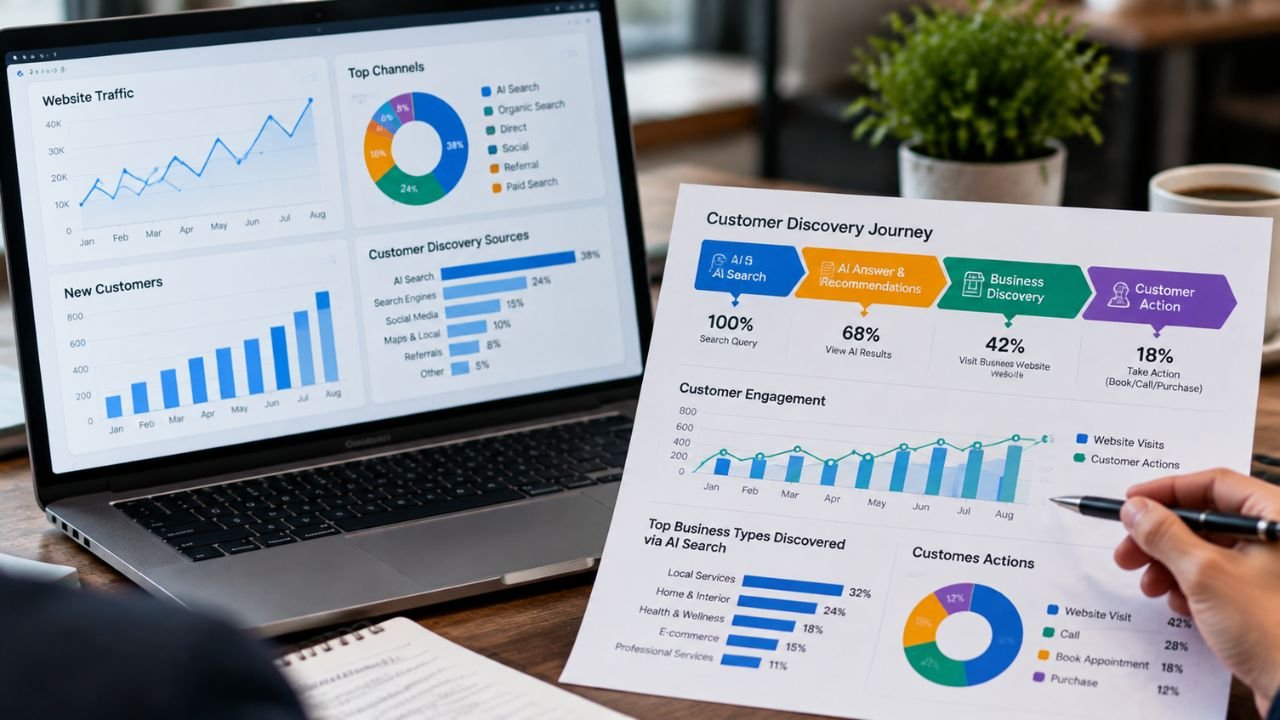
AI search turns discovery from browsing a list into approving a shortlist.
More and more, a customer’s first impression of a business is a sentence written by an AI system, before they ever see the logo.
Three things change along the way.
- The question gets richer. People describe their situation instead of typing keywords, and follow-up questions carry context forward. Google now lets people move from an AI Overview straight into a conversation in AI Mode, so the research that used to span ten searches happens in one thread.
- The system does the comparing. Through query fan-out and retrieval, the AI gathers reviews, listings, articles, and forum threads, then compresses them. Businesses that are described consistently across those sources are easier to summarize, and easier to recommend.
- The click becomes a verification click. The customer still visits websites, but for a different reason. BrightLocal found that after reading positive reviews, 66% of consumers do further research while 34% are ready to buy, and 54% go on to check the business’s website. The same survey found 82% read AI-generated review summaries, and 23% would base a decision on that summary alone.
Being cited appears to help even as total clicks fall. Seer Interactive found that brands cited inside AI Overviews earned 35% more organic clicks and 91% more paid clicks than when they were not cited.
Seer is careful to say this is correlation.
Stronger brands may simply be cited more.
Either way, the cited business keeps more of a shrinking pool of clicks.
The practical result is a quiet change in what a website is for.
It used to introduce the business.
Now it often confirms what an AI system already said about the business.
If the site contradicts the answer, with different prices, a different service area, or no sign of the license the AI mentioned, the sale dies without anyone noticing.
One further shift is still early.
Google’s guide encourages site owners to explore agentic experiences, where AI agents visit websites to complete tasks such as booking.
OpenAI is testing a “Get Quote” flow for local services inside ChatGPT, currently in beta with approved partner platforms that supply business listing data.
Most small businesses cannot act on this directly yet.
They can make sure their listings on major platforms are complete and their quote forms are simple enough for a person, or an agent, to finish.
What AI Search Means for Local Businesses and Service Companies
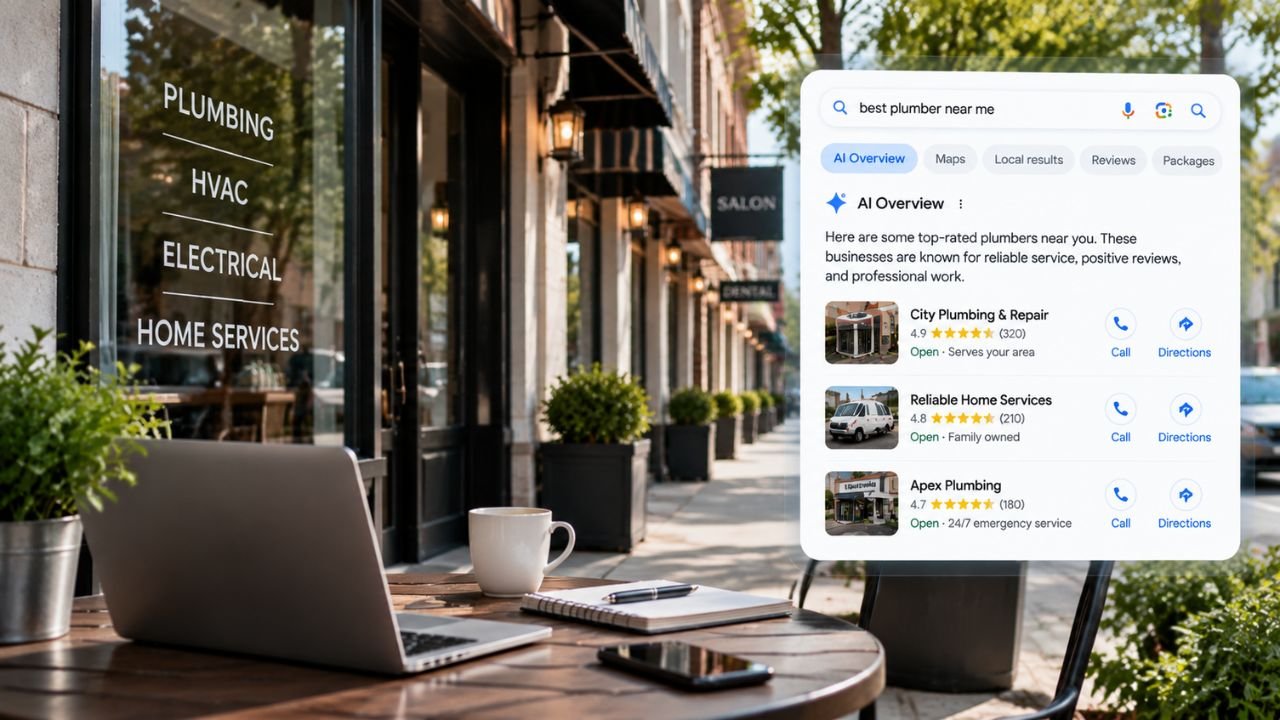
For local businesses, AI search runs on the same fuel as local SEO: accurate business data, reviews, and independent mentions.
What changed is how many places that fuel is read from, and how demanding customers have become.
BrightLocal’s 2026 survey of 1,002 US adults puts numbers on both shifts:
- 45% used AI tools such as ChatGPT for local recommendations, making AI the third most-used source after Google and Facebook.
- Google’s share as a source for reviews fell from 83% to 71%, while Apple Maps nearly doubled from 14% to 27%.
- The average consumer uses six different review sites when choosing a business.
- 47% won’t use a business with fewer than 20 reviews.
- 74% only care about reviews written in the last three months.
- 31% will only use a business rated 4.5 stars or higher, up from 17% a year earlier.
- 89% expect owners to respond to reviews, and templated replies put off 50%.
Google confirms that local data feeds its AI features.
Its guide notes that AI responses can include information about local businesses and that Google Business Profiles help services appear in both AI responses and regular results.
Microsoft makes the same point for Copilot, recommending Bing Places for Business to keep address, hours, and contact details current for AI answers.
Two local levers get far less attention than they deserve.
- Top Places List. Google may show a rich result listing the “top places” lists that mention a business, such as a local publication’s roundup of the best movers in a city. The lists must be curated, genuine, independent, and not sponsored, and the feature only applies to businesses with a physical location. Earning a spot in real local roundups is no longer just PR. It is a visibility asset inside Google itself.
- Review freshness. When three-quarters of consumers ignore reviews older than three months, a business with 400 reviews and nothing recent can look weaker than a competitor with 80 reviews and a steady weekly flow. AI summaries read the same timeline.
The right priorities depend on the type of business:
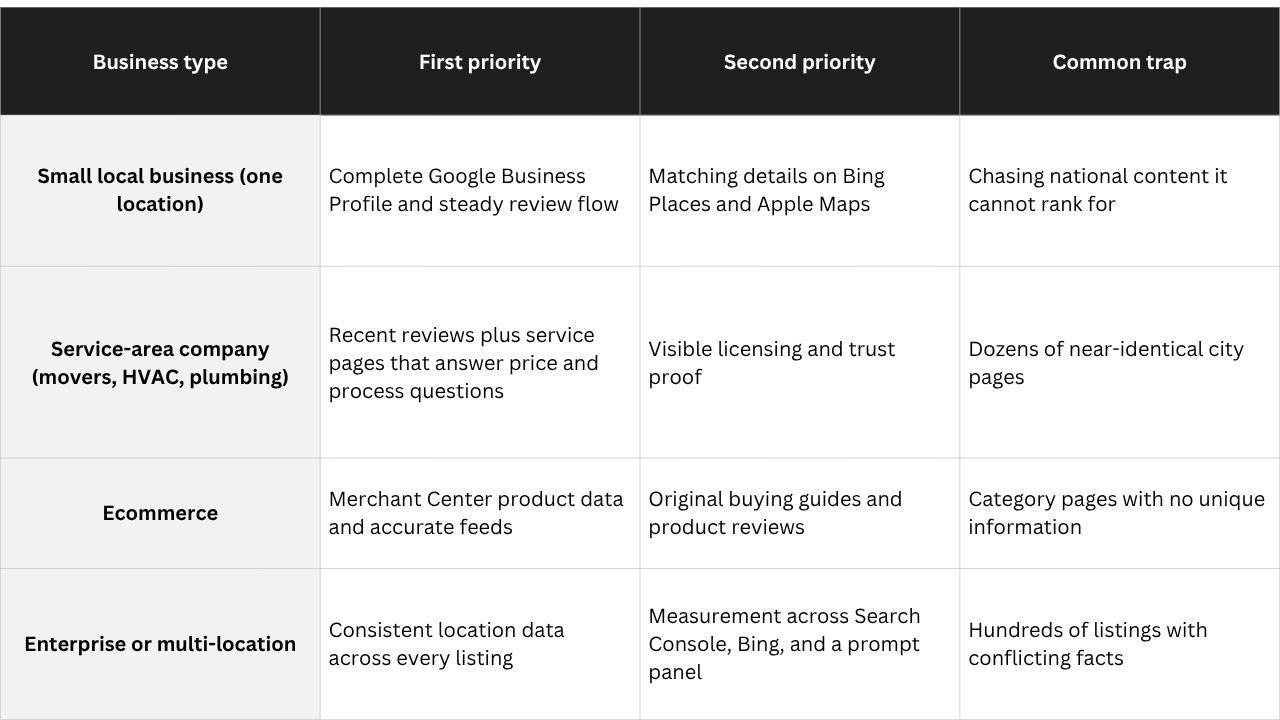
For online stores, the same logic applies with product data standing in for review profiles.
Clean feeds, category pages that answer real buying questions, and product pages with information no competitor has are the core of ecommerce SEO in an AI-first results page.
How Moving Companies Can Benefit From Future Search Changes
Moving is one of the clearest cases where AI search rewards honest operators.
It is expensive, stressful, and trust-heavy, and customers already know scams exist.
Both people and AI systems look for proof, and a legitimate mover has more of it than a fly-by-night operator.
The trust problem is built into the industry.
The Federal Motor Carrier Safety Administration runs Protect Your Move, a public database where anyone can look up interstate movers, their complaint history, and their safety records, along with guidance on spotting rogue movers.
Customers are primed to verify.
Every verifiable fact a mover publishes is a trust signal for a person and a retrieval signal for a machine.
In moving, the scammer and the honest operator can write the same homepage.
They cannot fake the same federal registration history, review timeline, and independent mentions.
That asymmetry is exactly what AI systems are built to read.
Moving customers ask three very different kinds of questions, and each one is answered in a different place:
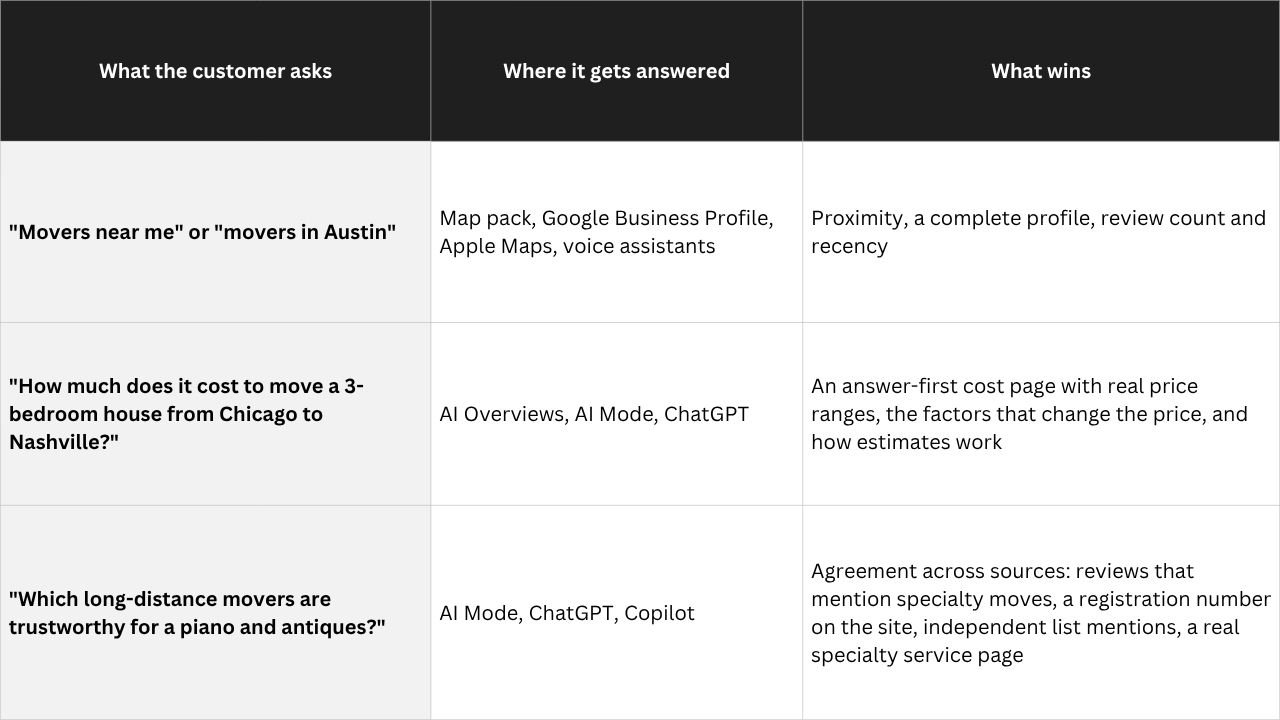
That last question shows fan-out at work.
An AI system might split it into searches about piano moving costs, how to check a mover’s registration, and mover reviews in the customer’s city.
A mover with a genuine piano-moving page, a licensing page that links to the FMCSA lookup, and recent reviews from customers who describe moving a piano gives the system three separate reasons to include it.
Practical moves for moving companies, in order of effort:
- Publish registration numbers where customers look. Put the USDOT and MC numbers in the footer and on quote pages, and link to the FMCSA lookup. It costs nothing and answers the first question a cautious customer asks.
- Build one honest cost page. Use real price ranges from completed jobs and explain what moves the number: distance, volume, stairs, season, specialty items, and the difference between binding and non-binding estimates. This is exactly the non-commodity content Google’s guide describes.
- Ask for reviews the day after delivery. Invite customers to describe the move in their own words, including the route and anything unusual they moved. Keep requests steady through the slow season so the review timeline never goes quiet.
- Reply to every review personally, within a week. Consumers notice silence and notice templates.
- Keep business facts identical everywhere. Name, address, phone, hours, service area, and registration numbers should match across Google Business Profile, Bing Places, Apple Business Connect, Yelp, and the Better Business Bureau.
- Earn real local mentions. Local news roundups, chamber of commerce listings, real estate agent partner pages, and moving association memberships all add independent agreement. Paid placements do not qualify for Google’s Top Places List.
- Build pages for real services, not swapped city names. Long-distance moves, packing, storage, piano moving, and office relocation each deserve a genuine page. Two hundred near-duplicate city pages invite the scaled content problems Google warns about.
- Design the quote flow for the verification visitor. Keep the form short, offer a video survey, show the registration number and recent reviews next to it, and track visits from chatgpt.com in GA4.
Visibility is only half of the equation.
The other half is what happens after the customer arrives: quote speed, follow-up, paid channels, and conversion.
That side is covered in depth in the 2026 Guide: How Do Moving Companies Get More Leads, which pairs well with the search visibility steps above.
The Four Gates Framework: A Practical Implementation Plan
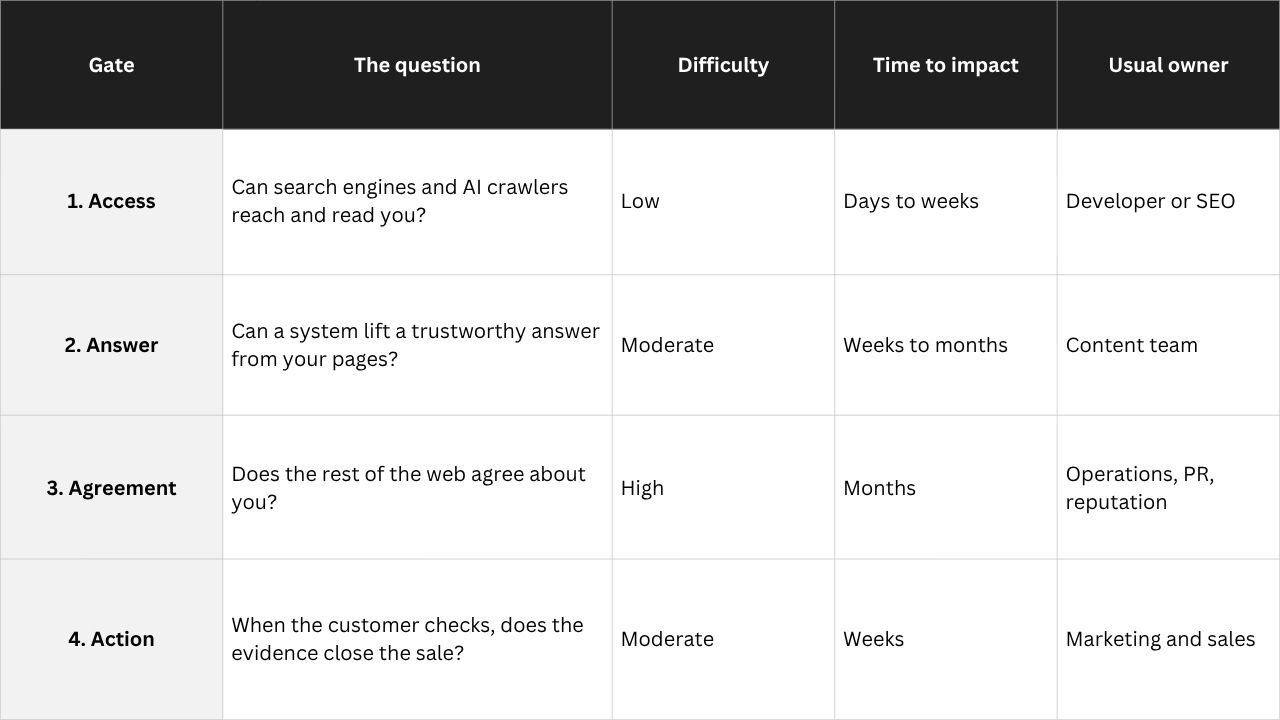
The Four Gates Framework treats AI-era search visibility as four questions every business must pass, in order, before search turns into leads.
Each gate is a question an engine or a customer asks.
Failing an early gate cannot be fixed by excelling at a later one.
Gate 1: Access
What to do: Confirm key pages are indexed and eligible for snippets, with no accidental noindex or nosnippet tags.
Check the Search generative AI control in Search Console; including your site is the default, but it is worth confirming no one changed it.
Allow Googlebot, Bingbot, and OAI-SearchBot in robots.txt, and make a separate, deliberate decision about training crawlers such as GPTBot.
Verify the site in both Google Search Console and Bing Webmaster Tools, and claim Google Business Profile, Bing Places, and Apple Business Connect listings.
Why it matters: Every AI answer starts with retrieval. A page that cannot be crawled cannot be cited.
Common mistake: Security or firewall settings that block crawlers the business actually wants, discovered months later.
Who needs it: Every business. This gate is a prerequisite, not an optimization.
Gate 2: Answer
What to do: Rebuild the five to ten pages that matter most for revenue so each opens with a direct answer, defines its terms, uses question-style headings, and puts numbers in tables.
Add one piece of original information to each, such as real price ranges, timelines, or process details only this business can provide.
Why it matters: AI systems extract passages. Original, specific passages give them a reason to choose one source over another.
Common mistake: Rewriting everything “for AI” or publishing dozens of thin FAQ pages. Google’s guide says neither is needed, and mass production risks spam policies.
Who needs it: Everyone, with the biggest gains for service businesses and ecommerce sites whose customers ask detailed questions before buying.
Gate 3: Agreement
What to do: Build a steady review flow on the platforms customers actually use, reply to every review, keep business facts consistent everywhere, and earn genuine mentions from local media, associations, partners, and industry directories.
Why it matters: AI answers synthesize many sources. When those sources agree, the business becomes easy to summarize and safe to recommend.
Common mistake: Manufacturing agreement.
Google says inauthentic mentions are less helpful than they seem, and fake reviews are now illegal under the FTC’s rule on online reviews, as BrightLocal’s survey notes.
Who needs it: Local and service businesses first, because AI recommendations for them lean heavily on reviews and listings.
Gate 4: Action
What to do: Make the pages a verifying customer lands on confirm the AI’s summary.
Show pricing ranges, credentials, recent reviews, real photos of the team and equipment, and a fast way to get in touch.
Make sure what the site says matches what the listings and reviews say.
Why it matters: The customer who arrives from an AI answer is often close to deciding.
Friction or contradiction at this stage wastes the visibility earned at the first three gates.
This is where conversion rate optimization earns its place in a search strategy: fewer clicks means each one has to convert.
Common mistake: Sending AI-referred visitors to a generic homepage with a long form and no proof.
Who needs it: Any business that sells a considered purchase, from moving and home services to B2B software.
How to measure the four gates
Measurement is still imperfect, so combine several signals instead of trusting one:
- Google Search Console: the Generative AI performance report for impressions in AI Overviews and AI Mode by page. It reports impressions, so pair it with lead data.
- Bing Webmaster Tools: AI Performance for citation counts, cited pages, and grounding queries, which reveal the phrases Copilot used to find your content.
- GA4: referral visits from chatgpt.com and other AI platforms, tied to form fills and calls.
- A fixed prompt panel: 20 to 30 real customer questions asked monthly in ChatGPT, Google AI Mode, and Copilot, recording whether the business is named or cited and which competitors appear instead.
Most businesses start at Gate 2 because new content feels like progress.
The fastest wins often sit at Gate 1, where one blocked crawler or one mismatched phone number quietly cancels everything built on top of it.
A 90-day rollout
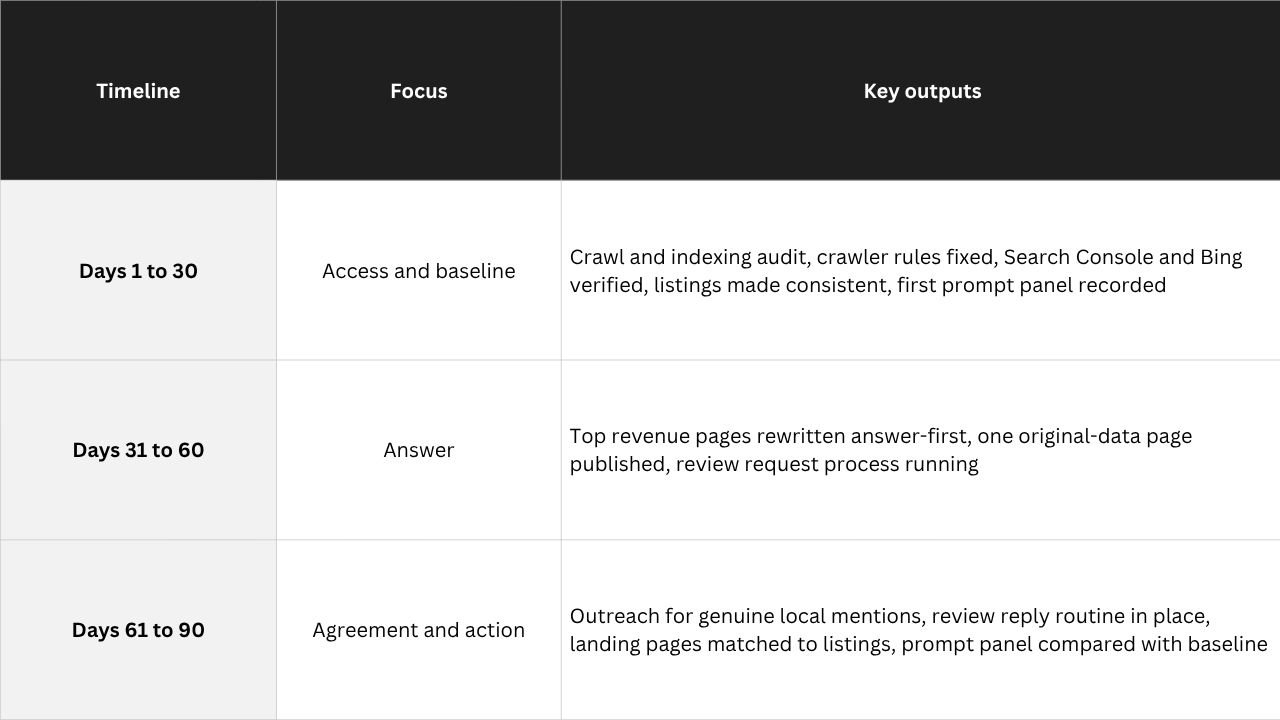
Smaller businesses often run this plan with one owner and no marketing team, which raises a fair question about what to handle in-house and what to hand off.
This breakdown of what a digital marketing agency does for small businesses is a useful way to decide where that line falls.
Common Mistakes That Waste AI Search Budgets
- Treating AEO and GEO as separate from SEO. Google calls it all SEO, and splitting the work across vendors produces conflicting changes on the same pages.
- Buying “AI files” as a fix. Google Search ignores llms.txt files. They do no harm and may serve other systems, but they are not a strategy.
- Chopping pages into fragments. Google says its systems understand pages that cover several topics. Write for readers.
- Mass-producing pages for every query variation. This is the scaled content pattern Google’s spam policies target.
- Manufacturing mentions or reviews. It fails Google’s systems and, for reviews, breaks federal rules.
- Reading the “40% GEO boost” as a promise. It was a relative gain measured in a research setup, not a guarantee for any website.
- Blocking the wrong crawler. Blocking OAI-SearchBot to stop AI training removes the site from ChatGPT search. GPTBot is the training crawler.
- Measuring clicks alone. Impressions, citations, and leads from AI referrals tell a truer story than click-through rate on its own.
- Letting reviews go stale in the off-season. Consumers and AI summaries both weigh recent reviews heavily.
- Ignoring Bing and Apple. Copilot draws on Bing, and Apple Maps usage for reviews nearly doubled in a year.
Conclusion
The future of search is not the end of SEO.
It is a stricter version of it, where being found is only the first gate and being trusted by the rest of the web decides who gets recommended.
SEO earns eligibility, AEO earns the answer, and GEO earns the recommendation.
Businesses that connect all three to a website built for the verifying customer will turn AI search into leads while competitors are still arguing about acronyms.
The most practical next step is a Four Gates audit this month, starting with Access, because nothing downstream works if engines cannot reach the pages.
Moving companies ready to go further on the conversion side can find a complete lead generation playbook in the 2026 Guide: How Do Moving Companies Get More Leads.
This guide is published by EcomOptix, an ecommerce marketing agency USA brands work with on SEO, AI search visibility, and conversion.
More AI search playbooks are on the EcomOptix blog, and teams that want an outside review of their own four gates can request a free growth analysis.
FAQs
Does SEO still matter in 2027 with AI search?
Yes. Google states that its AI Overviews and AI Mode are built on its core ranking systems, and a page must be indexed and eligible for a snippet to appear in them. Strong SEO is the entry ticket to AI visibility on Google.
What is the difference between SEO, AEO, and GEO?
SEO helps pages rank in search results. AEO helps content get selected as a direct answer in snippets, People Also Ask, AI Overviews, and voice replies. GEO helps a business get named or cited inside AI-generated answers from tools like ChatGPT, Gemini, Copilot, and Perplexity.
What is GEO optimization?
GEO optimization is the practice of improving how often and how accurately AI systems include your content or business in their generated answers. It focuses on crawler access, evidence-rich content, and consistent information across reviews, listings, and third-party sites.
What is GEO marketing?
GEO marketing covers the off-site work that shapes AI answers: reviews, press coverage, expert mentions, directories, and consistent business data. It matters because AI systems build answers from many sources, not just your website.
How do you get cited by ChatGPT?
Allow OpenAI's OAI-SearchBot in robots.txt, keep your site well indexed in Bing as well as Google, and publish specific, original, well-sourced information. Track results through visits tagged utm_source=chatgpt.com in your analytics. No method guarantees a citation.
Do I need an llms.txt file?
Not for Google. Google's documentation says Google Search ignores llms.txt files and that they neither help nor hurt rankings. Some other AI services may read them, so they are optional rather than essential.
How can local businesses prepare for AI search?
Keep Google Business Profile, Bing Places, and Apple Maps listings complete and consistent, build a steady flow of recent reviews, reply to every review personally, and earn genuine mentions in local media and independent "best of" lists.
How will AI search affect moving companies?
AI search rewards movers who can prove trustworthiness. Customers increasingly ask AI tools which movers are reliable, and those answers draw on reviews, listings, and licensing signals. Movers who publish registration numbers, real pricing guidance, and recent reviews are more likely to be recommended.