EcomOptix

Author: Manoj Chauhan

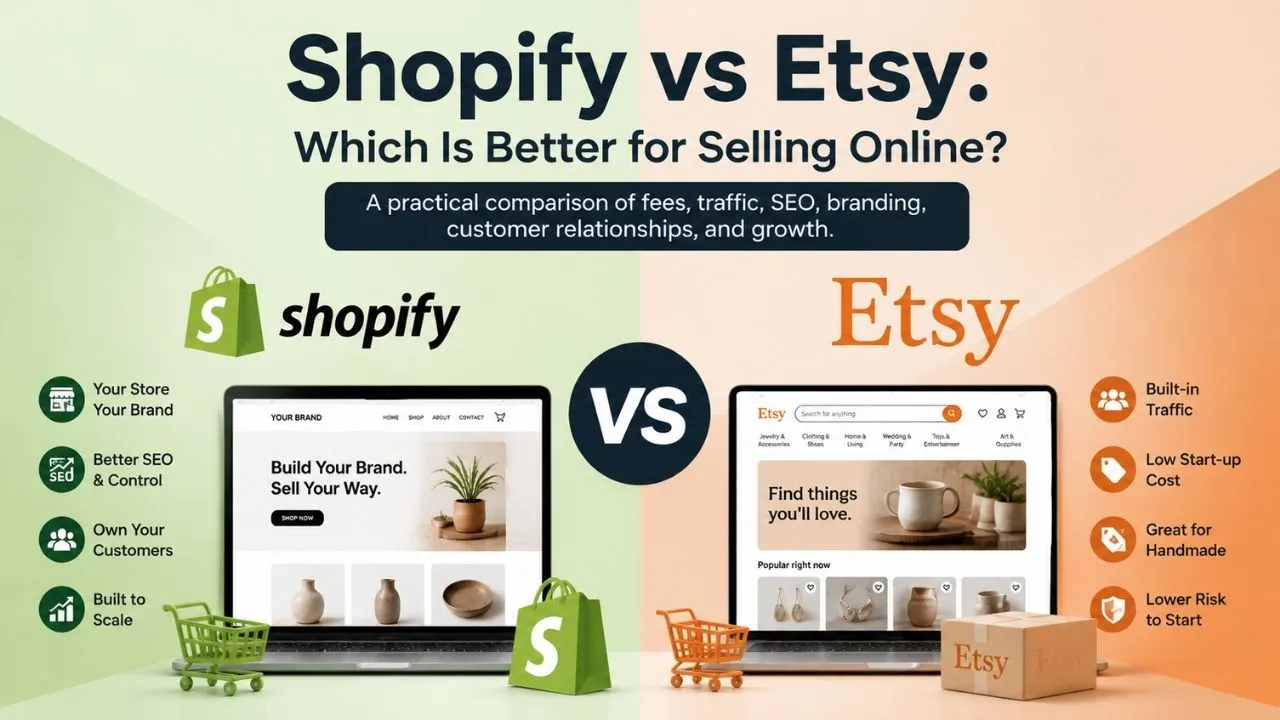
  • Shopify vs Etsy: Which Is Better for Selling Online?

    Shopify vs Etsy: Which Is Better for Selling Online?

    Shopify vs Etsy jpg


    A practical comparison of fees, traffic, SEO, branding, customer relationships, and growth.

    Short answer: Etsy is usually the better starting point for handmade, vintage, custom, or craft products when you need marketplace discovery and low fixed costs. Shopify is usually better when you want a branded store, more control over SEO and customer relationships, and a platform that can scale with your business—but you must create or buy your own traffic. Many established sellers use both, with Etsy as a discovery channel and Shopify as the brand home.

    The key distinction:
    Shopify is a standalone ecommerce platform that powers your own storefront.
    Etsy is an online marketplace where your shop sits inside Etsy’s shared shopping environment.
    The decision is therefore about business model and customer acquisition—not just which checkout has the lower fee.

    Shopify vs Etsy at a glance

    If your priority is… Usually the better fit Why
    Testing demand quickly Etsy Lower fixed commitment and built-in marketplace discovery.
    Owning the storefront experience Shopify Custom domain, brand design, site structure, and checkout control.
    Getting found without an audience Etsy Shoppers already browse the marketplace, although competition is intense.
    Building SEO and repeat-purchase assets Shopify More control over pages, content, email capture, and customer journeys.
    Selling handmade or vintage items Etsy first; Shopify later or alongside it Etsy fits the category; Shopify gives the brand more room to grow.
    Subscriptions, wholesale, or a broad catalog Shopify A standalone commerce system is generally more adaptable to complex operations.
    Keeping risk and work low at the beginning Etsy Faster setup, but you accept marketplace rules, competition, and dependence on Etsy.

    The core difference: marketplace vs. standalone store

    Etsy supplies a destination where shoppers search for products from many sellers. That gives a new seller a chance to be discovered before the seller has an audience, but it also puts the shop next to competitors and places the customer relationship inside Etsy’s policies and platform experience.

    Shopify supplies the storefront technology: hosting, checkout, catalog and inventory tools, payment connections, reports, themes, and an app ecosystem. You choose the domain, positioning, page structure, and marketing mix. Shopify can make a business look and operate more like an independent brand, but it does not automatically bring shoppers. A polished Shopify store with no acquisition plan can generate no sales.

    Fees and total cost: the comparison most articles oversimplify

    Fees and total cost the comparison wepg

    A fair comparison separates fixed costs, per-order costs, optional marketing costs, and operating costs. “Etsy is free” and “Shopify has no transaction fees” are both incomplete statements.

    Etsy’s fee stack

    • Listing fee: $0.20 per listing or renewal. Listings generally expire after four months, and quantity-based renewals can create additional listing fees.
    • Transaction fee: 6.5% of the order total defined by Etsy’s policy, including the item price and amounts charged for shipping and gift wrap. Tax treatment varies by location.
    • Payment processing: A country-specific percentage plus a flat fee. In the United States, the current help page lists 3% + $0.25; in India it lists 5% + ₹25. It is charged on the payment total, including shipping and tax where applicable.
    • Advertising: Etsy Ads are pay-per-click. Offsite Ads are charged only when Etsy attributes an order to an offsite ad; the rate is generally 15% below the relevant sales threshold and 12% after the threshold, subject to Etsy’s current rules and a per-order cap.
    • Optional subscriptions and adjustments: Etsy Plus is optional. Pattern is a separate Etsy website product with its own subscription price after the trial and still uses Etsy Payments processing. Currency conversion, regulatory operating fees, deposit fees, taxes, and Payoneer or bank charges may apply depending on the seller’s location.

    Verify the live rules before publishing or pricing products: Etsy Fees & Payments Policy; Etsy payment-processing fees; Etsy fees and taxes help page; Pattern pricing.

    Shopify’s fee stack

    • Subscription: Shopify charges a recurring plan fee. As a U.S. illustration, its current pricing pages show Basic at $39 per month when billed monthly, with lower effective annual pricing often displayed. Prices, billing options, included features, and plan availability vary by country.
    • Payment processing: If Shopify Payments is available and used, you pay the card-processing rate for your market and plan. A U.S. online card example shown on Shopify’s pricing materials is 2.9% + $0.30 on the entry plan; the exact rate depends on market, card type, plan, and transaction circumstances.
    • Third-party payment provider fees: If you use a provider other than Shopify Payments, Shopify may add a plan-based third-party transaction fee on top of the provider’s own processing fee. That is why “0% transaction fee” should never be read as “0% payment cost.”
    • Store operations: A custom domain, premium theme, apps, email/SMS tools, shipping services, fulfillment, returns, and paid advertising can add to the monthly cost. Shopify includes hosting, bandwidth, SSL, and a myshopify.com domain; a custom domain is normally an additional purchase.

    See the current details in Shopify pricing and Shopify Payments cost guidance.

    A simple U.S. variable-fee example

    The table below isolates a single order so the fee mechanics are visible. It assumes one $0.20 Etsy listing, a $50/$200/$1,000 order with no tax and free shipping, no Etsy Ads or Offsite Ads attribution, and Shopify Payments on an entry-level U.S. Shopify plan. It excludes the Shopify subscription, apps, domain, fulfillment, product costs, refunds, and advertising.

    Order value Etsy: listing + 6.5% + 3% + $0.25 Shopify: 2.9% + $0.30 Difference before fixed costs
    $50 $5.20 $1.75 Etsy is $3.45 higher
    $200 $19.45 $6.10 Etsy is $13.35 higher
    $1,000 $95.45 $29.30 Etsy is $66.15 higher


    What the example does—and does not—prove: At roughly twelve $50 orders per month, the $3.45 variable-cost difference could mathematically offset a $39 monthly Shopify subscription. That is a contribution-margin illustration, not a recommendation: Etsy may create sales that Shopify would not have generated, while Shopify may require SEO, email, social, or paid acquisition spending.

    How to compare your own total cost

    1. Calculate contribution margin by channel. Start with selling price minus product cost, packaging, shipping subsidy, payment fees, platform fees, refunds, and ad cost. Compare what each order contributes—not just the headline rate.
    2. Model fixed costs over realistic order volume. Spread Shopify’s plan, apps, domain, and email tools across expected monthly orders. Do not spread them over an optimistic sales target.
    3. Price in the cost of traffic. Etsy can supply discovery but may charge advertising-related fees. Shopify may have lower order fees but require paid ads, content, partnerships, or months of SEO work.
    4. Use your seller location. Etsy payment processing, regulatory fees, taxes, deposits, currency conversion, and Shopify Payments availability are market-specific. A U.S. example cannot be copied into an India, U.K., EU, or Australia forecast.

    Traffic, marketing, and customer acquisition
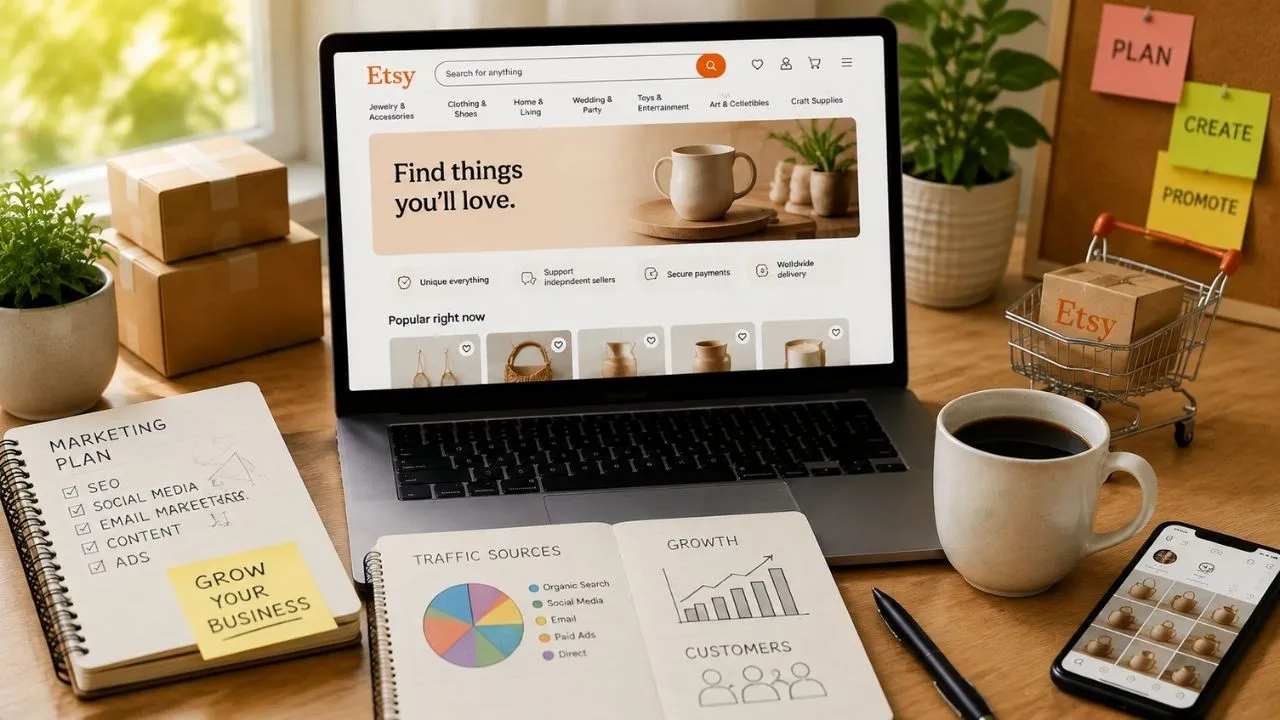
    Traffic, marketing, and customer acquisition jpg

    Etsy’s main advantage is not simply that it is easy to use; it is that Etsy is already a shopping destination. Etsy’s latest company information reports roughly 86.5 million active buyers and 5.6 million active sellers, which demonstrates marketplace scale but does not guarantee impressions or sales for an individual shop. Your listings still compete on relevance, price, photography, reviews, delivery performance, and customer service.

    Marketplace scale reference: Etsy company information. The figures are platform-level totals, not a forecast for any individual seller.

    Etsy discovery is earned and can be paid for

    • Organic Etsy search: Etsy considers relevance and listing information such as titles, tags, attributes, and descriptions, along with listing quality and buyer experience. Results are personalized, and competition and shopper behavior change.
    • Etsy Ads: Etsy Ads operate on a pay-per-click auction model. A click is a cost even when it does not become an order, so track return on ad spend and contribution margin.
    • Offsite Ads: These are different from Etsy Ads. An attributed sale can create a percentage fee even though the seller did not set a per-click bid for that particular order.
    • Marketplace risk: Search visibility can be affected by customer-service standards, shipping performance, reviews, cases, and policy compliance. A seller has less control over the algorithm and the surrounding buying experience than on an independent site.

    For the current mechanics, see Etsy’s SEO guide, search-visibility guidance, tag guidance, and Etsy Ads explanation.

    Shopify gives you the tools, not the audience

    A Shopify store needs an acquisition plan. Common channels include organic search, social content, email, creator partnerships, referrals, marketplaces, affiliate programs, paid search, paid social, and repeat purchases. Shopify can connect these channels and present a consistent brand experience, but the platform itself does not put your product in front of ready-to-buy shoppers in the way Etsy marketplace search can.

    That responsibility is a cost and an opportunity. You have to earn the first visit, but a successful store can build a durable audience through permission-based email, customer accounts, content, product education, and repeat-purchase journeys. Those assets are more difficult to build inside a marketplace.

    SEO: Etsy search visibility vs. Shopify site ownership

    Both platforms can support search visibility, but they expose different levels of control.

    SEO question Etsy Shopify
    Can product pages appear in Google? Yes. Optimize the shop and listing content, then follow Etsy’s policies. Yes. You control more of the site architecture and on-page content.
    What can you edit? Titles, descriptions, tags, attributes, images, alt text, shop content, policies, and branding elements. Titles, meta descriptions, URLs, content pages, collections, blogs, images, redirects, theme markup, and more.
    How much technical control? Limited to Etsy’s marketplace structure and templates. More control over domain, navigation, collections, internal links, templates, and technical SEO foundations.
    Does the platform guarantee rankings? No. No. Technical access is not the same as relevance, authority, or demand.
    Who must do the marketing work? You compete for Etsy search and may use Etsy’s ad products; Etsy supplies marketplace discovery. You must create demand through SEO, content, social, email, partnerships, marketplaces, or paid media.


    Etsy SEO is listing optimization inside a marketplace

    Etsy lets sellers improve shop and listing pages with relevant titles, tags, attributes, descriptions, images, image alt text, video, policies, and an About section. This is enough to earn visibility in Etsy and potentially in external search, especially when the product matches a specific query. It is not the same as owning a full site architecture: you have less control over URLs, navigation, category pages, internal linking, page templates, and the context around the listing.

    Shopify SEO is a stronger long-term content asset

    Shopify supports custom domains and automatically generates a sitemap. Its SEO tools and themes can support editable page titles, meta descriptions, URLs, image alt text, canonical tags, SSL, collections, blogs, and structured content. That broader control can compound over time through category pages, product-led content, buying guides, comparison pages, and internal links. It still requires research, useful content, technical maintenance, link earning, and conversion optimization. A sitemap is not a ranking strategy.

    Technical references: Shopify SEO overview, Shopify sitemap guidance, and Etsy SEO for shop and listing pages.

    Branding, store ownership, and customer relationships

    Etsy gives you a shop identity within Etsy. You can use a shop name, logo, banner, featured listings, About content, policies, and—through Etsy Plus—additional appearance options. But shoppers are still moving through Etsy’s shared marketplace, where they can compare competing products and where Etsy controls the overall checkout, navigation, messaging, and policy environment.

    Shopify lets you build the customer-facing layer around your own brand: a custom domain, home page, collections, product education, navigation, checkout styling, promotions, content, and post-purchase experience. You can connect customer accounts, analytics, CRM, email, reviews, subscriptions, fulfillment, and other tools. This creates more work, but it also creates more room for differentiation.

    Customer data is not a simple “you own it” vs. “Etsy owns it” question

    On Shopify, you generally have more direct access to customer and order records and can export customer data or connect it to other systems. You must still follow privacy, email, SMS, consumer-protection, and data-retention laws. Marketing permission is not implied merely because someone placed an order.

    On Etsy, the seller receives the information needed to fulfill the transaction, but Etsy’s rules and privacy framework limit how buyer information can be used. Do not treat an Etsy order as permission to add a buyer to an independent mailing list or redirect the buyer off Etsy. Use consent-based marketing and follow the current seller, privacy, and anti-circumvention rules.

    Relevant references: Shopify customer import and export guidance, Etsy Seller Policy, and Etsy privacy policy.

    Ease of setup and day-to-day operations

    Operational area Shopify Etsy
    Initial setup More decisions: theme, domain, payments, shipping, tax settings, navigation, policies, apps, and analytics. Faster launch: create the shop, add listings, configure payments and shipping, and meet marketplace requirements.
    Catalog and inventory Strong inventory, product, location, reporting, and app options for a growing catalog. Good listing and order tools, but complex multichannel operations may require an integration or app.
    Payments Shopify Payments where supported, plus third-party providers and other payment methods. Etsy Payments where available; processing terms are tied to the seller’s country and bank location.
    Shipping and fulfillment You design the process and can connect carriers, fulfillment, print-on-demand, and warehouse tools. Etsy offers marketplace seller tools and shipping options, but the seller still owns product preparation and delivery performance.
    Analytics Store, traffic, product, order, and channel reporting, with more connected-data options. Etsy Stats and marketplace insights help with listings and demand, but the view is centered on Etsy activity.

    Integrations are a spectrum—not a binary

    Shopify has a large app ecosystem and is often easier to extend into email, subscriptions, reviews, fulfillment, POS, accounting, wholesale, and multichannel selling. Etsy also supports integrations and a public API for eligible seller and developer use. The practical question is whether the exact tool you need can sync listings, inventory, orders, shipping status, and returns reliably at a cost you can absorb.

    References: Shopify reports, Shopify inventory management, and Etsy API guidance.

    Which products fit Shopify or Etsy?

    Product or business model Best starting fit Important qualification
    Handmade, custom, personalized, or craft items Etsy, then consider Shopify Etsy matches the shopping intent; Shopify helps build a branded repeat-purchase channel.
    Vintage goods Etsy Confirm Etsy’s vintage definition, listing rules, and required disclosures.
    Print-on-demand Both can work Use an approved production-partner workflow and disclose production partners where Etsy requires it. Check IP and product-safety obligations.
    Digital downloads Either Choose based on discovery, file delivery, customer support, and brand/retention goals.
    Subscriptions, wholesale, B2B, or complex bundles Shopify A standalone platform generally provides more room for workflows and integrations. Confirm plan and app costs.
    Generic dropshipping or reselling Usually not Etsy Etsy generally requires items to be made, designed, handpicked, or sourced within its policy; Shopify does not remove legal, quality, disclosure, or supplier responsibilities.

    Etsy product-policy risk matters

    Etsy is not a general-purpose catalog for any product a seller can source. Its Seller Policy requires listings to fit Etsy’s permitted categories and requires accurate descriptions, original photos or video, intellectual-property compliance, and relevant disclosures. Dropshipping and reselling are restricted except for limited policy exceptions. A production partner can be permitted for an original design, but the seller must follow Etsy’s disclosure and listing requirements.

    Read the live requirements in Etsy Seller Policy before investing in inventory, templates, or advertising.

    Scalability and platform risk

    Etsy can scale a product line, but growth comes with more competition, more customer-service volume, more fees, and greater exposure to Etsy’s search, payment, and policy decisions. Etsy’s Customer Service Standards and Purchase Protection criteria make shipping, tracking, responsiveness, reviews, and cases operational priorities. Purchase Protection can help qualifying orders, but it is not universal insurance and does not eliminate seller responsibility.

    Shopify gives a business more control as the catalog, team, channels, and marketing system grow. It can be a better core for multiple sales channels, a branded content strategy, customer retention, and more complex inventory. The trade-off is ongoing financial and operational responsibility: monthly plan costs, apps, payment fees, data/privacy obligations, site maintenance, fraud/chargeback exposure, and traffic acquisition. Shopify reduces dependence on a marketplace; it does not make the business independent of every platform, payment processor, carrier, or app.

    Risk and service references: Etsy Customer Service Standards and Etsy Purchase Protection.

    Should you sell on both Shopify and Etsy?

    Often, yes—provided the economics and operations justify it. A two-channel strategy can use Etsy to test demand and capture marketplace shoppers while Shopify becomes the long-term home for brand, content, retention, and direct traffic. It can also reduce dependence on one source of sales.

    A practical two-channel setup

    1. Choose a primary system of record. Decide where SKU names, inventory counts, product costs, and order status are authoritative.
    2. Sync only what you can monitor. An integration can reduce duplicate work, but a failed inventory sync can create overselling, late shipping, or customer-service problems. Budget for the app and its maintenance.
    3. Give each channel a job. For example, Etsy can test keywords and product-market fit; Shopify can support bundles, email capture, content, repeat purchase, or wholesale conversations.
    4. Track contribution by channel. Separate Etsy fees, Shopify fees, ad spend, returns, fulfillment, and support time. A channel with more revenue is not automatically the more profitable channel.
    5. Stay inside Etsy’s rules. Do not use Etsy orders, messages, packaging, QR codes, or listing tactics to evade fees or redirect buyers to another venue. Any cross-channel marketing must be based on a lawful, compliant source of consent.

    The last point is not optional: review Etsy’s rules on off-platform transactions and fee avoidance and the Seller Policy.

    Which should you choose?

    Use the following decision rules as a starting point, then validate them against your margins, product restrictions, audience, and marketing capacity.

    Choose Etsy first if…

    • You are validating handmade, custom, vintage, craft, or other Etsy-compatible products.
    • You have little or no existing audience and want marketplace search to create a first chance at discovery.
    • You want to keep fixed costs low while testing price, photos, product-market fit, and fulfillment.
    • You can accept marketplace competition, policy requirements, and limited control over the customer journey.
    • Your expected volume is low or uncertain and a monthly storefront subscription would be difficult to justify.

    Choose Shopify first if…

    • You are building a distinct brand with a custom domain, a differentiated customer experience, and a long-term content strategy.
    • You already have traffic from social, email, search, creators, retail, a community, or another marketplace.
    • You need broader control over SEO, landing pages, collections, navigation, customer accounts, analytics, or integrations.
    • You sell products or business models that benefit from subscriptions, wholesale, B2B, bundles, multiple locations, or more complex workflows.
    • You can fund the monthly plan, apps, payment processing, site operations, and customer acquisition while sales develop.

    Use both if…

    • You want Etsy discovery and Shopify brand ownership to serve different stages of the same customer journey.
    • Your product margins can cover two sets of channel costs and the operational overhead of keeping listings and inventory accurate.
    • You have a clear primary catalog/inventory system and a policy-compliant way to market to people who opt in.

    A five-step platform decision checklist

    1. Write down your product category, production model, average order value, gross margin, and likely monthly order volume.
    2. Check Etsy eligibility, intellectual-property requirements, production-partner rules, shipping expectations, and payment availability before selecting Etsy.
    3. Estimate a Shopify store’s full monthly cost: plan, domain, apps, payment processing, fulfillment, email, support, and acquisition.
    4. Calculate the number of profitable orders each channel needs—not merely the break-even point on platform fees.
    5. Review the decision after the first meaningful test period using conversion rate, contribution margin, repeat purchase, customer-acquisition cost, and support time.

    Summary

    Etsy is a marketplace with built-in shopper intent, low fixed commitment, and strong fit for handmade, vintage, custom, and craft-led businesses. Shopify is a standalone ecommerce platform with more control over branding, SEO, customer relationships, integrations, and scale—but it shifts traffic generation and more operating costs onto the seller.

    If your biggest constraint is finding initial demand, start with Etsy or use it as one channel. If your biggest goal is building a durable brand and customer-retention asset, build Shopify into the plan. Compare contribution margin and acquisition cost, not just the listing fee or monthly subscription. And if you use both, give each channel a clear job and follow Etsy’s rules about buyer data and off-platform transactions.

    Frequently asked questions

    Etsy usually has lower fixed cost, but higher variable fees on each order. Shopify has a recurring plan and operating costs, but its payment cost per order can be lower. Your order value, volume, ad spend, country, apps, and traffic source determine the total.

    Common Etsy costs include the $0.20 listing or renewal fee, a 6.5% transaction fee, country-specific Etsy Payments processing, possible Etsy Ads or Offsite Ads charges, and location-specific currency, regulatory, deposit, or tax-related costs.

    Common Shopify costs include the subscription, payment processing, possible third-party payment-provider fees, domain, apps, themes, email/SMS, fulfillment, and marketing. Shopify Payments can remove a separate third-party transaction fee where available, but card processing still applies.

    Etsy is usually easier if the beginner wants to list a small number of permitted products and test demand. Shopify is a better beginner choice when the seller already has an audience or is intentionally building a standalone brand and is willing to learn store setup and marketing.

    Yes. Many businesses use Etsy for marketplace reach and Shopify for brand and retention. Keep inventory synchronized, measure channel-level profit, and do not use Etsy orders or messages to redirect buyers or evade Etsy fees.

    Yes. Shopify can support handmade products and gives the seller more control over brand, content, bundles, email, and repeat purchase. Etsy may still be valuable because shoppers already search there for handmade and personalized products.

    Not automatically. Shopify gives you tools for SEO, content, social, email, and paid acquisition; it does not supply Etsy’s marketplace audience. Plan for traffic generation before moving a proven product to Shopify-only.

    Etsy sellers receive the information needed to fulfill orders, but Etsy policies limit how buyer information may be used. A transaction is not blanket permission for independent email marketing or off-platform selling. Shopify generally gives more direct access and export flexibility, subject to privacy and marketing laws.

    Shopify generally offers more control over domain, site structure, collections, pages, blogs, URLs, internal links, and technical SEO. Etsy can still rank listings and shops when sellers optimize relevant content and deliver a good buyer experience. Neither platform guarantees rankings.

    Print-on-demand can be compatible when the product and design meet Etsy rules and required production partners are disclosed. Generic dropshipping or reselling is generally not an Etsy fit. Shopify can support more sourcing models, but it does not remove product-safety, IP, tax, disclosure, or supplier responsibilities.

    Consider Shopify when you have repeat demand, a recognizable brand, enough margin to fund the store, a traffic plan, or operational needs Etsy cannot serve well. You do not have to “move” completely; a two-channel test may be safer than an abrupt migration.

    For a simple estimate, subtract Shopify’s variable payment cost from Etsy’s variable fees for a typical order, then divide the monthly Shopify fixed cost by that per-order difference. Add marketing, apps, fulfillment, refunds, taxes, and the value of Etsy’s built-in demand before making a decision.
  • What Does a Digital Marketing Agency Do for Small Businesses? (2026 Guide)

    What Does a Digital Marketing Agency Do for Small Businesses? (2026 Guide)

    A plain-English guide to what agencies do, the services they offer, and the results you can realistically expect.

    You know you need more customers. You can feel that more people are searching online than ever, and somehow your competitor down the road keeps showing up first. But when someone says “you should hire a digital marketing agency,” you nod along without really knowing what one does all day.

    You are not behind. Most small business owners are in the same spot. Marketing changed faster than anyone had time to keep up with.

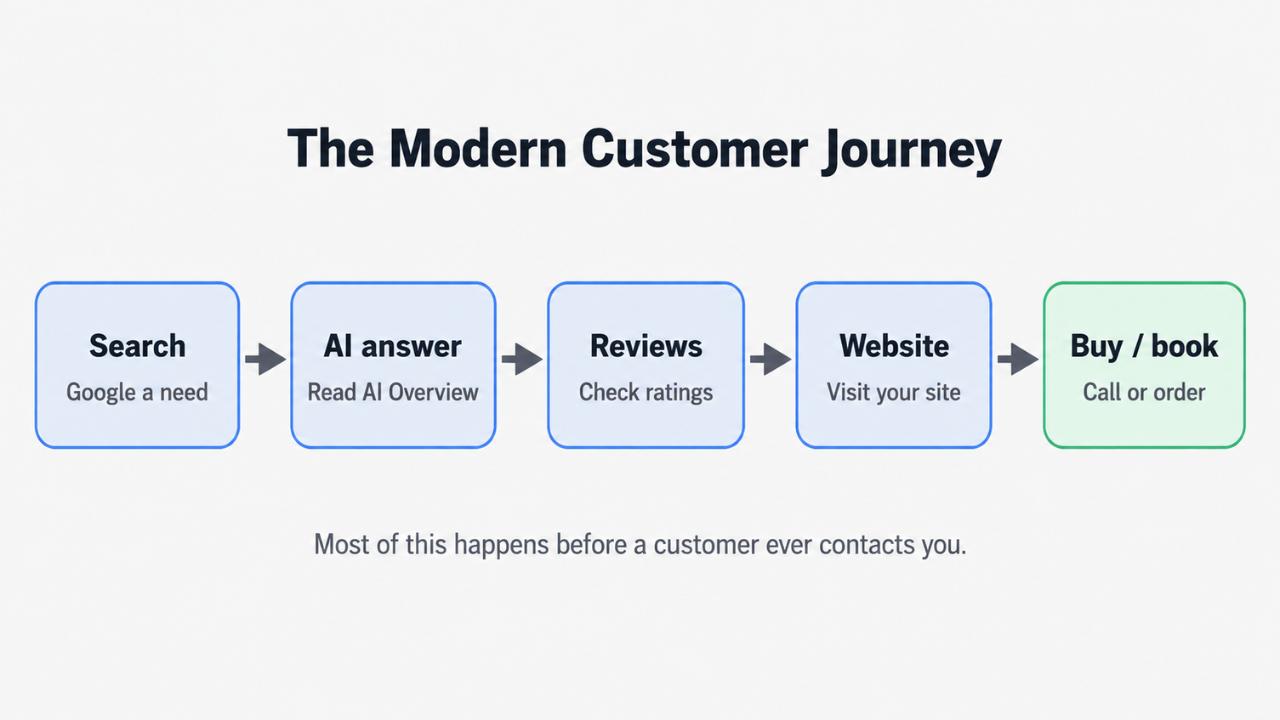
    Here is what changed by 2026. Customers do not just “Google” things anymore. They search on Google, read AI Overviews that answer questions before they click, ask ChatGPT or Gemini for recommendations, scroll social feeds, and check reviews before they ever call you. Your future customer often decides before speaking to a single person. A digital marketing agency exists to make sure your business shows up, looks trustworthy, and gets chosen at each of those moments.

    This guide explains what these agencies actually do, in plain language, with no sales pitch.

    Quick Answer:What Does a Digital Marketing Agency Do for Small Businesses?

    A digital marketing agency helps a small business attract customers online and turn them into sales. It does this through SEO, content marketing, paid advertising, website design and optimization, social media marketing, email marketing, and performance tracking.

    In plain terms: an agency makes sure people can find your business when they search, trust it when they land on your site, and have an easy way to buy or book. Then it measures what works and adjusts.

    A simple way to remember the whole job is the Find, Trust, Buy path. Agencies help customers find you, trust you, and buy from you. Every service below fits one of those three steps.

    What Is a Digital Marketing Agency?

    A digital marketing agency is a company that promotes other businesses online. Instead of newspaper ads or billboards, it uses websites, search engines, social media, email, and online ads to bring in customers.

    The purpose is simple: get the right people to notice your business and take action, like calling a plumber, booking a dentist, or buying a product.

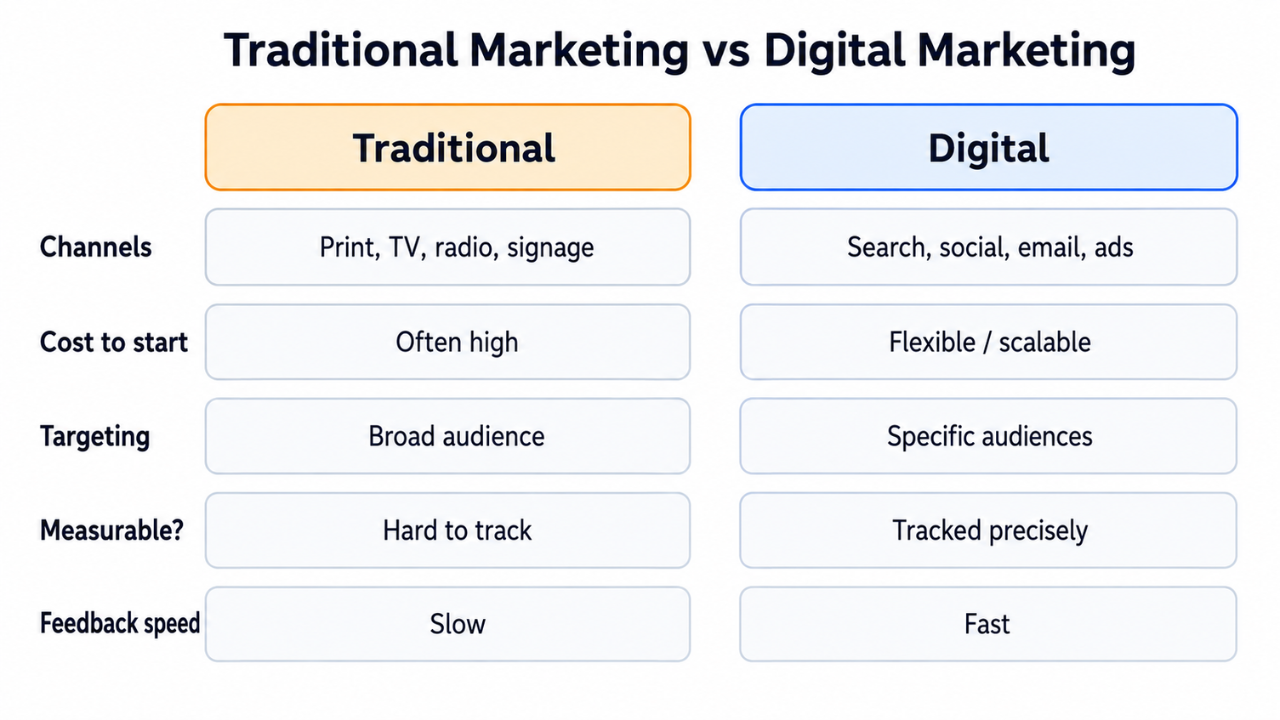
    Here is how that differs from old-school marketing. A traditional advertising company focuses on awareness through print, radio, TV, or signage, and it is hard to know how many customers that billboard brought in. A digital agency works in channels where almost everything can be measured: who saw your ad, clicked, called, and bought.

    Example: A local roofing company is invisible on Google. An agency builds a clear website, gets it ranking for “roof repair near me,” and runs a small Google Ads campaign. Within months the phone rings with people searching for exactly that service. That is the difference between hoping to be seen and being findable on demand.

    Traditional vs digital marketing at a glance.

    Why Is Digital Marketing Important for Small Businesses?

    Digital marketing matters because that is where your customers already are. Around 81% of shoppers research online before they buy, even when the final purchase happens in person. If you are not visible during that research, you are not in the running.

    Customer behavior has flipped. People used to call three businesses and pick one. Now they search, compare reviews, and often decide before any conversation. The business that shows up and looks credible wins the click.
    Local search is the clearest example. Roughly 76% of people who search for something nearby on their phone visit a business within a day. Someone typing “emergency electrician near me” is ready to hire. If your competitor ranks and you do not, that job is theirs.

    Most small businesses do not lose to better companies. They lose to more visible ones.

    How today’s customers move from search to purchase.

    How Does a Digital Marketing Agency Help Small Businesses?

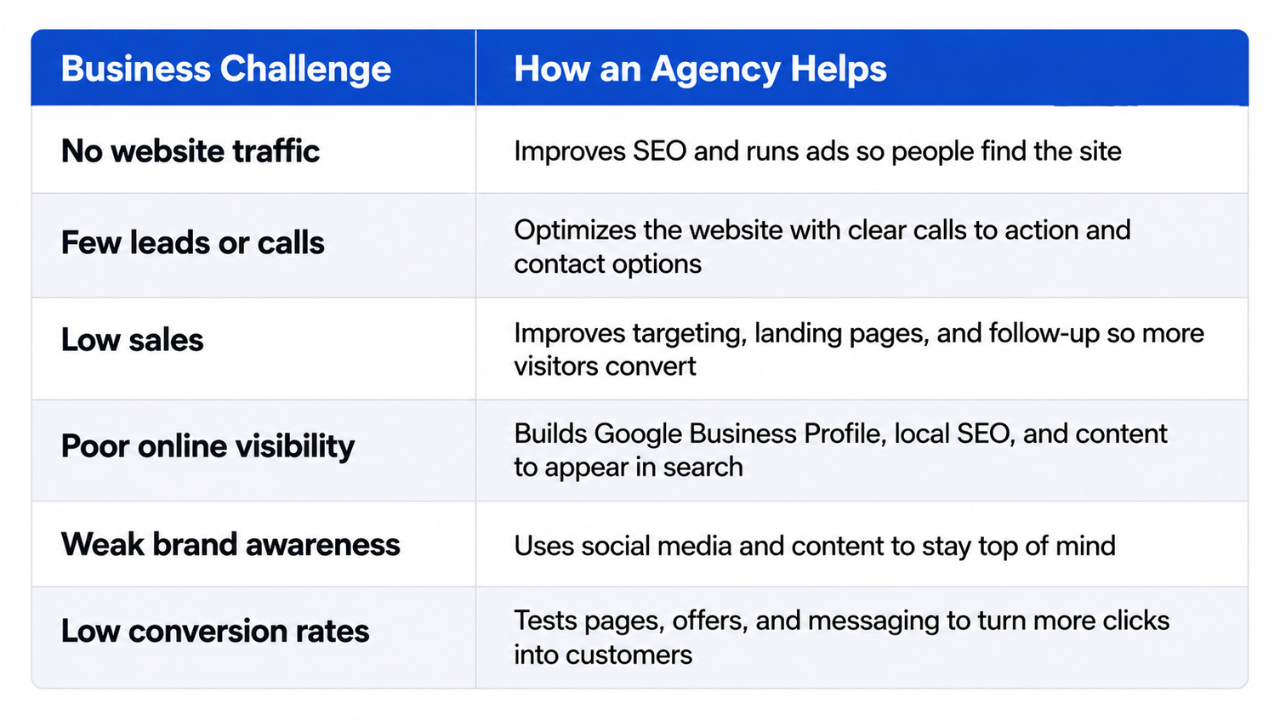
    An agency helps by fixing the specific gaps that stop a business from growing online. Most owners feel a vague problem like “not enough customers.” The agency’s job is to find the exact cause and fix it.

    How Does a Digital Marketing Agency Help Small Businesses (1)

    What most owners get wrong: they assume the problem is “not enough traffic.” Often the traffic is fine and the website quietly loses people who were ready to buy. A good agency diagnoses before it spends.

    What Services Do Digital Marketing Agencies Typically Provide?

    Agencies offer a menu of services. A small business rarely needs all of them at once.

    Search Engine Optimization (SEO)

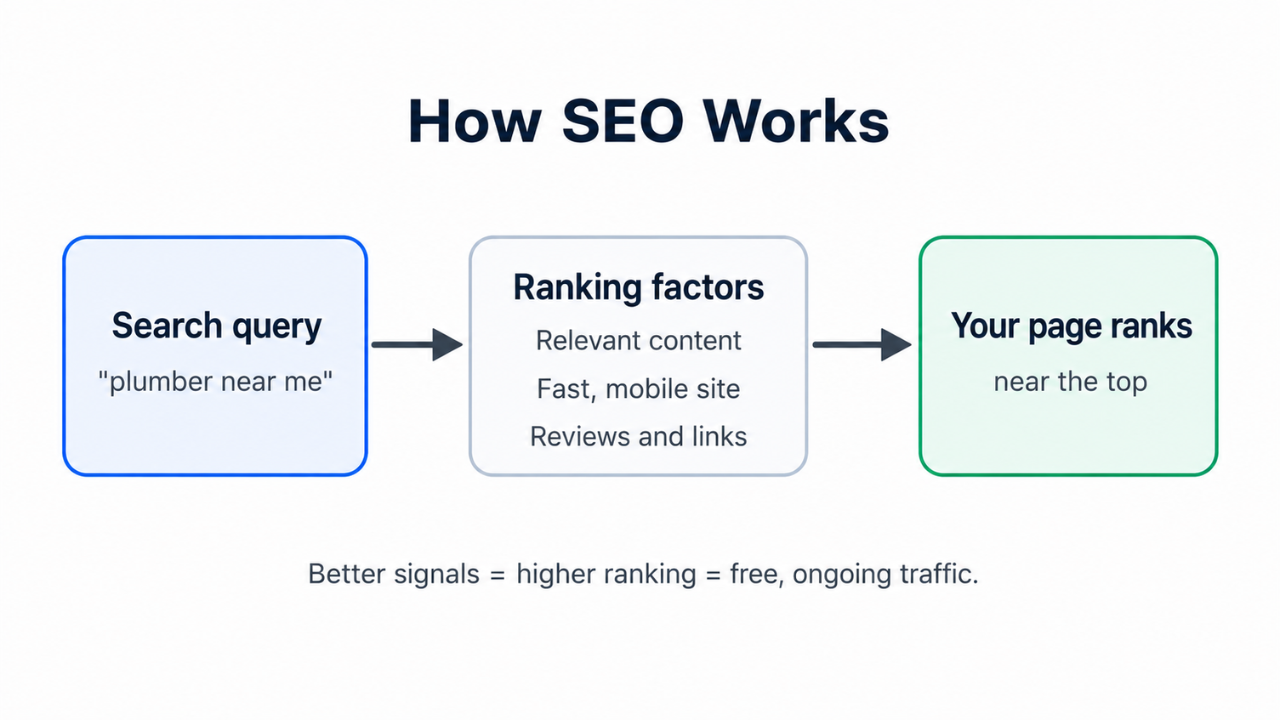
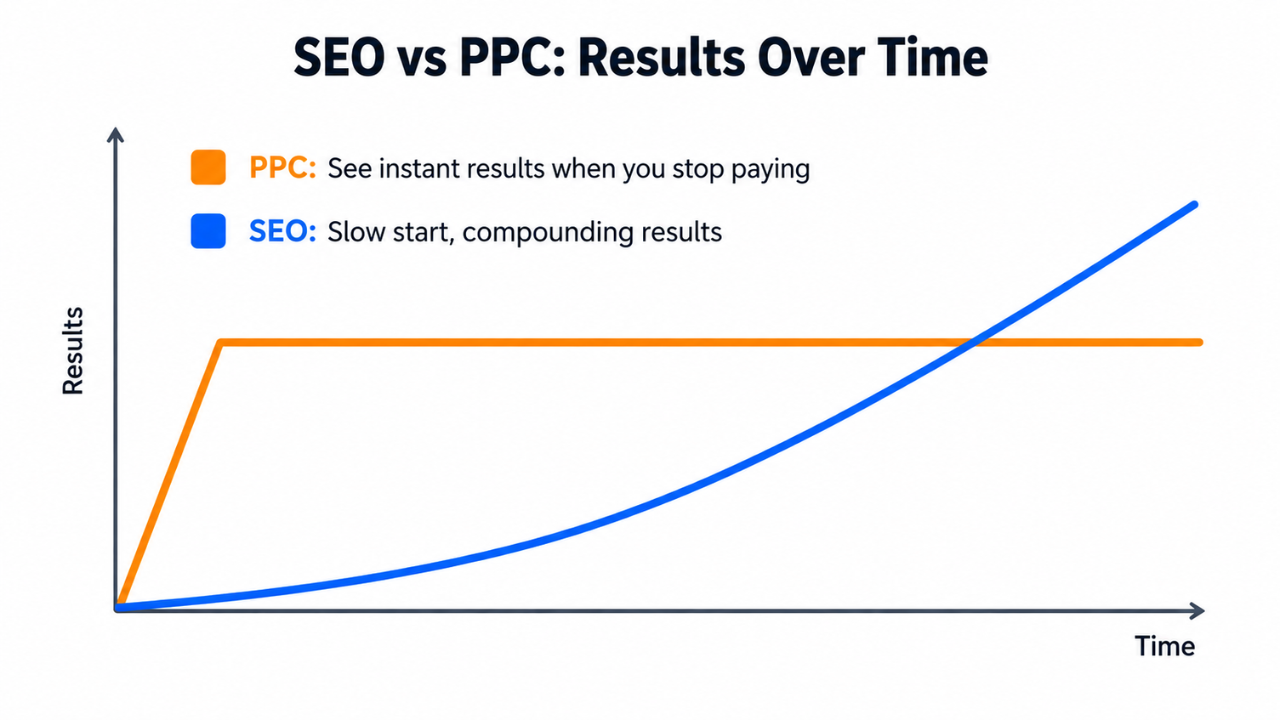
    SEO makes your website show up higher in search results without paying for each click. It has two parts. General SEO helps your pages rank for what you sell. Local SEO helps you appear in map results and “near me” searches through your Google Business Profile, reviews, and location pages. SEO is slow but compounding: it can take months, but once you rank, the traffic keeps coming for free. You can see our SEO results across ecommerce and local businesses.

    how-seo-works-search-ranking-process.png

    Pay-Per-Click Advertising (PPC)

    PPC is paid advertising where you pay only when someone clicks. Google Ads and Facebook or Instagram Ads are the most common. The advantage is speed: you can appear at the top today, not in three months. But PPC is rented visibility. The leads stop the moment you stop paying, while SEO is visibility you own over time. Many agencies run both.

    Website Design and Optimization

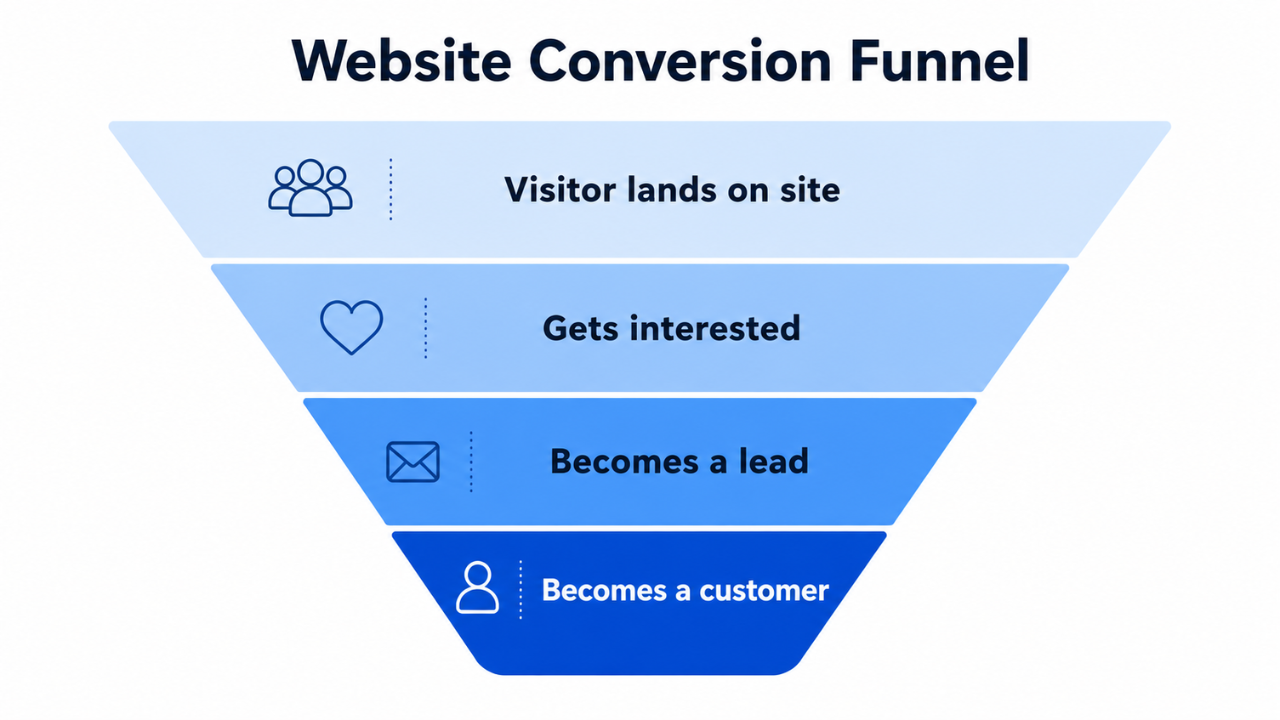
    Your website is your digital storefront. An agency makes sure it loads fast, looks good on a phone, and guides visitors toward one clear action like “Call Now” or “Book Online.” This step is underrated. You can drive all the traffic in the world to a confusing, slow site and still get few customers.

    Website-coversion-funnel.jpg

    Content Marketing

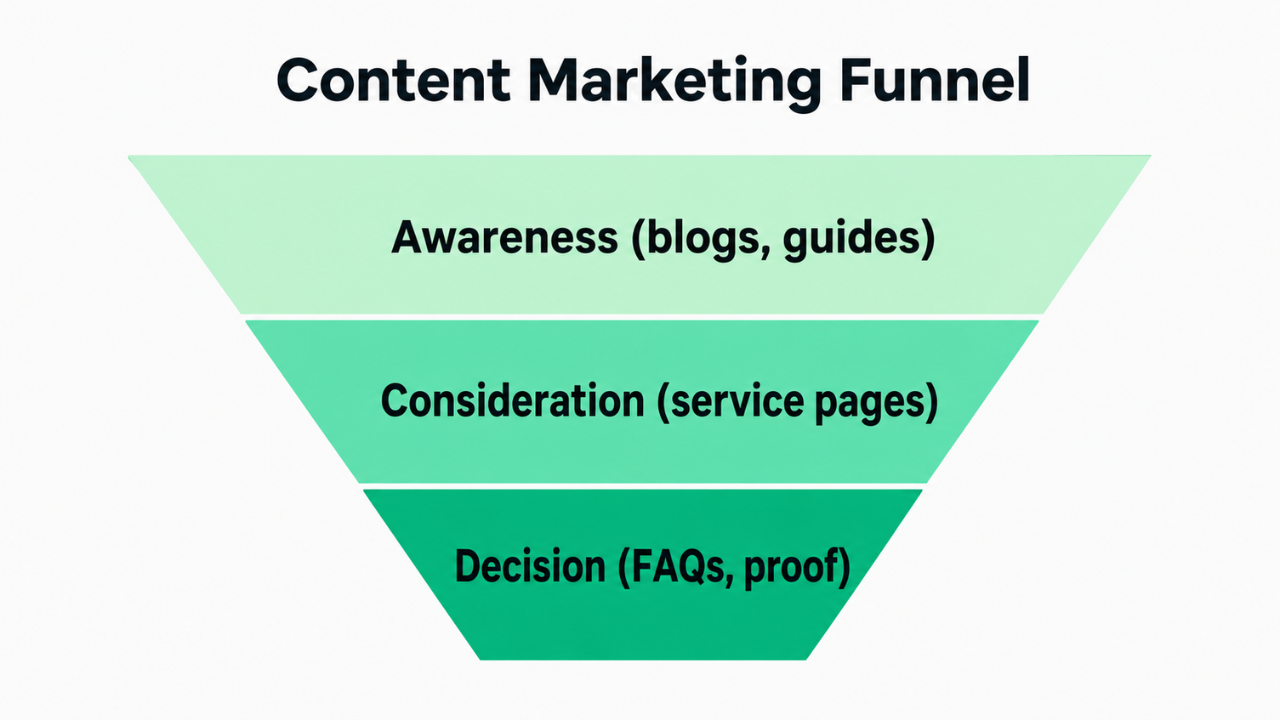
    Content marketing means creating useful blog posts, service pages, guides, and FAQs that answer customer questions. It helps you rank in search and builds trust. In 2026 it matters more than ever, because AI tools like ChatGPT and Google’s AI Overviews pull answers from clear, helpful content, so good content can get you recommended inside AI answers, not just the blue links.

    content-marketing-funnel-stages.png

    Social Media Marketing

    Social media marketing uses platforms like Instagram, Facebook, TikTok, and LinkedIn to build awareness, trust, and engagement. For most small businesses it is a trust and reminder channel, not a direct sales machine. A restaurant’s photos make people hungry; a contractor’s before-and-after posts prove quality. It supports the sale rather than always closing it.

    Email Marketing

    Email marketing keeps you in touch with people who already know you, driving repeat business and referrals through promotions, updates, and reminders. It is one of the highest-return channels: studies regularly find email returns around $36 for every $1 spent, because you are talking to people who already chose you once.

    Analytics and Reporting

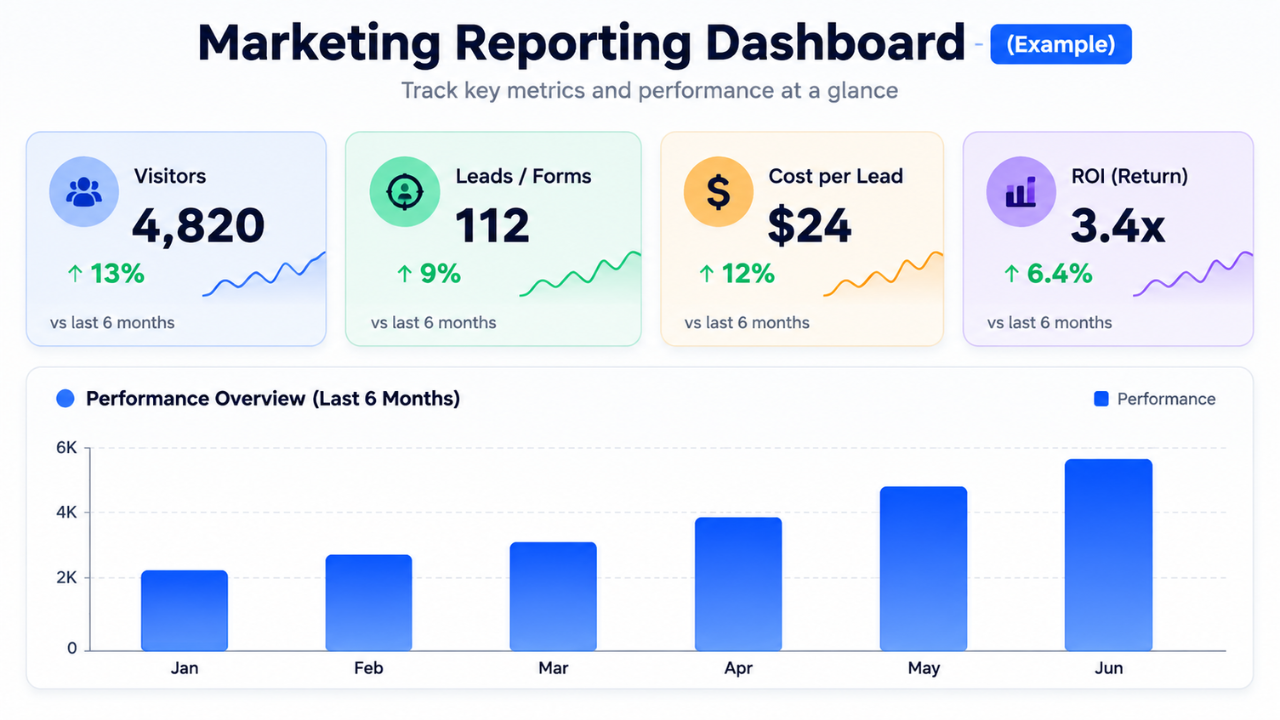
    Analytics tells you what is actually working. An agency measures traffic, leads, calls, sales, and return on investment (ROI), then uses that data to decide where to spend next. Without measurement, marketing is guessing. The real value of an agency is knowing which work to do more of.

    marketing-reporting-dashboard-example.png

    What Does Working With a Digital Marketing Agency Look Like?

    It follows a repeating cycle, not a one-time project.

    Step 1: Business Discovery. The agency learns your business, customers, goals, and competitors.

    Step 2: Marketing Strategy. It builds a plan: which services and channels, and what to do first.

    Step 3: Campaign Execution. It builds the website, runs ads, writes content, and optimizes SEO.

    Step 4: Monitoring and Optimization. It tracks results and adjusts what underperforms.

    Step 5: Reporting. It shows you the numbers and what they mean in plain language.

    The five-step cycle most agencies follow.

    Can Small Businesses Do Digital Marketing Themselves?

    Yes, and many start that way. The question is not whether you can, but whether it is the best use of your time.

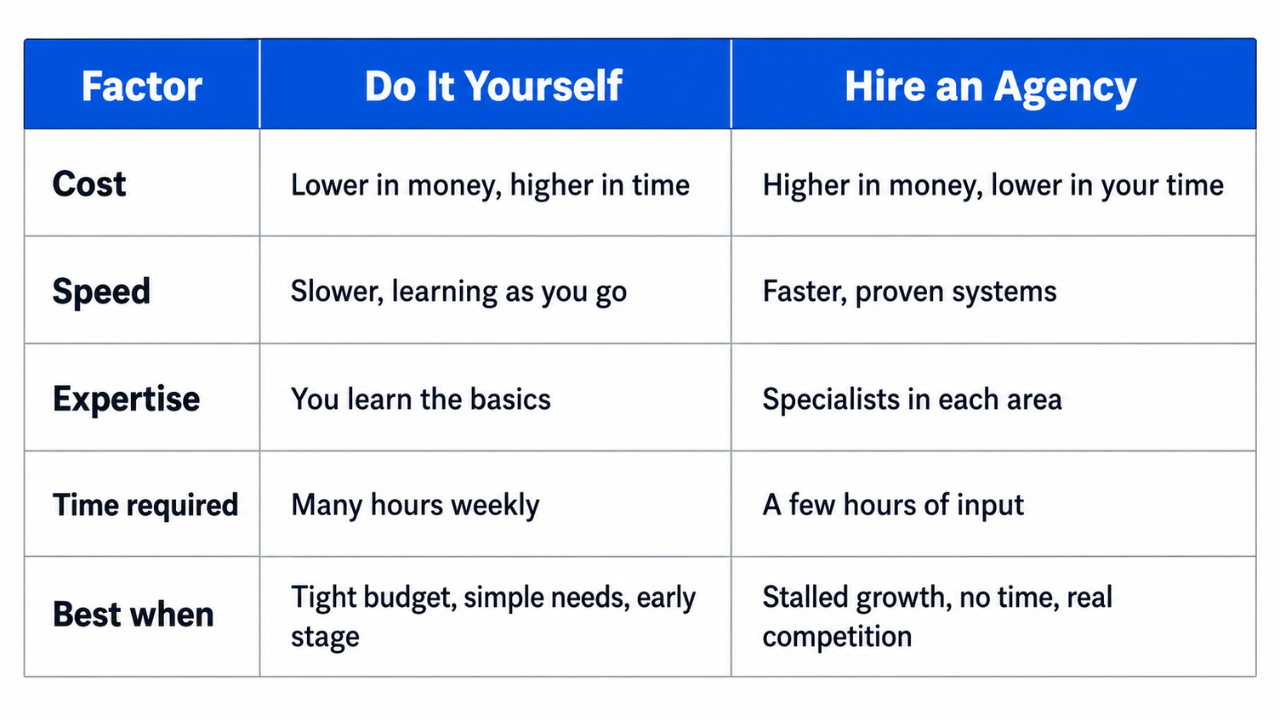
    DIY digital marketing vs hiring an agency.

    DIY makes sense when budgets are tight, needs are simple, and you have time to learn. Hiring help makes sense when marketing eats hours you should spend running the business, or results have stalled. The honest middle ground: most owners can handle a Google Business Profile and basic social posts, and bring in help for the technical work like SEO and ads.

    What Results Can Small Businesses Expect?

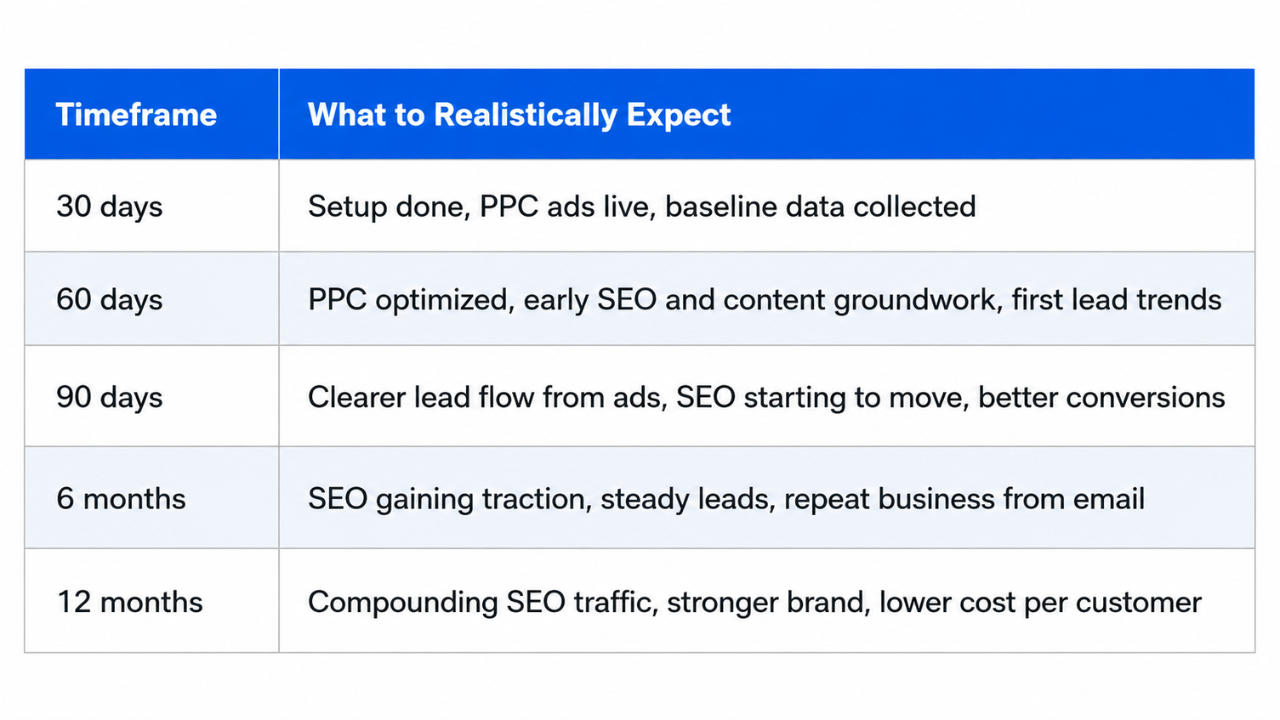
    Realistic results depend on the channel. Paid ads work fast. SEO and content take months but last. Anyone promising instant rankings is selling, not explaining.

    Digital marketing results timeline from 30 days to 12 months.

    By channel: PPC can produce leads in days. SEO usually takes three to six months to show real movement and longer to mature. Content builds slowly then compounds. Social media is a long game of trust. Most businesses see fast early wins from ads while cheaper organic channels build underneath.

    Common Misconceptions About Digital Marketing Agencies

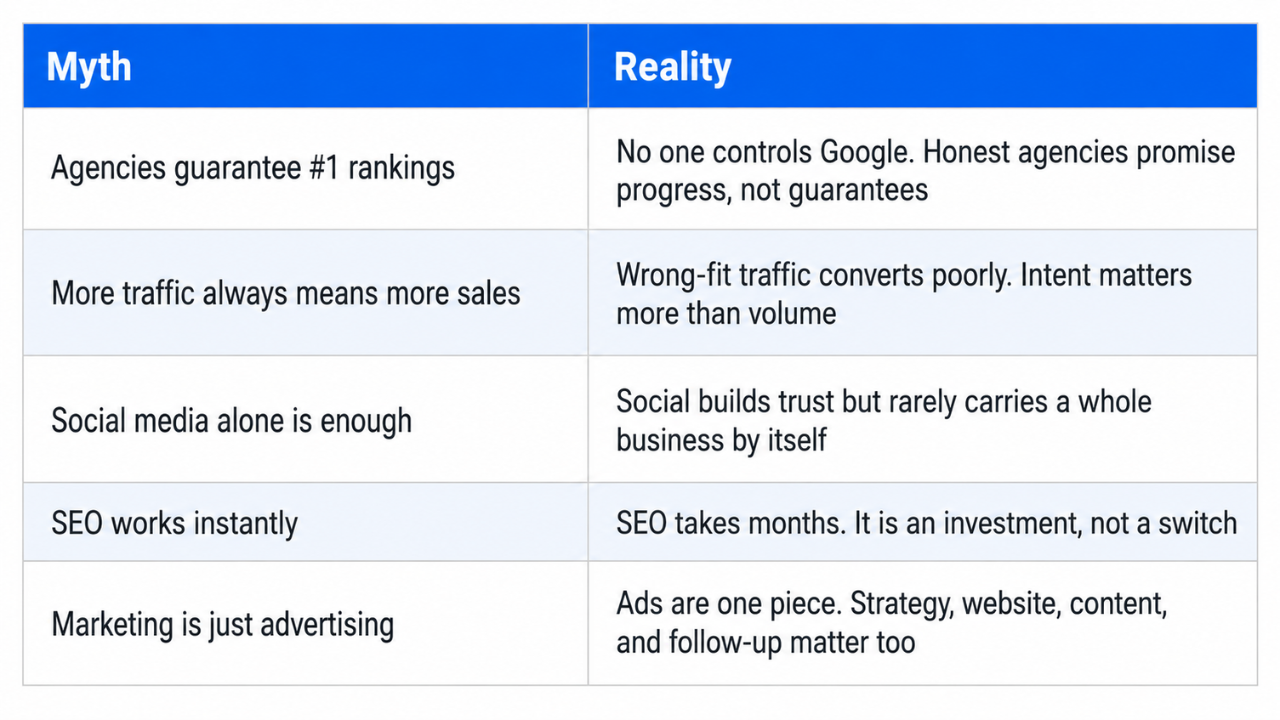
    Common Misconceptions About Digital Marketing Agencies jpg

    If an agency guarantees the top spot on Google, treat it as a warning sign, not a selling point.

    When Should a Small Business Consider Hiring a Digital Marketing Agency?

    Consider hiring when marketing no longer fits into the margins of your day. The clearest signals are limited expertise, no time, stalled growth, rising competition, or plans to expand.

    If you are growing fine and have time to learn, DIY is reasonable. But if leads have flatlined or competitors are pulling ahead, the opportunity cost adds up fast. Every month you stay invisible is customers quietly choosing someone else. There is no shame in either choice; the point is to decide on purpose, not by default.

    Key Questions to Ask Before Hiring an Agency

    • Experience: Have you worked with businesses like mine in my industry?
    • Case studies: Can you show real results from past clients?
    • Reporting: How and how often will you report, and in what terms?
    • Communication: Who is my contact, and how do we stay in touch?
    • Strategy: What would you focus on first for my business, and why?
    • Pricing transparency: What exactly is included, and are there extra costs?


    A trustworthy agency answers these clearly. Vague answers and pressure to sign fast are red flags.

    Final Thoughts

    A digital marketing agency helps your business become more visible online, attract the right customers, and grow steadily over time. It handles getting found, building trust, and turning interest into sales, then measures it so the budget goes where it works.

    You do not need every service, and you do not need to hire anyone tomorrow. What you need is a clear picture of where customers find businesses like yours, and an honest look at whether you have the time and skills to compete there. Whether you do it yourself or hire help, the goal is the same: be easy to find, easy to trust, and easy to buy from.

    Frequently Asked Questions

    Because most customers research online before buying, and competing there takes skills and time most owners do not have. An agency provides the expertise and does the ongoing work.

    It puts your business in front of people actively searching for what you offer, makes you look trustworthy, and turns that attention into calls, bookings, and sales you can measure.

    Planning strategy, executing campaigns, improving your website, creating content, managing ads and social, tracking performance, and reporting results in plain language.

    To connect a business with the right customers online and guide them from first discovery to purchase, efficiently and measurably.

    Marketing is any promotion of a business. Digital marketing is the part that happens online, where results can be tracked precisely.

    Usually through monthly retainers, project fees, or a percentage of ad spend. The ad budget you pay to Google or Meta is separate from the agency’s fee.

    A clear strategy, regular work, honest reporting, and steady progress, not overnight miracles or guaranteed rankings.

    When you lack the time or skills, your growth has stalled, competition is rising, or you are expanding and need to scale visibility quickly.

    Yes, especially basics like a Google Business Profile, reviews, and social posts. The harder, time-heavy work like SEO and paid ads is where most owners benefit from help.

    For most, yes. Channels like SEO and email deliver strong long-term returns, and being findable online is now essential rather than optional.

    A mix usually wins: local SEO and a strong website as the foundation, paid ads for fast leads, and content plus email to build trust and repeat business.

    Paid ads can work in days. SEO and content usually take three to six months to gain traction and longer to mature. Plan for a marathon with some early sprints.

    It varies by service and market. Many small businesses invest a percentage of revenue in marketing; the U.S. Small Business Administration suggests around 7-8% for businesses under $5 million. Ask for clear, itemized pricing.

    Know your goals and budget, ask for case studies and clear reporting, understand exactly what is included, and watch for guarantees that sound too good to be true.

  • The GEO Checklist: 100+ Steps, Ranked by What Actually Works

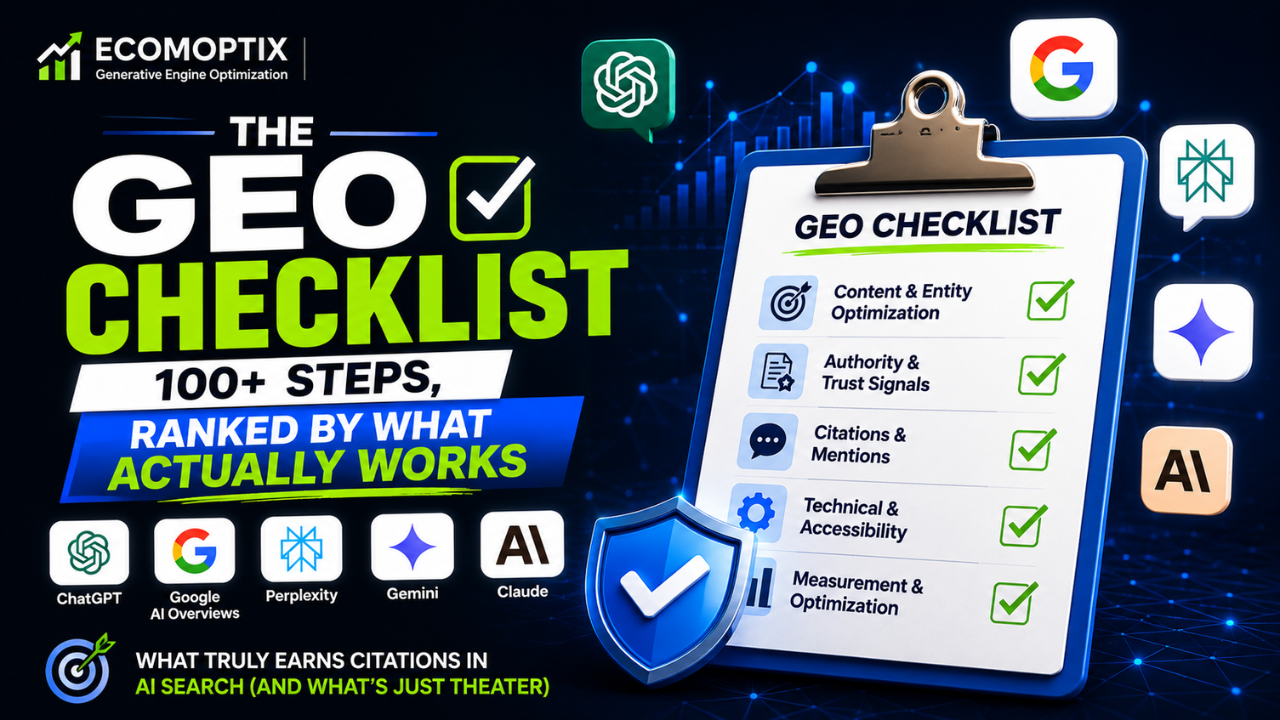
    The GEO Checklist: 100+ Steps, Ranked by What Actually Works

    Geo Checklist

    What truly earns citations in ChatGPT, Google AI Overviews, Perplexity, Gemini, and Claude, and what is just theater you can stop paying for.

    You can rank on page one of Google and still be invisible the moment a buyer asks ChatGPT the same question. The link they would have clicked never gets shown. The answer gets written without you in it. And the checklist you have been working through to fix this is, for the most part, your old SEO checklist with the letters G, E, and O stapled to the front.

    That is the quiet problem with the entire category. Search GEO checklist right now and you get a wall of near-identical 100-point lists, many of them written by AI, most of them telling you to do the exact same things you were already doing in 2019. Add schema. Improve Core Web Vitals. Fix your canonicals. Useful housekeeping. Almost none of it is why an answer engine decides to repeat your sentence instead of a competitor’s.

    You do not optimize to rank inside an AI answer. You earn the right to be repeated.

    This is the checklist that tells you the truth. Every item is here, more than 100 of them, but they are ranked by leverage, not listed as equals. You will see which moves the research actually supports, which are basic hygiene, and which are the theater that GEO vendors love to sell because they are easy to deliver and impossible to disprove. Across the audits we run at EcomOptix, the gap between sites that get cited and sites that do not almost never comes down to the technical busywork. It comes down to four things, and most checklists barely mention three of them.

    Why The Old Playbook Stopped Being Enough

    AI search is no longer a side channel. It is becoming the layer between your customer and your website, and it answers most questions without sending a click.

    The behavioral shift is the part you cannot argue with. Zero-click searches climbed sharply after Google rolled out AI Overviews, which now appear on roughly a quarter of all Google searches according to Conductor’s 2026 query analysis. Gartner has projected traditional search volume will fall about 25 percent by 2026 as people move questions to chatbots and assistants. The average ChatGPT prompt runs around 23 words; the average Google search is three or four. Your content was built to match a three-word keyword. The question being asked now is a full sentence.

    Here is the part that should reframe your whole strategy. The overlap between the pages that rank in Google’s top results and the pages that AI engines actually cite has collapsed from around 70 percent to under 20 percent, per industry analysis summarized across the GEO research community. Translation: ranking and getting cited are now two different games with two different winners. Doing well at one no longer guarantees the other.

    Ranking and getting cited used to be the same job. They are not anymore.

    And before anyone tells you AI traffic is too small to matter, look at who is converting. Ahrefs found AI search visitors made up about 0.5 percent of traffic but generated roughly 12 percent of signups, a conversion ratio many times higher than organic. Vercel has reported around 10 percent of new signups coming from ChatGPT referrals. The volume is small. The intent is not. Someone arriving from an AI answer has already been pre-sold by a machine they trust. That is the highest-intent visitor on the internet right now.

    Most teams react to this by panic-installing schema and an llms.txt file, then wondering why nothing changes. That is the wrong end of the problem, and we will get to exactly why.

    What Is GEO (Generative Engine Optimization)?

    GEO is the practice of structuring your content, data, and brand presence so AI engines cite you as a source inside their generated answers. Where SEO earns a ranked link, GEO earns a mention in the answer itself.

    The term comes from a peer-reviewed study, not a marketing agency. Researchers from Princeton, Georgia Tech, IIT Delhi and the Allen Institute formalized it in the paper GEO: Generative Engine Optimization presented at ACM KDD 2024. They tested content strategies across thousands of queries and found that specific, evidence-led changes, adding statistics, quotations and cited sources, measurably lifted how often and how prominently content appeared in AI answers, with citation-related methods showing some of the largest gains. That single finding is the backbone of everything worth doing in GEO. Most checklists never mention it.

    GEO vs SEO vs AEO vs Content Marketing

    These terms get used interchangeably and they should not be. The distinctions decide where you spend your effort.

    Discipline Goal Wins when Primary lever
    SEO Rank a link in search results Your page is in the top 10 blue links Relevance, authority, technical health
    AEO Win the direct answer box / featured snippet Your passage is pulled as the one-line answer Answer-first formatting, FAQ and HowTo schema
    GEO Get cited inside a synthesized AI answer An AI names you as a source in its response Entity recognition, evidence density, third-party trust
    Content marketing Build audience and demand over time People read, share and remember you Story, value, distribution

    AEO and GEO overlap heavily in tactics; the difference is scope. AEO targets the snippet for one question. GEO targets being pulled into any synthesized answer, including long comparisons that draw on many sources at once. The mistake is treating GEO as a rebranded SEO. It is not. It is closer to a blend of structured content, PR and entity building.

    Most businesses do not fail at GEO because of technical gaps. They fail because no machine recognizes them as an entity worth citing.

    How AI Engines Actually Choose Their Sources

    AI engines answer a question by breaking it into smaller sub-questions, retrieving documents for each, then synthesizing a single answer and naming a few sources. You get cited when your content is the cleanest, most credible, most quotable match for one of those sub-questions.

    This is the mechanic almost no checklist explains, and it changes how you write. When someone asks a complex question, the engine does not run one search. It runs several, one for each fragment of the question. This is called query fan-out. Ask an AI for “the best email tool for a small ecommerce store under 10,000 subscribers” and it may quietly search for email platform comparisons, ecommerce email features, and small-business pricing separately, then stitch the answer together.

    So the unit of optimization is not the page. It is the passage. Each section of your content is evaluated on its own as a potential answer to one sub-question. A page that is brilliant as a whole but has no self-contained, quotable sections will lose to a page that answers each fragment cleanly in its own block.

    The Princeton study quantified the position effect too: a large share of citations come from the earliest part of a text. Lead with the answer in every section, or watch the engine pull a competitor who did.

    The page is no longer the unit. The passage is.

    What Each Engine Tends To Favor

    They are not identical. Optimizing blind to the differences wastes effort.

    Engine How it behaves What it rewards
    ChatGPT (Search) Synthesizes from retrieved web results; leans heavily on encyclopedic and high-authority sources Wikipedia and Wikidata presence, clear entity identity, structured definitions
    Google AI Overviews Built on Google’s index; appears on ~25% of searches Short direct answers, FAQ/HowTo schema, freshness, existing topical authority
    Perplexity Real-time search with numbered citations on almost every claim Authoritative, recent, well-structured sources; easy to track which page was cited
    Gemini Draws on Google’s ecosystem and knowledge graph Entity data, structured content, strong existing search presence
    Claude Synthesizes longer, coherent passages; values explanation and evidence Clear reasoning, well-supported claims, coherent self-contained sections

    Notice the pattern across all five: clear structure, evidence, and recognized identity. Nobody on that list is rewarding your llms.txt file. Hold that thought.

    The CITE Framework: The Four Levers That Actually Earn Citations

    Everything in this checklist maps to four levers. We call it the CITE Framework: Credible Entity, Ingestible Structure, Third-Party Trust, and Evidence Density. Get these four right and the technical details mostly take care of themselves. Obsess over the technical details and ignore these four, and you stay invisible.

    After enough audits, you stop seeing 100 separate ranking factors and start seeing four buckets. Most published checklists pour 70 percent of their items into one bucket, structure, because those items are easy to write, easy to deliver, and easy to charge for. The other three buckets are harder, slower, and far more decisive. That imbalance is the single biggest reason GEO checklists feel busy and produce nothing.

    Lever What it means Why it decides citations
    C — Credible Entity Be a thing the model recognizes Engines cite known entities. If your brand, founder and products are not understood as distinct entities, you are a stranger the model has no reason to name.
    I — Ingestible Structure Be accessible and easy to extract If AI crawlers cannot reach you, or your content has no self-contained, answer-first passages, there is nothing clean to lift. This is the hygiene layer.
    T — Third-Party Trust & Links Be referenced by others The strongest signal is not on your own site. Studies repeatedly find the large majority of AI citations trace back to earned media and third-party sources, not brand-owned pages.
    E — Evidence Density Be worth quoting The Princeton study’s core finding: original statistics, quotations and citations are what lift visibility. Opinion without evidence rarely gets repeated.

    Everyone optimizes structure. Almost no one fixes entity recognition and third-party trust. That is where the citations actually live.

    The checklist below is organized by these four levers, plus the vertical and operational sections you need (local, ecommerce, monitoring). Each item carries a leverage tag so you know where to spend first.

    The Honest Scoring System

    Score each item 0, 1, or 2, but weight by leverage. A perfect technical score with zero entity or trust work is not a 90 percent GEO setup. It is a well-built site nobody cites.

    Plenty of checklists hand you a tidy 0 to 200 score that treats all 100 items as equal. That number looks rigorous and means almost nothing, because there is no evidence that doing 100 equally-weighted things correlates with AI visibility. Equal weighting is the false-precision trap. We use a weighted version instead.

    Score per item Meaning How to judge
    0 Not implemented The item is absent or broken
    1 Partially implemented Started, inconsistent, or incomplete
    2 Fully implemented Done well and verified live

    Then apply leverage weights when you total it up:

    • High leverage (x3): Entity, evidence and third-party trust items. These move citations the most.
    • Medium leverage (x2): Answer-first structure, schema, freshness, AI crawler access.
    • Low leverage (x1): General technical hygiene that helps the whole site but rarely decides a citation on its own.

    Run the raw 0 to 2 score for a quick picture. Apply the weights when you decide what to fix first. The weighting is the strategy. The raw number is just inventory.

    Section 1: Ingestible Structure — Technical Access (Lever I)

    Technical GEO is table stakes, not strategy. If AI crawlers cannot reach and parse you, nothing else matters; but doing it perfectly does not make you citable on its own. Get it to ‘solid’ and move on.

    This is the section every other checklist inflates. We are keeping it tight on purpose. Most of this is standard technical SEO, which means if you have a competent SEO foundation, you are already most of the way there.

    Crawl, index and foundation (Low leverage hygiene)

    ☐  Crawlability: confirm key pages are reachable and not buried behind JavaScript that bots cannot render

    ☐  Indexability: no accidental noindex on pages you want cited

    ☐  XML sitemap: present, current, submitted in Search Console

    ☐  Robots.txt: allows your important content and the AI crawlers (covered below)

    ☐  Canonical tags: one clear canonical per page, no conflicting signals

    ☐  HTTPS: secure, valid certificate, no mixed content

    ☐  Mobile friendliness: responsive, readable, tap targets sized correctly

    ☐  Core Web Vitals: passing or close; slow pages get crawled less and trusted less

    ☐  Site speed: server response under control, images compressed

    Structured data / schema (Medium leverage)

    Schema does not guarantee citation, but it makes your content machine-legible, which helps engines understand what each entity and passage is. FAQ and HowTo schema in particular feed Google AI Overviews.

    ☐  Organization schema (ties your brand together as an entity, high value, see Section 3)

    ☐  Article schema with author and date

    ☐  FAQPage schema on genuine FAQ blocks

    ☐  HowTo schema on step-by-step content

    ☐  Product schema on ecommerce pages

    ☐  LocalBusiness schema for location-based businesses

    ☐  Review and AggregateRating schema where reviews are real and policy-compliant

    ☐  Breadcrumb schema for site structure clarity

    ☐  Author / Person schema linking to verifiable author identity

    AI crawler access (Medium leverage, often broken)

    This one matters and is frequently misconfigured. If you block the bots that feed the answer engines, you have opted out of GEO entirely. Across audits we see sites that blocked GPTBot during a privacy panic and never turned it back on, then wonder why ChatGPT never cites them. Check your robots.txt for each of these and decide deliberately:

    ☐  GPTBot (OpenAI / ChatGPT training and search)

    ☐  OAI-SearchBot (OpenAI’s search crawler, separate from GPTBot)

    ☐  ClaudeBot (Anthropic / Claude)

    ☐  PerplexityBot (Perplexity)

    ☐  Google-Extended (controls use of your content for Google’s AI, separate from Googlebot)

    ☐  CCBot (Common Crawl, an input to many models)

    ☐  Bingbot (feeds Copilot and other Microsoft AI surfaces)

    The decision is strategic, not automatic. Allowing them is the price of admission for visibility. If you have proprietary content you do not want used for training, that is a legitimate reason to block, but understand you are trading citation potential for protection.

    The llms.txt question (Be honest: very low leverage today)

    As of 2026, no major AI provider has confirmed it uses llms.txt to retrieve, rank or cite content. Independent studies found no correlation with AI visibility, and AI crawlers overwhelmingly skip the file and read your HTML directly. Ship it if you like; do not expect citations from it.

    This is the cleanest example of GEO theater in the wild. The pitch is seductive: drop a tidy Markdown file at your root, tell the AIs how to read your site, win visibility. The evidence does not support it. Semrush’s controlled research found no statistical correlation between implementing llms.txt and better AI performance. Google’s John Mueller has said major crawlers do not prioritize these files over standard HTML. Log analyses of hundreds of millions of bot events show AI crawlers fetching the file rarely, if at all.

    Here is the nuance worth keeping. llms.txt is genuinely useful as infrastructure for AI agents and coding tools, things like Cursor and Claude Code, that need a clean map of a site. That is a real and growing use case. It is just not a citation or ranking lever for search today. So:

    • What actually works: ship a short, curated llms.txt if it is cheap, purely as future-proofing and for agent tooling.
    • What does not: generating an llms-full.txt copy of every page, which can create duplicate-content problems, or paying anyone who promises citation lift from it. That is overselling.

    ☐  llms.txt: optional, short, curated; treat as infrastructure not visibility

    ☐  llms-full.txt: skip unless you understand the duplicate-content risk and have a specific agent use case

    Section 2: Ingestible Structure — Content Format (Lever I)

    Content GEO is about making every section independently quotable. Lead with the answer, keep passages self-contained, and write in the language people actually ask in. This is the highest-leverage part of the structure lever.

    Remember the fan-out mechanic. Each section is judged alone. So the way you format is not cosmetic; it determines whether there is anything cleanly extractable on your page. This is where good GEO writing diverges hardest from old SEO writing, which buried the answer under 300 words of throat-clearing to hit a word count.

    ☐  Answer-first sections: open every H2 and H3 with a complete, direct answer in the first one or two sentences

    ☐  Self-contained passages: each section makes sense lifted out on its own, no “as mentioned above”

    ☐  Question-style subheadings: phrase headings the way users ask (“How much does X cost?”) to match fan-out sub-queries

    ☐  Short paragraphs: two to three sentences; dense blocks are harder to extract

    ☐  Definition blocks: give a crisp one-sentence definition for key terms and concepts

    ☐  Summary or TL;DR block near the top for long pieces

    ☐  Genuine FAQ sections answering real questions in two to four sentences each

    ☐  Comparison tables for any “X vs Y” or “best tool for” topic

    ☐  Step-by-step instructions for processes, numbered and discrete

    ☐  Natural term variation: synonyms and related phrasing beat repeating one keyword

    ☐  Entity-rich language: name the people, products, places and concepts explicitly

    ☐  Cover subtopics on one page: broad, deep coverage gives engines more surface to cite

    Freshness (Medium leverage)

    Recency is a real signal in AI answers. Industry analysis from Seer Interactive found the large majority of AI Overview citations came from content published or updated within the last couple of years, and recently updated pages appeared far more often. Stale content quietly drops out of answers.

    ☐  Visible, accurate “last updated” dates on evergreen content

    ☐  A real update cadence: refresh stats, examples and claims, not just the date stamp

    ☐  Remove or merge outdated pages that contradict your current content

    The standard advice is “write comprehensive content.” In practice, comprehensive but unstructured loses to focused and extractable every time.

    Section 3: Credible Entity (Lever C) — High Leverage

    AI engines cite entities they recognize. If a model does not understand your brand, founder and products as distinct, well-connected entities, it has no confident reason to name you. Entity building is slow, unglamorous, and one of the two highest-leverage things in GEO.

    This is the section most checklists wave at and move past, because you cannot deliver it in a sprint. ChatGPT leans heavily on encyclopedic sources; Wikipedia and Wikidata sit near the center of how models understand the world. Being a recognized entity is what turns you from “a website” into “a known answer.”

    ☐  Organization schema with sameAs links to your official profiles (LinkedIn, Crunchbase, social, Wikipedia if present)

    ☐  Consistent brand name, spelling and description everywhere it appears online

    ☐  Founder and key-people entities: detailed, consistent bios; Person schema; LinkedIn presence

    ☐  Product and service entities: each named, described and given its own canonical page

    ☐  Wikidata entry for your organization if you qualify (more attainable than Wikipedia)

    ☐  Wikipedia presence only if genuinely notable; never fake notability, it backfires

    ☐  Knowledge Graph signals: claim and complete your Google Knowledge Panel where one exists

    ☐  Consistent NAP (name, address, phone) across every directory and citation

    ☐  About and author pages that establish who you are and why you are credible

    ☐  Entity associations: be mentioned alongside the other recognized names in your category

    ☐  Crunchbase, industry databases and reputable directories with consistent details

    The mechanism is association. Models build a web of relationships between entities. The more consistently your brand appears connected to your category, your people and your products across trusted sources, the more confidently an engine can place you in an answer. Inconsistent details, three spellings of your company name, a different address on every directory, actively weaken that web.

    The problem is not that AI does not know your content. It is that AI does not know you exist as an entity worth trusting.

    Section 4: Evidence Density (Lever E) — High Leverage

    Original data, statistics, quotations and citations are what the foundational GEO research found actually lifts visibility. Content that asserts gets skimmed. Content that proves gets quoted. This is the most controllable high-leverage lever you have.

    The Princeton KDD 2024 study is unambiguous here: adding statistics, quotations and cited sources produced the measurable gains, and citation-related methods were among the strongest. This is the rare GEO lever with peer-reviewed backing rather than vendor folklore. It is also the one you can act on this week without waiting for a knowledge panel to form.

    ☐  Original data or research: even a small survey or internal dataset you can publish

    ☐  Specific statistics with named sources and dates, not vague “studies show”

    ☐  Direct quotations from named experts or practitioners

    ☐  Citations to authoritative external sources within your content

    ☐  A named, ownable framework or methodology (this is one; name yours)

    ☐  Proprietary benchmarks or “state of” reports for your niche

    ☐  Concrete examples and mini case studies with real numbers and outcomes

    ☐  Visual assets: original charts, diagrams and data visualizations

    ☐  Referenceable definitions and concepts others can cite back to you

    ☐  Clear attribution so your data stays linked to your brand when repeated

    There is a strategic loop here most people miss. When you publish original data, other sites cite it. Those citations build your third-party trust (Lever T) and reinforce your entity (Lever C). Evidence density is the cheapest way to start all three flywheels at once. A single genuinely useful statistic, widely repeated, can do more for your AI visibility than a year of generic blog posts.

    Opinion is cheap and forgettable. A number with your name on it gets repeated for years.

    Section 5: Third-Party Trust & Links (Lever T) — High Leverage

    The strongest citation signal usually does not live on your own website. Repeated studies find the large majority of AI citations trace back to earned media and third-party sources. You cannot fully checklist your way to this; it is PR and reputation work, which is exactly why most GEO checklists avoid it.

    This is the uncomfortable truth the structure-heavy checklists dodge. If 80-plus percent of citations come from places you do not own, then most of your GEO leverage is off-site. ChatGPT’s heavy reliance on Wikipedia, the rise of Reddit and YouTube as cited sources, the dominance of earned media, all of it points the same way: get talked about by trusted third parties.

    Links and mentions that matter for AI

    ☐  Relevant, authoritative backlinks from sites in or adjacent to your niche

    ☐  Digital PR: earn coverage in publications your audience and the models trust

    ☐  Unlinked brand mentions: AI weighs mentions, not just hyperlinks, so being named matters

    ☐  Expert contributions: bylines, podcast appearances, quotes in journalist roundups

    ☐  Research-driven link acquisition: publish data, let others cite it (ties to Lever E)

    ☐  Presence on high-citation platforms: relevant Reddit threads, YouTube, industry forums, Wikipedia where appropriate

    ☐  Reviews and third-party validation on platforms the models read (G2, Trustpilot, industry sites)

    ☐  Entity-reinforcement links: profiles and directories that confirm who you are

    ☐  Consistent presence in “best of” and comparison content others publish about your category

    What actually works here: pick the two or three sources your category’s AI answers keep citing, find them by checking what Perplexity and ChatGPT name when you ask your money questions, and go earn a place in those specific sources. What does not work: buying generic links at volume. AI citation is about trusted, relevant mentions, not link count. A single mention in a source the model already trusts outperforms fifty directory links.

    If you are not in the sources the AI already trusts, you are not in the answer. Go to where the citations come from.

    Section 6: E-E-A-T For GEO

    E-E-A-T (Experience, Expertise, Authoritativeness, Trustworthiness) is not a GEO lever on its own; it is how the C and T levers express themselves. Strong E-E-A-T signals make your entity more trustworthy and your content more citable.

    Experience

    ☐  First-hand signals: “we tested,” “in the audits we run,” real screenshots and results

    ☐  Original photos, data and examples from actual work, not stock

    Expertise

    ☐  Named authors with verifiable credentials and Person schema

    ☐  Author bios linking to their broader body of work and profiles

    ☐  Depth that demonstrates genuine command of the topic

    Authoritativeness

    ☐  Third-party recognition: citations, awards, coverage (Lever T)

    ☐  A recognized brand entity across the web (Lever C)

    ☐  Topical authority: deep, interlinked coverage of your core subject

    Trustworthiness

    ☐  Clear contact, about, privacy and editorial information

    ☐  Accurate, sourced, regularly updated content

    ☐  Transparent authorship and data provenance

    Google’s helpful-content systems now actively devalue content that reads as machine-generated regardless of accuracy. The defense is the same as good GEO: real experience signals, named expertise, and evidence. The thing that protects you from AI-content penalties is the same thing that earns AI citations. That is not a coincidence.

    Section 7: Local GEO Checklist

    AI answers local queries by drawing on listings, reviews, citations and geo-specific pages, then applying the user’s location. Inconsistent local data is the fastest way to get left out of “near me” answers.

    When someone asks an assistant for a contractor, clinic or restaurant in their area, the engine builds its picture of local options from Google Business Profile data, review platforms, local citations and your location pages. Gaps and inconsistencies there translate directly into missed citations.

    ☐  Google Business Profile: claimed, complete, accurate categories and hours

    ☐  Reviews: steady volume, genuine, responded to; quantity and recency both count

    ☐  Local citations: consistent NAP across directories and local platforms

    ☐  Service-area pages: distinct, genuinely useful pages per area you serve

    ☐  Location pages: real local detail, not template spam with the town name swapped

    ☐  LocalBusiness schema with geo coordinates and service area

    ☐  Review schema where reviews are real and compliant

    ☐  Location mentions in content that match how locals describe the area

    ☐  Local authority links: chambers, local press, community sites

    ☐  Consistency between your site, GBP and every third-party listing

    Across local audits we run, thin location pages and inconsistent NAP are the two most common reasons a business is invisible in AI local answers despite ranking fine in the map pack. The map pack tolerates inconsistency better than the answer engines do.

    Section 8: Ecommerce GEO Checklist

    Ecommerce brands struggle in AI search because product pages are thin on the evidence and comparison content that engines cite, and because so much buying-decision content lives on third-party review sites the AI trusts more than the store. Win by becoming the source of the comparison, not just the listing.

    When a shopper asks an AI “what’s the best X for Y,” the engine rarely cites a raw product page. It cites the buying guide, the comparison, the review roundup. Most stores publish none of that, so they get summarized out of their own category. The fix is to own the decision content, not just the transaction page.

    ☐  Product schema: complete, accurate, with price and availability

    ☐  Review schema and genuine customer reviews on product pages

    ☐  Comparison content: “X vs Y,” “best X for Z” guides you publish yourself

    ☐  Buying guides that answer real pre-purchase questions

    ☐  Product and category FAQ content addressing objections and use cases

    ☐  Google Merchant Center feed accurate and current

    ☐  Product entities: each key product understood as a distinct entity

    ☐  Category page optimization with genuine descriptive content, not just a grid

    ☐  Trust signals: returns, shipping, guarantees stated clearly

    ☐  User-generated content: Q&A, reviews, photos that add unique detail

    ☐  Presence in third-party reviews and roundups for your products (Lever T)

    Stores optimize the product page and ignore the buying guide. The buying guide is what the AI actually cites.

    Section 9: GEO Monitoring Checklist

    You cannot manage what you cannot see, and traditional rank trackers do not show AI citations. Track two things: whether you are mentioned, and whether you are cited as a source. Citation is the stronger signal.

    AI answers are probabilistic; they shift between sessions and users, so monitoring means running consistent prompts over time rather than checking a fixed rank. Distinguish mentions (your brand appears in an answer) from citations (the AI uses your page as a named source). Citations are the scoreboard.

    Dedicated AI visibility tools

    Several platforms now track brand mentions and citations across ChatGPT, Perplexity, Google AI Overviews, Gemini and Claude. Commonly used options include Profound, Peec AI, Otterly.AI, Scrunch AI and ZipTie, with Semrush adding AI visibility into its broader toolkit. Pick based on whether you need simple mention tracking, deeper citation-source analysis, or enterprise reporting.

    ☐  Multi-engine visibility tracking with consistent prompt sets run on a schedule

    ☐  Citation-source tracking: which exact URLs the engines pull from

    ☐  Share-of-voice vs competitors on your category’s key prompts

    Free and first-party methods

    ☐  Server log / Cloudflare analysis: confirm AI crawlers are actually fetching your pages

    ☐  GA4 referral tracking: isolate traffic from chatgpt.com, perplexity.ai and similar

    ☐  Google Search Console: watch for impression and click pattern shifts as AI Overviews expand

    ☐  Manual prompt testing: ask the engines your money questions and record who they cite

    ☐  Brand mention monitoring across the web for unlinked references

    Start free before you buy a tool. Run your 10 most important buyer questions through each engine once a month and log who gets cited. That manual baseline tells you more than a dashboard until you have scale.

    The GEO Audit Worksheet

    Copy this structure into a spreadsheet. Score each lever, apply the weights, and let the weighted total tell you where to spend first. The point is not the number; it is the priority order it produces.

    Lever / Area Weight Score (0-2) Priority Action / Notes
    C — Credible Entity x3 High Schema, NAP, Wikidata, founder entities
    E — Evidence Density x3 High Original data, stats, quotes, framework
    T — Third-Party Trust x3 High Digital PR, mentions, high-citation sources
    I — Content structure x2 Medium Answer-first, self-contained passages, FAQ
    I — Schema & AI crawlers x2 Medium Crawler access, FAQ/HowTo/Org schema
    I — Freshness x2 Medium Update dates, refresh cadence
    Local (if applicable) x2 Medium GBP, reviews, location pages, NAP
    Ecommerce (if applicable) x2 Medium Buying guides, comparisons, product schema
    I — Technical hygiene x1 Low Crawl, index, speed, HTTPS, canonicals
    llms.txt x1 Low Optional infrastructure, not a citation lever
    Monitoring in place x1 Low Tooling or manual prompt baseline

    Weighted total = sum of (score x weight). Compare your three High-leverage rows first. If those are weak, fixing technical items is rearranging furniture in an empty house.

    25 Common GEO Mistakes That Keep You Invisible

    Most GEO failures are not exotic. They are the same handful of avoidable mistakes, and the biggest one is spending all your effort on the lowest-leverage lever.

    1. Blocking AI crawlers (GPTBot, ClaudeBot, PerplexityBot, Google-Extended) and forgetting you did it.
    2. Treating GEO as rebranded SEO and only doing technical work.
    3. Pouring all effort into structure while ignoring entity and third-party trust.
    4. Believing llms.txt will earn you citations. It will not, today.
    5. Generating an llms-full.txt copy of every page and creating duplicate content.
    6. Burying the answer below 300 words of intro, so there is nothing clean to extract.
    7. Writing for three-word keywords when AI prompts are full 23-word questions.
    8. Sections that are not self-contained, full of “as mentioned above.”
    9. No original data or statistics, just recycled opinion everyone else also published.
    10. Vague sourcing: “studies show” with no named source or date.
    11. No named author, no Person schema, no verifiable expertise.
    12. Inconsistent brand name, NAP and details across the web, weakening your entity.
    13. No Organization or sameAs schema tying your brand together as an entity.
    14. Ignoring earned media and third-party mentions, where most citations come from.
    15. Chasing link volume instead of relevant, trusted mentions.
    16. Letting content go stale; AI answers favor recent, updated sources.
    17. Thin, templated location pages for local businesses.
    18. Ecommerce stores optimizing product pages but publishing no buying guides or comparisons.
    19. No FAQ content answering the real questions buyers ask.
    20. Over-reliance on unedited AI-generated content that reads as machine output.
    21. No comparison tables on inherently comparative topics.
    22. Keyword stuffing instead of natural term and entity variation.
    23. No monitoring, so you have no idea whether you are cited or invisible.
    24. Measuring vanity rankings instead of AI citations and AI-referred conversions.
    25. Paying a vendor for “GEO” deliverables that are all low-leverage theater.

    If you only fix one thing: stop spending 70 percent of your time on the 10 percent of GEO that is technical hygiene.

    The Future Of GEO

    GEO is moving from getting cited toward getting transacted with. As agents start acting on behalf of users, the brands that are recognized entities with clean, machine-readable surfaces will win not just the citation but the purchase.

    A few directions worth preparing for, without overreacting to any single one:

    • Agentic search: assistants that do not just answer but act, booking, buying, comparing. This is where llms.txt and clean machine-readable product data finally earn their keep, as infrastructure for agents rather than as a ranking trick.
    • Citation-based ranking: as the overlap between blue-link rankings and AI citations keeps shrinking, citation share becomes its own KPI, tracked and optimized separately from rankings.
    • Entity-first SEO: the knowledge graph and entity recognition become more central than individual keywords. Being a recognized entity is the durable moat.
    • Earned media as the GEO frontline: PR and SEO converge, because the citations live in third-party coverage. The team that owns AI visibility will sit between content, PR and data.
    • Multi-engine fragmentation: different engines, different favored sources. Monitoring across all of them stops being optional.

    The through-line: every plausible future rewards the same three things this checklist weights highest, recognized entity, real evidence, and third-party trust. The tactics will churn. Those fundamentals will not. Build for them and you are hedged against whatever the engines do next.

    Where To Start

    Most businesses working on GEO are busy and invisible at the same time, grinding through technical checklists while the citations go to competitors who are recognized entities with real data behind them.

    The opportunity is that almost everyone is making the same mistake. If you shift your effort to the three high-leverage levers, entity, evidence and third-party trust, while everyone else polishes schema and ships llms.txt files, you get cited in answers your competitors cannot reach.

    Run the audit worksheet on your own site this week. Score the three High-leverage rows honestly. If they are weak, that is your entire roadmap, in priority order.

    If you want this done properly across a real site, with the entity, evidence and PR work that the checklists conveniently leave out, that is the work we do at EcomOptix. Book a Page 1 Blueprint Session and we will show you exactly where your AI visibility is leaking and what to fix first.

    Frequently Asked Questions

    SEO earns a ranked link in search results. GEO earns a mention inside the AI’s synthesized answer. They increasingly have different winners: the overlap between top Google results and AI-cited sources has dropped from around 70 percent to under 20 percent.

    No. They share technical foundations, but GEO’s decisive levers are entity recognition, evidence density and third-party trust, which are closer to PR and data work than to traditional on-page SEO.

    AEO (Answer Engine Optimization) targets the direct answer box or featured snippet for a specific question. GEO is broader: being pulled into any synthesized AI answer, including multi-source comparisons. The tactics overlap heavily.

    An AI citation is when an answer engine names your page or brand as a source for a claim in its response. It is stronger than a mention, because the engine is attributing information to you specifically.

    Yes. ChatGPT Search retrieves and synthesizes live web content, leaning heavily on authoritative and encyclopedic sources like Wikipedia. Allowing GPTBot and OAI-SearchBot is required to be eligible.

    llms.txt is an unofficial Markdown file proposing how AIs should read your site. As of 2026 no major provider confirms using it for citations, and studies find no visibility correlation. It is useful as infrastructure for AI agents, not as a ranking or citation lever. Ship a short one if cheap; do not expect citations from it.

    Indirectly. Schema makes your content machine-legible and helps engines understand your entities and passages. FAQ and HowTo schema in particular feed Google AI Overviews. It supports citation but does not guarantee it.

    Being a recognized entity, publishing original evidence (data, statistics, quotes), being referenced by trusted third parties, and formatting content into clear, self-contained, answer-first passages. Those four, in roughly that order of leverage.

    Yes. Use GA4 referral data to catch traffic from AI domains, server logs to confirm AI crawlers are fetching you, and dedicated tools (Profound, Peec AI, Otterly.AI, Scrunch AI, ZipTie) to track mentions and citations across engines.

    There is no single best tool. For citation-source detail, look at platforms built around that; for affordable monitoring, lighter tools work; for scale, enterprise platforms. Start with free manual prompt testing before buying anything.

    They break a question into sub-queries (fan-out), retrieve documents for each, then synthesize one answer and cite a few sources. You get cited when your passage is the cleanest, most credible match for a sub-query, and you appear early in your content.

    Because they are different games now. Ranking signals relevance and authority; citation also depends on entity recognition, evidence and third-party trust. A page can rank well and still have nothing cleanly quotable or no recognized entity behind it.

    Yes, and it is the best-evidenced lever. The Princeton KDD 2024 study found adding statistics, quotations and cited sources measurably lifted AI visibility, with citation-related methods among the strongest.

    Trusted, relevant mentions matter a lot, but quality beats volume. Most AI citations trace back to earned media and third-party sources, so a mention in a source the model already trusts outperforms many generic links.

    Yes. Unlinked mentions still contribute to how a model understands and trusts your brand as an entity, which is part of why PR and reputation work matter so much for GEO.

    Regularly enough to stay current. AI answers favor recently updated sources, so refresh stats, examples and claims on a real cadence, not just the visible date.

    Only deliberately. Blocking GPTBot, ClaudeBot, PerplexityBot or Google-Extended opts you out of citation in those engines. Block only if protecting proprietary content matters more than visibility.

    Keep Google Business Profile complete, earn genuine reviews, maintain consistent NAP everywhere, and build real location and service-area pages with LocalBusiness schema. Inconsistent local data is the top reason local businesses miss AI answers.

    Own the decision content. Publish buying guides and comparisons, add product and review schema, and earn placement in third-party review sites. AI rarely cites a raw product page; it cites the guide.

    The fast levers (answer-first structure, adding evidence, fixing crawler access) can show movement in weeks. The high-leverage entity and third-party trust work compounds over months. There is no overnight switch.

    Often yes, because of intent. AI-referred visitors convert at far higher rates than typical organic traffic, so small volume can produce outsized signups and sales.

    When an AI breaks a complex question into several smaller searches, answers each, then combines them. It is why each section of your content should independently answer one clear sub-question.

    No, and trying backfires. Fake notability, manufactured reviews and AI-spun filler are exactly what entity and helpful-content systems are built to catch. Real evidence and real third-party trust are the only durable path.

    Publish one piece of genuinely useful original data in your niche, then earn third-party coverage of it. That single move feeds evidence density, third-party trust and entity recognition at once.

  • Ahrefs DR vs Moz DA: What They Really Mean, Why They Differ, and Why Most Buyers Get Them Wrong

    Ahrefs DR vs Moz DA: What They Really Mean, Why They Differ, and Why Most Buyers Get Them Wrong

    Ahref vs MOz

    A website can show a Domain Rating of 80 and pull in fewer visitors than a local bakery’s Instagram page. Another site sitting at DR 30 can quietly bank thousands of organic visits a month. If that sounds backwards, that confusion is exactly what an entire industry is built to sell you.

    Most people buying links, judging websites, or grading their own SEO are making decisions on two numbers that were never designed to measure what they think they measure. They treat DR and DA like a credit score handed down from Google. They are not. Google does not calculate them, does not see them, and does not use them.

    Across the site audits we run for clients in the US, UK, and Australia, the single most common money-loser is a business owner who paid for a “DR 70+ guest post” and got nothing. No ranking lift. No traffic. Sometimes a manual penalty. The number looked great in a spreadsheet. The result was zero.

    A high authority score is a claim about backlinks. It is never a promise of customers.

    Why This Matters More in 2026 Than Ever

    In May 2024, an accidental leak of Google’s internal Search documents changed this conversation for good. For years Google said it had no site-wide “authority” score at all. The leaked files showed a stored signal literally named siteAuthority, sitting inside Google’s quality signals (as The Register reported). That did not validate DR or DA. It proved something more useful: Google measures authority its own way, with its own data, and the third-party scores you are paying attention to are educated guesses about a system they cannot see inside.

    At the same time, AI search changed who you are trying to impress. ChatGPT, Perplexity, Gemini, and Google’s AI Overviews do not read your DR. They read your content, your sources, and your real authority signals. Buying a high number does nothing for any of them.

    So here is the lens this guide uses, and the one we apply on every audit. Call it the R.E.A.L. Authority Check. Before you trust any website, including your own, score it on four things: Relevance, Engagement, Authenticity, and Longevity. DR and DA touch maybe one of those, and badly. By the end, you will be able to look at any domain and know in two minutes whether its authority is real or rented.

    What Is Ahrefs Domain Rating (DR)?

    Ahrefs Domain Rating (DR) is a score from 0 to 100 that measures the strength of a website’s backlink profile, and nothing else. It is not a Google metric and not a measure of traffic. DR comes from Ahrefs, an SEO tool company. It looks at one thing: who links to your site, and how strong those linking sites are (Ahrefs explains it here). The more unique websites point to you, and the more powerful those websites are, the higher your DR climbs.

    The math is close to Google’s old PageRank idea, applied at the domain level instead of the page level. Ahrefs finds every domain with at least one followed link to you, then checks how many other domains each of those linkers also links to. A site that links to three places passes far more weight than a site that links to a million.

    A concrete example: ahrefs.com itself sits around DR 88, and moz.com around DR 91. They earned those numbers from huge volumes of links from strong sites, not from being popular shopping destinations.

    One detail trips people up: DR is logarithmic and relative. Moving from 20 to 30 is easy. Moving from 70 to 80 is brutal. And your DR can fall even when you lose no links at all, simply because other sites gained links and pushed you down the scale.

    DR measures who vouches for you. It says nothing about whether anyone visits.

    Factors that influence DR Factors that do NOT influence DR
    Number of unique referring domains Your content quality
    The DR of those linking domains Your organic traffic
    How many other sites each linker links to Your keyword rankings
    Followed (dofollow) links Your on-page SEO and user experience
    Overall link-profile size Google’s actual opinion of your site

    What Is Moz Domain Authority (DA)?

    Moz Domain Authority (DA) is a 1 to 100 score that predicts how likely a site is to rank in Google, based on a machine learning model trained on backlink data. It is a forecast, not a ranking factor. Moz built DA and was first to popularize a domain authority number (HubSpot’s breakdown covers this well). Since the DA 2.0 update in early 2019, Moz calculates it with a machine learning model that compares your link profile to sites with known rankings, then predicts your ranking ability.

    The key word is predict. DA tries to answer “how likely is this site to show up in Google results?” by spotting patterns across Moz’s index. It leans heavily on linking root domains and total links, then folds in spam signals through Moz’s Spam Score and trust signals through MozTrust.

    Context decides meaning. A small local blog at DA 30 might be strong for its niche. A national publisher at DA 30 would be weak. The number only means something next to direct competitors.

    Because it is a model, DA shifts on its own. Moz re-trains and re-scales it, so your score can move even when nothing about your site changed. That is normal, and it is one more reason to never treat DA as a precise measurement.

    What DA factors in What DA is NOT
    Linking root domains and total links A Google ranking factor
    Link quality and relevance A traffic number
    Spam and trust signals A guarantee of rankings
    A predictive machine learning model A fixed or official score

    Ahrefs DR vs Moz DA: The Side-by-Side Comparison

    DR measures backlink strength only. DA predicts ranking ability using machine learning. Both run to 100, both are third-party scores, and neither is used by Google. The table below lays out every practical difference.

    Attribute Ahrefs DR Moz DA
    Built by Ahrefs Moz
    What it measures Backlink profile strength Predicted ranking ability
    Core method PageRank-style link graph Machine learning prediction
    Data source Ahrefs link index Moz Link Explorer index
    Scale 0 to 100, logarithmic 1 to 100, logarithmic
    Traffic influence None None directly
    Spam handling Minimal Built in (Spam Score)
    Update frequency Frequent Periodic re-training
    Used by Google No No
    Best use Compare link profiles Rough competitive benchmark
    Main weakness Easy to inflate with links Lags, drifts, weak correlation

    Here is what the table cannot fit in a cell. These tools see different slices of the web. Ahrefs crawls its own link index. Moz crawls its own. Neither sees what Google sees. You are comparing two different maps of two different worlds, then wondering why the coordinates do not match.

    Why DR and DA Show Different Numbers

    DR and DA differ because they use different link databases, different algorithms, and different goals. The same site can read DR 75 and DA 35, or DR 40 and DA 65. Three reasons drive it.

    Different databases. Ahrefs and Moz crawl the web separately. One may have found 9,000 referring domains to your site while the other found 4,000. Different inputs, different scores.

    Different algorithms. DR is close to pure link strength. DA is a ranking prediction that layers in spam and trust modeling. They are answering different questions.

    Different objectives. DR asks how strong a link profile is. DA asks how likely a site is to rank. A site stuffed with cheap links can score high DR from raw link weight but a lower DA, because Moz’s model smells the spam.

    DR 75 / DA 35: a site that aggressively built or bought links. Strong on raw link weight, but the prediction model is suspicious of it.

    DR 40 / DA 65: an older, trusted brand with fewer but cleaner, more relevant links that the model rewards.

    What we see people try, and why it fails: chasing the gap by buying more links to lift the lagging score. It rarely works and usually makes the spam signal worse. What actually moves both numbers, slowly, is earning relevant links from real sites that real people visit.

    Are DR and DA Google Ranking Factors?

    No. Google does not use Ahrefs DR or Moz DA. Both are third-party scores built by private companies with no access to Google’s algorithm. Moz states on its own materials that DA is not a Google ranking factor. Google’s John Mueller has said the same repeatedly; in one widely shared exchange he said you do not need a DA for Google Search because Google does not use it.

    Now the nuance almost every article gets wrong. Google saying “we do not use DA” is true. Google also long claimed it had no site-wide authority score at all. The 2024 documentation leak contradicted that second claim: the files included a stored signal called siteAuthority inside Google’s quality signals (Search Engine Land covered the leak in depth). John Mueller had previously said on camera that Google had “nothing like a website authority score.” The documents suggested otherwise.

    Hold two facts together. Google does not use Moz’s or Ahrefs’ number. But Google almost certainly computes its own site-level authority, with its own data, that you cannot buy or see. Chasing DR to please Google is aiming at a target Google is not even looking at.

    This is the part worth bookmarking. The leak did not prove DR or DA are real ranking factors. It exposed why the opposite belief is dangerous. People assume that because Google has some authority concept, raising a third-party authority score must help. It does not transfer. Google’s internal signal is reportedly shaped by content quality, link profile, click behavior, and brand strength, not by any vendor’s API.

    Why people still cling to DR and DA: they are simple, public, and comparable. One number is easier to sell, report, and argue about than the messy truth. That convenience is exactly the trap.

    Why High-DR Websites Can Have Almost No Traffic

    A site can show DR 70+ and get almost no organic traffic because DR only measures links, and links can be bought, faked, inherited, or pointed at content nobody searches for. Ahrefs studied around 14 billion pages and found that 96.55% of them get no organic search traffic from Google (see the study). High link metrics do not rescue a page from that pile.

    The common scenarios behind a high-DR ghost town:

    • Expired domains. Someone buys a domain that once had strong links; the DR carries over for a while even though the site is now empty or repurposed.
    • Private blog networks (PBNs). Networks of sites built to link to each other and to paying clients. The links inflate DR. The sites have no real audience.
    • Redirected authority. A spammer 301-redirects an old high-DR domain into a new site to pass the score. The number jumps; the traffic never follows.
    • Artificial backlink profiles. Mass-bought links from farms spike DR on paper, while Google ignores or penalizes them so traffic stays flat.
    • Guest posting farms and link-selling sites. Sites that exist only to publish paid posts pump their own DR to charge more, while real readership is near zero.

    What buyers try, and why it fails: filtering by “DR 50 minimum.” That filter catches none of the above. What catches them is checking organic traffic and traffic trend right next to the DR. A DR 70 site with 80 monthly visits is a billboard in a desert.

    Why High-DA Websites Can Have Almost No Traffic

    A high-DA site can lose nearly all its traffic because DA reflects historical link authority, while traffic depends on current rankings, fresh content, and relevance, all of which decay. DA is sticky. It is built on accumulated links, so it lingers long after a site stops performing.

    The usual reasons a DA 60 site sits empty:

    • Historical authority. Strong links earned years ago remain, while the business and content moved on or stopped.
    • Declining or thin content. Pages that no longer answer what people actually search for.
    • No ranking keywords. The site ranks for almost nothing with real search demand.
    • Lost relevance. The niche moved, the brand faded, or competitors out-published them.

    In the majority of cases we see, a high-DA-low-traffic site is not a fraud. It is a faded one. That is different from a manipulated high-DR site, and the fix is different too: relevance and fresh content, not link cleanup.

    What the Studies Actually Say (and the Correlation Trap)

    Studies show backlinks correlate with rankings and traffic, but correlation is not causation, and no credible study shows DR or DA cause rankings. Ahrefs’ own large-scale research found a positive correlation between the number of referring domains to a page and its search traffic, then stated directly that this does not prove links cause rankings (their analysis).

    On the DA side, an analysis published by Search Engine Land argued that Moz’s DA does not correlate with Google rankings nearly as strongly as the metric’s popularity implies.

    Here is the logic that breaks most people’s reasoning. Good sites tend to earn links and tend to rank, so links and rankings show up together. That does not mean adding links to a weak site drags it up. The link did not cause the ranking; the quality that earned the link did.

    Most SEO failures are not link shortages. They are relevance shortages wearing a link costume.

    How the Guest Posting Industry Sells You a Number

    Much of the guest posting and link-selling industry uses DR, DA, and “traffic” as marketing props, and several common tricks can inflate those numbers on sites that deliver no real value. A seller lists a site as “DR 65, DA 50, 20k traffic” and charges accordingly. Often, every one of those numbers is staged.

    The eight manipulation methods we see most

    1. Expired domains. Buy a domain with leftover authority, put a blog on it, and sell posts on its borrowed DR.
    2. Redirected authority. 301-redirect an old strong domain into the seller’s site to pump the score artificially.
    3. Artificial backlink campaigns. Blast cheap links at the site to spike DR right before listing it for sale.
    4. PBN support links. Prop the site up with a private network the buyer never sees.
    5. Temporary link injections. Show inflated metrics during the sale, then strip the supporting links after payment so the value quietly collapses.
    6. Foreign-language authority manipulation. Build links from unrelated foreign sites to lift the number while the audience is useless to you.
    7. Site-wide links. Footer or sidebar links across thousands of pages to fake a strong profile. Google heavily discounts these.
    8. Spammy referring domains. A profile padded with low-grade directories, comment links, and link farms that prop up DR but signal risk.

    If a “DR 70” guest post costs less than a decent dinner, you are not buying authority. You are buying a number.

    How buyers get misled: the seller leads with the metric, the buyer filters by the metric, and nobody checks whether real humans visit the site or whether it ranks for anything. The number does all the talking.

    Warning signs before you pay

    • Traffic far lower than the DR would suggest.
    • Traffic from countries unrelated to the site’s language or topic.
    • A backlink profile full of unrelated niches.
    • Outbound links to gambling, CBD, crypto, or essay-writing on a supposed marketing blog.
    • Dozens of guest posts published per day.
    • No real brand presence anywhere off the site.

    What Happens to DR and DA When a Domain Expires?

    When a domain expires, its links rot slowly and its DR and DA decay over months, not instantly, which is exactly why expired-domain schemes work for a while. When a site goes offline or changes hands, the links pointing to it do not vanish overnight. Ahrefs has noted that a large share of links die over time anyway, with the majority decaying across roughly a decade. But the decay is gradual.

    In the short term, an expired domain keeps much of its DR and DA. That window is what sellers exploit. Over time, as linking pages disappear, get updated, or are themselves de-indexed, the tools recrawl, recalculate, and the score slides toward reality.

    Will DR remain? Partly, for months, then it falls. Will DA remain? Same pattern, often slower because DA is stickier. The lesson for buyers: a high score on a recently changed or expired domain is the least trustworthy score of all.

    Which Metric Is More Reliable?

    For judging raw backlink strength, DR is more reliable. For a rough ranking-likelihood guess, DA is more useful. For deciding whether a site is worth your money, neither is enough on its own.

    DR strengths: a bigger, fresher link index, frequent updates, and a clean read on link-profile strength. DR weakness: it ignores traffic, relevance, and spam, so it is easy to inflate.

    DA strengths: it factors in spam and trust and aims directly at ranking likelihood. DA weakness: a model that lags, drifts on its own, and correlates weakly with actual rankings.

    Use DR for quick link-profile comparison and link prospecting. Use DA for a fast competitive benchmark. Use neither when deciding to buy a link, hire a site, or judge real SEO health. For that, you need performance data, not a vendor score.

    The Metrics That Matter More Than DR and DA

    Organic traffic, keyword rankings, topical relevance, traffic trend, and branded search tell you far more about a website’s real value than any authority score. The table below shows why.

    Metric What it tells you Why it beats DR/DA
    Organic traffic Real visitors from Google now Cannot be faked as easily as links
    Ranking keywords What the site actually ranks for Shows real search demand, not link math
    Topical relevance Whether the niche fits yours A relevant link beats a high-DR irrelevant one
    Traffic trend Direction over 12 months Exposes spikes and decay a score hides
    Branded search Whether people seek the brand Real authority shows up as demand
    Referring domain quality Who links and how cleanly Quality, not the count behind the score
    Conversion potential Whether traffic could buy Authority means nothing without intent
    Content quality Whether humans would read it Aligns with how Google judges sites

    These map straight onto the R.E.A.L. Authority Check. Relevance is topical and geographic fit. Engagement is real organic traffic and rankings. Authenticity is a clean, relevant link profile rather than a farmed one. Longevity is a steady or rising trend, not a one-time spike. Score those four and the DR becomes a footnote.

    How to Evaluate a Website Before Buying a Guest Post

    Before paying for any link or guest post, run the site through a real-performance checklist, not a DR filter. If it fails relevance or shows fake traffic, walk away regardless of its score. Here is the R.E.A.L. check applied, step by step.

    1. Traffic quality. Pull organic traffic in Ahrefs or Semrush. Real and steady, or near zero?
    2. Traffic trend. Rising, flat, or a sudden unexplained spike that screams manipulation?
    3. Country relevance. Is the traffic from your target market or from random regions?
    4. Topic relevance. Does the site actually cover your niche, or everything under the sun?
    5. Ranking keywords. Does it rank for real terms with genuine search demand?
    6. Indexed pages. Are its pages actually in Google? Search site:domain.com to sanity-check.
    7. Link profile quality. Clean and relevant, or stuffed with farms, directories, and unrelated niches?
    8. Outbound links. Is it selling links to gambling, crypto, essays, or pharma?
    9. Spam indicators. How many posts per day? Any “write for us, paid” footprints everywhere?
    10. Content quality. Would a human read it, or is it thin filler wrapped around links?

    If it passes all ten, the DR is the least interesting thing about it. If it fails relevance or traffic, no score is high enough to make it worth your budget.

    15 Myths About DR and DA, and the Reality

    Myth Reality
    Google uses DR to rank sites Google does not use DR at all
    Google uses DA to rank sites Google does not use DA at all
    High DR guarantees traffic DR measures links, not visitors
    High DA means a safe site to link from DA can be inflated; check traffic and links
    A DR 80 site always beats a DR 30 site A relevant DR 30 site often outperforms it
    DR and DA should match Different data and goals make them differ
    You can buy your way to a real high DR Bought links inflate scores, not results
    DR never drops without losing links It is relative; others rising pushes you down
    DA is precise It is a model that drifts on its own
    More links always raise DA Quality and spam signals matter more
    DR equals website quality DR ignores content and user experience
    A high score means high revenue Revenue needs traffic, intent, and relevance
    Expired domains keep their value Authority decays once the site changes
    DR/DA are interchangeable One measures links, one predicts ranking
    Tracking DR is a real SEO strategy Tracking traffic and rankings is the strategy

    The Verdict: What to Actually Do

    Do not chase DR. Do not trust DA as proof of anything. Use both as rough, secondary signals, and make real decisions on traffic, relevance, and rankings.

    Should businesses chase DR? No. Chasing a vendor’s number is optimizing for a scoreboard Google never reads.

    Should agencies sell DR? An honest agency uses DR as one input and reports on traffic, rankings, and revenue. Selling “DR points” as a deliverable is selling a vanity metric.

    Should buyers trust DA? Only as a loose benchmark, never as proof of value or safety.

    What should matter instead: relevant organic traffic, rankings for terms your customers actually search, a clean and relevant link profile, and a trend that points up.

    A high authority score is a claim about backlinks. It is never a promise of customers.

    If You Have Ever Paid for a Number

    If you have ever paid for a “high DR” link and watched nothing happen, you already know the number lied. The fix is not a better score. It is evaluating sites and links the way Google’s own systems lean: relevance, real traffic, and trust earned over time. At EcomOptix, we audit link opportunities and site authority on actual performance data, not vendor scores, so you stop paying for numbers and start buying results. If you are about to invest in links or content and want a second set of eyes that reads past the DR, that is the work we do.

    Frequently Asked Questions

    What is a good DR?

    There is no universal good DR, because it is relative. A score that is competitive in your niche, ideally matching or beating the sites ranking for your keywords, is what matters, not an absolute number.

    What is a good DA?

    Same answer. A DA of 30 can be strong for a local business and weak for a national publisher. Compare it to the sites you compete with, not to a fixed target.

    Can a DR 20 site outrank a DR 80 site?

    Yes, often. Google ranks pages on relevance, content, and many signals, not on Ahrefs DR. A focused DR 20 page can beat a DR 80 page that is off-topic or thin.

    Can DR be manipulated?

    Yes. Expired domains, redirects, PBNs, and bought links can all inflate DR without adding any real audience or ranking power.

    Can DA be manipulated?

    Yes, though Moz’s spam modeling makes it a little harder. Freelancers openly sell DA inflation, which is a clear sign the number is gameable.

    Why did my DR drop when I lost no links?

    DR is relative and logarithmic. When other sites gain links, the scale shifts and your score can fall even though your own links are intact.

    Why did my DA drop suddenly?

    Moz periodically re-trains and re-scales the DA model. Your score can move with no change to your site, which is normal for a predictive metric.

    Should I buy links from DR 90 websites?

    Not on DR alone. Check the site’s real organic traffic, topical relevance, and link profile first. A high DR with fake traffic is worth nothing.

    Is DR more important than traffic?

    No. Real organic traffic and rankings tell you far more about a site’s value than DR, which only measures links.

    Does Google use DR?

    No. DR is an Ahrefs metric. Google has no access to it and does not use it.

    Does Google use DA?

    No. DA is a Moz metric. Google has confirmed it does not use third-party authority scores.

    Is Moz DA the same as Google’s siteAuthority?

    No. The 2024 leak suggested Google computes its own internal site authority, but it is built from Google’s own data and is not Moz’s DA or Ahrefs’ DR.

    What is the difference between DR and DA in one line?

    DR measures backlink strength; DA predicts ranking likelihood. Different tools, different data, different goals.

    Does a high DR guarantee traffic?

    No. Ahrefs found that 96.55% of pages get no Google traffic at all. Links without relevant content and rankings produce no visitors.

    How often do DR and DA update?

    DR updates frequently as Ahrefs recrawls. DA updates on Moz’s periodic re-training cycle, so it can feel less responsive.

    Are expired domains worth buying for SEO?

    Usually risky. Their authority decays once the site changes, and Google often discounts redirected or repurposed domains.

    Why does a high-DR site have no traffic?

    Because DR only counts links. The site may be a PBN, an expired domain, a link farm, or simply ranking for nothing people search for.

    Can I increase DR fast?

    Only with risky bought links that inflate the score without results. Real DR growth comes slowly from relevant links earned by good content.

    Do nofollow links affect DR?

    Largely no. DR is built mainly on followed links, so nofollow links have little to no direct effect on the score.

    Is DA still relevant in 2026?

    As a loose competitive benchmark, yes. As proof of ranking power, safety, or value, no. Track real performance instead.

    What metric should I track instead of DR or DA?

    Track organic traffic, ranking keywords, traffic trend, and conversions. Those reflect business value; authority scores do not.

    Does buying guest posts on high-DA sites help rankings?

    Usually not. If the site has no real traffic or relevance, the link adds little and may carry risk. Relevance and real audience matter more than DA.

    How do I check if a site’s DR is fake?

    Compare its DR to its real organic traffic and inspect its backlink profile. A high DR with near-zero traffic and spammy links is a manipulated score.

    Are DR and DA ranking factors?

    No. Neither is a Google ranking factor. They are third-party estimates that can be useful context but never proof of how you will rank.

  • The 5 Best Ecommerce Marketing Agencies in Connecticut

    The 5 Best Ecommerce Marketing Agencies in Connecticut

    Running an online store is tough. You need to juggle SEO, ads, email marketing, and dozens of other tasks just to stay competitive. That’s why finding the right marketing agency can change everything for your business.

    Connecticut has become a hot spot for digital marketing talent. But with so many ecommerce marketing agencies in the USA claiming to be “the best,” how do you choose? We’ve done the homework for you. After looking at real results, client reviews, and what each agency actually delivers, here are the top 5 that stand out.

    Let’s break down what makes each one special and help you figure out which fits your needs.

    1. EcomOptix: The Ecommerce Specialists Who Actually Get It

    EcomOptix

    EcomOptix takes the top spot for a simple reason: they only work with online stores. No dentists, no lawyers, no local plumbers. Just eCommerce, all day, every day.

    Why EcomOptix Works So Well

    Think about it. Would you rather have a doctor who treats everything or a specialist who’s performed your exact surgery hundreds of times? That’s EcomOptix. They know eCommerce inside and out because it’s all they do.

    They understand that selling online is different. Your customers can’t touch products. They compare prices in seconds. They abandon carts for the smallest reasons. EcomOptix gets these challenges and knows how to solve them.

    What really sets them apart? They treat your store like their own business. They obsess over your conversion rates, fight for every ranking position, and celebrate when your sales go up. I’ve seen agencies that just go through the motions—EcomOptix isn’t one of them.

    What EcomOptix Does Best

    • SEO That Actually Drives Sales: EcomOptix doesn’t just chase any traffic—they go after buyers. They find keywords people use when they’re ready to purchase, not just browsing. Then they optimize your site so Google can’t ignore it. Most clients see their organic traffic double or triple within a year.
    • Ads That Make Money: Anyone can spend your ad budget. EcomOptix makes it profitable. They set up Google Shopping campaigns that showcase your products perfectly. They create Facebook ads that stop scrollers in their tracks. And they track everything to make sure you’re making more than you spend.
    • Making Your Store Faster and Better: A slow site kills sales. EcomOptix speeds things up, fixes broken checkout processes, and removes anything that frustrates customers. They’re especially good with Shopify and WooCommerce stores.
    • Reports You Can Actually Understand: No confusing jargon or meaningless metrics. EcomOptix shows you exactly what’s working, what isn’t, and what to do next. You’ll always know where your money goes and what you get back.

    Who Should Work with EcomOptix

    If you’re already making decent sales (around $500K+ per year) and want to scale up, EcomOptix is perfect. They work especially well with jewelry stores, furniture retailers, and pet supply shops. These businesses have customers who buy multiple times, making the investment in good marketing worth it.

    2. Hardy Digital Co.: Your One-Stop Marketing Shop

    Hardy Digital Co.

    Hardy Digital Co. is like having an entire marketing department at your fingertips. They handle everything, which means you don’t have to juggle multiple agencies or freelancers.

    Why Going Full-Service Makes Sense

    Ever tried coordinating different specialists? Your SEO person says one thing, your ad manager says another, and your social media team is off doing their own thing. It’s exhausting and inefficient.

    Hardy Digital Co. fixes this mess. Everyone works together under one roof. Your SEO strategy supports your paid ads. Your social media reinforces your email campaigns. Everything connects and makes sense. The result? Better results with less headache for you.

    What Hardy Digital Co. Offers

    • SEO That Builds Your Reputation: Hardy doesn’t take shortcuts. They build your search rankings the right way with great content, solid technical work, and real backlinks. It takes time, but the results last.
    • Smart Paid Advertising: They run ads on Google, Bing, Amazon—wherever your customers are. They test different approaches, find what works, and scale up the winners. No guessing, just data-driven decisions.
    • Social Media That Sells: Forget vanity metrics like likes and follows. Hardy creates social campaigns that drive real business results. They turn your fans into customers and your customers into advocates.
    • Building a Brand People Remember: A strong brand lets you charge more and sell easier. Hardy creates logos, messaging, and experiences that make you stand out from the competition.

    Best For Growing Businesses

    Hardy Digital Co. works great for businesses ready to level up their marketing. If you’re tired of DIY marketing or working with freelancers, they provide the professional support you need without enterprise prices.

    3. Dido Agency: The Email Marketing Wizards

    Dido Agency

    Most stores treat email like an afterthought. Dido Agency turns it into a money-making machine. They regularly help stores generate 30-40% of total revenue just from email.

    Why Email Still Works (When Done Right)

    Email isn’t sexy or new, but it works. Your email list is full of people who already know and like your brand. They’re easier to sell to than strangers. Plus, you own your email list—unlike social media followers that platforms control.

    Dido Agency specializes in Klaviyo, the best email platform for eCommerce. They know every feature, trick, and strategy to maximize your results. While others dabble in email, Dido masters it.

    How Dido Makes Email Profitable

    • Automated Campaigns That Run Themselves: Dido sets up email flows that work 24/7. Welcome emails for new subscribers. Reminders for abandoned carts. Win-back campaigns for lost customers. These automated emails make money while you sleep.
    • Treating Different Customers Differently: Not all customers are the same. Dido segments your list so VIP customers get special treatment, bargain hunters see sales, and new customers receive helpful content. Everyone gets emails that actually interest them.
    • Emails That Look Great and Convert: Pretty emails are nice, but Dido focuses on emails that sell. They balance design with clear calls-to-action. Every email works perfectly on phones (where most people read email).
    • Constant Testing and Improvement: Dido tests everything—subject lines, send times, images, offers. They find what works best for your specific audience and keep improving results over time.

    Perfect If You Need More Repeat Customers

    If you’re spending tons on getting new customers but ignoring the ones you already have, Dido can help. They’re perfect for stores with good traffic but poor repeat purchase rates.

    4. HiFlyer Digital: Fast Growth Through Aggressive Advertising

    HiFlyer Digital

    HiFlyer Digital is built for speed. They help businesses grow fast through aggressive, data-driven advertising campaigns. Think of them as your growth hackers.

    The Need for Speed

    Sometimes you need results from yesterday. Maybe you have investors to impress. Maybe you’re racing competitors. Maybe you just want to grow as fast as possible. That’s when HiFlyer makes sense.

    They don’t waste time with lengthy planning phases. They launch fast, test everything, and scale what works. This approach isn’t for everyone, but it delivers rapid results when you need them.

    HiFlyer’s Fast-Growth Tactics

    • Advertising Everywhere at Once: HiFlyer doesn’t put all eggs in one basket. They run campaigns on Google, Facebook, Instagram, TikTok, Pinterest—wherever your customers hang out. This blanket approach finds profitable channels quickly.
    • Testing Tons of Creative: Instead of guessing what ads will work, HiFlyer tests dozens of variations. Different images, videos, copy, audiences—they try it all. Data tells them what works, not opinions.
    • Scaling Winners Aggressively: When HiFlyer finds winning campaigns, they pour fuel on the fire. They’ve figured out how to scale budgets quickly without destroying profitability. Most agencies scale too slowly—HiFlyer goes full throttle.
    • Tracking That Actually Works: iOS updates broke most tracking systems. HiFlyer adapted advanced solutions that show which ads really drive sales. You’ll know exactly what’s working, even with privacy restrictions.

    Great for Ambitious Brands

    If you need hockey-stick growth charts or have aggressive revenue targets, HiFlyer delivers. They’re perfect for venture-backed startups or any business that prioritizes growth speed over everything else.

    5. Razor Clicks: Slow and Steady Wins the Race

    razorclicks

    Razor Clicks takes the opposite approach from HiFlyer. They focus on sustainable, long-term growth that builds lasting value. No tricks, no shortcuts, just solid marketing that works year after year.

    Why Patience Pays Off

    Quick wins often lead to quick losses. Aggressive tactics can trigger Google penalties. Huge ad spends can become unsustainable. Razor Clicks avoids these problems by playing the long game.

    Their strategies get stronger over time. SEO builds momentum. Content libraries become valuable assets. Customer relationships deepen. This approach might feel slow at first, but it creates real, lasting success.

    Razor Clicks’ Sustainable Services

    • Clean, Safe SEO: Razor Clicks earns rankings through quality, not tricks. They create great content, earn legitimate backlinks, and fix technical issues properly. Your rankings grow slower but stay stable through algorithm updates.
    • Profitable PPC Campaigns: Instead of chasing growth at any cost, Razor Clicks focuses on profitable growth. They find the sweet spot where your ads make money consistently. No roller coaster rides—just steady returns.
    • Content That Builds Authority: Razor Clicks creates blogs, guides, and resources that position you as an expert. This content attracts free traffic while building trust with potential customers. Over time, it becomes one of your most valuable assets.
    • Partnership, Not Just Service: Razor Clicks acts like part of your team. They share honest feedback, focus on long-term success, and treat your business like it matters (because it does).

    Best for Stable Growth

    Family businesses, bootstrapped startups, and anyone who values stability should consider Razor Clicks. They’re perfect if you want predictable growth without drama or surprises.

    How to Choose the Right Agency for You

    Picking an agency is like dating—you need to find the right match. Here’s how to decide:

    • Pick EcomOptix if: You run an established online store and want specialists who live and breathe eCommerce. You’re ready to invest in serious growth and want an agency that gets the unique challenges of selling online.
    • Pick Hardy Digital Co. if: You want everything handled by one agency. You’re tired of managing multiple vendors and want consistent marketing across all channels.
    • Pick Dido Agency if: Your email marketing sucks and you know it. You have decent traffic but customers rarely buy twice. You want to squeeze more revenue from your existing audience.
    • Pick HiFlyer Digital if: You need to grow fast—like, really fast. You have money to invest and want aggressive growth over careful planning. Speed matters more than sustainability.
    • Pick Razor Clicks if: You prefer turtle speed to rabbit speed (remember who won that race?). You want marketing that builds lasting value, not quick wins that disappear.

    The Truth About Agency Costs

    Let’s talk about money. Good agencies cost $3,000 to $15,000 per month. That might sound like a lot, but here’s the thing: good agencies pay for themselves.

    If an agency charges $5,000 monthly but helps you make an extra $20,000, you’re up $15,000. That’s not an expense—it’s an investment. Cheap agencies that don’t deliver results are the real waste of money.

    What Happens Next?

    Your competitors are already working with agencies to steal your customers. Standing still means falling behind. The question isn’t whether you need help—it’s which agency fits your situation best.

    Start by being honest about your needs. Understanding what an agency can realistically deliver helps you set those expectations. Do you want rapid growth or steady progress? Do you need specialists or generalists? Can you invest for long-term returns or do you need quick wins?

    Once you know what you want, reach out to agencies that match. Ask for case studies in your industry. Talk to their current clients if possible. Trust your gut if something feels off.

    The right agency partnership can transform your business. The wrong one wastes time and money. Choose carefully, but choose soon. Every day you wait is a day your competitors get ahead.

    Common Questions About Marketing Agencies

    How quickly will I see results?

    Paid ads can show results in days or weeks. Ecommerce SEO takes 3-6 months for real impact. Email marketing falls somewhere in between. Good agencies set realistic expectations from the start. Run away from anyone promising overnight success.

    Is it better to hire specialists or generalists?

    Depends on your situation. Specialists go deeper in their area but you might need multiple agencies. Generalists handle everything but might not excel at any one thing. Consider your internal capabilities when deciding.

    What are red flags to watch for?

    Agencies that guarantee specific rankings (nobody controls Google). Agencies that won’t share clear reports. Agencies with cookie-cutter packages for every client. High turnover in their client base. If something feels sketchy, it probably is.

    Can’t I just do this myself?

    Sure, but consider the real cost. Hiring experts, buying tools, training staff—it adds up fast. Most businesses find agencies more cost-effective than building in-house teams. Plus, agencies bring experience from working with dozens of similar businesses.

    How do I know if an agency is worth the money?

    Ask about specific results they’ve achieved for similar businesses. Request references you can actually call. Start with a small project to test the relationship. Good agencies prove their worth quickly—bad ones make excuses.

  • Top 6 Ecommerce Marketing Agencies Louisiana

    Top 6 Ecommerce Marketing Agencies Louisiana

    Selling online isn’t the hard part. Selling consistently and profitably? That’s the real game.

    The fact remains unchanged that not every agency that claims to do ecommerce actually understands it. You will obviously see some decent-looking websites, while others might even run a few Facebook ads. 

    But do you think this is enough? No, right? You need someone who knows how to convert browsers into loyal buyers. It’s not as easy as it sounds, because of the number of agencies that are there in Louisiana. 

    But if you have been reading our pieces, you might know we make the difficult things easy peasy for our readers.

    So, we have already done in-depth research and shortlisted Louisiana’s top agencies. Everything you are going to read ahead is what each agency has mentioned on their website. So, expect no assumptions or unreliable facts, just actual facts and real expertise.

    EcomOptix

    EcomOptix Logo

    If you run an eCommerce business, you’ve probably dealt with “full-service” agencies that try to do everything for everyone. One week they’re building restaurant websites, the next they’re learning what a product feed is. That’s not EcomOptix.

    This agency was built specifically for online stores, and it shows in everything they do.

    What sets them apart:

    • Every service they offer, from ad strategy to email flows, everything  is designed only for eCommerce.
    • They’ve helped brands hit 6x return on ad spend and generate over 70% of revenue through email.
    • They work across platforms (Shopify, WooCommerce, custom builds), but always with one goal, growth that’s profitable and scalable.
    • Their dashboards and analytics give you full visibility, no fluff, just numbers that matter.
    • They understand eCom challenges deeply, from high CAC to abandoned carts — and build strategies that actually solve them.

    EcomOptix isn’t an agency that just includes eCommerce, it’s the core of who they are. If you’re serious about scaling, this is the partner that already knows what you need, no hand-holding required.

    Online Optimism

    Online Optimism

    For all those who are looking for a team that’s full of fun , is modern, and highly strategic, Online Optimism is your ideal pick. They bring you a full-suite approach, from branding and SEO to paid ads and content creation, with specialized solutions for eCommerce brands.

    Notable features:

    • Conversion-focused strategies for Shopify and WooCommerce.
    • Their blog shows a deep understanding of search behavior, customer journeys, and CRO.
    • They’re heavy on transparency and reporting, a plus for growing eCom stores that want visibility.
    • Also offer video and motion design, which is a strong plus for brands that need scroll-stopping creatives.
    • Their “Optimists” (team members) come with industry-specific expertise, not generalists.
    • Great for DTC brands that want a polished identity, along with growth campaigns.

    Online Optimism feels like the kind of team that can help a young brand look and act like a big player.

    Bent Media

    Bent Media

    If you want your eCommerce marketing partner to actually understand web infrastructure, Bent Media brings over two decades of experience.

    Here’s what’s worth noting:

    • They focus on website development, SEO, PPC, and analytics, making them a strong choice for eCom brands needing a technical edge.
    • Their experience includes complex CMS and backend builds, which helps if your store is custom-built or needs serious integration.
    • They work across industries, but have handled multi-site architecture, making them great for eCom with multiple storefronts or regions.
    • They’re also skilled in eCommerce UX strategy, ensuring your site converts,  not just looks pretty.
    • Bonus: Their Google-certified team knows how to turn paid traffic into profitable conversions.

    Not the flashiest brand on this list, but very solid if you’re scaling and need a seasoned team behind the curtain.

    Click Here Digital

    click here digital

    If your eCommerce store is already running paid ads, or thinking about it, Click Here Digital might be exactly what you need. They specialize in data-driven ad strategies across just about every major platform.

    Whether it’s Google, Meta, Amazon, Microsoft Ads, OTT, or Programmatic, they do it all, and they do it well.

    Here’s what makes them stand out:

    • They’re a Google Premier Partner, so they know how to spend smart and scale ROAS.
    • Certified by Meta, Amazon, and Microsoft Ads, meaning you’re covered on all fronts.
    • They give you a dedicated account strategist, live dashboards, and transparent performance reports.
    • Bonus: they have an in-house creative team, so your ads don’t just run, they actually look good and perform.

    While they’re not eCommerce-only, their ad expertise and obsession with performance make them a smart choice for brands that want to grow fast through paid channels.

    Vested Marketing

    Vested Marketing

    Vested proudly calls itself “Louisiana’s HubSpot Agency” — and for good reason. They’ve carved out a strong niche in inbound marketing, helping businesses grow through strategies like SEO, content creation, lead nurturing, and automation.

    If you’re running a B2B eCommerce brand or selling high-ticket products, Vested’s mix of HubSpot CRM integration and inbound expertise is built to create real, long-term sales pipelines,  not just short bursts of traffic.

    Why they stand out:

    • They’re a Certified HubSpot Partner with proven results, not just buzzwords.
    • Their team is strong in SEO, content workflows, and landing page design — all the essentials for attracting and converting the right audience.
    • They follow a “Growth-Driven Design” approach, which means your website and landing pages keep evolving based on what’s actually working.
    • You get a full suite under one roof: CRM setup, email marketing, lead capture systems, and marketing automation.

    In short, if your brand needs a smart blend of strategy and technology, Vested is one of the few agencies that truly delivers on both fronts.

    BlakSheep Creative

    BlakSheep Creative

    For smaller eCommerce businesses looking for custom branding, content, and local SEO, BlakSheep brings that local Louisiana fire.

    What they offer:

    • Affordable web design, SEO, branding, and social media marketing.
    • Strong focus on small businesses and non-profits, which makes them a good fit for early-stage eCommerce startups.
    • Their websites are built with WordPress or WooCommerce, and come SEO-ready from the start.
    • Their content services include blog writing, press releases, and local SEO, helping new stores get found.
    • They also build branding elements like logos and packaging – helpful if you’re launching a product-based brand.
    • Think of them as a creative partner more than a growth hacker, perfect for getting your store off the ground.

    Final Word: Who Should You Trust with Your eCom Brand?

    All the agencies we covered have their strengths, some are great at content, others at ads or design. But if you’re running an online store and want real growth, EcomOptix is the one that stands out.

    Why? Because eCommerce isn’t just part of what they do, it’s the only thing they do.

    You won’t need to explain what a product feed is or why abandoned cart emails matter. They already get it. Their whole team is built around helping online stores grow –  faster, smarter, and with real results.

    If you’re serious about scaling your eCom business, EcomOptix is the partner that actually knows what it takes.

    Frequently Asked Questions 

    How do I know if an agency actually understands eCommerce?

    Look at their core services. Do they talk about product feeds, ROAS, email flows, and conversion rates? Or do they just mention “digital marketing” in general? Agencies like EcomOptix make it clear they specialize in eCommerce, and that’s a big green flag.

    What’s the difference between a general digital agency and an eCommerce-focused one?

    General agencies might build websites or run social media, but they don’t always understand the buying journey in online retail. An eCom-focused agency knows how to drive sales, reduce cart abandonment, build high-converting landing pages, and optimize for platforms like Shopify and WooCommerce.

    I’m just starting my store. Should I still hire an agency?

    Yes, but the right one. If you’re early-stage, look for an agency that helps startups with branding, websites, and local SEO without breaking the bank. You don’t need enterprise-level services yet, just a solid foundation.

    Why is EcomOptix ranked highest on this list?

    Because they don’t “also” do eCommerce, it’s all they do. Their strategies, tools, and team are all built specifically for online stores. No fluff, no learning curve. Just a deep, proven focus on real growth metrics like ROAS, email-driven revenue, and scaling your brand.

  • 7 Top-Rated eCommerce Marketing Agencies in Alabama

    7 Top-Rated eCommerce Marketing Agencies in Alabama

    If you’re an eCommerce business owner in Alabama, you’ve probably faced the big question: “Which marketing agency should I partner with to actually grow my store?”

    You don’t want generic digital services. You want growth. Real, trackable, revenue-driving growth. So instead of a boring list, let’s flip the script.

    Imagine each of these agencies is applying to work with your brand. Here’s what they bring to the table, how they’d pitch themselves, and why they might be the right hire for your eCom journey.

    EcomOptix

    This one is a growth-obsessed strategist who speaks fluent eCommerce.

    EcomOptix

    EcomOptix walks in like someone who already knows your margins, your average order value, and exactly why your ROAS tanked last quarter. They’re not here to “run your ads”, they’re here to optimize your entire sales engine.

    They specialize exclusively in eCommerce, and it shows. Their pitch isn’t flashy, it’s focused:

    Why They Stand Out:

    • They don’t just run ads, they build the full journey. From eye-catching paid ads to high-converting landing pages, emails, and CRO, they make sure every piece works together to actually drive sales.
    • Shopify is their playground, but they’re flexible. While they’re Shopify-first, they can work just as smoothly with platforms like WooCommerce.
    • You’re never in the dark. With real-time tracking and clear analytics, you’ll always know what’s working, what’s not, and where to tweak for better results.
    • They’ve scaled brands big time. We’re talking real DTC brands going from $50K a month to over $5 million. This team knows how to grow.


    EcomOptix isn’t just another agency promising big results. They roll up their sleeves and actually build the kind of growth most brands only talk about. 

    They care about your store like it’s their own, digging into what’s working, fixing what’s not, and making sure every move pushes you forward. If you’re looking for a team that gets it and grows with you, not just for you, this is the one.

    Webology 

     The SEO Powerhouse With Paid Ads as a Secret Weapon

    Webology

    Webology is that one agency that just talks about SEO, but they will impress you with real results.  If you see their past clients, they are all over page one of Google. If you want your store to actually get found, they’re the ones who know how to make it happen.

    So what’s Webology’s edge?

    They’re one of those rare teams that really gets eCommerce SEO, whether you’re trying to rank nationally or just dominate your local market. They don’t just throw ads at the problem either. Their Google Ads + SEO hybrid approach means you’re covered both short-term and long-term.

    They’re big on the details too, like technical audits, smart keyword research, and product page tuning.

    Who’s it for?

    • Brands that are tired of paying too much for clicks.
    • Brands that want to grow steadily, not just spike for a month.
    • And brands that need people who understand how an eCom site actually works, not just how to write blogs.

    Webology doesn’t show off or shout. They just quietly get results, and that’s what makes them stand out.

    NINE 

    The Brand Stylist Who Designs Experiences, Not Just Stores

    the nine digital

    NINE walks in like the creative director your brand never knew it needed.

    They don’t just build websites, they build emotional connections through design and storytelling.

    What NINE Does Best:

    NINE builds every site from scratch to match your brand and your goals. They’ve even built their own website editing tool called Caboose, which makes updating your site super easy (no tech skills needed). It runs on secure platforms like Heroku and Amazon S3, so it’s fast and reliable too.

    They also handle the full marketing side, SEO, paid ads, email, social, and more, with a focus on getting real results, not just traffic that doesn’t convert.

    Who They’re Great For:

    • Brands that want a website that feels unique and performs well
    • Businesses ready to get serious about digital growth—eCommerce, retail, manufacturing, nonprofits, and more
    • Teams that care about clean design and data-backed strategy

    MarketingPlug

    The Scrappy, Data-Driven Hustler That Gets Results

    Marketingplug

    MarketingPlug comes in with energy. They’re not here to overcomplicate things. They’re here to make your ads convert, your email click, and your metrics move up and to the right.

    What they bring:

    • Performance marketing for eCommerce, especially Meta & Google Ads.
    • Email/SMS retention campaigns, not just flows—but real segmentation strategy.
    • Nimble, budget-smart execution, perfect for small to mid-size brands.

    MarketingPlug is for you if:

    • You’re budget-conscious but need impact fast.
    • You’re testing product-market fit and need a partner who moves quickly.
    • You want a young, aggressive team that’s deeply in tune with paid media.

    They’re your ride-or-die if you’re growing and want a plug-and-play performance team.

    Intero Digital

    The Versatile Corporate Marketer With eCom Capabilities

    intro digital

    Intero doesn’t just dabble in eCommerce—they bring the full suite. With a big-agency feel and the portfolio to match, they combine SEO, paid ads, content, Amazon marketing, and PR into one tight strategy. If your business spans more than just a single store, they’re built to handle that complexity.

    What they bring to eCom brands:

    • Smart, performance-driven marketing for both Amazon and Shopify
    • SEO, paid search, and content that builds long-term visibility
    • A national team with deep Alabama roots and coast-to-coast delivery power

    When Intero makes sense:

    • You’re selling on multiple channels, Shopify, Amazon, maybe even wholesale
    • You’re not just running ads, you need a coordinated, multi-service strategy
    • Your business is growing fast, and you need a team that can scale with you

    Intero is that rare agency that can zoom out, see the bigger picture, and stitch all your moving parts into a plan that actually works. If you’re not just building a store, but building a brand that lives across platforms, this is the partner that knows how to keep up.

    ScaledOn

    The Performance Architect Focused on Retail + eCom

    ScaleOn

    ScaledOn shows up with big-picture strategy and deep media buying expertise. Their sweet spot? Brands that straddle online and retail and need scalable ad structure across both.

    What they do best:

    • Google & Meta Ads, with advanced campaign structures.
    • Marketplace advertising for Amazon, Walmart, and more.
    • Retail-to-DTC strategy, helping brands unify sales channels.

    ScaledOn is a smart hire if:

    • You’re transitioning from retail to DTC (or doing both).
    • You need an ad partner with enterprise campaign structure.
    • You want a team that understands national expansion, not just local growth.

    They think like a strategist, act like a performance team, and bring a global lens to the Alabama market.

    To Bring it All Together

    All seven agencies bring something strong to the table, whether it’s creative design, smart SEO, or data-backed ad campaigns. But let’s cut to the chase: if you’re running an eCommerce brand and want real growth, EcomOptix is hard to beat.

    While others might specialize in parts of the journey, EcomOptix looks at your store end to end, from clicks to conversions to customer retention. They’re not just another marketing team; they’re strategic thinkers who care about your margins, your growth curve, and the actual dollars hitting your account.

    They work like a partner, not a vendor. You’ll get clear direction, full transparency, and results that don’t just look good in a report, but make a difference in your bottom line.

  • Top 10 Marketing Agencies in Missouri for eCommerce Growth

    Top 10 Marketing Agencies in Missouri for eCommerce Growth

    Are you working hard to grow your online store in Missouri? Do you feel lost looking for a team that will really help you sell more? Perhaps you’ve tried ads, but your sales haven’t increased. Maybe your website looks nice, but shoppers do not buy. You are not the only one. Many business owners have the same worries.

    The right marketing agency can make a big difference. They know how to bring the right people to your shop. They help you turn visitors into loyal, paying customers. But picking a marketing agency is not easy. There are many choices online. You want a partner who understands your needs, listens to your goals, and explains things simply.

    This blog lists the top ten ecommerce marketing agencies in Missouri. These are real teams with real stories. They know Missouri, and they know how to help online stores just like yours.

    1. EcomOptix – Missouri’s Ecommerce Growth Partner

    EcomOptix – Missouri’s Ecommerce Growth Partner

    EcomOptix is known for helping online stores grow fast. They use clear, easy-to-follow plans. They work with platforms like Shopify and WooCommerce. Their team builds fast websites that work on any device.

    What do they do?

    • Build and update online shops
    • Make websites run faster
    • Help you get noticed on Google with SEO
    • Run ads on Google, Facebook, and Instagram
    • Set up email lists to bring shoppers back

    Why use EcomOptix?

    • They use simple steps that are easy to understand
    • They show you what works with precise numbers
    • Their main goal is to help you earn more
    • They talk to you often and answer questions

    Shops that work with EcomOptix typically experience increased foot traffic and sales in the first few months.

    2. Intero Digital

    Intero Digital is based in Columbia, Missouri. They help online stores get more website visitors and shoppers. Their team is strong in SEO and digital advertising.

    What do they do?

    • Improve your search rankings on Google
    • Run brilliant digital ad campaigns
    • Give clear reports each month

    Why do people pick Intero Digital? They focus on getting good traffic, not just more clicks. You see who is buying and why.

    3. Sellozo

    If you sell products on Amazon, Sellozo makes your ads work much better. Their software identifies what works and prevents you from wasting money on ads that don’t generate sales.

    What do they do?

    • Manage Amazon ads for you
    • Automate and improve ad campaigns
    • Show easy-to-read reports

    If you want to grow on Amazon, Sellozo is a smart partner. You do not need to be a tech expert, they make it easy.

    4. Out of Bounds Communications

    Out of Bounds Communications is in Kansas City. Some agencies waste your money on random ads. This team sets up smart paid search ads. They know how to target individuals who are ready to make a purchase.

    What do they do?

    • Run Google and Bing ads
    • Build ads for real shoppers
    • Adjust campaigns as you grow

    Their clients feel like Out of Bounds is part of their own team, not an outsider.

    5. The Peachy Company

    The Peachy Company focuses on helping stores get more profit, not just more clicks. This means helping you find new shoppers and encouraging your existing customers to make repeat purchases.

    What do they do?

    • Plan long-term growth
    • Set up email offers to past buyers
    • Run loyalty and rewards programs

    You can see your results easily. They always link actions to real sales.

    6. Redline Minds

    Redline Minds is for stores that want to look better, work better, and sell more. If your website is slow or hard to use, they can help.

    What do they do?

    • Build and fix ecommerce websites
    • Improve sales by making checkout simple
    • Add tools that help you see what shoppers like

    They mix technical skills with innovative design.

    7. Growth Bureau

    Growth Bureau

    Growth Bureau helps your store get more visitors from search engines. This means customers can find you, even if you stop running ads.

    What do they do?

    • Plan your keywords
    • Write blog posts and website pages that people find useful
    • Keep your website strong

    Their approach works best for individuals who seek long-term, steady growth, rather than just quick wins.

    8. INSITE ADVICE

    INSITE ADVICE

    INSITE ADVICE covers everything from web design to digital ads. They make plans for every type of online business and are based in St. Louis.

    What do they do?

    • Design new websites
    • Run digital and social ads
    • Create marketing plans you can follow

    Their team explains things clearly and adjusts to your needs.

    9. Mindstream Media

    Mind Stream Media Group

    Mindstream Media works with bigger brands. They can help you if you want to grow your store outside Missouri or even across the country.

    What do they do?

    • Run big ad campaigns in print, online, and social media
    • Build detailed plans for lots of products
    • Track results so you know your money is well spent

    If you want to reach more people in more places, Mindstream knows how.

    10. McElligott Digital Marketing

    McElligott Digital Marketing

    This team is great for small shops, especially if you’re just starting with digital marketing. They assist with essential tasks such as local SEO and website updates.

    What do they do?

    • Local search marketing
    • Update and improve your website
    • Set up ads for a small budget

    They make marketing feel simple, not stressful.

    Final Thoughts

    Missouri has many talented ecommerce marketing agencies. Some focus on small shops just starting. Others work with big brands on national campaigns. EcomOptix is a favorite for honest plans and precise, data-based results. The other teams on this list each offer specialized skills, ranging from website design and advertising to SEO and customer loyalty.

    You want a partner, not just a service provider. Good marketing grows your store step by step. Take your time. Ask questions. Choose a team that talks with you, listens, and explains things in a way you understand.

    Ready for better sales and less stress? Start talking to one of these top ecommerce marketing agencies in Missouri today. Your online store’s next chapter could start right here.


  • 6 Best eCommerce Marketing Agencies in South Carolina

    6 Best eCommerce Marketing Agencies in South Carolina

    If you’re running an eCommerce business, you know how competitive the online space can be. Whether you’re just starting out or looking to scale, working with the right marketing agency can make all the difference. South Carolina is home to some of the best eCommerce marketing agencies out there, each offering its unique expertise to help your online store grow and thrive.

    Here are 6 of the best eCommerce marketing agencies in South Carolina, each with its own specialties, and we’ve got to say, if you’re serious about your business, you’re in good hands with any of these agencies!

    Ecomoptix – The Ultimate Data-Driven Partner for Your eCommerce Growth

    Ecomoptix - The Ultimate Data-Driven Partner for Your eCommerce Growth

    If reliable results are what you’re after, EcomOptix is the eCommerce agency that delivers, no fluff, just performance. Widely regarded as one of the best eCommerce marketing agencies in South Carolina, EcomOptix combines precision, performance, and deep data expertise to help online stores scale smarter, not harder.

    This is not your run-of-the-mill agency that throws ads into the void and hopes something sticks. EcomOptix goes deeper. Their entire approach is grounded in real-time analytics, conversion-focused strategies, and full-funnel optimization, meaning they don’t just bring traffic to your site. They turn that traffic into sales and, more importantly, loyal customers.

    Why Brands Trust EcomOptix (And Why You Should Too)

    EcomOptix has built a name for itself by helping eCommerce brands achieve measurable, consistent, and sustainable growth. Whether you’re struggling with high bounce rates, abandoned carts, or poor ad performance, this agency dives in with tailored strategies that fix the leaks in your funnel and keep your business growing.

    What They Do Best:

    • Full-funnel eCommerce optimization
    • Conversion Rate Optimization (CRO) and UX/UI improvements
    • Data analytics to boost performance
    • Paid media strategy (Facebook, Instagram, Google)
    • Email marketing campaigns that actually work

    Ecomoptix’s results speak for themselves, they consistently help clients increase their conversion rates and ROI. If you’re serious about growing your online store, this is the agency to get on your side. 

    Lounge Lizard – Creativity Meets Functionality

    Lounge Lizard

    If you’re looking for a digital agency that mixes creativity with solid, high-performing eCommerce solutions, then Lounge Lizard could be exactly what you need. They’re well-known for their stunning website design, strong branding, and top-notch SEO services. 

    What sets them apart is their ability to create online stores that not only look amazing but also work seamlessly. Think of them as digital machines running on creativity and functionality.

    Lounge Lizard has worked with some big-name clients, and their portfolio really speaks for itself. They know how to craft eCommerce experiences that feel personal, unique, and, most importantly, effective. 

    So, if you’re in the market for a website that doesn’t just catch eyes but also turns visitors into loyal buyers, Lounge Lizard has the expertise to make that happen.

    Here’s What They Do Best:

    • Web Design & Development – Crafting sites that are both beautiful and functional
    • Branding & Identity Creation – Building brands that truly stand out
    • Custom eCommerce Solutions – Tailored designs and solutions for unique business needs
    • SEO & Digital Marketing Strategy – Making sure your store gets seen by the right people

    Their ability to blend creativity with practicality makes Lounge Lizard a go-to choice for any business ready to level up its digital presence. 

    Whether you’re just starting out or looking to redesign, they’ve got the skills to help you stand out and succeed.

    2 Visions – Smart Strategies, Real Results

    2 Visions

    Some agencies give you the same plan they give everyone else. 2 Visions doesn’t play that game.

    They take the time to really get to know your brand, what makes it tick, who your customers are, and where you want to go. Then they build a strategy that’s made just for you. No guesswork, no shortcuts.

    Whether you’re trying to get seen online, run better ads, or turn more visitors into buyers, they know how to make it happen.

    What they’re really good at:

    • Building custom marketing plans for your business
    • Helping you show up on Google with smart SEO
    • Running paid ads that don’t waste your budget
    • Making sure more people hit “buy” on your site

    If you’re after real growth that lasts, not just a short-term spike, 2 Visions is a team that rolls up their sleeves and gets it done the right way.

    Lagom Pack – Simplicity Meets Effectiveness

    Lagom Pack

    Sometimes, less is more. If you’re looking for a streamlined approach to eCommerce marketing that cuts through the noise, Lagom Pack is the agency for you. 

    Known for simplifying complex eCommerce strategies, they focus on creating clear, effective campaigns that drive results without overwhelming you with unnecessary details.

    They help you with everything from web design to SEO, and their emphasis on user-centered design ensures that your customers will have an intuitive and enjoyable shopping experience.

    What They Do Best:

    • Brand strategy and identity
    • eCommerce web design & development
    • SEO and content marketing
    • Digital strategy and analytics

    For businesses that want to stay focused on their core goals while achieving great results, Lagom Pack offers a simple but powerful approach.

    Tekli – Performance Marketing That Actually Performs

    If you’re serious about scaling your eCommerce business, Tekli is a name you’ll want to remember. Tekli isn’t just another agency running ads, they’re a performance-first powerhouse built around one core mission: delivering real, measurable results. 

    Whether you’re trying to drive high-quality traffic, optimize conversions, or make every marketing dollar count, Tekli brings a strategic, data-backed approach to the table.

    They understand that in today’s competitive market, guesswork doesn’t cut it. That’s why every campaign, every tweak, and every strategy is grounded in data and built to perform.

    What Tekli Does Best:

    • Paid Media Strategy – Expert management of Google Ads, Facebook Ads, and Instagram Ads to reach the right audience and maximize returns
    • SEO & SEM – Helping your brand get found by the people who are actively searching for what you offer
    • Website Development & CRO – Building and optimizing websites that not only look great but convert like clockwork
    • Analytics & Reporting – Clear, actionable insights to keep your campaigns on track and performing at their best

    Tekli focuses on outcomes, not just activity. Their team is hands-on, transparent, and obsessed with performance. 

    Whether you’re launching a new product, entering a new market, or trying to break through growth plateaus, Tekli brings the experience and execution to make it happen.

    Four15 Digital – Driving Sales with Intelligent Digital Strategies

    Four15 Digital - Driving Sales with Intelligent Digital Strategies

    You know how some agencies talk a big game but struggle to deliver real results? Yeah, Four15 Digital isn’t one of them.

    Based in South Carolina, this team knows eCommerce inside out, and they’re all about helping brands build a serious online presence. Whether you’re launching a new store or trying to scale your existing one, Four15 brings both the brains and the creative spark to make it happen.

    They’re especially good at turning “just okay” websites into conversion machines. Their secret? A mix of thoughtful design, sharp messaging, and a deep understanding of what makes users click (literally).

    Here’s their wheelhouse:

    • Clean, conversion-focused web design & development
    • Smart, SEO-driven content strategy
    • Targeted social media marketing and paid campaigns
    • High-ROI PPC and display ads
    • Transparent analytics and reporting to keep you in the loop

    No cookie-cutter stuff here. Four15 takes the time to understand your brand and tailor strategies that actually move the needle. They’re the kind of partner who rolls up their sleeves and works like they’re part of your team.

    If you want results without the runaround, Four15 Digital is worth the call.

    Best eCommerce Marketing Agencies in South Carolina by Business Type

    Choosing the right agency often comes down to your business model, growth stage, and marketing needs. Here’s a quick guide to help you pick the perfect fit based on what you sell and how you operate:

    Business Type Recommended Agencies Why It’s a Fit
    Fashion or DTC Brands Ecomoptix, Lounge Lizard Experts in high-converting creative, CRO, and paid ads — ideal for visual brands.
    SaaS or Tech eCommerce Tekli, Four15 Digital Performance-first teams with a focus on data, scaling, and conversion architecture.
    Small or Local Retailers Lagom Pack, 2 Visions Personalized service and strategy for brands needing clarity and efficient scaling.
    High-Ticket or Niche Stores Ecomoptix, 2 Visions Data-driven optimization and deep strategy work for long-term revenue growth.
    New eCommerce Startups Lagom Pack, Lounge Lizard Focused on brand-building, clean design, and strong first impressions.
    Scaling DTC at 7+ Figures Ecomoptix, Tekli Advanced paid media and funnel optimization to support aggressive scaling goals.

    The Bottom Line

    Choosing the right eCommerce marketing agency is a game-changer, and South Carolina has no shortage of talent. But if you’re after real results, EcomOptix is a clear standout. 

    They don’t just run ads or chase vanity metrics, they dig deep into data, fix conversion leaks, and build strategies that actually drive revenue. Every move they make is focused on sustainable, measurable growth. 

    Whether you’re a startup or scaling fast, EcomOptix brings the kind of performance marketing that turns potential into profit. If you’re ready to grow smarter, not harder, they’re the partner you’ve been looking for.


  • 5 Top-Ranked Marketing Agencies in Idaho- 2025 List

    5 Top-Ranked Marketing Agencies in Idaho- 2025 List

    Idaho has become a great place for businesses that want to grow online. Many companies here help others with marketing. If you want to get more customers or be more well-known, choosing the right ecommerce marketing agency is a big step. 

    Some focus on law firms, some on dentists, some on big e-commerce stores, and others on all types of small businesses. For smaller companies, it helps to understand how agencies support small businesses before comparing providers. The best agencies pay attention to what you need, and their work shows real, honest results.

    Below, you’ll find the five top marketing agencies in Idaho for 2025. Each one brings special skills and experience. You will see what each does, their focus, and why clients like them.

    1. EcomOptix – Leading Digital Marketing for E-commerce

    EcomOptix

    EcomOptix is known for helping e-commerce businesses with digital marketing. This agency uses data and gives each client a clear strategy to follow. EcomOptix builds websites that load fast and look sharp. They make stores easier for people to use, so shoppers buy more. The team checks what works, changes what doesn’t, and helps clients see steady growth.

    Specializations:

    • E-commerce marketing
    • Website speed and design
    • SEO (showing up in Google)
    • Data-based advertising
    • Omnichannel campaigns (social, email, paid ads)

    Strengths:

    • Real improvement in online sales and shop visits
    • Professional web development and store designs
    • Tracking for what brings in customers and keeps them
    • Helps both new online shops and growing businesses


    What makes EcomOptix stand out is their commitment to helping online retailers grow profits through smart, tested marketing ideas.

    2. VELOX Media – Idaho’s ROI-Focused Agency

    VELOX Media

    VELOX Media has a reputation in Idaho for getting results. They care about your return on investment (ROI). Their team uses a mix of SEO, paid ads, and strong content to make your business easy to find online.

    Specializations:

    • Advanced SEO and technical website fixes
    • Managing Google Ads and social campaigns
    • Content creation for your site
    • Analytics for measuring campaign success

    Strengths:

    • Focuses on measurable results each month
    • Works with brands in different industries
    • Transparent communication and clear reporting
    • Adapts plans based on your growth goals


    Many Idaho clients choose VELOX for their honest approach and track record of delivering steady business growth.

    3. UPQODE – Creative and Full-Service Marketing

    UPQODE

    UPQODE is one of Idaho’s top digital agencies. They help clients design new websites and create ads that bring customers. Their services go beyond just ads. They build brand image and help grow awareness for your business. UPQODE can design, write, and plan all your marketing in one place.

    Specializations:

    • Website and e-commerce store design
    • Search engine optimization (SEO)
    • Brand planning and logo design
    • Content writing
    • Graphic design and advertising

    Strengths:

    • Modern, eye-catching websites that help you stand out
    • Handles everything so that you can focus on your business
    • Works with different company sizes and industries
    • Creative team that listens and adapts to feedback


    UPQODE is often chosen for their creativity, technical skill, and custom project plans.

    4. Social Eyes Marketing – Local and Digital Growth

    Social Eyes Marketing

    Social Eyes Marketing is based in Boise and works with many Idaho businesses. Their main goal is to help companies perform well on search engines and social media.

    Specializations:

    • Web design and site updates
    • Local SEO to help people nearby find you
    • Online ads on Google and social sites
    • Video creation
    • Logo and branding design

    Strengths:

    • Helps local businesses speak to their communities
    • Strong at designing both websites and graphics
    • Guides you through online reviews and reputation
    • Known for honest, easy-to-understand service


    If you are a local Idaho brand, Social Eyes Marketing is popular for helping you grow your reach and sales through better web presence and digital tools.

    5. Hagadone Media Group – Multi-Channel Reach

    Hagadone Media Group

    Hagadone Media Group is a big name for Idaho marketing. They help businesses with all digital needs, and are part of a larger company. Hagadone works with different kinds of advertising, both digital and classic. From website setup to big ad campaigns, they can cover a lot for you.

    Specializations:

    • Digital ads (Google, social, more)
    • Website development
    • Graphic and video production
    • Email campaigns
    • Print advertising and local partnerships

    Strengths:

    • Large team with deep experience in many markets
    • Handles both big campaigns and smaller projects
    • Good for businesses who want to grow beyond Idaho
    • Full-service, so you only need one partner


    Clients choose Hagadone Media Group for their broad skills, regional knowledge, and ability to manage lots of different marketing needs at once.

    How to Choose the Right Marketing Agency in Idaho

    Choosing a marketing agency wisely is a significant step. Here are some simple tips to find a good match:

    Think about your main goal

    Are you focused on e-commerce, want to be found on Google, or want more people to walk into your local business? Pick an agency that does what you need most.

    Look at their work

    Check their websites and see who they have helped before. Real examples show you what to expect for your business.

    Ask about costs early

    Don’t wait, talk about your budget and ask for clear prices. Some agencies charge by the hour, some by project, and some offer ongoing packages.

    Ask questions about communication

    Choose a team that answers your questions quickly and explains things in a way you understand. It’s important they listen to your concerns.

    Read reviews and ratings

    Websites like DesignRush list reviews and show rankings for many Idaho agencies. Good reviews show you’re not alone in trusting them.

    Find a size that fits your business

    Some agencies work best with big brands; others are perfect for new shops or small companies. Make sure their clients are similar to you.

    Plan for the long-term

    The best marketing results come from working with an agency for a while. Look for a team that wants to build a relationship, not just handle a one-off project.

    Conclusion

    Idaho has many talented marketing agencies. EcomOptix leads the way for e-commerce, bringing data-driven strategies and proven results for online stores. 

    VELOX Media is notable in clean reporting and ensuring that businesses receive real value. UPQODE provides fresh ideas and web design concepts, and Social Eyes Marketing is the most liked approach when it comes to growing our local business and reputation. Hagadone Media Group has a team and equipment to handle large scale campaigns and reach out to customers anywhere.

    There is no agency that suits everyone. The most suitable one is one which knows your needs, also communicates easily and operates with the same type of business as you. Take your time, check their work, and talk to their teams first.

    If you want your business to stand out online in Idaho, keep these top marketing agencies in the USA in mind as you explore your next marketing move.