EcomOptix

Author: Manoj Chauhan

  • 5 Tips to Help You Choose an Ecommerce Agency

    5 Tips to Help You Choose an Ecommerce Agency

    The importance of choosing the right ecommerce agency cannot be overstated. This is that one critical decision you make that is going to decide your 

    • Business’s growth
    • Customer experience, and 
    • Digital presence for years to come

    Undoubtedly, each agency offers quite similar services such as website development, marketing, and support, but the quality, strategy, and alignment they bring can vary drastically.

    To help you make an informed and confident choice, we have come up with five comprehensive tips that go beyond the basics. Rest assured, these tips are going to help you find a strategic partner who’s aligned with your business goals.

    1. Define Your Goals, Budget, and Key Performance Indicators (KPIs)

    Before making any move, you first have to define your business objectives. Know what you really want your ecommerce site to achieve. A few common goals are as follows –

    • Increasing conversion rates
    • Improving average order value (AOV)
    • Growing organic traffic
    • Expanding into new markets or regions
    • Optimizing site performance and user experience

    Be specific. You don’t have to say, “we want to get more sales,”, rather define the goal as – “need to increase our online revenue by at least 40% over the next 3 months through conversion rate optimization and email automation.”

    Also, determine your:

    • Budget range for both initial ecommerce website development and ongoing support
    • Timeline for delivery and launch
    • KPIs to measure success, such as conversion rate, bounce rate, customer lifetime value (CLV), return rate, or cost per acquisition (CPA)

    Why does this matter?

    When you are clear with what you need, the agencies will tailor their strategies, pricing, and timelines. Without clear goals, it’s hard for them to deliver results, and even harder for you to hold them accountable.

    Action step – Just note down whatever your requirements are and then share it with each agency you have shortlisted. 

    2.  Evaluate Agency Experience and Technical Capabilities

    The most crucial tip you’ll ever get is to choose an agency that has a proven track record. It should not only be in general web design or digital marketing, but particularly in ecommerce. 

    What to check:

    • Industry experience – Check if they have worked with businesses with similar niche as yours?
    • Platform expertise – Cross-check if they are certified partners with platforms like Shopify, Magento, BigCommerce, WooCommerce, or Salesforce Commerce Cloud
    • Case studies – Don’t ever fall for pretty visuals, read their case studies that have real-world instances and where they have delivered results.
    • Technological understanding – Know if they can handle integrations with third-party tools such as ERPs, CRMs, inventory systems, or headless CMS?

    Also ask if they’re familiar with:

    • Headless commerce architecture
    • Performance optimization (Core Web Vitals, speed, mobile responsiveness)
    • Custom app development or API integrations

    Why does this matter?

    When you approach an agency that understands your industry and platform better, it is sure to deliver a high-performing site that meets your business and technical needs.

    Action step – You can ask for 2-3 client references from the same projects. You can then get in touch with the client to know how the agency handled everything. 

    3. Review Communication Style & Project Management Approach

    Clear, consistent communication is essential for a successful agency relationship. You want to know what’s happening, when it’s happening, and what’s expected from you.

    Key areas to assess:

    • Communication Style – Know how they are going to keep you in loop throughout the project. It is necessary to know how often you can expect to hear from them.
    • Project Management Approach – See if they have a clear and efficient process for managing your project. You can directly ask them how they ensure that everything stays on track and within budget. 
    • Team Accessibility –Will you have direct access to the team working on your project? Knowing how accessible the team is can help you feel more comfortable sharing your thoughts and feedback as the project progresses. After all, collaboration is crucial!

    Why does this matter?

    Being able to deliver on time and meet your expectations relies heavily on having strong processes in place, not just good intentions. When an agency has clear systems and methods, it helps ensure that everything runs smoothly and that you get the results you want.

    Action step – Request a sample project timeline with milestones, review cycles, and delivery checkpoints.

    4. Understand Their Approach to Your Brand, Audience, and Strategy

    See, you’ll come across multiple agencies, and most of them won’t bother to deeply understand your brand’s voice, visual identity, and target audience. But you don’t have to get disappointed, try until you get the one that does. 

    Look for signs of strategic thinking:

    • Do they ask about your buyer personas, customer journey, or product margins?
    • Are they interested in your brand positioning and content tone?
    • Will they help you with conversion copywriting, UX design, and customer retention—not just visual design?

    Don’t settle for surface-level solutions.
    Many agencies can build a site, but fewer can build a strategy that resonates with your audience and drives sales. This includes email flows, product bundling, landing pages, loyalty programs, and cross-channel remarketing.

    Why does this matter?

    Ecommerce success isn’t just about the platform, it’s about storytelling, user experience, and persuasive design that converts visitors into buyers.

    Action step – During discovery calls, ask:
    “What would your first 90 days working on our brand look like?”
    This will reveal how much thought they give to brand fit and long-term strategy.

    5.  Compare Pricing Models, Contracts, and Long-Term Support

    While cost is always a factor, it should never be the only one. First, clarify the services a digital marketing agency provides and which ones your business needs. Instead of simply comparing quotes, compare values.

    Understand the pricing structure:

    • Fixed project fee – Common for website builds
    • Hourly or day rate – Used for ad hoc tasks or retainers
    • Retainer model – Best for long-term marketing or development work
    • Performance-based pricing – Less common, but can work for advertising or CRO engagements

    Also clarify:

    • What is included in the proposal (number of design revisions, training, analytics setup)?
    • Are there ongoing support or maintenance packages?What happens if the project takes longer than expected?
    • Can the scope be scaled up later without renegotiating from scratch?

    Why does this matter?

    Choosing the lowest-cost agency might save money upfront but can cost far more in missed opportunities, poor performance, or rebuilds later.

    Action step – Ask for a sample contract or terms of service, and make sure it includes clear deliverables, timelines, and exit clauses.

    Final Checklist to Choose the Right Ecommerce Agency

    Areas What to Ask
    Goals & KPIs What metrics will define success for us?
    Platform Experience Have you worked with this ecommerce platform before?
    Case Studies Can you show results from businesses like ours?
    Communication How often will we meet? Who will we work with directly?
    Strategy How do you approach UX, brand storytelling, and CRO?
    Pricing What’s included in your proposal and retainer options?
    Support What does your post-launch maintenance plan cover?

    4 Things That Truly Make an Ecommerce Agency Great

    1. They Get Your Business
      A great agency doesn’t just know marketing, they understand your industry, your products, and your customers. They speak your language and know what actually works for your niche.
    2. They Care About Your Customers
      The best agencies treat your customers like their own. They design strategies that build trust, improve experiences, and protect your profits, never pushing campaigns that might hurt your brand in the long run.
    3. They’re Focused on Real Results
      It’s not about fluff. A good agency is focused on growing your revenue. They help you spend smarter, cut waste, and make sure your investment turns into actual business growth.
    4. They Track What Actually Matters
      Instead of flooding you with random data, they track the metrics that help you grow, like conversion rates, order values, and return rates—and constantly look for ways to improve.

    Conclusion

    Choosing an ecommerce agency is one of the most important decisions you’ll make in scaling your digital presence. It requires more than comparing portfolios or pricing tables. It requires strategy, process, alignment, and trust.

    By defining your goals, digging into technical and industry expertise, understanding how agencies communicate and manage projects, prioritizing brand fit, and comparing value not just cost, you’ll be far better positioned to make a choice that delivers real business growth.

    Your agency shouldn’t just build your website. They should help build your success.

    Frequently Asked Questions 

    How can we assess an agency’s cultural fit with our team?

    Schedule initial meetings to gauge their communication style and responsiveness. Ask about their approach to collaboration and how they handle feedback. A good cultural fit will foster a productive partnership and ensure that both teams work harmoniously toward shared goals.

    Do ecommerce agencies offer post-launch support?

    Yes, most reputable agencies offer maintenance, troubleshooting, analytics reporting, marketing optimization, and retainer-based ongoing support plans. Always confirm what’s included in your post-launch package.

    How much involvement will our team need during the project?

    Expect to dedicate 5-10 hours per week for meetings and feedback. A good agency will clearly outline their needs and assign a project manager to streamline communication and keep things on track.

    What should we look for in an agency’s portfolio?

    Focus on case studies that showcase measurable results, like increased sales or improved user engagement. Look for diversity in projects and ensure they have experience in your industry.
  • Top 5 Professional Ecommerce Marketing Agencies in Ohio

    Top 5 Professional Ecommerce Marketing Agencies in Ohio

    Running an online store isn’t easy—especially when you’re trying to get noticed in a busy market like Ohio. That’s where the right marketing agency can make all the difference.

    A good team won’t just help you get more clicks—they’ll help you turn those clicks into real sales.

    I spent time going through client reviews, real results, and trusted sites like Clutch and Semrush to find the top 6 ecommerce marketing agencies in Ohio.

    At the top of the list is EcomOptix, based in Columbus, along with five other strong choices, each with their own unique style.

    In this blog, I’ll walk you through what they do best, who they work with, and how they’ve helped other businesses grow. I’ve also added a quick comparison table to help you choose the right fit.

    1. EcomOptix: Precision Ecommerce Growth

    What They Do Best:

    Based in Columbus, EcomOptix works only with ecommerce brands—which means they truly understand what online stores need to grow. Their team blends smart data tools with real creative thinking to improve every step of the customer journey—from the first click to the final purchase. The goal? Helping clients get more sales without wasting money.

    Real Success Story:

    A mid-sized pet supply store in Ohio teamed up with EcomOptix to fix low sales on their Shopify site. Within four months, they saw a 45% jump in conversions—thanks to SEO improvements, a focused PPC campaign, and a simpler, faster checkout. Even better? EcomOptix used customer behavior data to suggest the right products at the right time, which led to a 20% boost in average order value.

    Brands They’ve Helped:

    • Local pet store chain in Ohio
    • National home décor brand
    • Regional fitness equipment retailer

    Industries They Work With:

    Pet supplies, home goods, fitness, and fashion

    Why Clients Love Them:

    What makes EcomOptix different is their ecommerce-only approach—they’re not a general marketing agency trying to do it all. One small boutique owner from Ohio told us their team felt more like an in-house partner than an outside agency. Always available, always bringing smart, data-backed ideas. Their 4.9-star rating on Clutch says it all. Visit their website to explore real-time results.

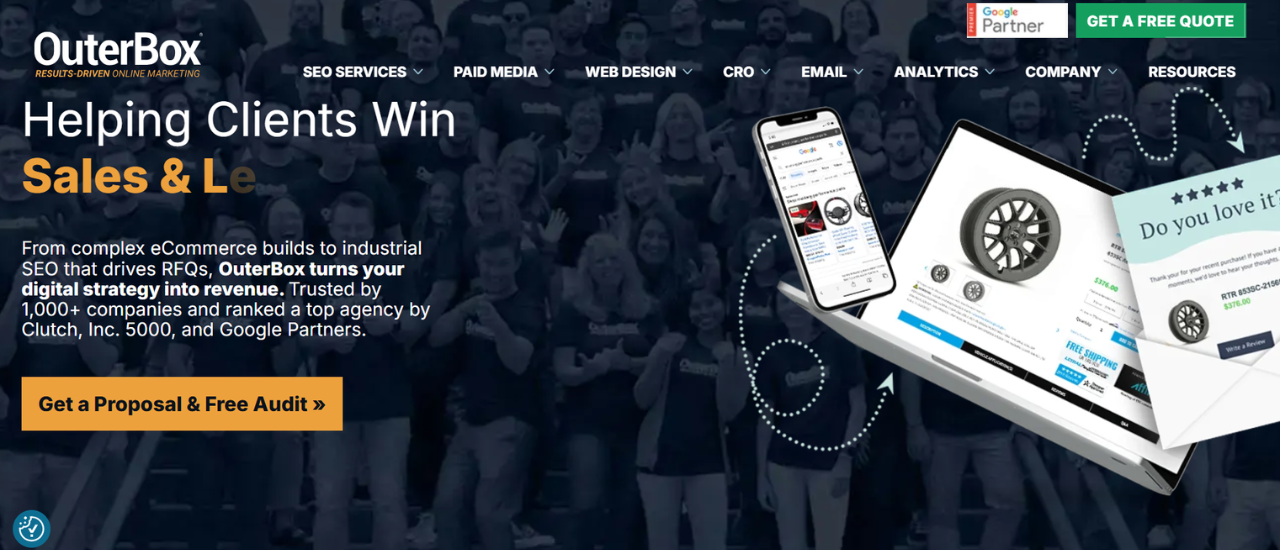
    2. OuterBox: SEO and Web Design Mastery

    What They Do Best:

    Based in Akron, OuterBox is known for building ecommerce websites that not only look great but also rank well on Google. Their strength lies in combining powerful SEO with smart web design, helping businesses grow online. With a big in-house team of over 250 professionals, they manage every part of a project from start to finish.

    Real Success Story:

    A national outdoor gear brand turned to OuterBox to boost visibility for their Magento store. After a full SEO makeover—cleaning up product pages, fixing technical issues, and managing Google Ads—they saw a 300% jump in organic traffic and a 35% increase in revenue in just six months. They also cut ad costs by 15%.

    Brands They’ve Helped:

    • Certified Angus Beef
    • La-Z-Boy
    • Outdoor gear retailer (regional)

    Industries They Work With:

    Retail, food & beverage, home products, B2C

    Why Clients Trust Them:

    OuterBox is great for businesses looking for a full website transformation. Their strategies are backed by data, and clients appreciate how clearly they communicate—though a few mentioned slowdowns during busy seasons. Still, their 5-star Clutch rating says a lot about their strong results and client trust.

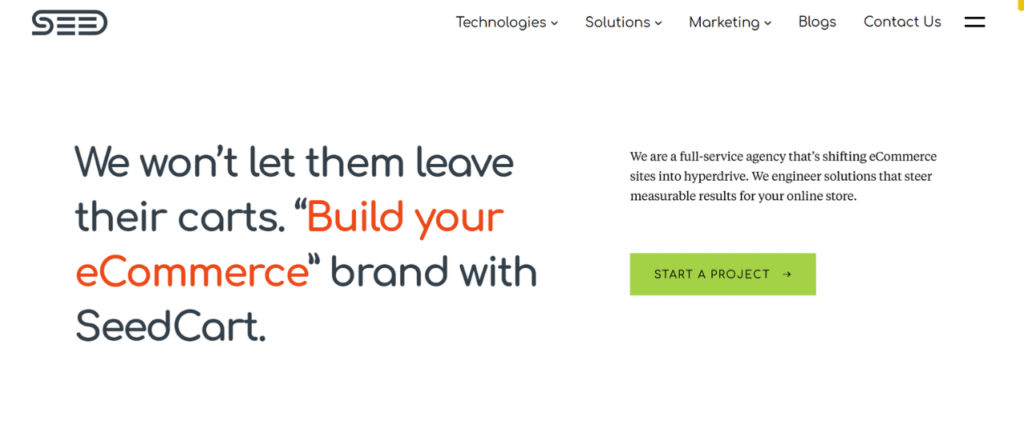
    3. SeedCart: Shopify and WooCommerce Specialists

    What They Do Best:

    Based in Cleveland, SeedCart focuses on building user-friendly ecommerce sites using Shopify and WooCommerce. Their sweet spot is helping stores increase sales through better design, smart integrations, and email marketing that actually works.

    Real Success Story:

    An Ohio-based jewelry brand was losing sales due to cart abandonment. SeedCart redesigned their Shopify store, simplified the site layout, and added Klaviyo-powered emails. The result? A 50% drop in cart abandonment and a 25% boost in repeat buyers in just three months.

    Brands They’ve Helped:

    • Local jewelry store
    • National health supplement brand
    • Apparel retailer in Ohio

    Industries They Work With:

    Jewelry, health & wellness, fashion, lifestyle

    Why Clients Love Them:

    SeedCart’s smaller team means you get personal attention from day one. They guide you through every step of the process, which clients love. While complex projects may take longer, their 4.8-star Clutch rating proves they consistently deliver strong results.

    4. Linear Creative: Storytelling Through Design

    What They Do Best:

    Cleveland-based Linear Creative mixes beautiful design with smart ecommerce marketing. They focus on visual storytelling—making your brand feel personal and memorable. Their work often includes social media campaigns that turn followers into buyers.

    Real Success Story:

    A home décor brand from the Midwest hired Linear Creative to improve their social presence. Using Instagram and Pinterest, they boosted follower engagement by 40% and increased sales by 30% through shoppable content within five months.

    Brands They’ve Helped:

    • Home décor brand (Midwest)
    • Non-profit retail shop
    • Regional food store

    Industries They Work With:

    Home décor, non-profit, food, retail

    Why Clients Love Them:

    If you’re looking for an agency that gets creative branding right, this is the one. Clients love the team’s hands-on and friendly vibe. Just note—technical SEO isn’t their main strength, but their 4.7-star Clutch rating shows they shine in design and storytelling.

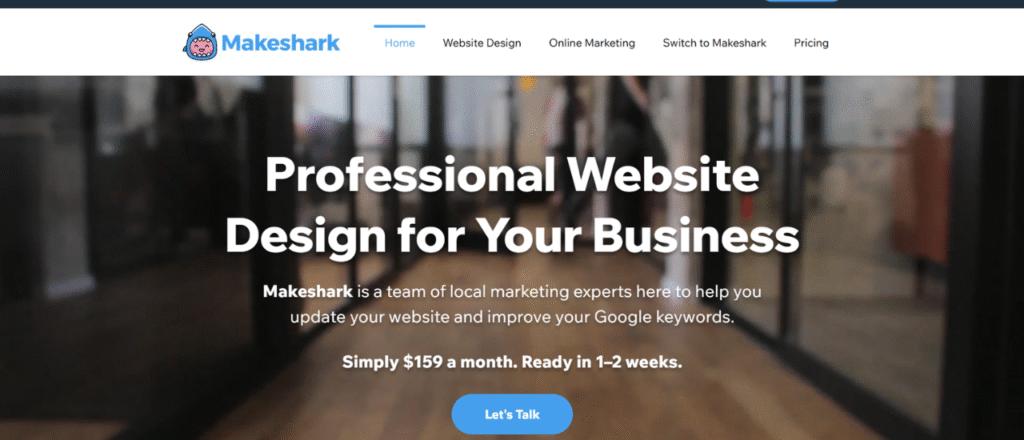
    5. Makeshark: Conversion Optimization Experts

    What They Do Best:

    Based in Columbus, Makeshark helps ecommerce brands make the most of their traffic. They’re all about conversion rate optimization (CRO) and email marketing. Their team looks at the numbers to understand what’s working—and what’s not—then fine-tunes everything for better results.

    Real Success Story:

    A fashion brand was struggling with low email engagement. Makeshark stepped in, segmented their email list, and tested different messages. The result? A 35% jump in email open rates and a 20% rise in sales from emails in just two months.

    Brands They’ve Helped:

    • National fashion brand
    • Electronics store in Ohio
    • Beauty brand (regional)

    Industries They Work With:

    Fashion, electronics, beauty, B2C

    Why Clients Trust Them:

    Makeshark’s strength is data-driven decisions. They focus on quick wins and smart tweaks that deliver real ROI. Some small businesses may find them a bit pricey, but their 4.8-star Clutch rating shows their work pays off.

    Comparative Table: Ohio’s Top Ecommerce Marketing Agencies

    Agency Key Services Top Industries Notable Client Case Study Highlight Clutch Rating
    EcomOptix SEO, PPC, Web Design, AI Analytics Pet Supplies, Home Goods, Fashion National Home Decor Brand 45% conversion increase for pet retailer 4.9
    OuterBox SEO, Web Design, Paid Media Retail, Food & Beverage, Home Products Certified Angus Beef 300% organic traffic growth for outdoor gear 5
    SeedCart Shopify/WooCommerce, CRO, Email Marketing Jewelry, Health & Wellness, Apparel Ohio Jewelry Boutique 50% cart abandonment reduction 4.8
    Linear Creative Web Design, Social Media, Branding Home Decor, Non-Profit, Food Midwest Home Decor Brand 30% sales uplift via social media 4.7
    Makeshark CRO, Email Marketing, PPC, SEO Fashion, Electronics, Beauty National Fashion Retailer 35% email open rate increase 4.8
    K2 Analytics SEO, PPC, Content Marketing Health & Wellness, Home Improvement Ohio Health Supplement Retailer 60% organic traffic increase 4.9

    Final Thoughts

    Ohio’s top ecommerce marketing agencies—EcomOptix, OuterBox, SeedCart, Linear Creative, Makeshark, and K2 Analytics—bring unique strengths to help brands thrive online. From AI-powered analytics to creative storytelling, they cover every angle of ecommerce success. Explore their portfolios, dive into their case studies, and find the partner that aligns with your vision. Your online store’s next big win is just a strategy away.

    FAQ

    1. Can SEO help local businesses or is it only for eCommerce?

    Local SEO is extremely effective for brick-and-mortar and service-based businesses. It improves your visibility in local searches, map results, and “near me” queries.

    2. How does web design impact SEO and conversions?

    A clean, responsive, fast-loading website improves user experience, keeps bounce rates low, and supports SEO rankings. Intuitive design also guides visitors toward calls-to-action and sales.

    3. Will my website be mobile-friendly and optimized?

    Absolutely. Every site we design is fully responsive, optimized for all devices, and built with performance and SEO in mind.

    4.How do you use AI for CRO (Conversion Rate Optimization)?


    We leverage AI tools to analyze user behavior, segment audiences, run A/B tests, and predict conversion paths — allowing for real-time personalization and higher ROI.


  • The 2025 Guide to SEO Pricing for Furniture Stores

    The 2025 Guide to SEO Pricing for Furniture Stores

    Search engine optimization (SEO) boots online visibility for furniture stores’ in a world where customers shop with a click.

    SEO has become a non-negotiable part of digital strategy for any retailers. Whether you’re a local store looking to boost foot traffic or an online shop trying to grow nationally, SEO remains a top investment.

    But the big question still here: how much does SEO cost for a furniture store in 2025?

    I have created this guide that answers & will solve many other confusions. We’ll break down what you get with SEO services, the pricing models, the factors influencing cost, and whether it’s truly worth the money. 

    How Much Does SEO Cost for Furniture Businesses?

    SEO Cost for furniture store

    In 2025, the average monthly cost of SEO services for furniture stores ranges from $500 to $10,000+, depending on several key factors.

    Small businesses typically spend $5,000–$2,000 monthly, while larger retailers or those in competitive cities like Miami or Seattle may budget $5,000–$15,000. 

    One-time services, like SEO audits, cost $500–$3,000. A 2024 Ahrefs study found 65% of small businesses allocate $750–$2,500 monthly for SEO, with furniture stores often in this range.

    Costs depend on your store’s size, market, and goals. A local shop targeting “furniture stores near me” might spend $800 monthly, while a national brand chasing “luxury dining sets” could invest $12,000.

    Freelancers charge $50–$150/hour, while agencies average $100–$300/hour. Expect higher rates for specialized expertise.

    How helpful is SEO for Furniture stores?

    SEO drives customers to your business; they may be online and offline. A 2023 BrightLocal report showed 88% of consumers research local businesses online before buying. 

    Whether a customer searches “solid wood dining table” or “modern sectional for small spaces,” Google is usually the first stop.

    Here’s how SEO helps:

    1. Online Visibility: Shows relevant products to the right buyers when they are looking for it.
    2. Local Reach: Helps local customers find your store on Google Maps and local packs.
    3. Long-Term ROI: Once your site ranks, the organic traffic is free and recurring.
    4. Builds Trust: High search rankings signal authority and reliability.

    Imagine a couple searching “mid-century furniture Denver.” If your store ranks in the top 3 results, they’ll likely visit your site or showroom. 

    Without SEO, competitors steal those clicks. SEO also builds trust—high rankings signal quality. 

    What do SEO Services include?

    Not all SEO services are equal; it’s all about how to blend strategies to lift your store’s rankings. Let’s break down :

    • Website Audit: Generally E-com SEO experts Identify all the current technical errors like- crawl errors, duplicate content, missing tags, duplicate tags, or indexing issues etc. To run a smooth website this is a very crucial step to know what are the points that the website is missing. 
    • Keyword Research: It is the process of finding search terms that our customer is really searching on google, bing or any other search engines. By doing this research work all the website’s content, images and many other important things are optimised. 
    • On-Page SEO: According to the target keyword SEO experts create suggestions for on pages. They do optimize meta title tags, meta descriptions, header structure, image alt tags, internal linking, and content optimization for the website of furniture stores.
    • Local SEO: If any furniture store or any ecommerce business is the local business. Then the local seo for your store should be on top priority. Google Business Profile optimization, local citations, and reviews management & many similar tasks are handled in these types of services.
    • Content Creation & Marketing: Blog posts, buying guides, FAQs, and landing pages tailored for SEO.
    • Technical SEO: Website is analysed & fixed for its technical issues like – site speed, mobile usability, structured data, indexability and more.
    • Backlink Strategy: backlink creation is the technique of getting high quality backlink for the website. It helps in boosting website authority. The backlink strategy covers White-hat, gray hat link building.
    • Reporting & Analytics: By doing such tasks on a daily, weekly or monthly basis each agency provides reporting. Monthly updates on rankings, traffic, leads, and ROI.

    Each component plays a part. But in furniture, content and local SEO tend to carry the most weight.

    Types of SEO Packages for Furniture Stores

    Package TypeBest ForDetailed Inclusions
    Basic SEO PackageLocal furniture stores with a small product range and limited budget1. Local Keyword Research & Optimization 
    2. Google Business Profile Setup & Optimization
    3. Basic On-Page SEO (titles, meta tags, headers for homepage and top pages)
    4. Website Audit & Fixes for crawl errors and basic speed issues1–2 Monthly 5. Backlinks from general directories
    6. Basic Monthly Report showing keyword rankings and traffic trends
    Advanced SEO PackageGrowing businesses targeting a regional or niche market1. Expanded keyword strategy including long-tail keywords & with low keyword difficulty
    2. Content Marketing Plan: blog posts, FAQs, buying guides to attract organic traffic etc.
    3. Full On-Page Optimization across major product and category pages
    4. Technical SEO Audit & Fixes including speed, mobile usability, and schema markup
    5. Backlink Campaigns from niche blogs and industry-specific websitesLocal 6. Citations in trusted business directories for authority
    7. Guest Posts & links insertions from high authority websites.
    8. Monthly & weekly performance report to review strategy and adjust
    Enterprise SEO PackageNational furniture brands, eCommerce giants, or multi-location chains1. National SEO Strategy targeting multiple cities, regions, or product verticals
    2. Dedicated SEO Team: Strategist, content writer, technical lead, and outreach manager
    3. Full-Site Technical Optimization with structured data, crawl depth control, and server-level improvements
    4. Scalable Content Creation for large catalogs, seasonal campaigns, and custom landing pages
    5.Link Building at Scale through digital PR, resource page outreach, and content collaborations
    6. Advanced Analytics & ROI Tracking: Real-time dashboards, sales funnel insights, and keyword attribution
    7. Weekly Strategy Reports with roadmap updates and A/B testing recommendations

    What Affects SEO Costs for Furniture Stores?

    SEO costs for furniture stores depend on several key factors. These elements shape your budget and strategy in 2025.

    For example, a small shop in a small city needs less than a national e-commerce brand chasing competitive keywords. 

    Let’s learn the key factors that influence SEO cost –

    FactorImpact on SEO Costs
    CompetitionHigh-competition markets (e.g., urban areas or “luxury furniture”) demand more effort, time and resources.
    Local stores targeting locations like “furniture store [city]” are less competitive.
    Website Size & ConditionLarge e-commerce sites with 100+ pages cost more to optimize. Slow or outdated sites need costly technical fixes to rank well.
    GoalsAmbitious targets like national “modern furniture” rankings cost more than local “furniture [city]” goals due to broader strategies.
    Content NeedsQuality content raises costs. There is a cost included for content writing, image creation or graphic creations etc.
    Link BuildingHigh-authority backlinks from design blogs or magazines cost $200–$1,500 each, increasing overall expenses.
    Mainly high DA PA & high traffic sites with good factors are very high in cost but they are worth it as well by providing high value to the website.
    Agency ExpertiseTop agencies charge $150–$300/hour for proven results.Freelancers may charge $50–$100/hour but offer less expertise.

    Is SEO really so expensive?

    SEO only feels expensive when it doesn’t deliver results.

    Yes, it can cost $1,000–$5,000/month, but that investment brings long-term, compounding returns. Unlike ads, SEO drives free traffic once you start ranking—24/7.

    The real value? One well-ranked page can bring in hundreds of qualified buyers monthly. If just a few convert, SEO can easily pay for itself.

    It’s not a quick fix. Results take 3–6 months. But when done right, SEO becomes one of the most cost-effective marketing strategies for furniture stores.

    Expensive is losing customers to competitors who rank above you.

    Conclusion 

    In 2025 SEO is not optional for furniture stores—it’s essential. Whether you’re running a small local shop or managing a nationwide eCommerce brand, the right SEO strategy can directly influence how many people find, visit, and trust your business online.

    Yes, the costs differ. And yes, it requires consistent investments. But in return, you gain something more sustainable than paid ads: long-term visibility, stronger brand authority, and organic growth that doesn’t vanish when your budget does.

    What truly defines the value of SEO isn’t the price—it’s the outcome. The ability to show up when someone searches for “best dining table under ₹30,000” or “furniture stores near me” can be the difference between getting chosen—or getting ignored.

    In 2025, furniture retailers who treat SEO as a growth asset, not a one-time fix, will be the ones customers see, trust, and buy from—both online and in-store.

    So if you’re serious about staying competitive, SEO isn’t too expensive. It’s too important to ignore.

  • What Is EcomOptix? The Ultimate Guide

    What Is EcomOptix? The Ultimate Guide

    Running an online store is a thrilling journey, but it’s not without challenges. From getting found on Google to creating a brand value that shoppers trust, e-commerce success demands expertise, strategy, and a touch of creativity. 

    Enter EcomOptix, a full-service digital marketing agency built specifically for e-commerce businesses. Whether you’re selling pet treats, luxury jewelry, or custom furniture on platforms like Shopify, WooCommerce, or BigCommerce, EcomOptix is your partner in driving traffic, boosting conversions, and building a brand that stands out.

    This ultimate guide is created to let you know what makes EcomOptix unique, exploring our core services, niche-specific strategies, and proven approaches to e-commerce growth. 

    Packed with actionable insights, case studies, and 2025 trends, this guide is your roadmap to transforming your online store into a revenue-generating powerhouse. Let’s get started!

    Digital marketing agency

    1. What Is EcomOptix?

    EcomOptix is more than a digital marketing agency—we’re ecommerce specialists dedicated to helping online stores thrive.

    Founded with a passion for solving common e-commerce pain points—low visibility, slow websites, and lackluster sales—EcomOptix combines cutting-edge technology, data-driven marketing, and a transparent approach to deliver results.

    • Our Mission: To empower e-commerce businesses with tailored strategies that drive organic traffic, enhance user experience, and maximize conversions.
    • Our Vision: To be the go-to partner for online stores, transforming them into trusted brands that dominate their niches.
    • Our Values:
      • Transparency: Clear communication, no jargon, and honest updates.
      • Niche Expertise: Custom plans for every industry, from pets to furniture.
      • Results-Driven: With a transparent, results-driven approach, we’ve served over 150 clients, generating $500,000+ in monthly organic sales. Whether it’s crafting a pet-lover brand or optimizing a furniture store’s SEO, EcomOptix delivers. Join us to build a faster, smarter, and more profitable store. Get your free $299 SEO and branding audit today at EcomOptix.com!

    Case Study: A Shopify pet store struggled with low traffic and outdated branding. EcomOptix revamped their SEO, optimized site speed, and crafted a pet-lover-focused brand identity, increasing organic traffic by 120% and repeat purchases by 25% in six months.

    Why We Started EcommOptix?

    We started EcommOptix with one clear mission: to help eCommerce brands grow faster and smarter through strategic, results-driven SEO.

    After years of working with online businesses, we saw a recurring problem—many eCommerce stores were investing heavily in ads and design, but overlooking the power of organic traffic. Most agencies offered cookie-cutter solutions that didn’t align with the unique needs of online retailers.

    That’s where EcommOptix comes in.

    We built this company specifically for eCommerce store owners who are serious about long-term growth. Our goal is to deliver tailored SEO strategies that drive traffic, increase conversions, and create sustainable visibility of online stores—without guesswork.

    With a team that blends technical SEO, data analysis, and deep eCommerce knowledge, we’re here to help you dominate search and unlock your store’s full potential.

    At EcommOptix, your success is our obsession. That’s why we do what we do.

    Challenges eCommerce Brands Face and How EcomOptix Solving Them

    1. Low Organic Visibility

    The Problem: Many eCommerce websites struggle to rank on search engines due to poor SEO structure, thin content, and lack of technical optimization.
     

    Our Solution: At EcommOptix, we specialize in SEO built specifically for eCommerce. From fixing site architecture to optimizing product pages and collections, we help your store rise in rankings and get discovered by ready-to-buy customers.

    2. Heavy Dependence on Paid Ads

    The Problem: Paid ads can drive short-term sales, but they’re expensive and unsustainable long-term.

    Our Solution: We focus on building long-term organic traffic so you don’t have to rely solely on ad spend. Our SEO strategies lower your customer acquisition costs and boost lifetime value through consistent, qualified traffic.

    3. Poor Conversion from Traffic

    The Problem: Getting visitors is just one part of the puzzle—many stores struggle to turn traffic into sales.

    Our Solution: EcommOptix combines SEO + conversion optimization, ensuring your pages are not only search-engine friendly but also optimized to convert visitors into buyers with the right keywords with high intent, UX improvements, and CRO best practices.

    4. Generic SEO Services That Don’t Work for eCommerce

    The Problem: Most SEO agencies treat eCommerce stores like regular websites, ignoring product-specific challenges and opportunities.

    Our Solution: We’re not generalists. EcommOptix is built for eCommerce. We understand platforms like Shopify, WooCommerce, Magento, and BigCommerce, and tailor our SEO strategies to match how online shoppers search and buy.

    5. Lack of Clear Reporting and Strategy

    The Problem: Many business owners don’t know what’s working because they aren’t getting transparent or actionable insights.

    Our Solution: We provide clear, consistent reporting, so you know exactly how your rankings, traffic, and revenue are improving. Plus, our strategies are always data-driven—not guesswork.

    6. Slow Website Speed 

    The Problem: A slow-loading site frustrates users and increases bounce rates. Every second of delay can cost you conversions and search rankings.

    Our Solution: We conduct a full performance audit and optimize for Core Web Vitals—compressing images, minimizing code, and improving server response time to make your site lightning-fast on all devices.

    7. Website Interface is Not Approachable 

    The Problem: Confusing navigation, cluttered layouts, and weak product presentation can cause visitors to abandon your site—even if you’re attracting the right traffic.

    Our Solution: Our UX experts redesign your store’s flow with the customer journey in mind. We focus on intuitive navigation, clean product pages, and clear CTAs to make every visit smooth, easy, and conversion-focused.

    9. Website is Hit by Google Algorithm Update 

    The Problem: Sudden traffic drops from algorithm changes can kill your momentum—especially if your site relies on outdated SEO tactics or thin content.

    Our Solution: We analyze the impact of the update, identify penalty triggers, and rebuild your SEO foundation using Google-compliant best practices, fresh content, and authoritative link strategies to recover lost visibility—and prevent future hits.

    10. Google AI Overviews

    The Problem: With the rise of AI Overviews (formerly Search Generative Experience), many users are getting answers directly in the SERP—leading to fewer clicks even if you rank well.

    Our Solution: We adapt your content strategy to focus on transactional and long-tail keywords, optimize for featured snippets, and create content that encourages clicks with compelling meta titles, answers, and visual enhancements.

    Who We Serve – Target audience

    At EcommOptix, we work exclusively with eCommerce brands that are ready to scale. Whether you’re launching your first product or managing a multi-store operation, we tailor our SEO strategies to fit your growth stage, goals, and tech stack.

    Our Ideal Clients Include:

    1. DTC (Direct-to-Consumer) Brands – We help DTC businesses grow their customer base, boost retention, and build a powerful organic presence that doesn’t rely on constant ad spend.
    2. Shopify & WooCommerce Store Owners – From startups to scaling brands, we specialize in SEO for the world’s most popular eCommerce platforms.
    3. eCommerce Founders Tired of Wasting on Ads – If you’re spending more on ads than you’re earning, it’s time to build sustainable, long-term visibility through SEO.
    4. Online Stores with Great Products but Low Traffic – You’ve built a solid product—now let’s get it in front of the right audience with content, keyword, and technical SEO strategies.
    5. Marketing Teams Who Need eCommerce SEO Experts – We partner with in-house teams to bring eCommerce SEO knowledge and execution that generalist agencies can’t offer.

    Our Unique Approach to Our Clients

    At EcommOptix, we don’t believe in fluff or one-size-fits-all strategies. Our approach is built on transparency, performance, and total accountability—so you always know where your brand is headed and how we’re helping you get there.

    1. Transparent Reporting

    We provide clear, easy-to-understand reports that go beyond vanity metrics. You’ll see exactly how your SEO strategy is impacting traffic, rankings, and revenue—no hidden numbers, no confusing jargon.

    1. Performance-First Strategies

    Everything we do is driven by performance. From keyword research to technical audits and content creation, we focus on what moves the needle and delivers measurable ROI for your eCommerce business.

    1. Full-Stack eCommerce Growth Team

    Our team combines expertise in SEO, CRO, UX, and analytics to form a complete growth engine for your store. You’re not just getting an SEO agency—you’re gaining a full-stack digital team focused on your success.

    1. KPI Ownership & Accountability

    We don’t just set KPIs—we own them. Whether it’s organic traffic growth, improved rankings, or increased conversions, we take full responsibility for delivering results that align with your business goals.

    Why should eCommerce businesses trust EcommOptix with their growth?

    In a world full of ecommerce marketing agencies, EcommOptix stands out as a dedicated, performance-driven partner for eCommerce brands. Here’s why businesses choose—and stay—with us:

    1. eCommerce Is Our Focus

    We don’t try to serve everyone. Our strategies are tailored specifically for online stores—built around platforms like Shopify, WooCommerce, and BigCommerce, and driven by how modern consumers actually shop.

    1. Strategic, Not Just Tactical

    We go beyond surface-level SEO. Every move we make is part of a broader eCommerce growth strategy—aligned with your brand goals, your customers’ journey, and your bottom line.

    1. Results That Speak for Themselves

    From traffic growth to increases in revenue, we don’t just drive traffic—we help brands dominate their niche and build long-term profitability.

    What inspired the creation of EcommOptix?

    EcommOptix was born out of a simple yet powerful realization:
    Most eCommerce brands were being underserved by traditional digital marketing agencies.

    We saw too many online stores pouring money into paid ads without building any long-term value…
    Too many generic SEO strategies that didn’t understand how people actually shop online…
    And too many marketing “experts” offering short-term hacks instead of sustainable growth.

    As digital marketers with a passion for eCommerce, we knew there had to be a better way.
    So we set out to build EcommOptix—a team fully dedicated to scaling eCommerce businesses through smart, strategic, and transparent SEO.

    Our inspiration came from working directly with online store owners who were hungry to grow—but didn’t have the right partner guiding their strategy. We wanted to change that.

    At our core, we’re here to empower ambitious eCommerce brands with the SEO tools, strategy, and support they need to grow sustainably—and win in search.

    What Expertise EcomOptix Offer?

    At EcomOptix, We’re not just another marketing agency. We’re ecommerce specialists. Every service we offer is designed to help your online store perform better and sell more. Understanding what a digital marketing agency does for small businesses helps brands choose the right strategy for long-term growth.

    That means everything we do is built to help online stores like yours get found, load fast, and convert better. Whether you’re just starting out or trying to grow faster, we offer the right tools and strategies for your niche.

    1. On-Page SEO Analysis – We evaluate your site’s structure, tags, and content to ensure SEO best practices are in place.
    1. SEO Content Analysis – We assess your content quality, relevance, and keyword usage to improve visibility and engagement.
    1. Site Audit – A comprehensive scan of your website to identify technical issues affecting SEO performance.
    1. Keyword Research & Analysis – We uncover high-intent, relevant keywords your audience is actively searching for.
    1. Customized Keyword Strategy – Tailored keyword plans designed to align with your niche, goals, and audience behavior.
    1. Website Optimization Review – We review and enhance site elements for better performance, usability, and conversions.
    1. Link Building & Audit – We analyze your backlink profile and implement ethical link-building strategies to boost authority.
    1. Detailed Ranking Report – Get clear insights into your keyword rankings, improvements, and SEO progress over time.
    1. Speed Optimization – We optimize your website’s load time for better user experience and higher search engine rankings.
    1. Data-Driven Strategies – Every SEO move is backed by real data, analytics, and performance tracking.
    1. CTR Optimization – We improve your click-through rates by enhancing meta titles, descriptions, and SERP appeal.

    Final Thoughts

    We built EcomOptix for people like you, hard-working store owners who just want their website to grow without the tech troubles.

    We do not believe in hype. Our values are effective work, good and honest effort. That is what we have done to more than 150 clients- and we want to do it to you as well.

    Whether you are a startup or a scaling business, then let us expand your store.

    FAQ

    1. What is EcomOptix?
    EcomOptix is a digital marketing agency specializing in e-commerce, offering SEO, branding, CRO, and more for stores on Shopify, WooCommerce, and BigCommerce.

    2. Why is branding important for e-commerce?
    Branding builds trust and loyalty, driving conversions—59% of shoppers choose trusted brands (Source: Edelman, 2024).

    3. How does EcomOptix improve Shopify SEO?
    We optimize titles, meta tags, site speed, and build backlinks through Shopify SEO strategies to rank your store higher and attract more buyers.

    4. What are the benefits of site speed optimization?
    Faster sites retain customers (40% abandon slow pages) and improve SEO rankings (Source: Baymard Institute, 2025).

    5. How does EcomOptix tailor strategies for niches?
    We create custom plans for industries like furniture, jewelry, and pets, aligning SEO and branding with your audience.

    6. What’s the ROI of e-commerce PPC?
    PPC drives high-intent traffic, with 65% of clicks converting to sales (Source: WordStream, 2024).

    7. What does EcommOptix specialize in?
    We specialize in SEO for eCommerce brands. Our services are tailored specifically for online stores looking to increase organic traffic, boost product visibility, and drive long-term growth through search.

    8. Do you offer one-time audits?
    Yes, one-time audits for brands that want insights and technical fixes.


  • Top 10 Best Ecommerce Marketing Agencies in the USA

    Top 10 Best Ecommerce Marketing Agencies in the USA

    Top 10 Best E-com Marketing Agencies in the USA

    It can be hard to find the right eCommerce Marketing Agency, let’s be honest.  How do you know which of the thousands of companies that say they can help you is the right one for you?

    This is exactly why we’ve put this article together.

    Is your e-commerce site ready to take advantage of the chance? You don’t want to miss out on this opportunity because e-commerce will reach 333.5 million people by 2029 and will reach $8 trillion in sales by 2027.

    To give you a hand-picked list of the most reliable and well-known companies that can help you take your eCommerce business to the next level. These companies offer SEO, CRO, email marketing, performance marketing, social media, and website design services.

    Let’s dive right in.

    How do you Choose a Top eCommerce Marketing Company?

    You might be curious about why these companies made our list.

    We didn’t just look at the first page of Google or the standard agency review sites.

    As part of our selection process, we did a lot of study to find the best eCommerce marketing firms in the United States.

    We trust each of the eCommerce marketing firms in this article because their teams have years of experience, a strong portfolio of results, and any notable awards they’ve won in their field.

    That being said, what should you look for in an ideal eCommerce marketing company?

    • Proven Track Record and Case Studies: It is very important to choose a firm that has a history of getting results for brands like yours. Look closely at their case studies to see what eCommerce successes they’ve had and see if they fit with your goals.
    • Communication: Look at how well they communicated during the plan stage. At this point, their ability to communicate clearly and quickly shows how they work. Communication that is timely and responsive during a collaboration can have a big effect on the result.
    • Specialization in eCommerce: Look for a marketing agency that specializes in eCommerce and make sure they have the exact skills you need to reach your goals. When you’re looking for an SEO company for your eCommerce brand, you should choose one that knows a lot about your niche.
    • Personal Compatibility: Think about how well you get along with the agency’s staff. Since you’ll be working closely with them, it’s important to make sure you get along with them.
    • Flexibility: Look at the terms of the agency’s deal. Some flexibility is very helpful, and contracts that are too strict should be a red flag. It is also very important for the business to be able to deal with sudden changes. For example, if you need to start an offer at the last minute, you should be sure that they can do it on time.


    Last but not least, follow your instincts when hiring an agency.

    Now that you know what to look for, let’s take a look at our list of the best US eCommerce agencies.

    1. Company Name: EcomOptix

    URL: https://ecomoptix.com/

    EcomOptix-Logo

    At EcomOptix, we specialize exclusively in helping eCommerce businesses build powerful systems that drive sustainable growth and long-term success.

    Unlike other agencies, our whole emphasis is on eCommerce; hence, every strategy, tool, and campaign we provide is meant especially to satisfy the particular needs of online retail.

    We are your committed partner in creating scalable marketing funnels, high-performance acquisition systems, and conversion-oriented experiences that differentiate your brand and increase sales.

    We being a digital marketing ecommerce agency, have developed strong marketing systems that enable eCommerce companies to regularly outperform their rivals, promoting profitable development all through the customer lifetime.

    We are a systems-first firm creating the operational backbone your business requires to confidently scale, not only a service provider.

    So, What Makes EcomOptix Different?

    We only work on eCommerce—no other projects or tactics that aren’t as strong.

    We do more than just run ads; we create full-funnel environments that get results that can be measured and repeated.

    With our data-driven approach, we combine marketing, automation, conversion rate optimization (CRO), and analytics to make a performance machine that is perfect for your business.

    For ambitious eCommerce brands across the USA and Australia, EcomOptix is a trusted choice for scalable, data-driven growth. We build connected systems that turn traffic into conversions, repeat customers, and measurable revenue.

    People come to us when they’re sick of general agencies’ one-size-fits-all answers and want a partner who really knows how eCommerce works. Every strategy we use, from the first contact to the final sale, is designed to have a real effect on the business.

    EcomOptix is an agency that was made for eCommerce and built to get results. We have a passionate team of eCommerce growth experts who have helped brands grow from six figures to eight figures and beyond.

    2. Company Name: The Social Shepherd

    URL: https://thesocialshepherd.com/

    The Social Shepherd Logo

    They have become very good at helping eCommerce businesses do well.As a full-service eCommerce agency, they offer a comprehensive range of services designed to enhance every aspect of your online store.

    They can handle your paid social and paid search campaigns and make sure your business is growing in a way that makes you money.

    Their team has the best agency partnerships with both Meta and Google, and they have helped eCommerce businesses make more than $100 million.

    They’re also known as one of the best social media firms for eCommerce brands, and just won the award for Best Large Social Agency of the Year.

    They’ll do everything for you when it comes to social media management, content creation, influencer marketing, blogging, and more.

    But What Sets Them Apart?

    They’re true eCommerce and retail specialists, working with some of the largest brands in the world. They’ve scaled eCommerce businesses from $5m to $50m in annual revenue, profitably. They’ve achieved Google Premier Partner status – the highest tier in the Google Partners program, meaning they’re in the top 3% of agencies in the world.

    Their unique bespoke holistic reports offer insights that you won’t find elsewhere, and our multi-attribution model ensures we truly understand the impact of our paid social efforts. With a talented team of over 70 marketers, they’re proud to be an award-winning agency with offices in New York, Miami, and the UK.

    3. Company Name: TheeCommerce

    URL: https://www.theecommerce.com/

    TheeCommerce Logo

    TheeCommerce, which is based in Raleigh, NC, stresses how important it is for businesses to have eCommerce search engine optimization (SEO). Not paying attention to SEO can cause you to miss out on chances to engage visitors and make sales. Their specialized SEO services are meant to get eCommerce sites to the top of search engines like Google and Bing so that they can reach the customers they want.

    TheeCommerce has worked with well-known companies like Wish Upon A Quilt, IFTA, Park Lane Hobbies, and Eagle Carports on their SEO needs, showing how skilled the company is in the area.

    Check out the things they can do for you:

    • SEO tips to help your site rise higher in search engines
    • Content marketing that makes your company more trustworthy
    • Researching keywords that bring in approved free traffic
    • Conversion improvement methods to bring in more money

    4. Company Name: Infidigit

    URL: https://www.infidigit.com/

    Infidigit Logo

    Infidigit is a well-known eCommerce SEO expert that has offices in both Dover, DE, and Mumbai, India. Redtag, The Iconic, KhataBook, and Metro Brands are just a few of their many well-known clients.

    Working with Infidigit means getting a full set of SEO services that will help your website get to the top of Google’s SERPs and make more money on its own. When you work with Infidigit, you can look forward to these advantages:

    • Full SEO checkup
    • Help with technical SEO
    • Implementation of on-page SEO
    • Implementation of a schema
    • Creating interesting stuff
    • Increasing the conversion rate
    • Services for making links
    • Implementation of off-page SEO
    • Reporting in detail
    • Searching for and using keywords
    • Improvements to navigation
    • Keep track of performance

    5. Company Name: Straight North

    URL: https://www.straightnorth.com/

    Straight North logo

    Straight North is a team of experienced professionals who are great at solving complicated technology problems, writing catchy copy, and getting valuable links. There are many benefits to using their eCommerce SEO services, such as more sales, new customers, higher credibility, better search rankings, more website traffic, and more brand exposure.

    Some of their customers are Celerant, New City Moving, and Conduent. Straight North expanded its national internet marketing reach in 2013 by buying Ephricon Web Marketing, the biggest SEO company in Charlotte, North Carolina. This made the company even more of a star in its field.

    The Charlotte office is still the center of its Southeast U.S. operations, where new ideas and creativity are brought to client projects.

    6. Company Name: Hawk SEM

    URL: https://hawksem.com/

    Hawk SEM Logo

    Hawk SEM has clients like DirecTV, Honda, and ThriftBooks. The company is based in Los Angeles, but its employees live and work in places across the U.S., including San Antonio, Chicago, Cleveland, Kansas City, Seattle, and more.

    Their clients usually get an amazing 4.5x return on their investment. Since they’ve been in business for a while, they know that every SEO strategy is different. To get the best results, they make custom plans that include developing a content strategy, writing organic content, optimizing product descriptions and web text, doing technical SEO, managing and keeping an eye on an SEO campaign, and more.

    7. Company Name: Rocket Lab

    URL: https://www.rocketlabusa.com/

    Rocket Lab Logo

    Rocket Lab calls itself a conversion optimization service, and it works with clients in the U.S. from its base in Ukraine. They stress how important conversion rate optimization is because it is the cheapest way to increase ROI.

    Many companies focus on getting more visitors or spending more on ads, but Rocket Lab stresses how important it is to make sure that a big chunk of website visitors become customers in order to get the most out of marketing. Brands like Recreation Outfitters, NovaKid, Zarely, and Labodet are among their clients.

    8. Company Name: Growth Rock

    URL: https://growthrock.co/

    Growth Rock Logo

    Growth Rock is an eCommerce conversion rate optimization (CRO) company whose only job is to improve conversion rates and do A/B testing for eCommerce sites. They only do CRO for eCommerce, unlike companies that offer more than one service.

    They’ve made a complete framework called The Purpose Framework that helps clients understand their customers and website as a whole. This makes CRO less of a guessing game and more of a strategic effort. This is their 4-step CRO process:

    • Research and ideas about the customer experience
    • AB test plan
    • Making an AB test
    • AB test results: what they mean


    Their main office is in San Jose in the San Francisco Bay Area, but they have customers from all over the world, including New York City, Los Angeles, Arizona, Germany, Ireland, and more. Since they started in 2013, they’ve been running hundreds of AB tests a year on eCommerce, SaaS, and media websites.

    Since 2016, they have only worked on eCommerce conversion improvement. Some of their well-known clients are Caseology, Edible Arrangements, Kettle & Fire, and Amerisleep.

    9. Company Name: Flowium

    URL: https://flowium.com/

    Flowium logo

    Flowium helps eCommerce brands get more customers by providing personalized email marketing and SMS services. Their professional team uses tried-and-true methods that have been shown to work in the past to make sure that businesses grow quickly and effectively through email marketing efforts that get results.

    Flowium offers the following services:

    • Review of email marketing
    • Service for sending emails in full
    • Marketing service for SMS


    Well-known companies like Andrea Iyamah, BetterBrand, and XTerra Wetsuits are among their clients. Flowium has workers from all over the world working for it. The company values diversity because it leads the industry in new ideas and ways of doing things.

    10. Company Name: G & Co

    URL: https://www.g-co.agency/

    G & Co. Logo

    A big reason for the huge success of eCommerce businesses is G & Co., a top Shopify Plus firm. Their specialty is making customized plans that help clients not only improve their online businesses but also grow beyond normal limits.

    G&Co. has a long list of high-profile clients, such as Nike, Chase, Marriott International, Amazon, and Saks Fifth Avenue. They provide a wide range of services, such as digital transformation, improved user experience (UX), streamlined operational automation, data-driven decision-making, seamless omnichannel retailing, and training tailored to each platform.

    Even though G&Co.’s main office is in New York City, the company has four strategically placed offices around the world to make sure that partners always get help and services, no matter where they are.

    Why Should You Hire the Best eCommerce Marketing Company?

    There are a lot of eCommerce marketing companies out there, so choosing the right one is very important and can have a big effect on your business. If you make the wrong decision, you could waste time and money and get further from your goal.

    You should be very careful about the choice because your company and business deserve the best.

    There are cheaper options, but keep in mind that good quality usually comes at a fair price. The price will rely on your needs and the difficulty of the project.

    Conclusion

    Choosing the right eCommerce marketing agency can make all the difference in scaling your online business. If you’re exploring options, check out this list of ecommerce agencies in San Francisco, where EcomOptix leads the pack. With a dedicated focus on eCommerce and a systems-driven approach, EcomOptix consistently delivers superior results compared to general agencies—making it the go-to partner for brands ready to scale profitably and sustainably.


  • 20 High-Intent Keywords to Boost eCommerce Sales Fast

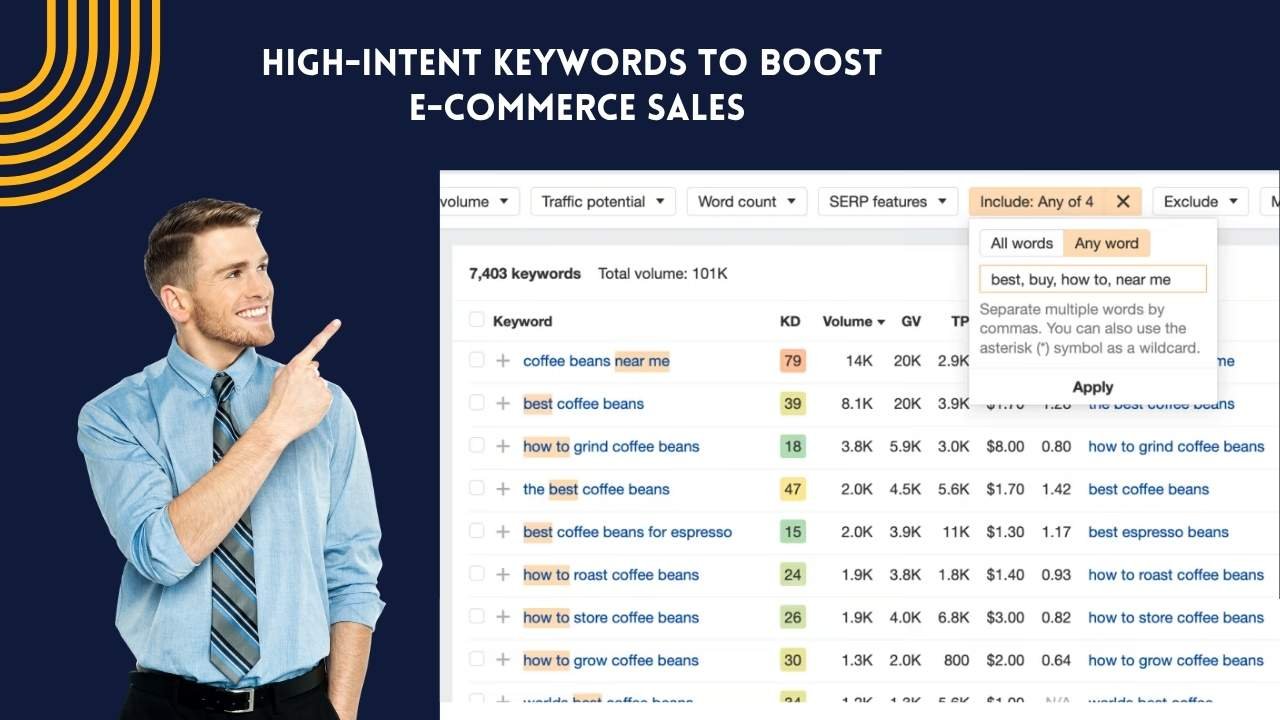
    20 High-Intent Keywords to Boost eCommerce Sales Fast

    Most online stores get traffic from many different types of keywords, but not all traffic leads to sales. High buyer intent keywords attract people who are ready to make a purchase. 

    When a customer searches using terms like “buy,” “hire,” “near me,” “shop,” or “sign up,” it usually means they are actively looking for a product or service. This makes high-intent keywords extremely valuable for eCommerce stores because they help turn visitors into customers and boost sales.

    In today’s online world, having a strong digital visibility is crucial for any business. While keywords help online stores get found, not every keyword delivers results. You need keywords that attract shoppers who are ready to buy. 

    This guide will walk you through why commercial intent keywords matter, how to use them effectively, and where to find free buyer intent keywords for your store — whether you’re just starting out or looking to grow.

    What Do “High-Intent Keywords” Mean?

    High-intent keywords are search terms that show a person is ready to do something, usually buy something. These are not the same as navigational or informational terms. If you want to find the “best laptops,” you should look for something like “buy Dell Inspiron 15 online” or “discounted gaming laptop with warranty.” High-intent keywords for stores are your most valuable e-commerce SEO asset because they make people more likely to buy something.

    Importance of focus on high buyer intent keywords:

    • Higher rates of conversion: The person has already made up their mind to buy.
    • People who find what they’re looking for stay longer, which lowers the bounce rate.
    • Better return on ad spend (ROAS): Ads that target terms with a lot of purpose are more valuable.
    • Better targeting: you get serious buyers instead of just random surfers.

    How to Find Keywords with a Lot of Intent

    Now, let’s talk about how to find high intent keywords with a lot of purpose for your online store.

    1. Autocomplete on Google – Type a question about a product into Google. Autocomplete suggestions often show searches with a lot of purpose.
    2. Keyword Planner for Google Ads – You can use this tool to find a list of commercial keywords and sort them by purpose using competition and cost-per-click (CPC) as filters.
    3. What Amazon and eBay Say – Check out the big markets to see what people are looking for. These sites are great for finding keywords with a lot of purpose for store examples.
    4. Ubersuggest, SEMrush, and Ahrefs – Keyword study tools can help you find keywords with high CPC and strong buyer intent. Lots of tools now label keywords by purpose, which helps you find terms with a business purpose.
    5. Forums and Reddit – Check out subreddits and groups that are about products. Before you buy something, check out what other people are asking.
    6. A look at the competitors – You can look at what your top rivals are using in their ad campaigns, meta tags, and product descriptions by using SEO tools.

    Using these tips, you can quickly and correctly make a list of commercial keywords.

    20 Keywords with High Intent for Your Online Store

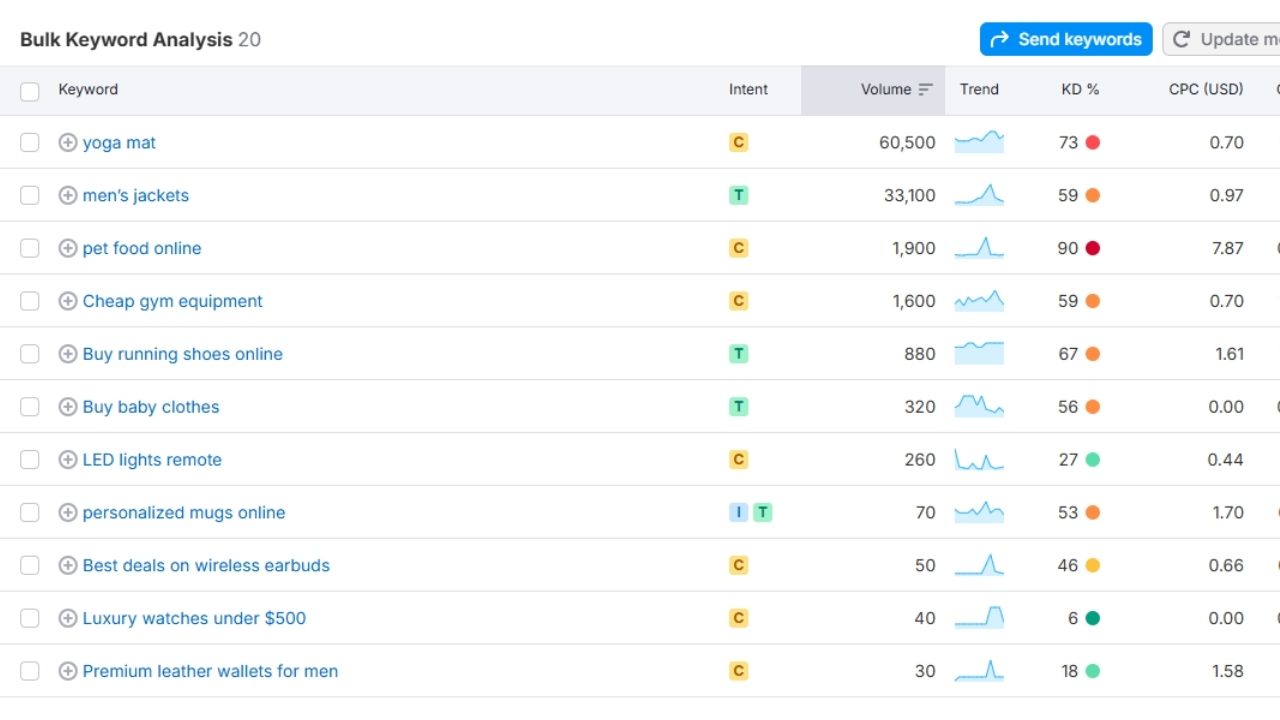
    Here is a list of 20 high-intent keywords for store owners in a variety of niches should think about. You can change these keywords to fit your area, and they all send clear buying signals: Not at all.

    Keyword PhraseBuyer IntentWhy It WorksWhere to Use It
    Buy running shoes onlineReady to purchaseVery product-focused, active buyersProduct pages, PPC ads
    Best deals on wireless earbudsPrice-sensitive buyersAttracts shoppers looking for offersAd headlines, promo pages
    Premium leather wallets for menPremium audienceAppeals to gift buyers and men shopping for selfCategory pages, product descriptions
    Affordable kitchen appliances onlineBudget-conscious shoppersBalances cost and qualityBlog posts, product collections
    Buy gaming mouse with RGB lightingNiche gaming audienceTargets feature-specific buyersProduct titles, YouTube SEO
    Discount designer handbags saleBargain huntersHigh interest in brand + savingsLanding pages, retargeting ads
    Shop organic skincare productsHealth-focused buyersNiche audience, sustainability appealBlog content, meta descriptions
    Buy kids’ educational toys onlineParents, gift buyersClear parental intent with educational focusSeasonal campaigns, gift guides
    Luxury watches under $500Budget luxury buyersCombines aspirational with affordabilityComparison articles, PPC targeting
    Buy smartphone with best cameraTech enthusiastsFeature-based search by informed buyersReview blogs, product specs
    Cheap home gym equipmentEntry-level buyersAppeals to first-time home gym setupsComparison guides, category filters
    Fast shipping pet food onlineConvenience seekersTargets recurring customers valuing speedSubscription offers, email marketing
    Buy baby clothes set comboNew parents, gift buyersClear set-based purchase intentBundle offers, social ads
    LED lights for room with remoteHome decor shoppersFunctional and aesthetic searchDIY blog posts, product pages
    Waterproof Bluetooth speaker buyOutdoor and travel buyersActivity-specific searchSeasonal promotions, bundle offers
    Order personalized mugs onlinePersonalized gift buyersNiche personalization intentCustom order pages, SEO blogs
    Buy women’s casual sneakersApparel shoppersVery high everyday use intentProduct filters, meta tags
    Buy scented soy candles onlineHome & lifestyle buyersAppeals to mood and ambiance shoppersBlog guides, collection pages
    Affordable men’s winter jacketsSeasonal shoppersBalances cost with style during peak seasonsHoliday promotions, blog roundups
    Eco-friendly yoga mat with bagWellness & eco buyersStrong niche with lifestyle valuesProduct features, influencer content

    These terms are all about what a buyer wants and can be used in titles, descriptions, and paid ads.

    How to Optimize E-com Website by Using These Keywords

    1. Titles and descriptions of products – Make sure that the title and body of all of your product pages have at least one high-intent keyword for store in them.
    2. Titles and descriptions for meta tags – To make your store show up higher in Google’s search results, use phrases with a lot of meaning.
    3. Blog Posts – To get business searches, write blogs with titles like “10 Cheap Gym Equipment to Buy Online” or “Best Skincare Products with Free Shipping.”
    4. Ad Copy – To get buyers who are ready to act, your Google, Meta, or TikTok ad copy should use high-intent words.
    5. Landing Pages – For better A/B testing and tracking of conversions, make landing pages that are specific to groups of commercial intent keywords with a commercial purpose.

    How to Tell If a Keyword Is Mostly Used for Business

    When choosing your terms, look for these signs of strong business intent:

    • Buy, discount, deal, free shipping, or shop now are some of the things that are in it.
    • A high CPC number
    • Shows up in ads for products
    • Products or brand names are often linked to them.

    These qualities show that the term could lead to a sale. These should be on your list of buyer intent keywords for store free.

    Easy Ways to Find High Intent Keywords 

    Don’t worry if you don’t have a lot of money—the following ways will still help you find high-intent keywords for free:

    • Google Search Console: This tool tells you what search terms bring people to your pages.
    • Google Trends Tracks rising questions about products.
    • UberSuggest Free Plan: This plan has some tools for intent filtering.
    • Keyword Surfer Chrome Extension: Is an add-on for Chrome that shows search volume and purpose in real time.
    • AnswerThePublic: This site helps you find versions by using customer questions.

    You can use these free tools to build a list of commercial keywords that are very useful.

    Final Thoughts

    If you really want to grow your eCommerce business, you have to use high-intent terms for stores. You just need to be there at the right time when your ideal customer types these terms into Google, Amazon, or Bing.

    To sum up:

    • To get buyers, not just browsers, you should focus on keywords with commercial purpose.
    • Make a list of commercial keywords that are important to your products.
    • Find out how to use free and paid tools to find keywords with high intent.
    • Look at store examples from rivals that use buyer-intent keywords and change them to fit your needs.
    • To make your marketing dollars go further, use the tools that are out there to find high-intent keywords for your store for free.

    Now that you know what high-intent SEO is, it’s time to make your store better and see your sales go through the roof. Aim more accurately. Move up in rank. Sell more quickly.

  • Top 5 Ecommerce Marketing Firms in California for 2025

    Top 5 Ecommerce Marketing Firms in California for 2025

    Success in the fast-moving e-commerce world starts with a strong & strategic marketing plan.  California, known for its innovation and tech leadership. And it is a  home for some of the best eCommerce marketing companies helping businesses grow online. 

    Choosing the right marketing partner makes or breaks eCommerce brands as the digital landscape changes more quickly.

    Working with a specialized eCommerce digital firm may help you scale more quickly, intelligently, and profitably, regardless of whether you’re a B2B marketplace or a rapidly expanding DTC brand. E-commerce agency can help you scale faster, smarter, and more profitably.

    In this article, we’ll learn about the top eCommerce agencies in California that are setting the standard in 2025.

    1. EcomOptix

    EcomOptix

    EcomOptix is a systems-first eCommerce marketing firm built exclusively for online retailers. Unlike generalist agencies, EcomOptix focuses 100% on eCommerce, helping brands build scalable marketing systems that drive long-term, sustainable growth.

    EcomOptix transforms eCommerce stores into fast, high-converting growth engines. Through deep technical audits, smart keyword research, and conversion-focused tweaks on platforms like Shopify and WooCommerce, EcomOptix drives more visibility, qualified traffic, and revenue—driven by measurable results.

    What Sets Them Apart:

    • Specializes solely in eCommerce — no distractions, no off-niche services
    • Builds high-performance funnels and automated acquisition systems
    • Combines CRO, analytics, paid media, and automation for full-funnel optimization
    • Works with both DTC and eCommerce B2B brands

    EcomOptix isn’t just a digital marketing agency in California — it’s an eCommerce growth engine. We help brands move from six to eight figures with precision, strategy, and measurable results.

    2. SmartSites

    SmartSites

    One of the best eCommerce companies in the U.S. is SmartSites. They offer strong digital solutions that help online companies expand, grow, and take over their markets. SmartSites is based in New Jersey, but it has a strong presence among eCommerce companies in California. It has become known as a reliable digital marketing agency in California and beyond.

    Founded in 2011 by brothers Alex and Michael Melen, is one of the fastest-growing digital agencies in the U.S. With a team of 80+ in-house designers and developers, SmartSites has completed 900+ websites and supported 500+ clients across industries. Their performance-focused approach has generated over $100 million in sales for their partners.

    SmartSites is a full-service eCommerce marketing company that focuses on creating effective digital strategies that lead to a clear return on investment (ROI). The company provides full solutions for online stores, ranging from pay-per-click (PPC) and SEO to web design and conversion rate optimization (CRO). 

    SmartSites is a great eCommerce website agency for brands that want a web presence that can grow as needed. They create conversion-focused online stores on platforms like Shopify, Magento, and WooCommerce. Their design-first method makes sure that every website not only looks good, but is also search engine, speed, and sales-friendly.

    Why Choose SmartSites:

    • Focused on the Growth of eCommerce

    SmartSites isn’t just a digital agency; it’s also an eCommerce marketing company that helps online brands get more visitors, make more sales, and get the most out of all their digital platforms.

    • Customised plans, not one-size-fits-all

    SmartSites makes sure that each plan fits the needs of your unique business. They make targeted plans that get real, measurable results whether you’re an eCommerce B2B or B2C business.

    • Digital Services for Everything

    SmartSites is a top eCommerce digital business that provides a wide range of services, including SEO, PPC, web design, email marketing, and more. These services are all available under one roof, which makes the process easy and quick.

    3. Umbrella

    Umbrella

    The flexible Umbrella platform gives local digital marketing companies and consultants the tools, services, and help they need to grow in the fast-paced field of digital marketing. Umbrella is a full-service white-label provider that lets smaller businesses offer enterprise-level services in SEO, PPC, social media, web development, and more, all under their own name.

    Focused on clarity and performance, Umbrella helps brands and agencies execute multi-channel paid media campaigns backed by real-time attribution insights, offering tailored strategies instead of one-size-fits-all solutions.

    Umbrella is different because it wants to level the playing field. You can use Umbrella as a solo consultant or as a firm that is growing. It gives you access to a carefully chosen marketplace of tested marketing services, sales automation tools, and a full business-in-a-box ecosystem. Right away, you can sell like a pro, without having to start from scratch.

    Umbrella gives agencies the tools, strategy, and help they need to grow quickly and with confidence in the California eCommerce market and the market across the country.

    Why Choose Umbrella:

    • Platform with Everything an Agency Needs

    You can start, run, and grow a digital marketing business with Umbrella. It has everything you need in one place, from white-label services to sales tools and training.

    • Marketing services with a white label

    You can use your own name to offer SEO, PPC, social media, email marketing, web design, and more. Umbrella takes care of the fulfilment, so you can focus on getting more customers.

    • Built for the growth of eCommerce

    Umbrella is a trusted eCommerce marketing company that helps agencies get started or grow in the eCommerce digital agency space by giving them tried-and-true strategies and services that are made for online brands.

    4. HawkSEM

    HawkSEM

    HawkSEM is an eCommerce marketing company that focuses on results. They help brands make more money by using data-driven digital marketing tactics. HawkSEM is the best digital marketing company in California. It is based in Los Angeles and is known for getting success in paid search, SEO, conversion rate optimization (CRO), and content marketing.

    Founded in 2006, HawkSEM is built on transparency, performance, and strategic clarity—crafting tailored digital marketing strategies based on each client’s unique goals and metrics, rather than using one-size-fits-all solutions or rigid service bundles.

    HawkSEM is a trusted eCommerce digital firm that works with both B2C and B2B eCommerce brands. They offer scalable solutions that fit the needs of the business and the industry. If you want to get more qualified traffic, raise your return on ad spend, or make the experience better for your visitors, HawkSEM has the plan and the tools to make it happen.
    Why Choose HawkSEM:

    • Marketing Based on Results

    HawkSEM is an eCommerce marketing company that focuses on getting results and puts ROI first. Their strategies are based on performance metrics that can be measured, not just nice-to-have metrics. This makes sure that every dollar you spend works harder for your business.

    • ConversionIQTM is a proprietary technology.

    One thing that makes HawkSEM unique is their own marketing intelligence tool, called ConversionIQTM. It keeps track of how users act throughout the whole customer journey. This lets you make better decisions, attributions, and optimisations in real time.

    • Expertise in Many Areas

    HawkSEM is a full-service digital marketing business in California that works with paid search, SEO, remarketing, email, and conversion rate optimization (CRO). They make full, multichannel strategies that are unique to each client.

    5. Ignite Visibility

    Ignite Visibility

    Ignite Visibility is a top eCommerce marketing company and award-winning digital marketing business in California. They are known for helping online brands grow in ways that can be measured.

    Founded in 2013, Ignite Visibility is a full-service digital marketing agency offering services in SEO, paid media, email marketing, CRO, social media, Amazon marketing, and more. With a client-first approach and a team of in-house experts, the agency supports over 160+ happy clients and uses its proprietary Certainty Tech platform to forecast and optimize campaign results.

    They are a full-service eCommerce digital business that can help both B2C and B2B clients with SEO, PPC, CRO, email, and social media marketing. Ignite is one of the best eCommerce companies, and they also make great eCommerce websites, using platforms like Shopify and Magento to build stores that sell a lot of items. 

    Their strategic intelligence and focus on data make them the go-to eCommerce growth agency for ambitious California eCommerce businesses that want to make more money and do better.

    Why Choose Ignite Visibility:

    • Custom plans that get real results

    Every client of Ignite Visibility gets a marketing strategy that is made just for them. Their method is always performance-focused, clear, and in line with your growth goals, no matter if you’re a large company, a startup, or an eCommerce B2B brand.

    • Expertise in eCommerce

    Ignite is a full-service eCommerce marketing company that uses omnichannel programs to help online stores get more visitors, improve conversion rates, and make more money. They get results at every stage of the eCommerce process, from Amazon marketing to advanced conversion rate optimization (CRO).

    • Leadership that wins awards

    Clutch, The Manifest, and Inc. 5000 have named Ignite Visibility as one of the best eCommerce agencies in the U.S., and the company is led by expert John Lincoln.

    Conclusion

    Choosing the right eCommerce marketing firm isn’t about size—it’s about finding the best fit for your goals, platform, and growth stage. Each of these 5 California-based agencies brings something unique to the table.

    EcomOptix specializes in scalable systems and automation, while Umbrella offers white-label solutions for growing agencies. Full-service leaders like SmartSites, HawkSEM, and Ignite Visibility deliver performance-driven strategies with proven ROI.

    If you’re serious about improving eCommerce store rankings in 2025, the right agency can drive real growth and keep you ahead of the curve.

  • 10 On-Page Ecommerce SEO Fixes That Double Store Rankings

    10 On-Page Ecommerce SEO Fixes That Double Store Rankings

    When did you last click on the second page of search results to buy something online? Can’t remember, right? 

    Well… visibility = sales. But if there were no strong on page SEO for an ecommerce website, your store would be like a hidden shop with no signboard. Whatever you are running –

    • Shopify
    • WooCommerce, or
    • Custom site

    Optimizing your product and category pages will significantly improve your rankings and revenue. If you are still wondering, “What exactly is an on-page SEO fix?” It is what will help search engines and shoppers find your site quickly and easily. 

    We are here to break down the 10 best on-page ecommerce SEO fixes that will not only help you to improve your ranking a bit, but also almost double it. 

    1. Optimize Product Titles for Humans and Google

    Optimize Product Titles for Humans and Google

    Your product title is like the intro that tells both search engines and shoppers about the product you are selling in a few words. I suggest you avoid making this common mistake of using generic, vague, or overly technical titles that most ecommerce store owners make. If you continue to do so, it will confuse the user and provide no SEO value. 

    Examples of Poor Product Titles:

    • “Smart Device 3000” – Too vague. What kind of device?’
    • “Women’s Top” – Too generic. What type? What color or style?

    Better Product Titles that Follow On Page SEO Shopify Practices:

    • “Wireless Smart Speaker with Bluetooth – Black”
    • “Women’s Cotton V-Neck T-Shirt – White”

    This small change improves your page’s click-through rate, gives Google better context, and helps customers immediately know what you’re offering.

    2. Write Meta Descriptions That Sell

    Yes, of course, meta descriptions don’t directly impact rankings, but they play a crucial role in getting users to click on your link, ditching competitors. If you happen to write a vague or too robotic description, chances are that people will skip right over it.

    If you wish to fix the existing ones, consider this simple formula –

    • Be clear about what the product is
    • Why is the product useful
    • What action do you want the shopper to take

    Try keeping it between 150–160 characters, and sprinkle in relevant keywords like “cotton t-shirt for men” or “free shipping men’s t-shirt.”

    NOTE: Writing high-converting meta descriptions is featured in almost every technical SEO book — it’s still a core part of advanced technical SEO strategy.

    3. Ditch Duplicate Product Descriptions

    I have seen this practice followed most of the time, where people just copy product descriptions from manufacturers or other sites. Google penalizes duplicate content, so if you don’t want to be the one getting affected and see your rankings go down, avoid doing this. 

    Instead, invest time in crafting original, compelling descriptions that not only describe the item but also highlight benefits and answer potential buyer questions.

    For example:
    Instead of just saying: 100% cotton t-shirt
    Say something like: Stay comfortable all day in our 100% breathable cotton tee — perfect for hot weather, gym sessions, or everyday casual wear.

    How to fix it?

    • Use a conversational tone
    • Address the buyer directly
    • Highlight use-cases, materials, fit, care instructions, and unique selling points (USPs)
    • Break it down using bullet points for clarity

    This is one of the best on page ecommerce SEO fixes because it directly addresses both user experience and search engine ranking.

    4. Clean Up Your URLs

    I think that a well-structured URL is not the one that is easier to remember, but also tells Google what your page is all about. This one is especially important for on page SEO for ecommerce websites, where product and category pages multiply quickly.

    Let me give you an example to better differentiate between a poor URL and an ideal one.

    Poor URL Example:yourstore.com/product?id=12345
    SEO-Friendly URL Example:yourstore.com/mens-black-cotton-tshirt

    Fix it by:

    • Including your main keyword (e.g., “mens-black-cotton-tshirt”).
    • Removing any unnecessary parameters or symbols.
    • Keeping it short, clear, and readable for humans.

    I know this might look like a small on-page SEO fix. But it is going to help search engines understand your page context, and enhance clickability when people see it in search results.

    Remember, clean URLs = better crawlability = higher ranking potential.

    5. Use Header Tags Strategically (H1, H2, H3…)

    Use Header Tags Strategically

    Think of header tags like the chapters and headings in a book. They help organize your page so both people and search engines know what’s important and how everything fits together.

    Many online stores don’t use these headers properly on their product and category pages. When that happens, it can confuse Google and make it harder for your page to show up in search results.

    How to fix it:

    • Use H1 for the main product name/title
    • Use H2s for key sections like “Product Description”, “Why Choose This Product?”, “FAQs”, etc
    • Use H3s under H2s to break up content further (e.g., “Material”, “Size Info”)

    By naturally incorporating relevant keywords into your headers, you can enhance readability while strengthening your ranking across various on-page SEO types.

    6. Boost Internal Linking Between Related Products

    Internal Linking Between Related Products

    You must know that Google uses internal links to understand your site architecture and discover new content. Unfortunately, most store owners tend to forget to link products to related ones, or from blogs to product pages. 

    Fix it with:

    • A “You May Also Like” section linking to related products.
    • Cross-linking between product categories.
    • Linking from blog posts to relevant products (e.g., “Check out our best-selling cotton t-shirts”).

    Doing this not only increases time-on-site but also helps spread SEO equity throughout your store.

    7. Add ALT Text to Every Image

    Images are a huge part of your online store’s appeal — but did you know that without ALT text, search engines basically can’t “see” them? Adding clear, descriptive ALT text tells Google what each image is about.

    This small step can make a big difference. Not only does it help your images show up in Google Image searches (hello, extra traffic!), but it also makes your site more accessible for everyone. So, optimizing ALT text isn’t just smart SEO — it’s good for your customers too!

    Fix it by:

    • Describing the image in 8–12 words.
    • Including the target keyword naturally.
    • Avoiding keyword stuffing or vague terms like “image123.jpg”.

    It’s also a must in any advanced technical SEO strategy.

    8. Speed Up Your Product Pages

    Let’s be real — no one likes a slow website. If your product pages take too long to load, shoppers won’t wait around… and Google won’t either. In fact, page speed is a confirmed ranking factor, and ignoring it can seriously hurt both your SEO and sales.

    Here’s how you can fix it (without needing to be super techy):

    • Compress your images so they load fast, without losing that crisp quality.
    • Use lazy loading for images that appear further down the page.
    • Clean up extra JavaScript and CSS that may be slowing things down.
    • Choose a fast Shopify theme, or optimize the one you’re using.

    Tools like Google PageSpeed Insights or GTMetrix make it easy to check your speed. And if you’re on Shopify, good news — there are built-in features and apps to help speed things up even more.

    Faster pages = happier shoppers + better rankings. Win-win!

    9. Use Structured Data (Schema Markup)

    If you want your product listings to stand out on Google, with star ratings, prices, and stock info right in the search results — structured data is the way to do it.

    Schema markup tells Google what your content actually means, not just what it says. For online stores, this means you can unlock rich snippets that show off things like:

    • Product ratings
    • Pricing details
    • Whether something is in stock

    This kind of info grabs attention and can seriously boost your click-through rate.

    Here’s how to get started:

    • Add Product schema to every product page
    • Include extra details using Review, Offer, and Availability markup
    • Run your pages through tools like Google’s Rich Results Test to make sure everything is working properly

    It’s a small technical step, but one that can make a big difference in how your store performs in search.

    10. Focus on Mobile-First On-Page SEO (Especially for Shopify)

    Let me put it this way — if your online store isn’t mobile-friendly, you’re leaving money on the table.

    Over 65% of eCommerce traffic now comes from mobile devices. And since Google uses mobile-first indexing, it looks at your mobile site first when deciding how to rank you. So, if your store doesn’t load well or is hard to use on a phone, it’s not just traffic you’re losing — it’s actual sales.

    Now, if you’re using Shopify, most themes are already responsive, which is great. But “responsive” doesn’t always mean fully optimized. A few small tweaks can go a long way.

    Here’s what I always check when optimizing a Shopify store for mobile:

    • Use a responsive theme that adapts to different screen sizes
    • Make sure the text is large enough to read without pinching or zooming
    • Keep your CTAs (like “Add to Cart”) big, bold, and easy to tap
    • Simplify your menus so navigation is clean and effortless
    • Ditch any pop-ups or banners that block the screen or frustrate users
    • Compress your images so they load quickly, even on mobile data
    • Always test your site using Google’s Mobile-Friendly Test

    Why this matters: If people land on your site and can’t find what they need, can’t tap the right button, or are waiting forever for it to load, they’re gone. And Google notices that bounce. It’s a direct signal that your page isn’t delivering a good experience, which can hurt your rankings.

    Quick Shopify Tip: Even if your theme says it’s mobile-responsive, don’t just trust the label. Always preview and test your key pages — like product, cart, and checkout — on actual phones and tablets. You’ll catch things emulators often miss.

    Wrapping it Up

    SEO for eCommerce doesn’t have to be rocket science — just a few smart tweaks here and there can totally shift the game. From cleaning up your URLs to speeding up your product pages and writing titles that make sense, these small on-page fixes go a long way. 

    So, take a deep breath, start checking things off this list, and watch your rankings (and sales) climb. You got this!

  • 20 E-com SEO Tips Every Store Owner Needs in 2025

    20 E-com SEO Tips Every Store Owner Needs in 2025

    Are you living in a delusion that your amazing products will sell themselves? So, let me clear – not in 2025. As the algorithms are getting smarter and the competition fiercer, you must put extra effort. Your retail store just doesn’t need great photos and glowing reviews, it needs to rank. 

    To be honest, most of the SEO advice you receive is outdated, vague, and even confusing. That is why I have put together 20 real, working seo for retailers that have actually proved to be fruitful for online stores at the present time. So, let’s read more!

    How to Do SEO for Ecommerce Websites?

    Here are a few ecommerce SEO tips for retailers-

    1. Target Long-Tail & Conversational Keywords

    If you’re still going after broad keywords like “t-shirts” or “bags,” it’s time for a reality check. In 2025, search engines and your potential customers are way more into long-tail and natural-sounding search terms. Think about how people actually talk when they’re searching: “best eco-friendly t-shirts for sensitive skin” is way more likely to convert than just “t-shirts.”

    Why? Because the longer the query, the clearer the intent. These users are closer to making a purchase. Tools like AnswerThePublic, AlsoAsked, and Google’s own autocomplete can help you uncover the questions real customers are asking. Start there and incorporate these phrases naturally into your product pages, blog posts, and meta tags.

    2. Use Product-Led Keywords That Signal Intent

    Use Product-Led Keywords That Signal Intent

    Here’s something I always tell clients: keywords are great, but buying intent is what gets your products moving off digital shelves. That’s where product-led keywords come into play. These are search phrases that clearly show someone’s ready to buy. For instance, instead of just “handbags,” someone might search “buy vegan leather crossbody bags online.”

    Notice the difference? That second one signals a buyer who’s deep in the decision phase. So, when creating your product titles, descriptions, and even collection page copy, work in product-led keywords. And don’t overthink it — just ask yourself: “If I were ready to buy, what would I type into Google?” That’s your starting point.

    3. Spy on Competitor Keywords and Fill the Gaps

    3. Spy on Competitor Keywords and Fill the Gaps

    Look, your competitors are already doing SEO, and some of them are doing it well. So instead of guessing what might work, why not borrow some data from their playbook? Tools like Ahrefs, Semrush, and even free ones like Ubersuggest let you pop in a competitor’s URL and see which keywords they’re ranking for.

    You’ll be surprised at how many opportunities are just sitting there waiting. Especially if they’ve missed optimizing for long-tail variations or product-specific searches. Once you spot gaps in their strategy, you can create better, more targeted content and steal some of that sweet traffic.

    4. Click-Worthy Titles & Meta Descriptions

    Click-Worthy Titles & Meta Descriptions

    Let me say this loud and clear: your product title isn’t just a label,  it’s a first impression. A boring title like “Blue Jeans” is not going to stand out. But “Stretch-Fit High Waist Blue Jeans” tells both the user and Google exactly what to expect.

    Your meta description is just as powerful. This short blurb appears under your link in search results, it can convince a shopper to click or keep scrolling. Focus on benefits, include your main keyword naturally, and add a touch of urgency or uniqueness. If you’re building your e-commerce SEO checklist, this one’s non-negotiable.

    5. Optimize for Google SGE (Search Generative Experience)

    Optimize for Google SGE (Search Generative Experience)

    2025 is the year of AI-powered search, and Google’s SGE is at the heart of it. Google now uses AI to summarize search results in a conversational, answer-style format. If your content is structured well, it might get pulled into those featured summaries — and that’s huge visibility.

    To show up in SGE answers, you need to use natural, question-driven phrases and provide clear, concise responses. Try incorporating FAQs on your product pages, and use subheadings that answer real user queries. 

    6. Don’t Let a Slow Site Kill Your Conversions

    Don’t Let a Slow Site Kill Your Conversions

    Let’s talk page speed, stability, and responsiveness — because Google is watching. Core Web Vitals are a set of performance metrics that measure how fast your store loads, how soon users can interact, and whether stuff jumps around on the page (like that annoying “Add to Cart” button dancing mid-scroll). If your site fails these, your rankings and conversions can take a hit.

    Use tools like PageSpeed Insights or Lighthouse to get a breakdown. Some quick wins? Compress large images, reduce third-party scripts, and enable lazy loading for visuals. Remember, people won’t wait 5 seconds for a product page to load — they’ll bounce. So speed = money.

    7. Content That Clicks, Ranks, and Converts

    Content That Clicks, Ranks, and Converts

    This one’s my favourite. Instead of just selling products, become your customers’ go-to resource. Let’s say you sell skincare. Don’t just list cleansers — write blog posts like “The Best Morning Routine for Oily Skin” or “5 Mistakes People Make When Layering Skincare.” Then, naturally, weave in your product links where relevant.

    This kind of content builds authority, drives traffic from longer queries, and keeps your audience engaged. Think about the real-life questions your audience has, and start answering them with authentic, well-written articles.

    8. Don’t Sleep on Local SEO – Especially GBP

    Don’t Sleep on Local SEO – Especially GBP

    Even if you’re an online store, local traffic can be a goldmine. And if you have a physical location, then optimizing your Google Business Profile (formerly GMB) is a must. Make sure your address, phone number, hours, and website are 100% accurate. Add photos, respond to reviews, and post updates regularly.

    Let’s say someone searches for “eco-friendly shoes near me.” If your profile is optimized, you could pop up in the map pack — and that’s prime digital real estate. Bonus tip? Use local keywords like “Toronto handmade candles” on your site and GMB listing. It connects the dots for both Google and your customers.

    9. Refresh Old Content 

    You don’t always have to start from scratch. Some of your older product pages or blog posts might already have decent rankings, they just need a little touch up. Google favours fresh, up-to-date content. So go back, review older pages, and ask yourself: Could I make this better?

    Maybe the pricing has changed, maybe you’ve got newer images, or perhaps you can optimize the title with a more relevant keyword. Add FAQs, update internal links, and give it a stronger meta description. 

    10. Focus on E-E-A-T

    Focus on E-E-A-T

    This one’s huge in SEO 2025 — Google’s E-E-A-T principle (Experience, Expertise, Authoritativeness, and Trust) plays a major role in how your pages rank, especially for transactional or sensitive content. So, how can you apply that to your store?

    • Start by adding real customer reviews and not just generic five stars. 
    • Thoughtful feedback that talks about product quality, shipping experience, or how your product solved a problem. 
    • Next, have an About page that builds credibility. Mention any certifications, years of experience, or even a note from the founder. 

    The more signals that show “This store knows what it’s talking about,” the better your standing in Google’s eyes.

    11. Build a Smart Internal Linking Strategy

    Build a Smart Internal Linking Strategy

    Think of internal links as helpful signposts on your website. If someone lands on a product page, guide them to related content, like a blog on how to use the product or a page with must-have accessories. For example, selling coffee makers? Link to your “brew guide” or “espresso mug” collection using natural, anchor text.

    This not only keeps visitors browsing longer, but also helps Google understand your site better. It spreads SEO value across your pages and makes it easier for people (and search engines) to find what they need. Simple links, big impact.

    12. Make Navigation and URLs Simple & SEO-Friendly

    If your website is hard to navigate, people (and Google) will leave quickly. Keep things easy to find with clear menus and simple page structures. Your URLs should also make sense, both to humans and search engines.

    Why? Because users can understand it at a glance, and so can Google. Plus, it improves crawlability and increases your chances of getting sitelinks in search results. 

    Bonus tip: Make sure your category names match what people are actually searching for. If your audience searches for “vegan bags,” don’t label your category “Eco-Carriers.” Keep it human and searchable.

    13. Optimize for Mobile-First Shopping

    Optimize for Mobile-First Shopping

    As we head into 2025, mobile traffic makes up over 60% of all website visits, and more than 70% for eCommerce. Plus, Google now uses your mobile site for ranking first. So if your store doesn’t look, load, and work well on phones, you’re missing out on customers and visibility.

    • Use large, tappable buttons, fast-loading pages, and clean product layouts with zoomable images. 
    • Make checkout quick with autofill and mobile payment options like Apple Pay or Google Pay. 

    If your mobile ecommerce sites are clunky, shoppers will bounce fast.

    14. SEO Audits & Analytics – Your Store’s X-Ray Vision

    SEO Audits & Analytics – Your Store’s X-Ray Vision

    If you’re not regularly checking how your site is performing, you’re missing out on key growth opportunities. Retail store SEO audits and analytics help you understand what’s working, what’s broken, and what needs a tune-up. Here’s what to focus on:

    • Broken links and site errors 
    • Traffic and user behaviour 
    • Search performance 
    • Page speed

    15. Build High-Quality Backlinks

    Build High-Quality Backlinks

    Backlinks are still a big deal when it comes to SEO. Quality links from trusted sites show Google that your store is credible and worth ranking higher. Here’s how to build backlinks for ecommerce :

    • Connect with niche bloggers who really understand your industry—they can give you valuable exposure.
    • Create content that people actually want to share, like “Ultimate Buying Guides” or “Top 10 Trends.”

    Just remember, avoid chasing spammy links. It’s all about quality over quantity. So first create the proper backlink strategy to get it. 

    There are many ways to get good backlinks like you can get backlinks for free, realistic link & paid safe relevant backlinks can boost authority.

    16. Create Dedicated Landing Pages for Campaigns & Categories

    Landing Pages for Campaigns & Categories

    Based on what I’ve seen and done, dedicated landing pages are a must for any campaign or category promotion. Just slapping a banner on the homepage won’t cut it. I focus on building pages with the right keywords, strong content designed to convert, and useful internal links.

    These pages improve SEO and boost performance in ads and email campaigns. Here’s what I recommend:

    • Use clear, focused headlines that match your campaign goals
    • Include strong calls-to-action to guide visitors toward buying or signing up
    • Add visuals or product highlights that make the page engaging and relevant
    • Keep the page simple and fast-loading for the best user experience

    17. Run A/B Tests on SEO Copy & Headlines

    Run A/B Tests on SEO Copy & Headlines

    I know running A/B tests on your SEO copy and headlines will pay off. SEO isn’t something you set and forget—small changes can lead to big results. Testing different headlines, meta descriptions, or product copy helps you find what really drives more clicks and conversions.

    I’ve used tools like Google Optimize, or even simple split testing plugins, to compare versions. When version B consistently performs better, that’s a clear win. SEO keeps evolving, so staying flexible with testing is key.

    18. Build Topic Clusters and Pillar Pages for Content Organization

    Topic Clusters and Pillar Pages for Content Organization

    Once I came across this strategy, I realized its impact immediately. 

    • Start by creating a comprehensive pillar page that covers a broad topic relevant to your store. 
    • Then, develop cluster pages focused on related subtopics, linking them back to the pillar. 

    This not only helps search engines understand your site’s structure but also boosts your rankings for multiple keywords. Implement clear internal links between clusters and the pillar page to improve user navigation and keep visitors engaged longer.

    19. Prepare for AI & Future Search Algorithms

    Prepare for AI & Future Search Algorithms

    SEO isn’t static — it evolves constantly, especially now with AI-powered search engines changing the game. These smarter algorithms understand intent, context, and even the nuances of language far better than before. 

    I recommend building your SEO strategy with flexibility in mind. Focus on creating authoritative, user-centred content that adapts to these advances. Keep an eye on emerging trends like AI-generated summaries and voice assistants. By planning, you’ll stay ahead, ensuring your store remains visible no matter how search engines evolve.

    20. Keep Learning — SEO Never Stops

    Keep Learning — SEO Never Stops

    SEO is not a one-and-done deal. Google updates, new trends, and shifting customer behavior mean your strategy must evolve too.

    Follow trusted SEO blogs like EcomOptix, Search Engine Journal, Backlinko, or Moz. Join eCommerce groups, test new tools, and review your SEO every quarter.

    The store owners in 2025 SEO? They’re the ones who keep learning, keep adapting, and never settle.

    Final Words

    You don’t need to implement all 20 SEO tips for your ecommerce website today. But start with the ones that align with your store’s current state and build from there. SEO isn’t just a checkbox — it’s your engine for long-term visibility, growth, and sales.

    Remember: Ranking high isn’t about tricking Google — it’s about helping your customers better than your competitors do.

    Let your SEO work as hard as your products do.

  • Top Ranked 15 eCommerce SEO Companies in Texas [2025 Guide]

    Top Ranked 15 eCommerce SEO Companies in Texas [2025 Guide]

    Finding the right eCommerce SEO partner in 2025 is more important than ever. With Google’s search algorithms constantly evolving and online competition growing rapidly. Your brand needs more than just basic SEO—you need a partner who understands how to rank product pages, drive organic traffic, and convert buyers.

    And if you’re running an online store in Texas, you’re in luck.

    Texas is home to some of the best eCommerce SEO companies in the country. From Houston to Austin to Dallas, agencies here blend technical SEO expertise with growth-focused strategies tailored for online retail. 

    This guide breaks down the list of top 15 eCommerce SEO companies in Texas—handpicked based on client reviews, industry recognition, and real-world results. 

    Whether you’re a startup, new Shopify store or an established retailer looking to scale, these agencies in Texas have the tools, team, and track record to help you grow.

    1. Ecomoptix

    EcomOptix

    Ecomoptix turns eCommerce stores into powerful growth machines. They begin with a deep technical audit—cleaning up site structure, optimizing speed and schema markup, and refining product pages for user intent. 

    Their work on Shopify and WooCommerce shops combines smart keyword research with conversion-focused tweaks. Every step is driven by data to boost relevant traffic and increase sales.

    I’ve seen them revamp slow, outdated shops into lightning-fast Shopify and WooCommerce sites. Their strategies combine keyword research with conversion science. Data informs every move, and each tweak drives more relevant traffic. 

    The result? More visibility and greater revenue. 

    If you want a Houston-based & top eCommerce SEO Companies that delivers both solid SEO and real business growth, Ecomoptix is a top choice.

    Office Location: Houston, Texas
    Founded: 2020
    Team Size: 25+ employees
    Key Services:
    eCommerce SEO, Technical SEO, Speed Optimization, Keyword Strategy, Product Schema, Content Strategy etc.

    Industries Served:
    Fashion, Furniture, Jewelry, Pet Supplies, Health & Wellness

    2. Searchbloom

    Searchbloom

    Searchbloom focuses on clear, data-driven SEO with transparent reporting you can trust. Featured in Forbes and USA Today, they craft custom strategies that go beyond basic SEO tactics.

    Founded in 2014, the company focuses on honesty, clear communication, and real results by developing custom search marketing strategies tailored to each partner’s business, goals, and budget instead of generic SEO packages.

    They handle thorough keyword research, on-page optimization, and high-quality link-building—all backed by dashboards clients can understand. Reviews highlight their tailored work over generic tactics DesignRush

    Small retailers and mid-size eCommerce brands value how Searchbloom adapts quickly to changes, explains progress clearly, and helps uncover ROI. If you wants to explore the Texas based eCommerce SEO Companies that blends science with strategy for real results, they deliver.

    Office Location: Austin, Texas
    Founded: 2014
    Team Size: Under 50

    Key Services: SEO, PPC, Local SEO, Content Strategy

    Industries Served: Retail, Consumer Goods, Services

    3. SmartSites

    SmartSites

    SmartSites combines web design, marketing, and SEO into a cohesive growth solution. 

    Cofounded by the Melen brothers, they rank among Adweek’s fastest-growing agencies. They launch high-performing eCommerce sites, then support them with SEO and PPC campaigns. 

    Starting with an in-depth analysis of your online presence, they enhance website design, refine SEO, and optimize PPC, creating tailored strategies that combine creativity with data-driven insights. 

    Their approach is full-funnel—they design for both aesthetics and conversions. Whether in retail, automotive, or tech, SmartSites aligns SEO tactics with clean design and ads for measurable business value. 

    They’ve helped clients like Roller Rabbit and Rakuten grow reach and revenue. Their depth and scale make them one of the strongest eCommerce SEO companies in Texas.

    Office Location: Houston, Texas
    Founded: 2011
    Team Size: 100–249

    Key Services: SEO, Web Design, PPC, CRO, eCommerce Marketing

    Industries Served: Retail, Automotive, Medical, Legal, Technology

    4. Funnel Boost Media 

    Funnel Boost Media 

    Funnel Boost Media marries conversion-first thinking with veteran leadership. Their Texas team builds marketing funnels powered by SEO, PPC, and brand design. 

    Since 2012, they’ve helped 750+ small to mid-size local businesses grow with clear, data-driven strategies and earned top reviews and media features.

    In one case, they boosted organic traffic by 84 % and conversions by 115 % through targeted optimizations. They focus on fast-moving, data-informed tactics: technical fixes, landing-page polish, and ongoing content refinement. 

    I like their no-fluff style. They talk in terms of business metrics, not buzzwords. If your eCommerce store needs actionable solutions that move the needle—and a partner who communicates clearly—Funnel Boost Media delivers.

    Office Location: San Antonio and Austin, Texas
    Founded: 2012
    Team Size: Under 50

    Key Services: Lead Generation, SEO, PPC, Web Design

    Industries Served:
    Home Services, Retail, Health & Wellness

    5. Victorious

    Victorious

    Victorious builds each campaign from the ground up. They begin with market analysis and deep keyword research, then layer in technical optimization, content development, and white-hat link strategies tailored to each business.

    Founded in 2016, the company serves clients in SaaS, finance, AI, and eCommerce with on-page SEO, technical fixes, content, and website improvements. Known for clear, data-driven work, they’ve been featured in Forbes and CBS.

    Instead of cookie-cutter plans, they deliver flexible, ROI-focused roadmaps. Brands like Oji Vape and Felix Gray have benefited from their data-first execution. Their transparent reporting and process clarity stand out. 

    If you want measurable results from an eCommerce SEO companies that adapts and documents every step, Victorious delivers with precision.

    Office Location: Austin, Texas
    Founded: 2013
    Team Size: 50–99

    Key Services:
    SEO Strategy, Link Building, Technical SEO, Content Optimization

    Industries Served:
    Retail, SaaS, Healthcare, Education, eCommerce

    6. LinkGraph

    LinkGraph

    LinkGraph blends AI-powered tools with human SEO expertise. They create data-rich dashboards and link-building systems that scale across eCommerce brands.

    Established in 2018, LinkGraph provides SEO, link building, paid media, and CRO for SaaS, eCommerce, and local brands. They combine AI tools with expert audits to improve rankings and site performance. 

    Their proprietary software helps with keyword clustering, content mapping, and automating outreach. They work closely with brands like HelloFresh and eBay for sustainable ranking gains. 

    LinkGraph’s model values transparency—clients see each strategy, each placement, and each outcome. This makes them ideal for businesses that want technical depth, measurable insights, and human-led execution.

    For eCommerce SEO in Texas, they combine software with strategy—and real-world results.

    Office Location: Austin, Texas
    Founded: 2018
    Team Size: 50–99

    Key Services: eCommerce SEO, Link Building, SEO Software, Keyword Clustering

    Industries Served: eCommerce, SaaS, Finance

    7. HigherVisibility

    HigherVisibility

    HigherVisibility is a multi-award funnel marketing agency. Named “Ecommerce SEO Agency of the Year” and five-time winner of SEO Agency of the Year awards. 
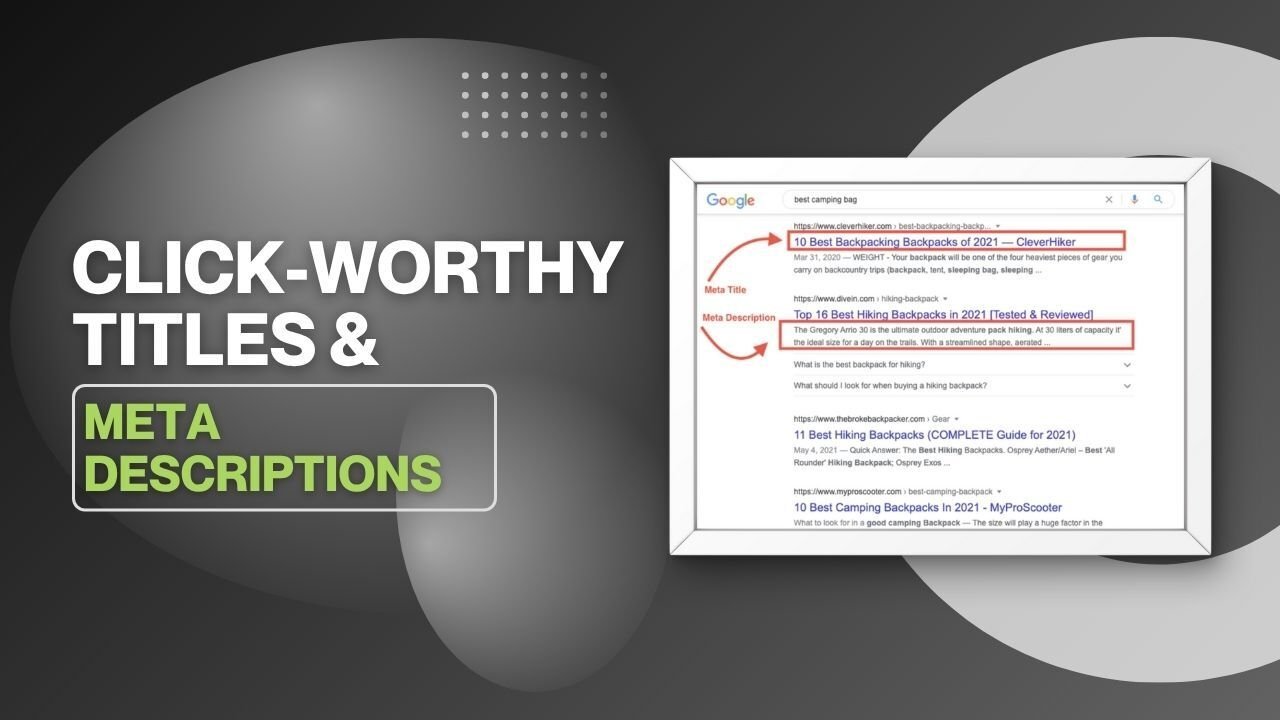
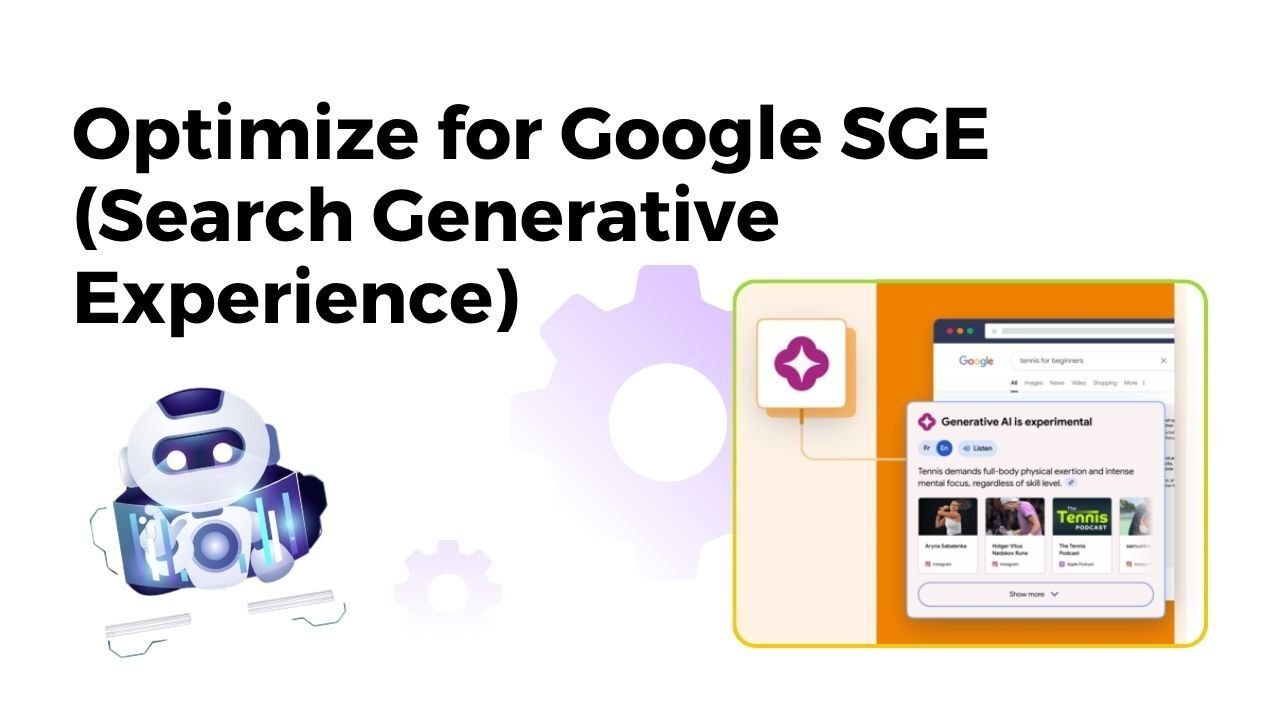
    They pair SEO with paid media and design to deliver growth across the buyer journey. Clients report dramatic improvements: “Now we are consistently ranking #1 on Google for our best‑selling products”.

    HigherVisibility uses its unique Targeted Growth System (TGS) to create custom SEO and PPC plans focused on clear, measurable results. They specialize in Franchise SEO to help brands grow across the country and Local SEO to improve visibility in nearby searches.

    They combine technical finesse, content strategy, and conversion optimization. If you are lookign for full-stack eCommerce SEO companies that has proven industry recognition and a broad skill set, HigherVisibility is a standout Texas option.

    Office Location: Austin, Texas
    Founded: 2003
    Team Size: 50–99

    Key Services: SEO, Paid Media, Web Design

    Industries Served: eCommerce, Finance, Healthcare

    8. Genie Crawl

    Genie Crawl

    Genie Crawl focuses on lean, agile SEO with flexible contracts and guaranteed pricing. Their boutique team customizes strategies to match each eCommerce brand’s goals.

    They emphasize personal attention, clear communication, and data-driven results. They’ve earned praise for shining a spotlight on small stores through thoughtful technical fixes, local SEO, and content pivots designed to move ranking quickly. 

    With over 10 years of experience, They specialize in SEO, PPC, and web development for various industries, including auto dealerships, law firms, healthcare providers, and real estate businesses.

    With tight teams and a responsive workflow, Genie Crawl is ideal when you want a Texas SEO partner that moves fast and scales with your business—without long-term lock-in.

    Office Location: Austin, Texas
    Founded: 2018
    Team Size: Under 50

    Key Services: SEO, Local SEO, Web Audits, Reporting

    Industries Served: Small Retail, Local Services

    9. Spectrum BPO

    spectrum

    Spectrum BPO focuses exclusively on marketplace eCommerce SEO. They serve 500+ brands like Amazon, Walmart, eBay, and Etsy brands—optimizing product listings, PPC campaigns, and A+ content. 

    Their disciplined approach blends scale with personalized support. Clients consistently rate their staff as “skilled, well‑trained, and efficient,” and note their adaptability and professionalism.

    If you’re selling across channels and need a Texas-based partner to handle SEO and listings at scale, Spectrum BPO offers Texas SEO expertise and infrastructure to manage multi-channel growth.

    Office Location: Richardson, Texas
    Founded: 2017
    Team Size: 250–499

    Key Services: Marketplace SEO, Product Listing, Amazon A+ Content, Walmart SEO

    Industries Served: Retail, Electronics, Health

    10. eSEOspace

    eSEOspace

    eSEOspace crafts web experiences built on SEO best practices from day one. They blend design, branding, and technical optimization into cohesive packages. 

    Their Houston-based team adapts content and structure based on user behavior and analytics—prioritizing local and on-page optimization for scalable visibility. 

    Brands appreciate their holistic method: websites that not only look polished but perform in search. For eCommerce businesses requiring site and SEO alignment at launch, eSEOspace delivers strategy and execution under one roof.

    Office Location: Houston, Texas
    Founded: 2008
    Team Size: Under 50
    Key Services: Web Design, Local SEO, eCommerce SEO

    Industries Served: eCommerce, Local Services

    11. My Biz Niche

    My Biz Niche

    My Biz Niche brings a unique data-first mindset to SEO and web design. Their team includes programmers, coders, and statisticians—not just marketers and writers. 

    They engineer performance—intentionally building sites for speed, conversion, and search visibility. Their work earning an Inc. 5000 mention reflects growth-driven culture. 

    From HVAC brands to DTC stores, they tailor solutions with analytical rigor and creative polish. If your eCommerce project needs backbone—structured data, fast UX, clean code—My Biz Niche offers a smart, strategic approach.

    Office Location: Austin, Texas
    Founded: 2014
    Team Size: 50–99

    Key Services: SEO, Web Design, UX Optimization

    Industries Served: eCommerce, B2B, Local Services

    12. Lounge Lizard

    Lounge Lizard

    With roots in branding and web design, Lounge Lizard blends creative flair and search engine optimization know-how. As a DesignRush award winner since 1998, they specialize in high-converting user experiences and smart optimization. 

    Their expansion brings full branding, design, and SEO services in Texas to local businesses. They craft standout eCommerce sites with crisp visuals and well-structured content—helping brands captivate audiences and climb rankings. 

    If you want an agency that values art and algorithms alike, and ensures your store looks as good as it ranks, Lounge Lizard fits the bill.

    Office Location: Austin, Texas
    Founded: 1998
    Team Size: 50–99

    Key Services: Branding, Web Design, eCommerce SEO, UX/UI

    Industries Served: Lifestyle, Hospitality, Fashion

    13. Agency Partner Interactive

    Agency Partner Interactive

    Agency Partner Interactive builds custom web and SEO strategies aimed at doubling—or tripling—revenue in 18 months. Based in Plano, they’ve completed over 1,800 projects for 850+ clients LinkedIn

    Their full-service model includes custom software, digital marketing, and design. They earned “Top 20 SEO Company in Texas” recognition from DesignRush. 

    Their tailored solutions cover site optimization, content workflows, and tech-stack integration—ideal for mid-market and enterprise eCommerce brands seeking measurable scale.

    Office Location: Plano, Texas
    Founded: (not disclosed)
    Team Size: 50–99

    Key Services: SEO, Web Development, Digital Marketing

    Industries Served: eCommerce, B2B, Software

    14. Thrive Internet Marketing Agency

    Thrive

    Thrive is a full-stack digital marketing and SEO agency. They craft mobile‑friendly, SEO-optimized websites backed by PPC, social media, and eCommerce strategy. 

    Their holistic approach delivers consistent, measurable impact—from improved traffic and conversions to enhanced UX. They’ve earned recognition in agency awards for both website design and SEO. 

    Whether launching a new Shopify site or optimizing an existing store, Thrive combines design and SEO to elevate visibility and boost sales.

    Office Location: Arlington, Texas
    Founded: 2005
    Team Size: 50–99

    Key Services: SEO, eCommerce Marketing, PPC, Web Design, Social Media

    Industries Served: Retail, eCommerce, SMBs

    15. Red Spot Design

    Red Spot Design

    Red Spot Design is a Dallas-based digital agency that focuses on affordable, results-driven SEO and web design. With over two decades of experience, they’ve helped hundreds of small and mid-sized businesses enhance their online visibility. 

    What stands out is their hands-on approach. They don’t outsource. Everything from strategy to development is handled in-house—ensuring better quality control. Their SEO work emphasizes technical health, localized keyword targeting, and conversion optimization. 

    For eCommerce brands that want a smaller agency with a strong reputation, personalized attention, and deep local SEO knowledge, Red Spot Design is a trusted pick in Texas.

    Office Location: Dallas, Texas
    Founded: 2001
    Team Size: 10–20 employees

    Key Services: SEO, Web Design, Local SEO, PPC

    Industries Served: eCommerce, Healthcare, Legal, Local Retail

    Conclusion

    Choosing the right eCommerce SEO company isn’t about finding the biggest agency—it’s about finding the right fit for your goals, platform, and growth stage. Each of the 15 Texas-based agencies listed here brings something unique to the table. 

    Some, like Ecomoptix, specialize in technical SEO and Shopify optimization. Others, like Spectrum BPO, are experts in marketplace SEO for Amazon and Walmart sellers. And then there are full-service powerhouses like SmartSites and Victorious, offering end-to-end SEO campaigns with proven ROI.

    If you’re serious about scaling your online store in 2025, the right SEO partner will save you time, drive measurable growth, and keep you ahead of the competition. Use this list as your launchpad—and don’t hesitate to reach out to a few of these agencies for a consultation.

    Want help deciding which eCommerce SEO company might be best for your store? Drop your details in the comments or get in touch—we’re happy to help.