
Home improvement ecommerce marketing is entering 2027 with a new set of rules. For years the formula was simple: buy more traffic, run more promotions, and let the product grid do the selling. That formula is breaking, and a lot of online stores haven’t noticed yet.
Here’s what the new game looks like. A homeowner wants to replace 400 square feet of flooring in a basement that took on water last spring. Before she ever lands on a store, she asks an AI assistant which vinyl plank holds up to moisture, how many boxes she needs, and whether the underlayment comes attached. If your product data can’t answer those questions, you aren’t part of the answer. If you are, but freight to her ZIP code only shows up at checkout, you lose her there instead.
The stores still growing online have moved their effort to two places. Upstream, into product data and clear delivered costs. Downstream, into the next project the same customer will start. The stores stuck in place keep paying for traffic that lands on the same thin category pages.
This guide covers the six new rules of online growth for home improvement retailers in 2027, what is confirmed versus forecast, and a 90-day plan you can start this quarter.
What Are the New Rules of Home Improvement Ecommerce Marketing in 2027?
The new rules come down to one shift: home improvement ecommerce marketing in 2027 is about winning the buying decision, not just winning the click. Growth will come from taking market share, because the market itself is barely growing.
The numbers explain why. The Leading Indicator of Remodeling Activity from Harvard’s Joint Center for Housing Studies, released in July 2026, projects homeowner improvement and repair spending of about $519 billion through mid-2027, with year-over-year growth slowing to 0.5 percent. That is a forecast, and the next update is due October 22, 2026, but the direction is hard to miss.
Online share keeps climbing anyway. The U.S. Census Bureau’s quarterly ecommerce report put ecommerce at 17.1 percent of all U.S. retail sales in the second quarter of 2026, up 12.2 percent from a year earlier while total retail grew 6.7 percent. That covers all retail, not home improvement alone, but it shows where buying behavior keeps drifting.
Put the two together and the implication is uncomfortable. When the category is flat, each new online customer is one that a competitor, a marketplace, or a big-box chain failed to keep.
Your site also does work you never see in the sales report. The Home Improvement Research Institute’s homeowner ecommerce study found that more than half of in-store purchases involve prior online research, and about 40 percent of homeowners want to move freely between online and in-store channels. Homeowners also named cabinets, flooring, exterior doors, and countertops as the products they most want to see in person before buying.
In a flat market, traffic you can’t convert is just a more expensive way to stay flat.
Here is what is settled and what is still a projection heading into 2027:
| Development | Status | Source |
|---|---|---|
| Checkout inside Google AI Mode and Gemini for eligible U.S. retailers, built on the Universal Commerce Protocol | Announced January 2026, rolling out | |
| New Merchant Center attributes for product Q&A, compatible accessories, and substitutes | Announced, rolling out in stages | |
| 500 x 500 pixel minimum for Merchant Center product images | Enforcement begins January 31, 2027 | Google Merchant Center |
| Remodeling spending growth near 0.5 percent by mid-2027 | Forecast | Harvard JCHS |
The Six New Rules at a Glance
Together, the six rules below form what we call the Project-Proof Growth Model, a way to plan marketing around how people actually buy home improvement products: by project, by specification, and by total delivered cost.
Three buying modes sit underneath it. Project-led buyers, renovating a bathroom or rebuilding a deck, need many products in the right sequence and within budget. Inspiration-led buyers, choosing lighting, decor, or furniture, need visual context and confidence in a style. Specification-led buyers, replacing a hinge, ordering lumber, or matching a faucet cartridge, need exact dimensions and compatibility, and little else matters.
Most catalogs contain all three. Generic ecommerce playbooks treat everything like the inspiration-led mode, which is why so many home improvement stores look polished and still convert poorly.
| New rule | The shopper’s question | Where it gets answered |
|---|---|---|
| 1. Sell the project, not the SKU | What do I need for this job? | Category pages, project guides |
| 2. Treat product data as marketing | Will this fit and work with what I have? | Product pages, Merchant Center feed, structured data |
| 3. Show the delivered cost early | What will it cost to get here, and what if it’s wrong? | Product page, cart, shipping and return policies |
| 4. Market to the next project | What do I need next? | Email, SMS, accounts, pro programs |
| 5. Let the feed run paid media | Which products deserve the budget? | Merchant Center, Shopping, Performance Max |
| 6. Measure margin, not ROAS | Did this order actually make money? | Analytics, ecommerce platform, finance |
Rule 1: Sell the Project, Not the SKU
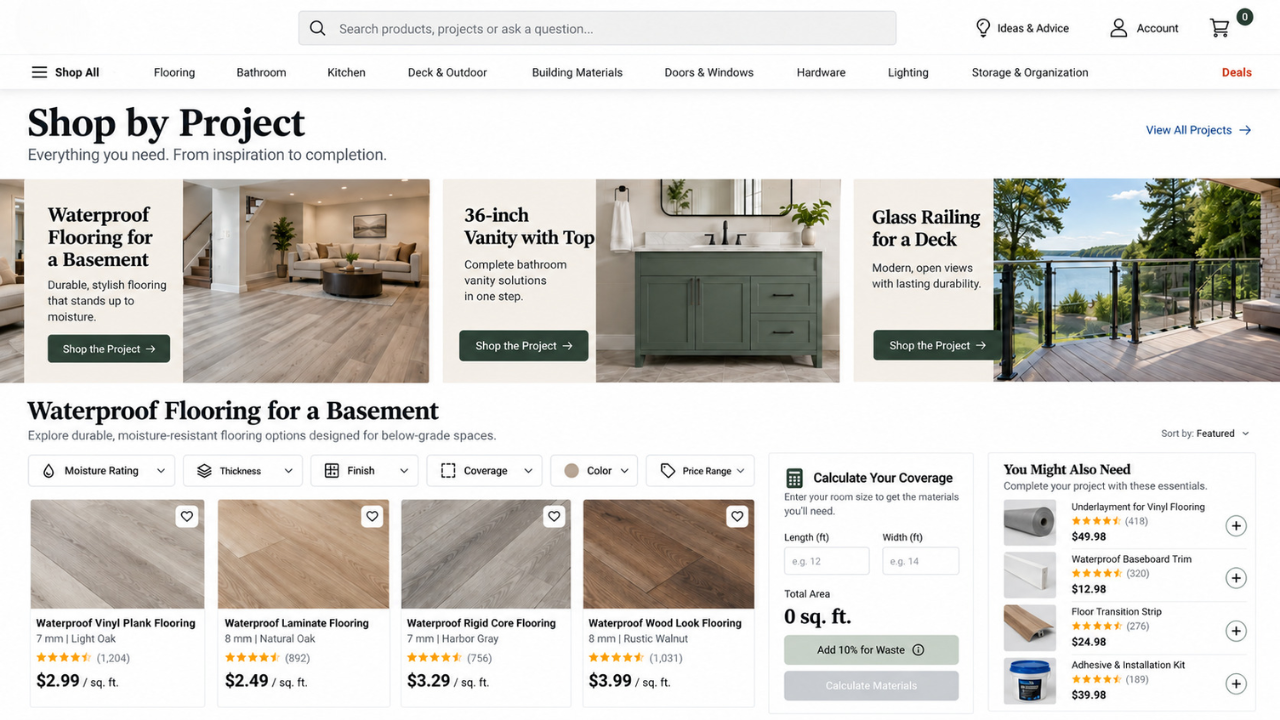
Home improvement search demand starts with a job, so your category structure should start there too. People search for “waterproof flooring for a basement,” “36-inch vanity with top,” or “glass railing for a deck,” not for your internal taxonomy. Searches like these carry clear buying intent, and our list of high-intent keywords that boost ecommerce sales shows how to spot and use them.
AI search makes this sharper. Google’s guide to optimizing for generative AI features explains that AI Overviews and AI Mode are rooted in its core ranking systems and use query fan-out, running several related searches behind a single question. Google’s own example is a question about fixing a lawn full of weeds, which fans out into searches about herbicides, chemical-free removal, and prevention. Nearly every home improvement question behaves the same way, so a store whose collection pages cover the real sub-questions of a job gets more chances to be pulled in. Before restructuring anything, it helps to understand how SEO, AEO, and GEO now work as one search system rather than three separate projects.
The tempting move is to mass-produce a page for every “flooring for X” variation. Google’s same guide says that creating pages for fan-out variations mainly to manipulate rankings or AI responses violates its scaled content abuse policy. What holds up is the opposite. Build fewer, deeper collection pages around real jobs, each with short buying guidance, the filters people actually use (moisture rating, thickness, finish), and a quantity or coverage helper where it applies.
In the home and furniture store audits we run, the most common gap is a collection page that ranks for almost nothing because it’s a product grid with one generic sentence above it. Our quick test is simple. Can a shopper answer three questions without leaving the page: which one, how many, and what else do I need? If not, that page is your first fix.
Rule 2: Treat Product Data as Marketing
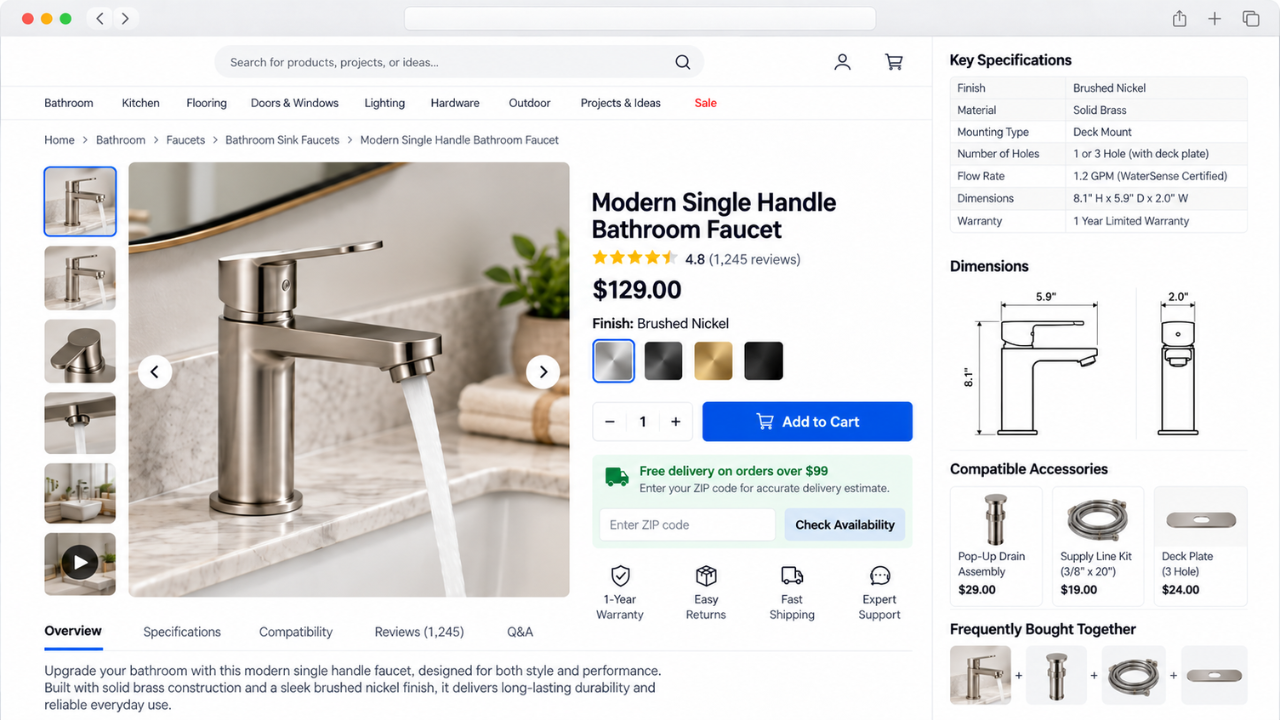
Your product data is now your most persuasive marketing asset, because shoppers and AI shopping surfaces both read it before they read your copy.
Google made this concrete in January 2026. Its announcement of the Universal Commerce Protocol introduced checkout inside AI Mode and the Gemini app for eligible U.S. retailers, a branded Business Agent that answers product questions on Search (launched with retailers including Lowe’s), and dozens of new Merchant Center attributes covering common product questions, compatible accessories, and substitutes. The Home Depot was among the companies endorsing the protocol.
Much of the data these surfaces need already has a home. The Merchant Center product data specification supports product length, width, height, and weight; up to 100 technical detail rows; up to 30 question-and-answer pairs; related products tagged as required parts, accessories, or substitutes; links to PDF documents such as install guides; and, in the U.S., links to 3D models. Few home improvement stores fill in more than the basics.
| Category | Data that decides the sale | Where it belongs |
|---|---|---|
| Flooring and tile | Coverage per box, thickness, wear layer, water resistance | Product details, Q&A, on-page spec table |
| Lighting and fixtures | Dimensions, lumens, color temperature, bulb base, dimmer compatibility, damp or wet rating | Product details, related products (bulbs, dimmers) |
| Railings and building materials | Dimensions, glass or material thickness, mounting type, weight, certifications | Dimension and weight attributes, spec sheet and install guide PDFs |
| Hardware and tools | Thread size, finish, battery platform, required parts | Related products (required part, accessory) |
| Kitchen and bath | Rough-in, mounting type, valve compatibility | Q&A, install guide PDF |
| Furniture and decor | Assembled dimensions, seat height, doorway clearance, materials | Dimension attributes, 3D model link |
Glass railing is a good example of why this matters. It’s a high-ticket, specification-led purchase, and the buyer is usually measuring a real deck, balcony, or staircase. They want glass thickness, mounting style (top-mount or side-mount), hardware finish, and installation details they can check against their own space before they order or request a quote. In our work with railing and furniture stores, the product pages that answer those questions up front are the ones that earn both the order and the quote request. Furniture has the same fit problem with seat height and doorway clearance, which is why it sits at the center of most furniture store SEO work.
Most stores respond to weak rankings by writing longer descriptions. Almost none complete the structured fields a machine can actually compare. When an assistant narrows results to wet-rated fixtures and your listing never states a rating, the listing has nothing to match on. If you use AI tools to draft descriptions at scale, have a person check every spec, and read up on how generative AI is changing ecommerce SEO before you publish hundreds of pages at once.
Consistency matters as much as completeness. Merchant Center lists conflicting data between your feed and your website among the common problems that can keep products from showing. Google’s merchant listing structured data supports price, availability, shipping, and return details, and recommends defining shipping and return policies once at the organization level. The on-page basics in our guide to optimizing an ecommerce product page for SEO still apply. The difference in 2027 is that the spec table, the feed, and the markup now carry as much weight as the description.
Rule 3: Show the Delivered Cost Before Checkout
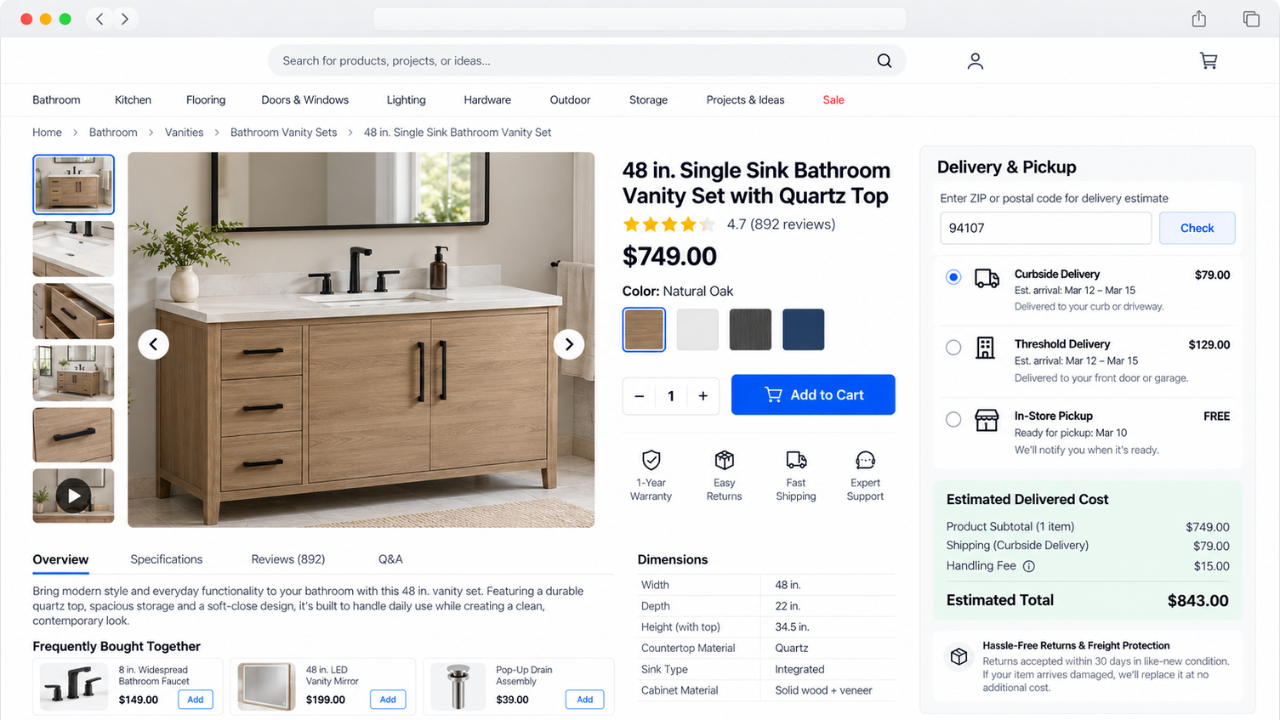
Let’s be honest about why people leave. It’s usually not your button color. It’s the moment they find out what the thing actually costs to get to their door.
The abandonment data backs this up. Among U.S. shoppers who abandoned a cart for reasons other than browsing, Baymard Institute’s checkout research found 40 percent left because extra costs were too high, 20 percent because delivery was too slow, 13 percent over the returns policy, and 12 percent because they couldn’t see the total cost upfront. HIRI’s homeowner study adds category detail. Difficulty judging product quality, high shipping costs, and the need for same-day delivery or pickup lead more than a third of homeowners to abandon online carts, and younger buyers worry more about damage in transit.
For bulky, heavy, or fragile goods, those numbers describe a business model problem, not a design problem. A vanity, a pallet of pavers, a set of glass panels, or a sectional sofa carries freight costs that a flat free-shipping banner can’t absorb without wrecking margin. What works better is transparency early:
- A ZIP-based delivered-cost estimate on the product page, before the cart
- The delivery type stated plainly (curbside, threshold, or room of choice) with a realistic window
- A clear damage and return policy for freight items, including who pays return shipping
- Low-cost samples for flooring, tile, countertops, and paint, the categories homeowners most want to touch first
These are the fixes that usually move the needle fastest in ecommerce conversion rate optimization for this category, well ahead of redesigns.
Retailers with showrooms or local stock have another option. Google’s local inventory ads documentation reports that retailers running local inventory ads alongside Shopping ads saw 21 percent more store visits and 9 percent more online conversions for products available in store, based on Google data from July 2023 to July 2024. For buyers near a store, pickup removes the freight question entirely.
Shipping cost revealed at checkout is the most expensive copy on your site.
Rule 4: Market to the Next Project
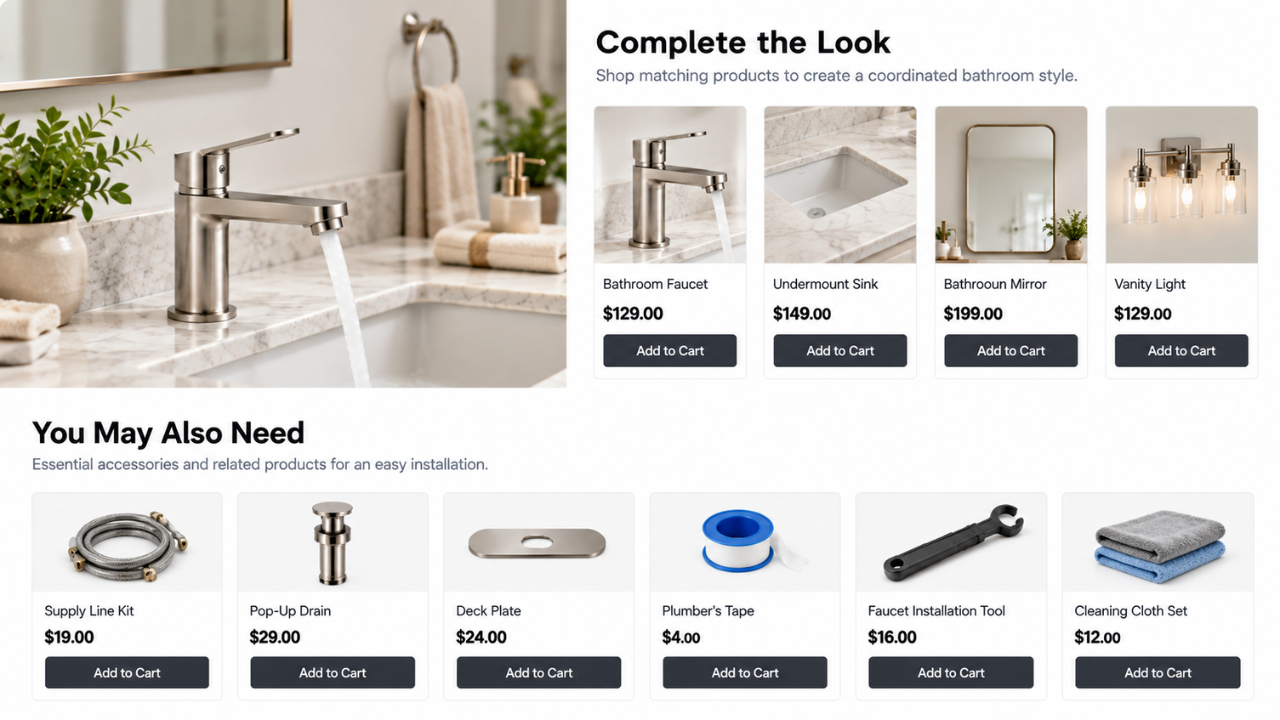
Home improvement customers come back on a project cycle, so your retention should follow project stages, not a generic weekly promo calendar.
Think about it from the buyer’s side. Someone who just laid new flooring is going to need transitions, baseboard, rug pads, and cleaner. A lighting buyer comes back for bulbs and dimmers. A cordless tool buyer is now tied to a battery platform. A homeowner who installed a deck railing may want matching stair sections, lighting, or cleaning and care products. None of this is a mystery, and the related-product data you built under Rule 2 doubles as the logic for your post-purchase flows.
Capture project context at checkout with one optional question, such as the room, the project type, or the planned completion date, and use it to time follow-ups.
Contractors and installers deserve their own track. They buy repeatedly, often in larger quantities, and they care far more about saved lists, quick reorders, quote requests, and account pricing than a 10 percent coupon. Building those paths is usually cheaper than buying the next new customer.
Most stores treat the first order as the finish line. In this category it’s usually the first of several.
Rule 5: Let the Feed Run Your Paid Media
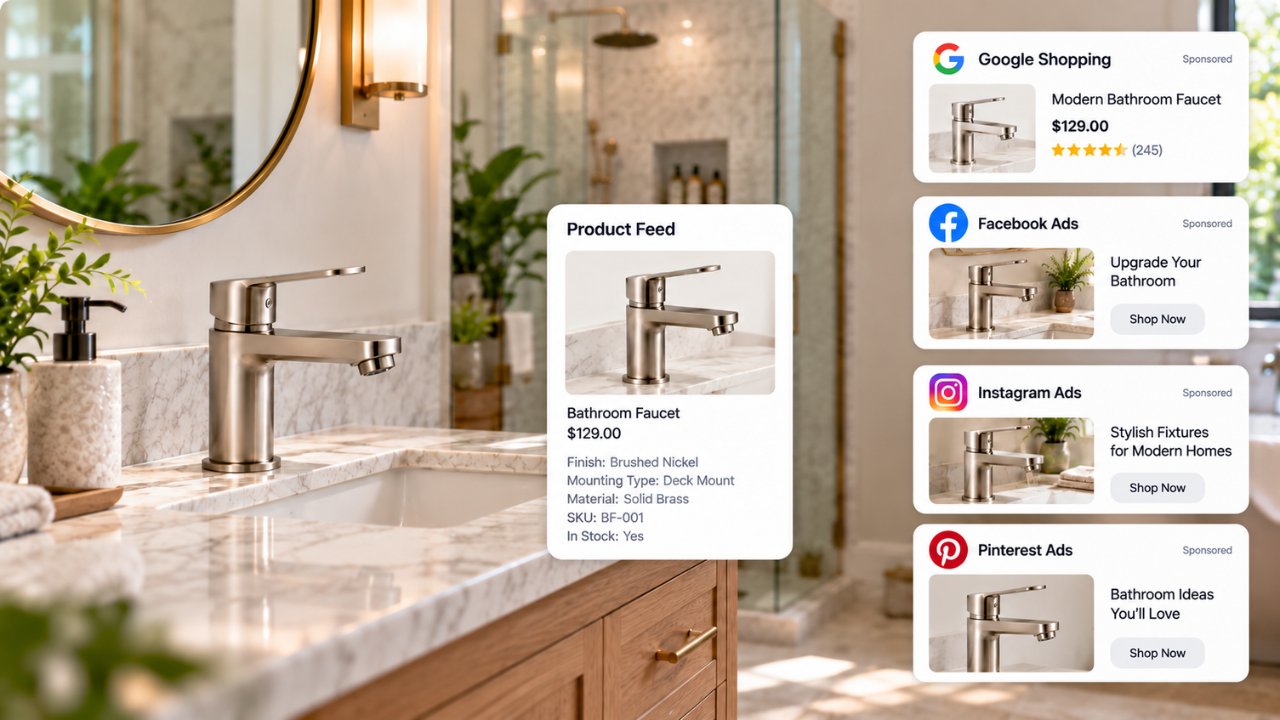
Shopping and Performance Max campaigns can only bid intelligently on products they understand, so feed quality now does much of the work keyword management used to do.
Two practical moves stand out. First, segment the catalog by economics, not just category. Use Merchant Center custom labels for margin band and freight class, and submit cost of goods sold so reporting reflects gross margin rather than revenue. A $40 faucet and a $1,400 vanity should never share one blended return target. Second, watch Google’s Direct Offers pilot, which lets advertisers show exclusive offers inside AI Mode and is being shaped with brands including Rugs USA. It’s a pilot, so treat it as a test budget, not a plan.
Assistants beyond Google rely on their own crawlers and sources. A structured GEO checklist for AI citations helps you check crawler access, evidence, and third-party mentions without guessing.
Rule 6: Measure Margin, Not ROAS
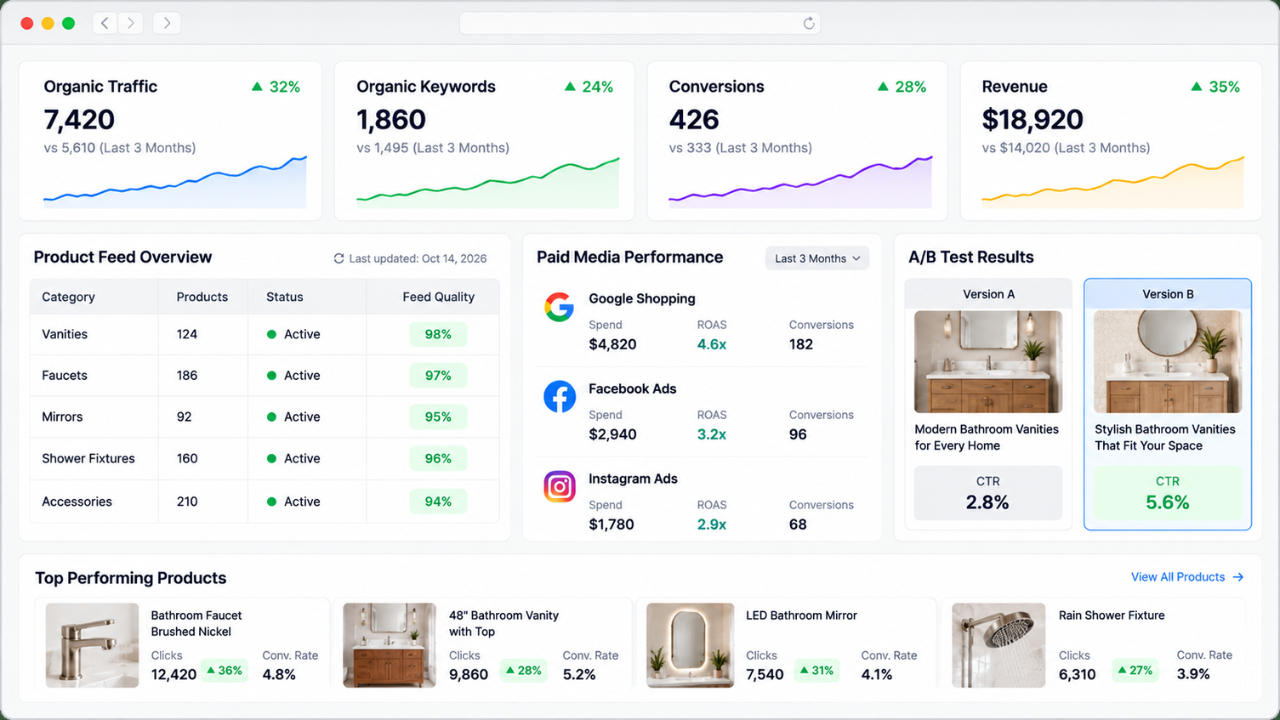
Platform ROAS overstates the value of heavy, freight-intensive, return-prone orders and understates research that closes in a store, so contribution margin per order is the number to manage in 2027.
Track these at minimum:
- Contribution margin per order after product cost, freight, payment fees, and expected returns or damage
- Customer acquisition cost by channel, judged against first-order margin rather than revenue
- Average order value by project type, since bathroom and flooring projects behave differently from single-item replacement buys
- 12- to 24-month customer value, because project cycles take time to repeat
- Quote requests and online-to-offline signals, such as store visits and pickup orders, for high-ticket or multi-location retailers
- AI visibility, using the Generative AI performance report Google added to Search Console
Plenty of owners stall here because the measurement stack needs analytics, feed, and platform work at the same time. If you’re weighing whether to build that capability in-house or bring in a partner, this plain-English look at what a digital marketing agency does for small businesses lays out what typically gets handed off and what stays with you. Whoever you choose, an ecommerce marketing agency should report on orders and margin, not just traffic and rankings.
A 90-Day Plan for 2027
- Pull your top 50 SKUs by revenue and score each one for dimensions, key specs, compatibility, Q&A, and image quality against the Merchant Center specification.
- Fix mismatches in price, availability, and shipping between your feed and your pages before adding anything new.
- Rebuild your five highest-potential collection pages around real jobs, with buying guidance and the filters shoppers use.
- Show a delivered-cost estimate and delivery type on the product page for every freight item.
- Launch one post-purchase flow per major category, timed to the next likely purchase.
- Rebuild reporting around contribution margin and add Search Console’s generative AI report to your monthly review.
Conclusion: The Stores That Win 2027 Answer First
In a flat market, the store with the most complete answer gets the sale, whether a person or an AI agent is asking. That means project-level category pages, specification data a machine can compare, delivered-cost certainty before checkout, retention that follows the customer into the next job, and reporting that tracks margin instead of platform ROAS.
If your catalog has the right products but thin data, the fastest return usually comes from an audit of your top-selling SKUs and collection pages. It’s the first step in most ecommerce SEO services worth paying for, and it’s worth doing whether or not you bring in help.
Frequently Asked Questions
How is AI shopping changing home improvement ecommerce in 2027?
AI tools now answer product questions and, for eligible U.S. retailers, can complete checkout inside Google AI Mode and Gemini. That puts more weight on structured product data, such as dimensions, compatibility, and Q&A, because assistants compare listings on those fields. Stores with thin or inconsistent data are less likely to be included in the answer.
Do home improvement stores still need SEO if they run Google Shopping ads?
Yes. Shopping ads capture buyers who already know what they want, while SEO and content capture the earlier project research that shapes which store they trust. Both also rely on the same product data, so improving one usually helps the other.
How can online stores sell bulky products like vanities, glass railings, or furniture profitably?
Show the delivered cost and delivery type on the product page, price freight by zone or class instead of hiding it behind a blanket free-shipping offer, and state your damage and return terms clearly. Samples, local pickup, and quote requests for large orders also reduce abandonment on high-ticket items.
How long does SEO take for a home improvement ecommerce store?
Technical fixes and product data improvements can help existing traffic within weeks. Organic growth from new rankings usually takes several months, depending on competition, catalog size, and how quickly changes get implemented. Anyone promising guaranteed rankings in a set time frame is overpromising.
What metrics matter most for a home improvement online store?
Contribution margin per order, customer acquisition cost by channel, average order value by project type, and repeat purchase value over 12 to 24 months matter more than platform ROAS. High-ticket stores should also track quote requests, and multi-location retailers should track store visits and pickup orders.
How is AI shopping changing home improvement ecommerce in 2027?
AI tools now answer product questions and, for eligible U.S. retailers, can complete checkout inside Google AI Mode and Gemini. That puts more weight on structured product data, such as dimensions, compatibility, and Q&A, because assistants compare listings on those fields. Stores with thin or inconsistent data are less likely to be included in the answer.
Do home improvement stores still need SEO if they run Google Shopping ads?
Yes. Shopping ads capture buyers who already know what they want, while SEO and content capture the earlier project research that shapes which store they trust. Both also rely on the same product data, so improving one usually helps the other.
How can online stores sell bulky products like vanities, glass railings, or furniture profitably?
Show the delivered cost and delivery type on the product page, price freight by zone or class instead of hiding it behind a blanket free-shipping offer, and state your damage and return terms clearly. Samples, local pickup, and quote requests for large orders also reduce abandonment on high-ticket items.
How long does SEO take for a home improvement ecommerce store?
Technical fixes and product data improvements can help existing traffic within weeks. Organic growth from new rankings usually takes several months, depending on competition, catalog size, and how quickly changes get implemented. Anyone promising guaranteed rankings in a set time frame is overpromising.
What metrics matter most for a home improvement online store?
Contribution margin per order, customer acquisition cost by channel, average order value by project type, and repeat purchase value over 12 to 24 months matter more than platform ROAS. High-ticket stores should also track quote requests, and multi-location retailers should track store visits and pickup orders.