
Plenty of small businesses are busy online and still not growing. They post three times a week, boost the odd post, keep a Google Ads campaign running that someone set up two years ago, and send a newsletter when there’s time. Revenue moves a little, then flattens. The problem usually isn’t effort. None of those activities are connected, so nobody can tell which ones pay for themselves and which ones just feel productive.
The small business growth strategies that hold up in 2027 work differently. They treat digital channels as one system: a focused offer, visibility wherever buyers ask questions (AI answers included), a website that converts, a reason for customers to come back, and a few numbers that tell you where the next dollar should go. Get those pieces working together and growth gets cheaper over time instead of more expensive.
What digital business growth means in 2027
Digital business growth is the process of increasing revenue and profit by using digital channels, customer data, and tools as one connected system that attracts the right customers, converts them, keeps them, and learns from every step. It isn’t the same thing as “doing digital marketing.” Marketing is one part of it. Growth also covers your offer, your margins, your customer experience, and the data that tells you what’s working.
The 2027 part matters because the path to purchase has more stops than it used to. A buyer might read a Google AI Overview, ask ChatGPT for a shortlist, check reviews on a map listing, and only then visit two websites. Your business has to show up, and make sense, at each of those points.
Digital growth vs. running campaigns
A campaign is a burst. A holiday sale, a promoted post, a month of ads. When it stops, the results usually stop too. A growth system is built so that each piece makes the next one cheaper.
Picture a home-goods store running a spring sale on Meta. As a standalone campaign, it brings in orders for two weeks and that’s the end of it. As part of a system, those first-time buyers join an email flow that asks for a review after delivery, suggests a matching product three weeks later, and invites them back for the next launch. The reviews make product pages more convincing. The questions customers ask in support emails become FAQ content that ranks in search and gets pulled into AI answers. The same ad spend keeps paying long after the ads stop.
Campaigns rent attention. Systems compound it.
What is digital business strategy?
A digital business strategy is a plan for where digital technology, data, and channels will give your business an advantage, and where they won’t. MIT’s Center for Information Systems Research describes digital strategy as “a business strategy inspired by the capabilities of powerful, readily accessible technologies.” The important word is business. A digital strategy isn’t a list of tools or a social media calendar.
For a small business, it comes down to three decisions:
- Where you’ll compete. Which customers, which offers, which markets.
- How digital helps you win there. Faster service, better product information, easier buying, stronger visibility for the questions your buyers ask.
- What you’ll deliberately ignore. The platforms, tools, and trends that don’t serve the first two decisions.
Digital marketing is the execution layer. Digitization, such as moving invoicing into software, is about efficiency. Digital business strategy sits above both and decides what’s worth doing in the first place. Every sound small business strategy now has a digital strategy inside it, whether it’s written down or not.
What changed heading into 2027
Some of what follows is established fact and some is informed expectation. It’s worth keeping the two apart.
Here’s what’s measurable today:
- Google reported in July 2025 that AI Overviews had more than 2 billion monthly users. By its Q2 2026 earnings update, AI Mode alone had passed 1 billion monthly active users, and Google had brought AI Overviews and AI Mode together into one search experience.
- People click less when an AI summary appears. Pew Research Center found users clicked a traditional search result in 8% of visits when an AI summary was shown, compared with 15% when it wasn’t. A 2026 Ahrefs study found an AI Overview correlates with a 58% lower average click-through rate for the top-ranking page.
- OpenAI said in March 2026 that ChatGPT had more than 900 million weekly active users.
- In BrightLocal’s 2026 Local Consumer Review Survey, the share of consumers using ChatGPT and other AI tools for local business recommendations rose from 6% to 45% in a year.
- US ecommerce sales reached 17.1% of total retail sales in Q2 2026, according to the US Census Bureau.
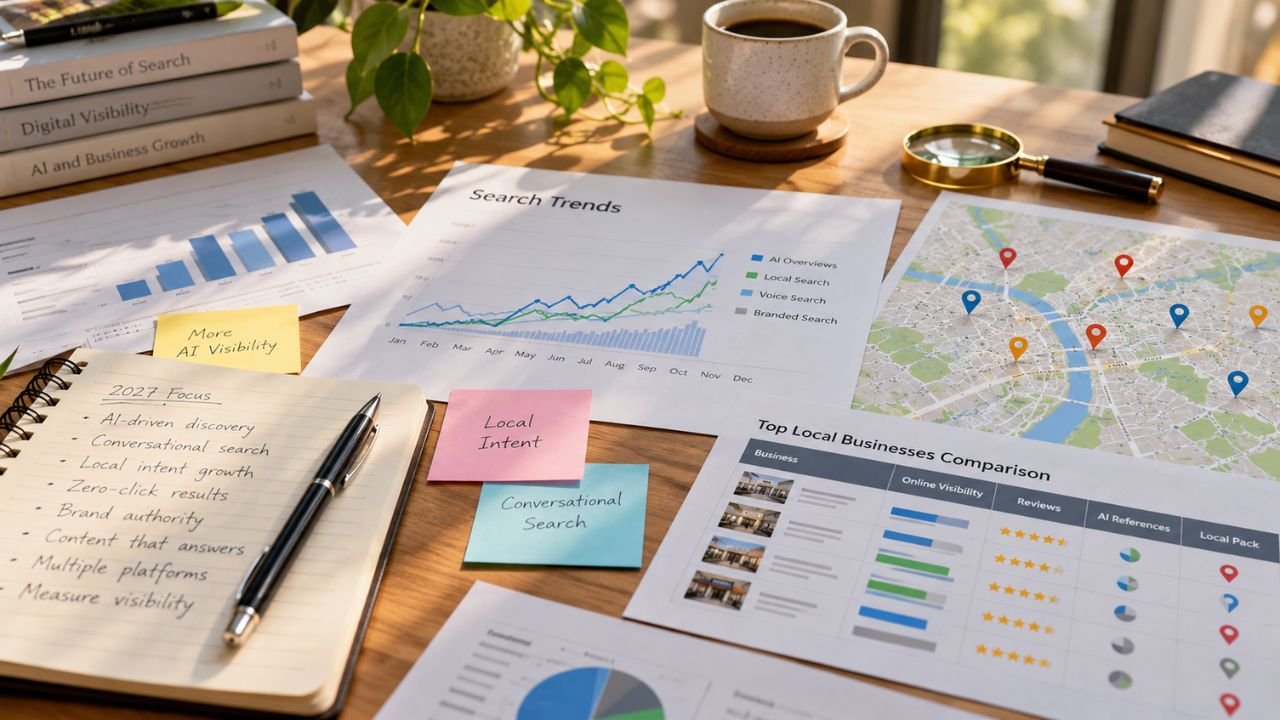
What that likely means for 2027 is an expectation, not a guarantee. Expect fewer clicks from search, but clicks from people further along in their decision. Being the source an AI answer draws on will matter alongside ranking. And businesses that own their customer relationships, through email lists, CRM data, and repeat buyers, will be less exposed when any one platform changes the rules.
The Five-Layer Growth Stack
The most useful way to build a small business growth strategy is as five layers that depend on each other. Skip one and the layers above it get more expensive.
| Layer | The question it answers | Signs it’s working |
|---|---|---|
| Focus | Who are we for, and what do we offer that they can’t easily get elsewhere? | A growing share of revenue from your target customer; healthy gross margin |
| Found | Can the right people find us when they’re looking, including in AI answers? | Qualified traffic, growth in branded searches, mentions and citations |
| Convert | When they arrive, do they buy, book, or inquire? | Conversion rate by channel, average order value, lead-to-sale rate |
| Keep | Do they come back, buy more, and tell others? | Repeat purchase rate, retention by cohort, steady reviews and referrals |
| Measure | Do we know which of the above is actually paying off? | Customer acquisition cost, lifetime value, payback period, revenue by channel |
Most small businesses build this stack upside down. They start with Found because it’s the most visible part (buy ads, post more, chase traffic), skip Convert and Keep, and never properly set up Measure. Then they wonder why every new customer costs more than the last one.
Pouring more traffic into a leaky website doesn’t grow a business. It just makes the leak more expensive.
The build order matters more than the tactics
If you already have steady traffic and customers, the order that usually pays back fastest is Focus, then a basic Measure baseline, then Convert and Keep, and only then scaling Found. Fixing conversion and retention first means every dollar you later spend on acquisition works harder.
If you’re new and have almost no traffic, you can’t optimize what doesn’t exist yet. Get enough visibility to win your first customers and learn from them, then tighten Convert and Keep as soon as you have real data to work with. In both cases, Measure runs underneath everything from day one, even if it starts life as a spreadsheet.
Layer 1: Focus on the customer, offer, and market you can win
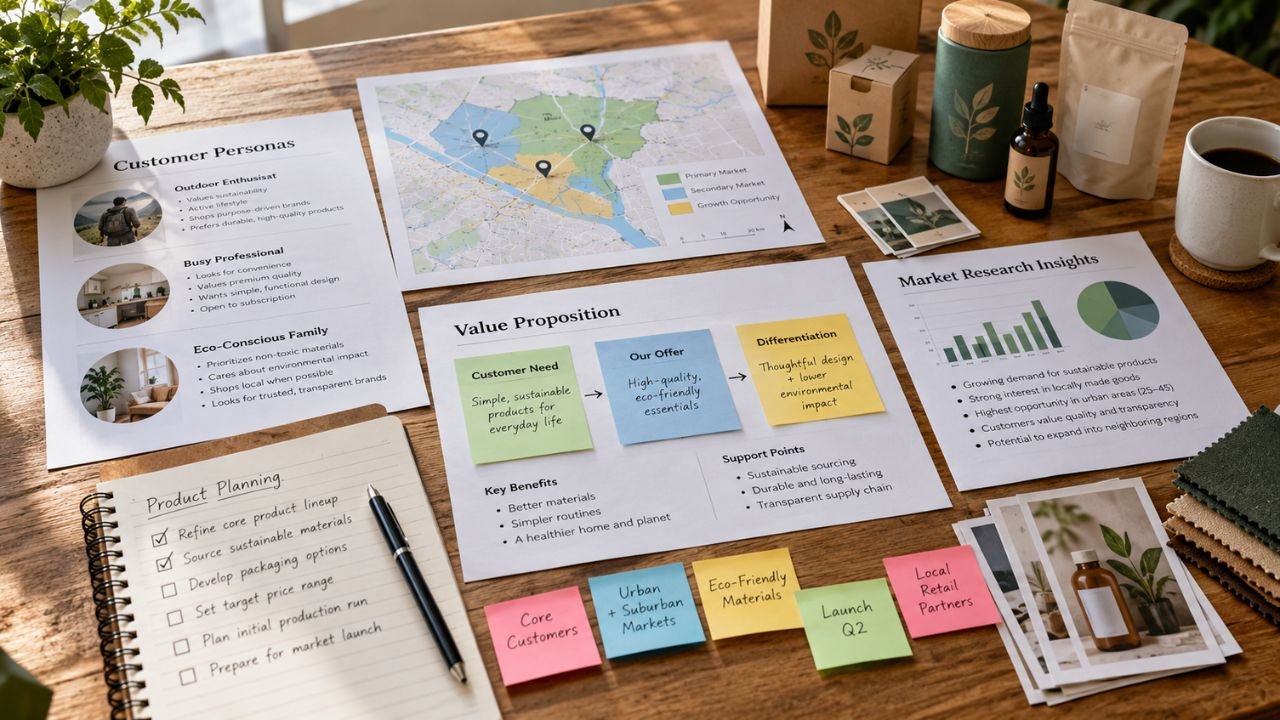
The cheapest growth strategy for a small business is narrowing down. A clearly defined customer and offer makes every later layer easier. Your content gets more specific, your ads convert better, and your reviews start saying the same thing about you.
A growth strategy for small business has to respect limited time and money, so focus is where a small team gets the biggest return.
- Pick a primary customer. Not “homeowners” but “homeowners in older houses who want energy upgrades without a full renovation.” Look at your 20 most profitable customers (profit, not revenue) and write down what they have in common.
- Pick a hero offer. The product, service, or bundle you most want to be known for. Its margin has to survive the cost of winning a customer.
- Write one sentence of positioning. “We help [customer] get [outcome] without [the usual frustration].” If you can’t fill that in without sounding like your three nearest competitors, positioning is your first problem, not marketing.
- Check your unit economics before choosing channels. If your average order earns $15 in gross profit, paid social will be hard to make work. If it earns $400, it might be easy.
How can small businesses inspire growth in the market?
Small businesses rarely win by outspending anyone. They win by being more specific, more useful, and easier to trust. That might mean publishing prices when competitors hide them, answering the awkward questions buyers usually only ask on a sales call, showing real people and real work instead of stock photos, or serving a niche that bigger brands consider too small to bother with. Those moves get noticed and talked about. Increasingly, they also get cited by AI tools looking for a specific, credible answer.
McKinsey’s research on growth found that “eighty percent of growth comes from maximizing the value of your core.” That’s a useful reality check before you launch a new product line or open a new region. Have you actually saturated the customers you already serve well? The classic Ansoff growth directions get riskier in a predictable order: selling more to your current market, taking your current offer to a new market, building new products for current customers, and diversifying into something new. Most small businesses should wring everything out of the first before touching the last.
When not to expand. Hold off when your core offer doesn’t yet have a repeatable way to win customers, a healthy margin, or the operational capacity to deliver more. Growth that outruns cash and capacity is one of the quicker ways to stall a business. Bureau of Labor Statistics data shows that roughly 1 in 5 new private business establishments close within their first year, and about half are gone within five years.
Layer 2: Get found across search, AI answers, and paid channels
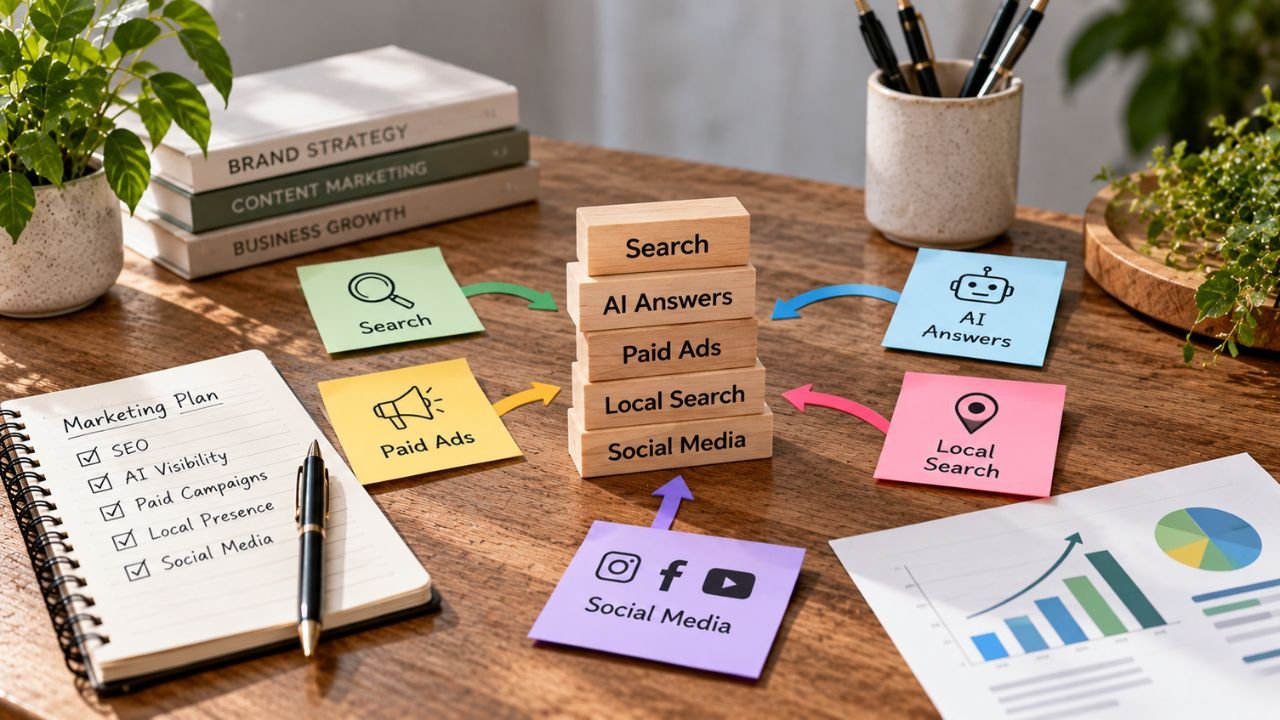
Being found in 2027 means showing up wherever buyers ask questions, from traditional search results and AI-generated answers to map listings, marketplaces, and social feeds. For most small businesses, organic search is the compounding base and paid media is the accelerator and testing ground. Getting that relationship backwards is expensive.
Search is still the foundation, and the entry ticket to AI answers
There’s plenty of noise about “optimizing for AI,” but Google’s own guidance is blunt. Its documentation for site owners says there are “no additional requirements to appear in AI Overviews or AI Mode, nor other special optimizations necessary.” The fundamentals still apply. Let your pages be crawled, link them together sensibly, put important content in text, make sure structured data matches what’s visible on the page, and keep your Business Profile and Merchant Center information current.
So the practical work looks familiar, just done more deliberately:
- Map your most valuable pages (service pages, category pages, core product pages) to the questions buyers ask before they purchase.
- Fix the technical issues that stop those pages from being crawled or loading quickly.
- Build content around real buyer questions, not keyword lists alone.
- Earn links and mentions from sites your customers actually read.
The standard advice is “publish more blog posts.” What works more often is improving the pages closest to the sale first, then building content that supports them. For online stores, that means category and product pages usually carry more revenue potential than the blog, which is why ecommerce SEO puts so much weight on them.
AEO and GEO: earning the answer, not just the ranking
Answer engine optimization (AEO) is about structuring content so search features and AI tools can lift a clear answer from it. Generative engine optimization (GEO) is about becoming a source that AI systems trust enough to cite or recommend. Both sit on top of solid SEO rather than replacing it, which our guide to how AEO, GEO, and SEO drive business growth covers in more depth.
For a small business, that translates into a few concrete habits:
- Lead with the answer. Open each important section with a direct answer, then explain. Passages that make sense on their own are easier to quote.
- Be consistent everywhere. Your business name, location, services, prices, and positioning should match across your website, Google Business Profile, directories, and social profiles.
- Get talked about elsewhere. Reviews, press mentions, partner pages, and community discussions give AI systems something other than your own claims to work from.
- Skip the shortcuts. Google says you don’t need new machine-readable files, AI text files, or special markup to appear in its AI features.
The catch is fewer clicks. With Pew’s data showing clicks to regular results nearly halving when an AI summary appears, visibility and traffic are no longer the same thing. The visitors you do get become more valuable, which is exactly why the Convert and Keep layers matter more now, not less. If you want a hands-on list to work through, this GEO checklist ranks the steps by impact.
Local search, if you serve an area
If customers come to you, or you go to them, your Google Business Profile and reviews are often your most valuable digital assets. BrightLocal’s 2026 survey found that 97% of consumers read reviews for local businesses, 68% will only use a business rated four stars or higher, and 74% look for reviews written in the last three months. Recency matters as much as the rating itself, so a steady flow of reviews beats a one-off push.
Paid search and paid social are accelerators, not foundations
Paid media is the fastest way to get in front of buyers and the fastest way to learn which message works. It’s also the fastest way to burn cash when the layers beneath it aren’t ready.
Paid makes sense when you need customers now while organic visibility builds, when you want to test an offer or message quickly before committing to it everywhere, and when your conversion rate and margins already make the math work. Hold off, or scale back, when your site converts poorly, when you can’t track which clicks become customers, or when gross profit per order can’t cover a realistic acquisition cost.
A familiar pattern goes like this. A business switches on ads, sees clicks but few sales, and decides “ads don’t work for us.” Usually the ads did their job. The landing page, the offer, or the follow-up didn’t.
The healthiest setup treats paid and organic as one plan. Paid tests messages and fills gaps. Organic builds the asset that reduces your dependence on paid over time.
Content that has a job to do
Content works when each piece has a clear purpose. Answer a pre-purchase question. Handle an objection. Compare options honestly. Help an existing customer get more out of what they bought. Your best content ideas are already sitting in sales calls, support emails, and reviews. A business that publishes honest answers to the ten questions every prospect asks will usually outperform one that churns out generic tips every week.
Choosing your channels
| Channel | Main cost | Time to results | Compounds over time? | Best when |
|---|---|---|---|---|
| SEO (including AEO and GEO) | Time and expertise | Usually months | Yes | You can commit for the long run |
| Local search and reviews | Mostly time | Weeks to months | Yes | You serve a defined area |
| Paid search | Cost per click | Days | No, it stops when spend stops | People already search for what you sell |
| Paid social | Cost per impression or click | Days | Mostly no | You need to create demand or test creative fast |
| Email and CRM | Software and time | Weeks | Yes | You have customers or leads to nurture |
| Marketplaces | Fees and commissions | Days to weeks | Partly, but the platform owns the customer | Your buyers already shop there |
| Organic social media | Time | Months | Slowly | You can show your product or work visually and post consistently |
Most small teams can run two or three of these channels well. Very few can run all seven.
Layer 3: Convert the attention you already have
For many small businesses, improving conversion is the fastest digital growth lever, because it raises revenue without raising acquisition costs. If your site converts 1% of visitors and you get it to 2%, you’ve doubled sales from the same traffic. No extra ad budget needed.
Where to look first:
- Speed and mobile experience. A Google-commissioned study by Deloitte found that a 0.1-second improvement across four speed metrics lifted retail conversions by 8.4%. The study dates from 2020, but slow mobile pages still cost sales. On Shopify stores, heavy themes and stacked app scripts are common culprits, which is the focus of Shopify speed optimization.
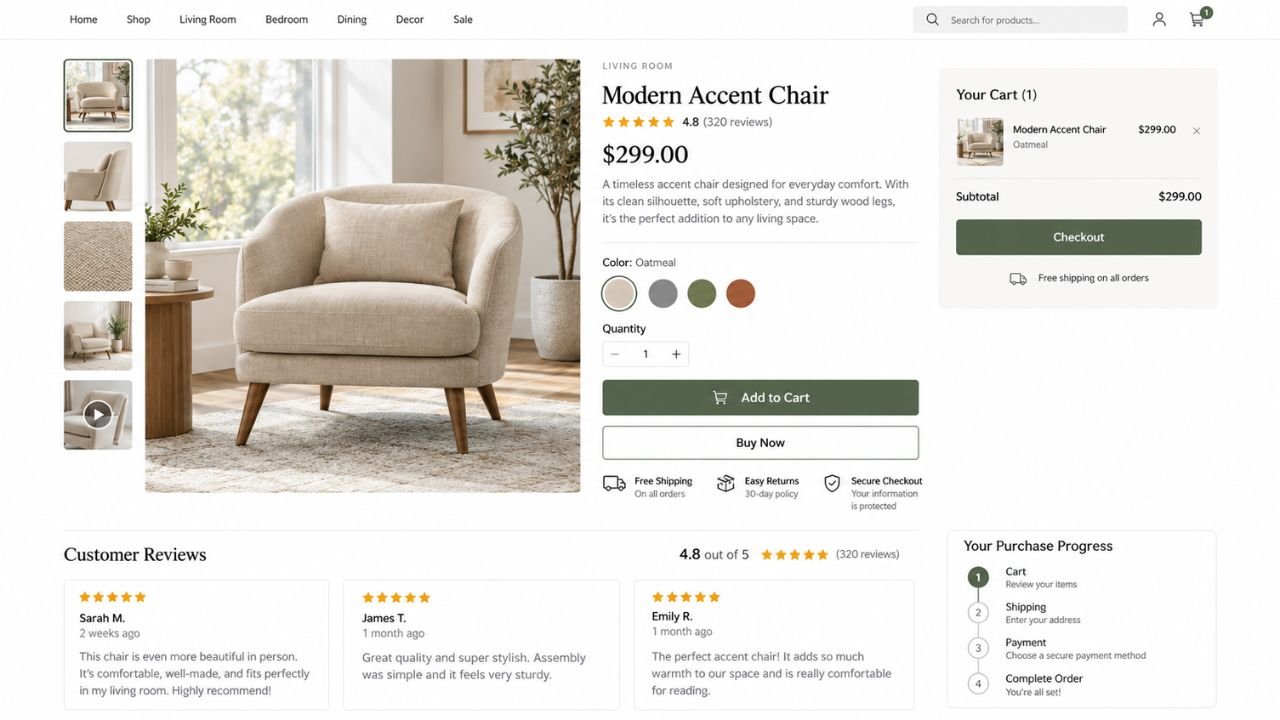
- Clarity above the fold. Within a few seconds, a visitor should know what you sell, who it’s for, and what to do next.
- Trust signals. Recent reviews, real photos, clear shipping and returns policies, visible contact details, and pricing that doesn’t hide until checkout.
- Friction. Long forms, forced account creation, surprise costs at checkout, and slow payment steps.
- Message match. If an ad promises a specific offer, the landing page should open with that offer, not your generic homepage.
How to test when you don’t have much traffic
Most small sites don’t get enough visitors for reliable A/B tests. Split a few hundred visits a week between two versions and the “winner” is often just noise. At small scale, these approaches tend to work better:
- Watch session recordings and heatmaps to see where people hesitate or leave.
- Ask recent buyers, and people who didn’t buy, what nearly stopped them.
- Make bigger, clearer changes instead of tweaking button colors, then compare performance across similar periods.
- Fix obvious problems without testing them. A broken mobile menu doesn’t need an experiment.
This is where structured conversion rate optimization earns its place. It swaps guesswork for a prioritized list of fixes based on how real visitors behave.
Track conversion rate by device and channel, average order value, cart and checkout abandonment, and, for service businesses, the share of inquiries that become paying customers.
Layer 4: Keep customers coming back
Retention is the most underused small business growth strategy, and often the most profitable one. A returning customer doesn’t need to be found again, already trusts you, and is the person most likely to send a friend your way.
Long-cited research from Bain & Company, summarized by Harvard Business Review, found that increasing customer retention rates by 5% increases profits by 25% to 95%, and that winning a new customer can cost five to 25 times more than keeping an existing one. Those figures are old and will vary by industry, but the direction holds. Acquisition without retention is expensive growth.
Email and CRM, the retention engine you own
Email and a basic CRM are the most dependable retention tools a small business has, because you own the list. No algorithm decides who sees your message. In Litmus’s 2025 State of Email survey of nearly 500 marketers, 35% reported a return of $10 to $36 for every $1 spent on email, and another 30% reported $36 to $50.
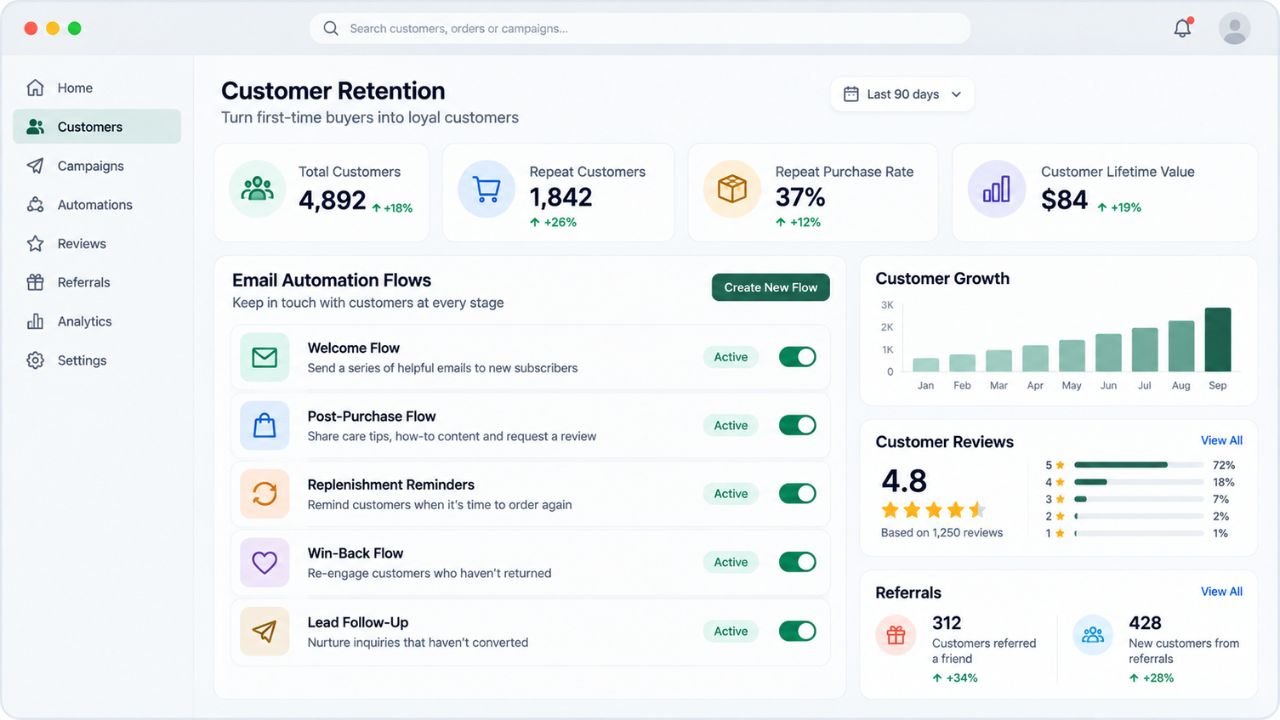
Build automated flows before you worry about a regular newsletter, because flows work every day without extra effort:
- Welcome flow for new subscribers or leads, setting expectations and answering common questions.
- Post-purchase or post-service flow with care tips, how-to content, and a review request once the customer has had time to use what they bought.
- Replenishment or rebooking reminders timed to when customers typically need you again.
- Win-back flow for customers who haven’t returned within your normal buying cycle.
- Lead follow-up for service businesses, because plenty of inquiries go cold simply because nobody followed up.
Reviews and referrals turn retention into acquisition
This is where the layers start feeding each other. Happy customers leave reviews. Reviews lift local rankings and conversion rates, and they increasingly shape AI recommendations. In the same BrightLocal survey, 40% of consumers said they trust AI platforms to provide business recommendations. Build the review request into your post-purchase flow, and give happy customers a simple, specific way to refer someone.
Personalization with first-party data, without overstepping
Customers expect relevance. McKinsey’s 2021 research found that 71% of consumers expect personalized interactions, and 76% get frustrated when that doesn’t happen. They’re also cautious. Salesforce’s 2026 State of the AI Connected Customer research found that 71% of customers feel increasingly protective of their personal information.
The practical answer for a small business is first-party and zero-party data. That means purchase history, preferences customers share directly through quizzes or sign-up forms, and the questions they ask you. Use it to send relevant offers and timely reminders, and be clear about what you collect and why. Google has decided to keep offering Chrome users a choice about third-party cookies rather than phasing them out, but cookie policy shouldn’t drive your strategy either way. Your own customer data is the asset that survives platform changes.
Track repeat purchase rate, time between purchases, retention by cohort (customers acquired in the same month), churn for subscriptions or retainers, review volume and recency, and the share of new customers who came through referrals.
Layer 5: Measure what actually drives decisions
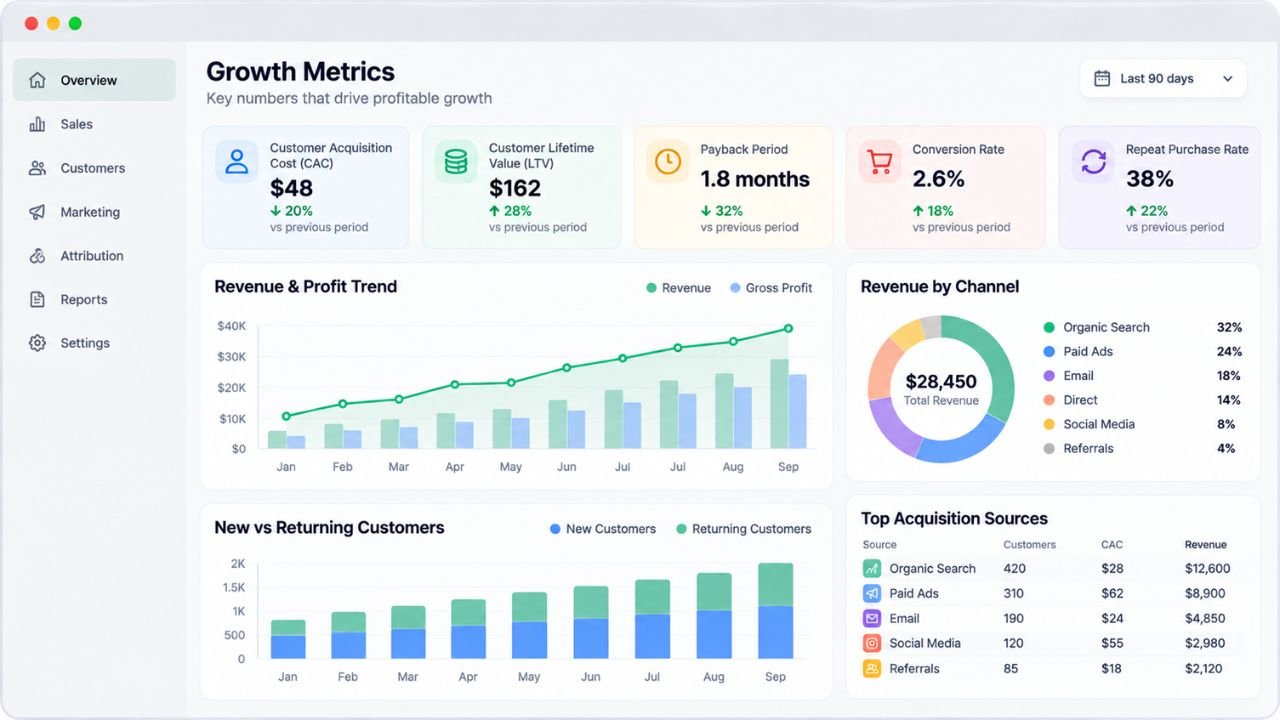
A small business needs a handful of numbers tied to profit, not a dashboard of everything. The core set is customer acquisition cost (CAC), customer lifetime value (LTV), payback period, conversion rate, repeat purchase or retention rate, and revenue by channel. Rankings, traffic, and follower counts are useful diagnostics. They’re not the scoreboard.
The unit economics most small businesses skip
Here’s a simplified, hypothetical example. An online store has an average order value of $80 and a 50% gross margin, so each order earns $40 in gross profit. Customers place 2.5 orders on average over two years, which makes lifetime gross profit per customer about $100.
If paid social brings in new customers at $60 each, the first order loses $20, and the business only makes money if the customer comes back. LTV to CAC sits at roughly 1.7 to 1. Now improve retention so the average customer places 3.5 orders instead of 2.5. Lifetime gross profit rises to $140, the ratio climbs above 2 to 1, and the same ad spend suddenly looks a lot healthier.
That’s why retention and acquisition can’t be planned separately. Many businesses use an LTV to CAC ratio of around 3 to 1 as a rule of thumb, though the right target depends on your margins, your cash position, and how quickly you need the money back.
If you can’t say what a customer is worth, you can’t say what you can afford to pay for one.
Be honest about attribution
No tool sees the whole customer journey. Someone might read your answer in an AI Overview, search your brand name a week later, click an email, and then buy. Last-click reporting hands all the credit to the email. Google also notes that traffic from its AI features is included in overall search traffic in Search Console rather than broken out on its own, so AI visibility rarely shows up as a neat line in your reports.
A few low-tech habits fill the gaps:
- Add a “How did you hear about us?” question at checkout or on inquiry forms. Self-reported answers catch word of mouth, podcasts, AI tools, and other sources your analytics misses.
- Watch branded search volume and direct traffic as signs that awareness is growing.
- Judge channels over months, not days, and track blended CAC (total acquisition spend divided by total new customers) alongside channel-level numbers.
A simple growth scorecard
| Metric | What it tells you | Where to find it | How often to review |
|---|---|---|---|
| Revenue and gross profit by channel | Which channels actually pay | Ecommerce platform, accounting software, GA4 | Monthly |
| Blended CAC | What a new customer costs overall | Ad platforms plus sales data | Monthly |
| Conversion rate by device and channel | Whether your site turns visits into sales | GA4 | Weekly to monthly |
| Repeat purchase or retention rate | Whether customers come back | Ecommerce platform or CRM | Monthly to quarterly |
| LTV and payback period | How much you can afford to spend on acquisition | A spreadsheet built from sales data | Quarterly |
| Organic clicks, impressions, and branded searches | Your visibility trend in search | Google Search Console | Monthly |
| Review volume, recency, and rating | Trust and local visibility | Google Business Profile, review platforms | Monthly |
Where AI and automation fit, and where they don’t
AI and automation aren’t a separate growth strategy. They’re accelerators that make each layer of the stack faster or cheaper once you know what that layer needs to do. Automating a process that doesn’t work just produces bad results faster.
Adoption is still early among the smallest firms. US Census Bureau survey data shows overall business AI use hovering between 17% and 20% from December 2025 to May 2026. Less than 20% of firms with four or fewer employees reported using AI, compared with 37% of firms with at least 250 employees. That leaves room for small businesses to gain ground, but it’s not a reason to buy tools before you’ve defined the problem they solve.
Where AI tends to help small teams:
- Summarizing reviews, support tickets, and call notes to surface recurring objections and product issues.
- Drafting first versions of product descriptions, email flows, and ad copy that a person then edits and fact-checks.
- Producing creative variations for paid testing.
- Automating reporting so your scorecard updates itself.
- Handling routine customer questions, with a clear handoff to a person. The same Salesforce research found 72% of customers say it’s important to know whether they’re talking to an AI agent, so be upfront about it.
Where it backfires:
- Mass-publishing unedited AI content. Google’s spam policies specifically list using generative AI tools to generate many pages without adding value for users as an example of scaled content abuse.
- Stacking subscriptions. A business paying for six AI tools that nobody uses consistently has a process problem, not a tooling problem.
- Replacing judgment and first-hand knowledge. Your experience is what makes your content and service worth choosing. Hand that over completely and you sound like everyone else.
The rule of thumb is simple. Do it manually until you understand it, then automate the parts that repeat.
A 90-day small business growth plan
A realistic 90-day plan fixes the foundations first, then adds visibility, so new traffic lands on a business that’s ready to convert and keep it. Here’s one way to sequence it for a team with limited hours.
Days 1 to 30: Focus and baseline
- Define your primary customer, hero offer, and one-sentence positioning.
- Set up or check conversion tracking in GA4, verify Google Search Console, and make sure your CRM or ecommerce platform records where customers came from.
- Add a “How did you hear about us?” field.
- Work out rough numbers for CAC, average order or job value, gross margin, and repeat rate. Rough is fine. Missing isn’t.
- Audit your top ten pages by traffic and revenue for speed, clarity, and trust gaps.
Days 31 to 60: Convert and keep
- Fix the three biggest conversion leaks you found.
- Launch a welcome flow and a post-purchase or post-service flow, including a review request.
- Set up a simple win-back or reactivation message.
- Clean up your Google Business Profile if you serve a local area.
Days 61 to 90: Get found
- Improve the pages closest to the sale (service, category, and product pages) for the questions buyers ask.
- Publish or update content that answers your most common pre-purchase questions.
- Make your business details consistent across directories and profiles.
- If your conversion rate and margins support it, run one controlled paid test with a clear success metric.
After 90 days, go back to the scorecard. Double down on what moved revenue or margin and cut what didn’t. Conversion fixes and email flows often show results early. SEO and AI visibility usually take several months to produce meaningful results, and the timeline depends on your competition, your site’s starting point, and how consistently the work gets done.
Mistakes that quietly stall growth
Most growth stalls don’t come from one bad decision. They come from a few habits that feel productive at the time.
Spreading across too many channels. Six half-maintained channels lose to two well-run ones. Every channel has a learning curve, and small teams rarely have the hours to climb more than a couple at once.
Treating traffic as revenue. Traffic growth that doesn’t move inquiries or sales is a diagnostic, not a win. Check what the extra visitors actually do.
Depending on a single platform. A business that makes most of its sales through one marketplace, one ad account, or one social profile is one policy change away from a rough quarter. Diversify gradually, starting with channels you own, like email and organic search.
Copying enterprise playbooks. Large companies can afford brand campaigns that take years to pay back. Small businesses usually need channels that pay back within months.
Growing faster than cash and capacity. More orders mean more inventory, staff time, and customer support. Plan the operational side before you push for volume. Many of the common reasons ecommerce businesses fail trace back to this gap between demand and operations.
When to bring in outside help
Most small businesses can handle the Focus layer and basic email flows themselves. The areas that usually justify outside expertise are technical SEO, AI search visibility, conversion optimization, and paid media management, where mistakes are expensive and the learning curve is steep. If you’re weighing that decision, this breakdown of what a digital marketing agency does for small businesses explains which services agencies typically cover and when hiring makes more sense than doing it yourself.
Whoever you work with, ask three things. Who actually does the work? How will results be reported in revenue and profit terms, not just rankings? What gets prioritized in the first 90 days? Be wary of anyone guaranteeing rankings or AI citations, because nobody controls those. If you run an online store and you’re comparing specialist partners, our roundup of ecommerce marketing agencies in the USA is a reasonable place to start your shortlist.
Conclusion
The small business growth strategies that work in 2027 aren’t new channels or clever hacks. They’re the fundamentals, connected and done in the right order. Focus the offer, get found where buyers ask questions, convert the visits you earn, keep the customers you win, and measure what actually pays.
Search is changing, AI is changing how people discover businesses, and clicks are harder to earn than they were. That raises the value of everything that happens after the click. Businesses that get conversion, retention, and measurement right will get more from every visitor, whichever platform sent them.
Growth that lasts is rarely one big channel win. It’s a stack of connected systems, each one making the next one cheaper.
Start with the weakest layer in your stack and fix that first. If you run an established online store and want a clear view of where your growth is leaking, EcomOptix works across SEO, AI search visibility, conversion, and paid growth as one plan.
Frequently Asked Questions
How can a small business grow with a limited budget?
Start with the low-cost layers that compound. Fix conversion problems on your existing website, set up automated email flows, build a steady stream of reviews, and improve the pages closest to the sale for search. These cost mostly time. Add paid advertising once you know your conversion rate and how much gross profit a typical customer brings in.
What is digital business strategy, and how is it different from digital marketing?
Digital business strategy decides where digital technology, data, and channels give your business an advantage, including which customers you serve, how digital tools help you win them, and what you’ll deliberately ignore. Digital marketing is the execution of part of that plan through channels like SEO, paid ads, email, and social media.
How long does it take for digital growth strategies to show results?
Conversion fixes and email flows can show results within weeks. Paid ads generate traffic within days, though profitable campaigns usually need a period of testing. SEO and AI search visibility generally take several months, depending on competition, your site’s starting authority, and consistency. A 90-day review is a sensible first checkpoint, with a six- to twelve-month view for organic channels.
Do small businesses need to optimize for AI search tools like ChatGPT and Google AI Overviews?
Yes, but mostly by doing SEO well. Google states there are no special requirements to appear in AI Overviews or AI Mode beyond standard best practices. Beyond that, write clear answer-first content, keep your business information consistent across the web, and earn reviews and mentions on credible third-party sites. Nobody can guarantee an AI citation, so treat it as an outcome of being genuinely useful and well known in your niche.