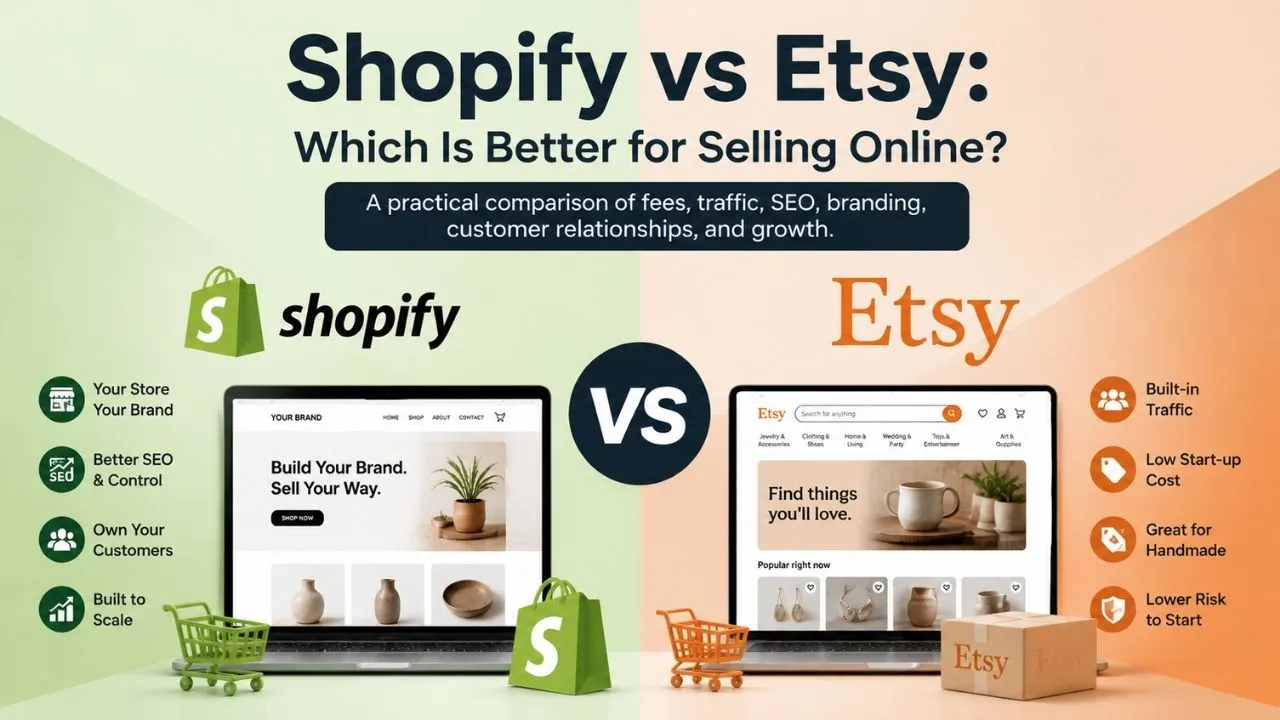
A practical comparison of fees, traffic, SEO, branding, customer relationships, and growth.
Short answer: Etsy is usually the better starting point for handmade, vintage, custom, or craft products when you need marketplace discovery and low fixed costs. Shopify is usually better when you want a branded store, more control over SEO and customer relationships, and a platform that can scale with your business—but you must create or buy your own traffic. Many established sellers use both, with Etsy as a discovery channel and Shopify as the brand home.
The key distinction:
Shopify is a standalone ecommerce platform that powers your own storefront.
Etsy is an online marketplace where your shop sits inside Etsy’s shared shopping environment.
The decision is therefore about business model and customer acquisition—not just which checkout has the lower fee.
Shopify vs Etsy at a glance
| If your priority is… | Usually the better fit | Why |
|---|---|---|
| Testing demand quickly | Etsy | Lower fixed commitment and built-in marketplace discovery. |
| Owning the storefront experience | Shopify | Custom domain, brand design, site structure, and checkout control. |
| Getting found without an audience | Etsy | Shoppers already browse the marketplace, although competition is intense. |
| Building SEO and repeat-purchase assets | Shopify | More control over pages, content, email capture, and customer journeys. |
| Selling handmade or vintage items | Etsy first; Shopify later or alongside it | Etsy fits the category; Shopify gives the brand more room to grow. |
| Subscriptions, wholesale, or a broad catalog | Shopify | A standalone commerce system is generally more adaptable to complex operations. |
| Keeping risk and work low at the beginning | Etsy | Faster setup, but you accept marketplace rules, competition, and dependence on Etsy. |
The core difference: marketplace vs. standalone store
Etsy supplies a destination where shoppers search for products from many sellers. That gives a new seller a chance to be discovered before the seller has an audience, but it also puts the shop next to competitors and places the customer relationship inside Etsy’s policies and platform experience.
Shopify supplies the storefront technology: hosting, checkout, catalog and inventory tools, payment connections, reports, themes, and an app ecosystem. You choose the domain, positioning, page structure, and marketing mix. Shopify can make a business look and operate more like an independent brand, but it does not automatically bring shoppers. A polished Shopify store with no acquisition plan can generate no sales.
Fees and total cost: the comparison most articles oversimplify

A fair comparison separates fixed costs, per-order costs, optional marketing costs, and operating costs. “Etsy is free” and “Shopify has no transaction fees” are both incomplete statements.
Etsy’s fee stack
- Listing fee: $0.20 per listing or renewal. Listings generally expire after four months, and quantity-based renewals can create additional listing fees.
- Transaction fee: 6.5% of the order total defined by Etsy’s policy, including the item price and amounts charged for shipping and gift wrap. Tax treatment varies by location.
- Payment processing: A country-specific percentage plus a flat fee. In the United States, the current help page lists 3% + $0.25; in India it lists 5% + ₹25. It is charged on the payment total, including shipping and tax where applicable.
- Advertising: Etsy Ads are pay-per-click. Offsite Ads are charged only when Etsy attributes an order to an offsite ad; the rate is generally 15% below the relevant sales threshold and 12% after the threshold, subject to Etsy’s current rules and a per-order cap.
- Optional subscriptions and adjustments: Etsy Plus is optional. Pattern is a separate Etsy website product with its own subscription price after the trial and still uses Etsy Payments processing. Currency conversion, regulatory operating fees, deposit fees, taxes, and Payoneer or bank charges may apply depending on the seller’s location.
Verify the live rules before publishing or pricing products: Etsy Fees & Payments Policy; Etsy payment-processing fees; Etsy fees and taxes help page; Pattern pricing.
Shopify’s fee stack
- Subscription: Shopify charges a recurring plan fee. As a U.S. illustration, its current pricing pages show Basic at $39 per month when billed monthly, with lower effective annual pricing often displayed. Prices, billing options, included features, and plan availability vary by country.
- Payment processing: If Shopify Payments is available and used, you pay the card-processing rate for your market and plan. A U.S. online card example shown on Shopify’s pricing materials is 2.9% + $0.30 on the entry plan; the exact rate depends on market, card type, plan, and transaction circumstances.
- Third-party payment provider fees: If you use a provider other than Shopify Payments, Shopify may add a plan-based third-party transaction fee on top of the provider’s own processing fee. That is why “0% transaction fee” should never be read as “0% payment cost.”
- Store operations: A custom domain, premium theme, apps, email/SMS tools, shipping services, fulfillment, returns, and paid advertising can add to the monthly cost. Shopify includes hosting, bandwidth, SSL, and a myshopify.com domain; a custom domain is normally an additional purchase.
See the current details in Shopify pricing and Shopify Payments cost guidance.
A simple U.S. variable-fee example
The table below isolates a single order so the fee mechanics are visible. It assumes one $0.20 Etsy listing, a $50/$200/$1,000 order with no tax and free shipping, no Etsy Ads or Offsite Ads attribution, and Shopify Payments on an entry-level U.S. Shopify plan. It excludes the Shopify subscription, apps, domain, fulfillment, product costs, refunds, and advertising.
| Order value | Etsy: listing + 6.5% + 3% + $0.25 | Shopify: 2.9% + $0.30 | Difference before fixed costs |
|---|---|---|---|
| $50 | $5.20 | $1.75 | Etsy is $3.45 higher |
| $200 | $19.45 | $6.10 | Etsy is $13.35 higher |
| $1,000 | $95.45 | $29.30 | Etsy is $66.15 higher |
What the example does—and does not—prove: At roughly twelve $50 orders per month, the $3.45 variable-cost difference could mathematically offset a $39 monthly Shopify subscription. That is a contribution-margin illustration, not a recommendation: Etsy may create sales that Shopify would not have generated, while Shopify may require SEO, email, social, or paid acquisition spending.
How to compare your own total cost
- Calculate contribution margin by channel. Start with selling price minus product cost, packaging, shipping subsidy, payment fees, platform fees, refunds, and ad cost. Compare what each order contributes—not just the headline rate.
- Model fixed costs over realistic order volume. Spread Shopify’s plan, apps, domain, and email tools across expected monthly orders. Do not spread them over an optimistic sales target.
- Price in the cost of traffic. Etsy can supply discovery but may charge advertising-related fees. Shopify may have lower order fees but require paid ads, content, partnerships, or months of SEO work.
- Use your seller location. Etsy payment processing, regulatory fees, taxes, deposits, currency conversion, and Shopify Payments availability are market-specific. A U.S. example cannot be copied into an India, U.K., EU, or Australia forecast.
Traffic, marketing, and customer acquisition
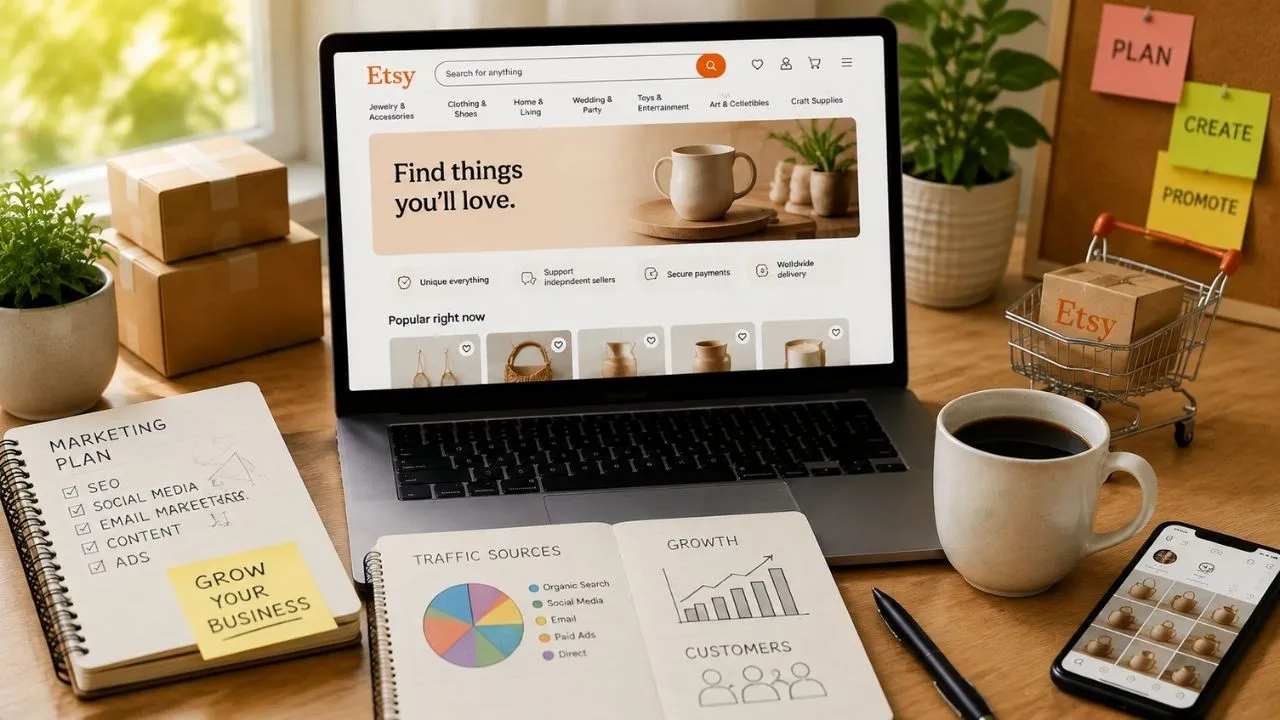
Etsy’s main advantage is not simply that it is easy to use; it is that Etsy is already a shopping destination. Etsy’s latest company information reports roughly 86.5 million active buyers and 5.6 million active sellers, which demonstrates marketplace scale but does not guarantee impressions or sales for an individual shop. Your listings still compete on relevance, price, photography, reviews, delivery performance, and customer service.
Marketplace scale reference: Etsy company information. The figures are platform-level totals, not a forecast for any individual seller.
Etsy discovery is earned and can be paid for
- Organic Etsy search: Etsy considers relevance and listing information such as titles, tags, attributes, and descriptions, along with listing quality and buyer experience. Results are personalized, and competition and shopper behavior change.
- Etsy Ads: Etsy Ads operate on a pay-per-click auction model. A click is a cost even when it does not become an order, so track return on ad spend and contribution margin.
- Offsite Ads: These are different from Etsy Ads. An attributed sale can create a percentage fee even though the seller did not set a per-click bid for that particular order.
- Marketplace risk: Search visibility can be affected by customer-service standards, shipping performance, reviews, cases, and policy compliance. A seller has less control over the algorithm and the surrounding buying experience than on an independent site.
For the current mechanics, see Etsy’s SEO guide, search-visibility guidance, tag guidance, and Etsy Ads explanation.
Shopify gives you the tools, not the audience
A Shopify store needs an acquisition plan. Common channels include organic search, social content, email, creator partnerships, referrals, marketplaces, affiliate programs, paid search, paid social, and repeat purchases. Shopify can connect these channels and present a consistent brand experience, but the platform itself does not put your product in front of ready-to-buy shoppers in the way Etsy marketplace search can.
That responsibility is a cost and an opportunity. You have to earn the first visit, but a successful store can build a durable audience through permission-based email, customer accounts, content, product education, and repeat-purchase journeys. Those assets are more difficult to build inside a marketplace.
SEO: Etsy search visibility vs. Shopify site ownership
Both platforms can support search visibility, but they expose different levels of control.
| SEO question | Etsy | Shopify |
|---|---|---|
| Can product pages appear in Google? | Yes. Optimize the shop and listing content, then follow Etsy’s policies. | Yes. You control more of the site architecture and on-page content. |
| What can you edit? | Titles, descriptions, tags, attributes, images, alt text, shop content, policies, and branding elements. | Titles, meta descriptions, URLs, content pages, collections, blogs, images, redirects, theme markup, and more. |
| How much technical control? | Limited to Etsy’s marketplace structure and templates. | More control over domain, navigation, collections, internal links, templates, and technical SEO foundations. |
| Does the platform guarantee rankings? | No. | No. Technical access is not the same as relevance, authority, or demand. |
| Who must do the marketing work? | You compete for Etsy search and may use Etsy’s ad products; Etsy supplies marketplace discovery. | You must create demand through SEO, content, social, email, partnerships, marketplaces, or paid media. |
Etsy SEO is listing optimization inside a marketplace
Etsy lets sellers improve shop and listing pages with relevant titles, tags, attributes, descriptions, images, image alt text, video, policies, and an About section. This is enough to earn visibility in Etsy and potentially in external search, especially when the product matches a specific query. It is not the same as owning a full site architecture: you have less control over URLs, navigation, category pages, internal linking, page templates, and the context around the listing.
Shopify SEO is a stronger long-term content asset
Shopify supports custom domains and automatically generates a sitemap. Its SEO tools and themes can support editable page titles, meta descriptions, URLs, image alt text, canonical tags, SSL, collections, blogs, and structured content. That broader control can compound over time through category pages, product-led content, buying guides, comparison pages, and internal links. It still requires research, useful content, technical maintenance, link earning, and conversion optimization. A sitemap is not a ranking strategy.
Technical references: Shopify SEO overview, Shopify sitemap guidance, and Etsy SEO for shop and listing pages.
Branding, store ownership, and customer relationships
Etsy gives you a shop identity within Etsy. You can use a shop name, logo, banner, featured listings, About content, policies, and—through Etsy Plus—additional appearance options. But shoppers are still moving through Etsy’s shared marketplace, where they can compare competing products and where Etsy controls the overall checkout, navigation, messaging, and policy environment.
Shopify lets you build the customer-facing layer around your own brand: a custom domain, home page, collections, product education, navigation, checkout styling, promotions, content, and post-purchase experience. You can connect customer accounts, analytics, CRM, email, reviews, subscriptions, fulfillment, and other tools. This creates more work, but it also creates more room for differentiation.
Customer data is not a simple “you own it” vs. “Etsy owns it” question
On Shopify, you generally have more direct access to customer and order records and can export customer data or connect it to other systems. You must still follow privacy, email, SMS, consumer-protection, and data-retention laws. Marketing permission is not implied merely because someone placed an order.
On Etsy, the seller receives the information needed to fulfill the transaction, but Etsy’s rules and privacy framework limit how buyer information can be used. Do not treat an Etsy order as permission to add a buyer to an independent mailing list or redirect the buyer off Etsy. Use consent-based marketing and follow the current seller, privacy, and anti-circumvention rules.
Relevant references: Shopify customer import and export guidance, Etsy Seller Policy, and Etsy privacy policy.
Ease of setup and day-to-day operations
| Operational area | Shopify | Etsy |
|---|---|---|
| Initial setup | More decisions: theme, domain, payments, shipping, tax settings, navigation, policies, apps, and analytics. | Faster launch: create the shop, add listings, configure payments and shipping, and meet marketplace requirements. |
| Catalog and inventory | Strong inventory, product, location, reporting, and app options for a growing catalog. | Good listing and order tools, but complex multichannel operations may require an integration or app. |
| Payments | Shopify Payments where supported, plus third-party providers and other payment methods. | Etsy Payments where available; processing terms are tied to the seller’s country and bank location. |
| Shipping and fulfillment | You design the process and can connect carriers, fulfillment, print-on-demand, and warehouse tools. | Etsy offers marketplace seller tools and shipping options, but the seller still owns product preparation and delivery performance. |
| Analytics | Store, traffic, product, order, and channel reporting, with more connected-data options. | Etsy Stats and marketplace insights help with listings and demand, but the view is centered on Etsy activity. |
Integrations are a spectrum—not a binary
Shopify has a large app ecosystem and is often easier to extend into email, subscriptions, reviews, fulfillment, POS, accounting, wholesale, and multichannel selling. Etsy also supports integrations and a public API for eligible seller and developer use. The practical question is whether the exact tool you need can sync listings, inventory, orders, shipping status, and returns reliably at a cost you can absorb.
References: Shopify reports, Shopify inventory management, and Etsy API guidance.
Which products fit Shopify or Etsy?
| Product or business model | Best starting fit | Important qualification |
|---|---|---|
| Handmade, custom, personalized, or craft items | Etsy, then consider Shopify | Etsy matches the shopping intent; Shopify helps build a branded repeat-purchase channel. |
| Vintage goods | Etsy | Confirm Etsy’s vintage definition, listing rules, and required disclosures. |
| Print-on-demand | Both can work | Use an approved production-partner workflow and disclose production partners where Etsy requires it. Check IP and product-safety obligations. |
| Digital downloads | Either | Choose based on discovery, file delivery, customer support, and brand/retention goals. |
| Subscriptions, wholesale, B2B, or complex bundles | Shopify | A standalone platform generally provides more room for workflows and integrations. Confirm plan and app costs. |
| Generic dropshipping or reselling | Usually not Etsy | Etsy generally requires items to be made, designed, handpicked, or sourced within its policy; Shopify does not remove legal, quality, disclosure, or supplier responsibilities. |
Etsy product-policy risk matters
Etsy is not a general-purpose catalog for any product a seller can source. Its Seller Policy requires listings to fit Etsy’s permitted categories and requires accurate descriptions, original photos or video, intellectual-property compliance, and relevant disclosures. Dropshipping and reselling are restricted except for limited policy exceptions. A production partner can be permitted for an original design, but the seller must follow Etsy’s disclosure and listing requirements.
Read the live requirements in Etsy Seller Policy before investing in inventory, templates, or advertising.
Scalability and platform risk
Etsy can scale a product line, but growth comes with more competition, more customer-service volume, more fees, and greater exposure to Etsy’s search, payment, and policy decisions. Etsy’s Customer Service Standards and Purchase Protection criteria make shipping, tracking, responsiveness, reviews, and cases operational priorities. Purchase Protection can help qualifying orders, but it is not universal insurance and does not eliminate seller responsibility.
Shopify gives a business more control as the catalog, team, channels, and marketing system grow. It can be a better core for multiple sales channels, a branded content strategy, customer retention, and more complex inventory. The trade-off is ongoing financial and operational responsibility: monthly plan costs, apps, payment fees, data/privacy obligations, site maintenance, fraud/chargeback exposure, and traffic acquisition. Shopify reduces dependence on a marketplace; it does not make the business independent of every platform, payment processor, carrier, or app.
Risk and service references: Etsy Customer Service Standards and Etsy Purchase Protection.
Should you sell on both Shopify and Etsy?
Often, yes—provided the economics and operations justify it. A two-channel strategy can use Etsy to test demand and capture marketplace shoppers while Shopify becomes the long-term home for brand, content, retention, and direct traffic. It can also reduce dependence on one source of sales.
A practical two-channel setup
- Choose a primary system of record. Decide where SKU names, inventory counts, product costs, and order status are authoritative.
- Sync only what you can monitor. An integration can reduce duplicate work, but a failed inventory sync can create overselling, late shipping, or customer-service problems. Budget for the app and its maintenance.
- Give each channel a job. For example, Etsy can test keywords and product-market fit; Shopify can support bundles, email capture, content, repeat purchase, or wholesale conversations.
- Track contribution by channel. Separate Etsy fees, Shopify fees, ad spend, returns, fulfillment, and support time. A channel with more revenue is not automatically the more profitable channel.
- Stay inside Etsy’s rules. Do not use Etsy orders, messages, packaging, QR codes, or listing tactics to evade fees or redirect buyers to another venue. Any cross-channel marketing must be based on a lawful, compliant source of consent.
The last point is not optional: review Etsy’s rules on off-platform transactions and fee avoidance and the Seller Policy.
Which should you choose?
Use the following decision rules as a starting point, then validate them against your margins, product restrictions, audience, and marketing capacity.
Choose Etsy first if…
- You are validating handmade, custom, vintage, craft, or other Etsy-compatible products.
- You have little or no existing audience and want marketplace search to create a first chance at discovery.
- You want to keep fixed costs low while testing price, photos, product-market fit, and fulfillment.
- You can accept marketplace competition, policy requirements, and limited control over the customer journey.
- Your expected volume is low or uncertain and a monthly storefront subscription would be difficult to justify.
Choose Shopify first if…
- You are building a distinct brand with a custom domain, a differentiated customer experience, and a long-term content strategy.
- You already have traffic from social, email, search, creators, retail, a community, or another marketplace.
- You need broader control over SEO, landing pages, collections, navigation, customer accounts, analytics, or integrations.
- You sell products or business models that benefit from subscriptions, wholesale, B2B, bundles, multiple locations, or more complex workflows.
- You can fund the monthly plan, apps, payment processing, site operations, and customer acquisition while sales develop.
Use both if…
- You want Etsy discovery and Shopify brand ownership to serve different stages of the same customer journey.
- Your product margins can cover two sets of channel costs and the operational overhead of keeping listings and inventory accurate.
- You have a clear primary catalog/inventory system and a policy-compliant way to market to people who opt in.
A five-step platform decision checklist
- Write down your product category, production model, average order value, gross margin, and likely monthly order volume.
- Check Etsy eligibility, intellectual-property requirements, production-partner rules, shipping expectations, and payment availability before selecting Etsy.
- Estimate a Shopify store’s full monthly cost: plan, domain, apps, payment processing, fulfillment, email, support, and acquisition.
- Calculate the number of profitable orders each channel needs—not merely the break-even point on platform fees.
- Review the decision after the first meaningful test period using conversion rate, contribution margin, repeat purchase, customer-acquisition cost, and support time.
Summary
Etsy is a marketplace with built-in shopper intent, low fixed commitment, and strong fit for handmade, vintage, custom, and craft-led businesses. Shopify is a standalone ecommerce platform with more control over branding, SEO, customer relationships, integrations, and scale—but it shifts traffic generation and more operating costs onto the seller.
If your biggest constraint is finding initial demand, start with Etsy or use it as one channel. If your biggest goal is building a durable brand and customer-retention asset, build Shopify into the plan. Compare contribution margin and acquisition cost, not just the listing fee or monthly subscription. And if you use both, give each channel a clear job and follow Etsy’s rules about buyer data and off-platform transactions.
Frequently asked questions
Is Etsy cheaper than Shopify?
Etsy usually has lower fixed cost, but higher variable fees on each order. Shopify has a recurring plan and operating costs, but its payment cost per order can be lower. Your order value, volume, ad spend, country, apps, and traffic source determine the total.
What are the main Etsy fees?
Common Etsy costs include the $0.20 listing or renewal fee, a 6.5% transaction fee, country-specific Etsy Payments processing, possible Etsy Ads or Offsite Ads charges, and location-specific currency, regulatory, deposit, or tax-related costs.
What are the main Shopify fees?
Common Shopify costs include the subscription, payment processing, possible third-party payment-provider fees, domain, apps, themes, email/SMS, fulfillment, and marketing. Shopify Payments can remove a separate third-party transaction fee where available, but card processing still applies.
Is Etsy or Shopify better for beginners?
Etsy is usually easier if the beginner wants to list a small number of permitted products and test demand. Shopify is a better beginner choice when the seller already has an audience or is intentionally building a standalone brand and is willing to learn store setup and marketing.
Can I sell on Shopify and Etsy at the same time?
Yes. Many businesses use Etsy for marketplace reach and Shopify for brand and retention. Keep inventory synchronized, measure channel-level profit, and do not use Etsy orders or messages to redirect buyers or evade Etsy fees.
Is Shopify good for handmade products?
Yes. Shopify can support handmade products and gives the seller more control over brand, content, bundles, email, and repeat purchase. Etsy may still be valuable because shoppers already search there for handmade and personalized products.
Can Shopify replace Etsy traffic?
Not automatically. Shopify gives you tools for SEO, content, social, email, and paid acquisition; it does not supply Etsy’s marketplace audience. Plan for traffic generation before moving a proven product to Shopify-only.
Do Etsy sellers own their customer data?
Etsy sellers receive the information needed to fulfill orders, but Etsy policies limit how buyer information may be used. A transaction is not blanket permission for independent email marketing or off-platform selling. Shopify generally gives more direct access and export flexibility, subject to privacy and marketing laws.
Which platform is better for SEO?
Shopify generally offers more control over domain, site structure, collections, pages, blogs, URLs, internal links, and technical SEO. Etsy can still rank listings and shops when sellers optimize relevant content and deliver a good buyer experience. Neither platform guarantees rankings.
Is Etsy good for print-on-demand or dropshipping?
Print-on-demand can be compatible when the product and design meet Etsy rules and required production partners are disclosed. Generic dropshipping or reselling is generally not an Etsy fit. Shopify can support more sourcing models, but it does not remove product-safety, IP, tax, disclosure, or supplier responsibilities.
When should an Etsy seller move to Shopify?
Consider Shopify when you have repeat demand, a recognizable brand, enough margin to fund the store, a traffic plan, or operational needs Etsy cannot serve well. You do not have to “move” completely; a two-channel test may be safer than an abrupt migration.
How do I calculate the Shopify vs Etsy break-even point?
For a simple estimate, subtract Shopify’s variable payment cost from Etsy’s variable fees for a typical order, then divide the monthly Shopify fixed cost by that per-order difference. Add marketing, apps, fulfillment, refunds, taxes, and the value of Etsy’s built-in demand before making a decision.