EcomOptix

Category: ai search

  • The Future of Search: How AEO, GEO, and SEO Drive Business Growth in 2027

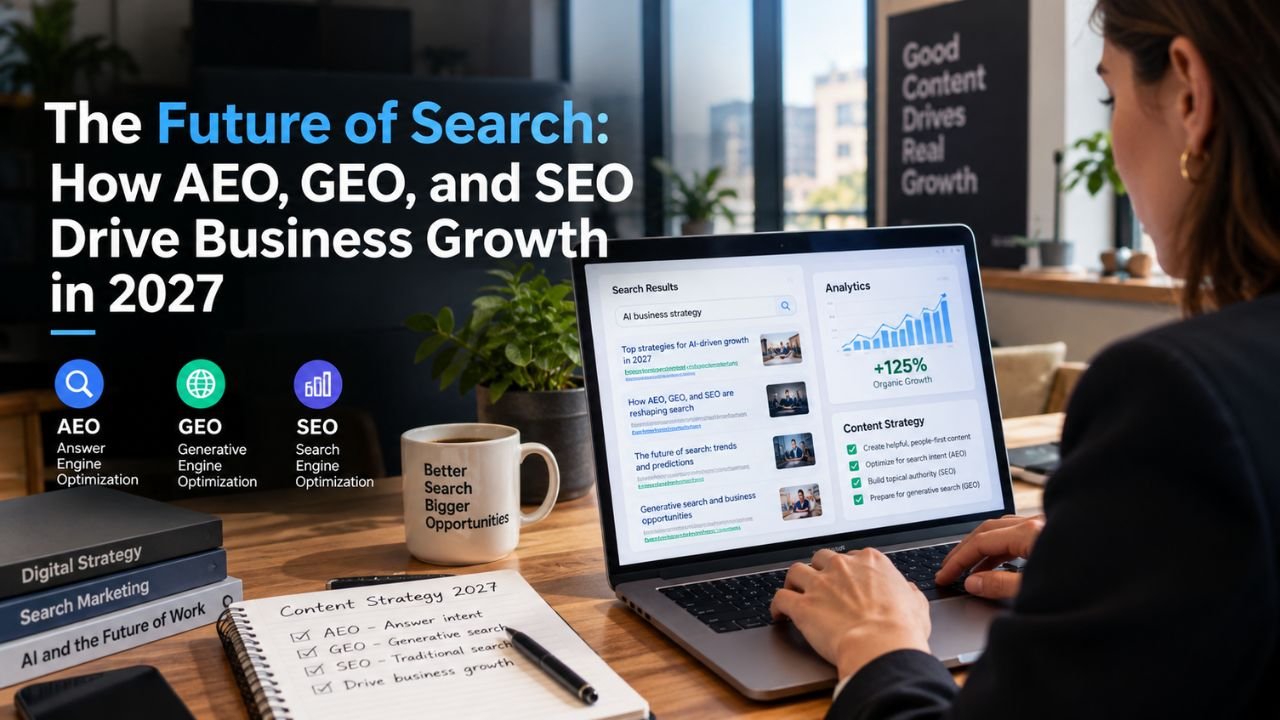
    The Future of Search: How AEO, GEO, and SEO Drive Business Growth in 2027

    future-of-search-aeo-geo-seo-business-growth-2027.webp

    SEO, AEO, and GEO are not three competing strategies. In 2027 they are three checkpoints on the same path to a customer.

    SEO decides whether search engines can find and trust your pages. AEO (answer engine optimization) decides whether your content becomes the answer people read. GEO (generative engine optimization) decides whether AI assistants such as ChatGPT, Gemini, Copilot, and Google’s AI Mode name your business when someone asks who to hire.

    The businesses growing from search this year run all three as one system and measure it differently than they did two years ago.

    Picture a moving company that still ranks third for “movers in Denver.” Its rank tracker looks healthy. Its phone is quieter. A growing share of its customers never scroll to that ranking. They ask Google’s AI Mode which long-distance movers are trustworthy, read a short list of names, check the reviews of two of them, and book one. If the company is not on that list, the third-place ranking is a trophy nobody sees.

    The numbers behind that scene are no longer speculative. At I/O 2026, Google reported that AI Overviews have more than 2.5 billion monthly users and AI Mode has passed 1 billion. BrightLocal’s 2026 Local Consumer Review Survey found that 45% of US consumers used AI tools for local business recommendations, up from 6% a year earlier. A strategy that only tracks rankings is now measuring the part of search that matters least.

    The short version:
    SEO earns eligibility.

    AEO earns the answer.

    GEO earns the recommendation.

    Growth comes from connecting all three to a page that converts the customer who comes to verify.

    Where Search Stands in 2027
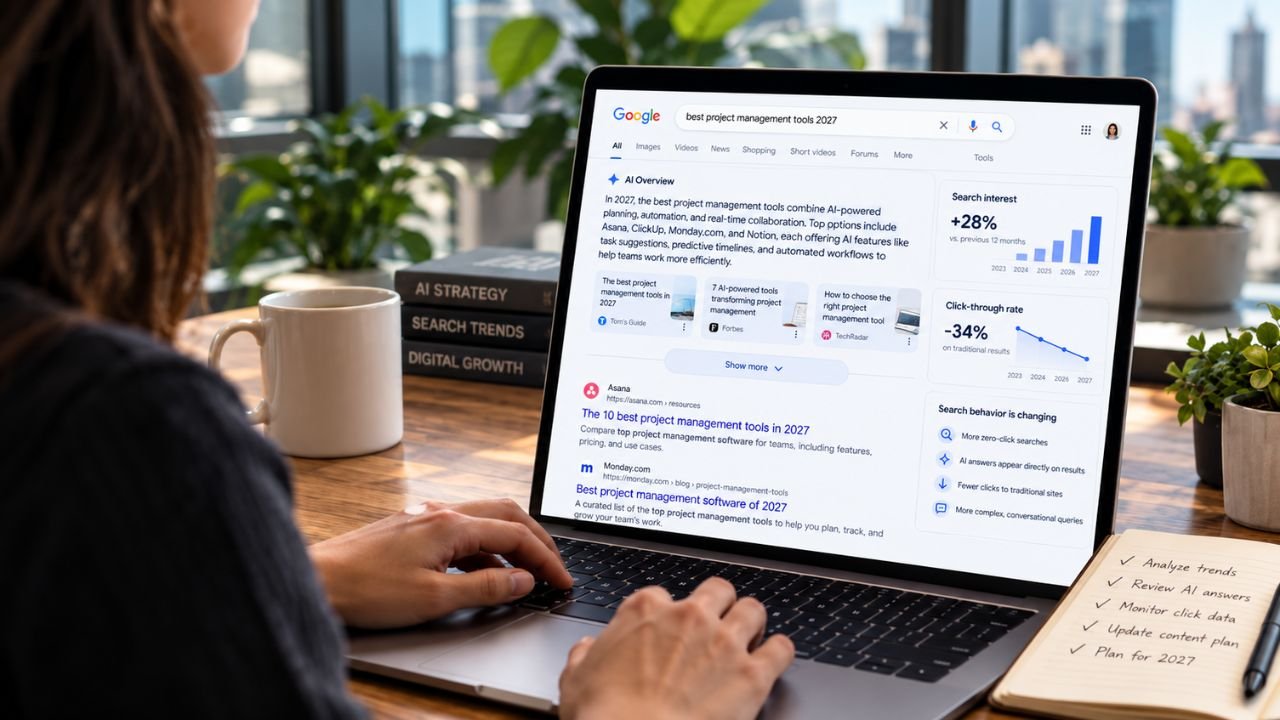
    Search in 2027 is bigger than ever and sends fewer clicks per query. Both statements are true at the same time, and most bad strategy starts from believing only one of them.

    In February 2024, Gartner predicted that traditional search engine volume would drop 25% by 2026 as AI chatbots absorbed queries. Two years later, Google told a different story at I/O: AI Mode queries have more than doubled every quarter since launch, and overall Search queries reached an all-time high last quarter. Google’s figures are self-reported, but they point to the real shift. People did not stop searching. The answer moved onto the results page.

    The click data shows what that costs. Pew Research Center tracked the real browsing of 900 US adults and found that people clicked a traditional result in 8% of visits when an AI summary appeared, compared with 15% when it did not. Links inside the summary were clicked in about 1% of visits. Ahrefs, using December 2025 data across 300,000 keywords, found that an AI Overview now correlates with a 58% lower click-through rate for the top-ranking page, up from 34.5% in its earlier study.

    Search didn’t shrink. The click did.

    2026 also brought the first official measurement tools for AI visibility. Google’s Generative AI performance report in Search Console reached all websites worldwide on August 31, 2026, showing impressions from AI Overviews and AI Mode by page, country, and device. Microsoft launched AI Performance in Bing Webmaster Tools in February 2026, showing how often a site is cited across Copilot and Bing’s AI summaries, plus the “grounding queries” the AI used to find that content.

    What is confirmed, what is measured, and what is still a prediction

    Much of the AI search conversation blends Google documentation, third-party studies, and vendor opinion into one confident voice. Separating them changes decisions.
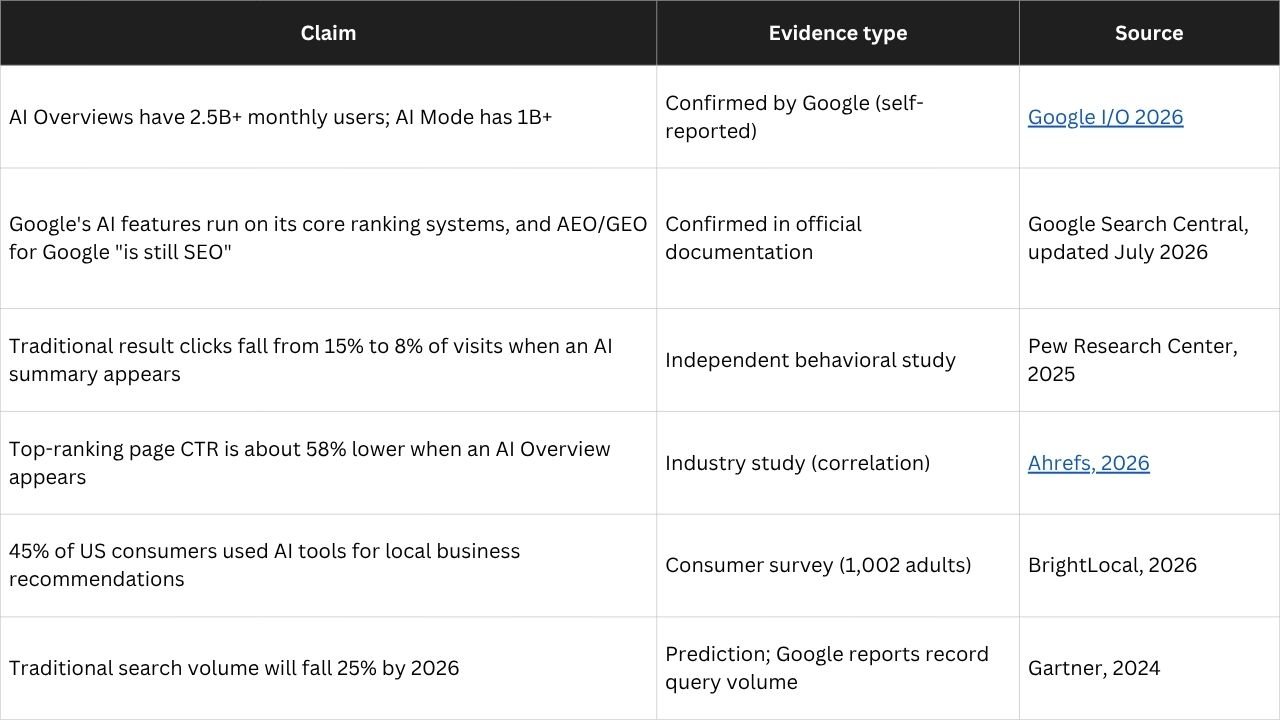
    What is confirmed, what is measured, and what is still a prediction

    Does SEO Still Matter in 2027? Yes, but Its Job Has Changed

    SEO still matters in 2027 because Google’s AI features are built on top of it. Google’s own guide on optimizing for generative AI features says these features are rooted in its core Search ranking and quality systems, and that a page must be indexed and eligible to show with a snippet before it can appear in AI Overviews or AI Mode. No index, no answer.

    What changed is the unit of competition. Classic SEO competed page against page for a position. AI search retrieves pages and then uses specific information from them. A page ranking fourth can supply the sentence an AI answer is built on, while the page ranking first gets summarized without a click.

    Google describes two mechanisms that explain this. The first is retrieval-augmented generation, where the model pulls relevant pages from the Search index before writing a response. The second is query fan-out, where the model runs several related searches at once to cover a question from different angles. One question becomes five searches. A business that covers the real subtopics of a customer’s problem gets more chances to be pulled in.

    Queries are also getting longer. Pew found that longer, more natural-language searches are more likely to produce an AI summary. A homeowner no longer types “movers Chicago.” They type the whole situation, with dates, distance, and the piano.

    The tempting response to fan-out is to publish a separate page for every variation of a question. Google names that directly in its guide: creating pages for fan-out variations mainly to manipulate rankings or AI responses violates its scaled content abuse policy. What holds up is the opposite. Fewer, deeper pages, each built around a real customer problem and the next three questions that problem creates.

    What has not changed matters just as much: crawlable pages, clear site structure, helpful people-first content, fast pages, and internal links that show how topics connect. SEO in 2027 is not replaced. It is stricter.

    What Is AEO, and How Is AEO Different From SEO in 2027?
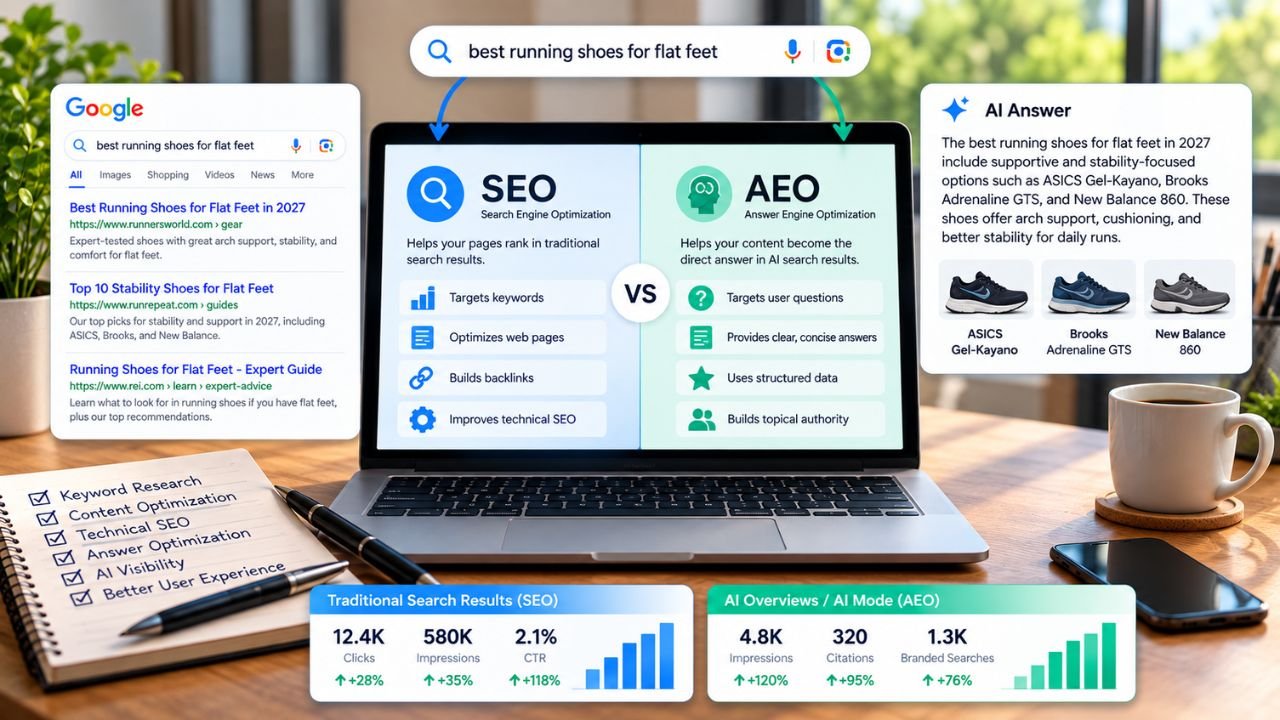
    What Is AEO, and How Is AEO Different From SEO in 2027?"

    AEO, or answer engine optimization, is the practice of making content easy to select as a direct answer. Its targets are featured snippets, People Also Ask boxes, citations inside AI Overviews, and the single reply a voice assistant reads aloud.

    The difference between AEO and SEO in 2027 comes down to the test each one passes. SEO asks whether a page deserves a position. AEO asks whether one passage from that page can be lifted out and trusted on its own. The same page can pass the first test and fail the second.

    Content that passes the AEO test tends to share a few habits:

    • Each section opens with the answer, then earns the detail.
    • Key terms get a plain, one-sentence definition.
    • Headings mirror how people actually ask questions.
    • Prices, ranges, steps, and comparisons sit in tables or lists, not buried in paragraphs.
    • Facts carry a date and get updated when they change.

    Google adds an important correction to much of the AEO advice online. Its guide says there is no need to break content into tiny “chunks,” no need to rewrite pages in a special style for AI, and no special schema required for AI features. Structured data still helps pages qualify for rich results, so it stays worth doing, but it is not a secret key.

    Most AEO advice fails because it optimizes the format and ignores the substance. A perfectly structured answer that says the same thing as fifty other pages gives an AI system no reason to choose it. Google’s guide calls this “commodity content” and contrasts it with non-commodity content that adds first-hand experience or original insight. Format helps a good answer get extracted. It cannot make an ordinary answer worth extracting.

    AEO at a glance
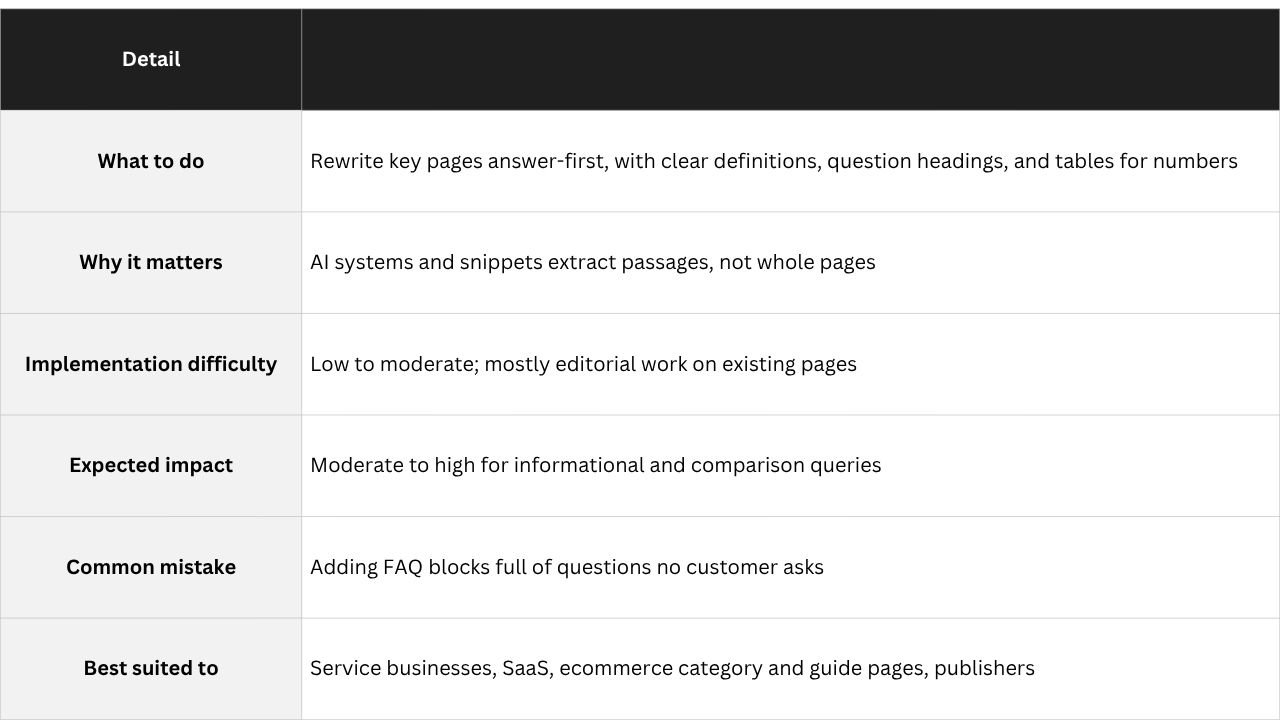
    AEO at a glance jpg

    What Is GEO, and How Should Businesses Prepare?

    GEO strategy for AI search visibility

    GEO, or generative engine optimization, is the work of increasing how often and how accurately a business or its content appears inside answers generated by AI systems such as ChatGPT search, Perplexity, Microsoft Copilot, Gemini, and Google’s AI Mode. SEO competes for a place in a list. GEO competes for a place in a sentence.

    What is GEO marketing?

    GEO marketing is the wider set of activities that feed those AI answers from outside your own website: customer reviews, press coverage, expert quotes, industry directories, community discussion, and consistent business information everywhere it appears. AI systems build answers from many sources at once, so what other sites say about a business often carries more weight than what the business says about itself.

    AI doesn’t recommend the best business. It recommends the business the web agrees about.

    What the original GEO research actually found

    The term comes from a paper by researchers from Princeton and other institutions, published at the KDD 2024 conference. It reported that content changes such as citing sources, adding quotations, and adding statistics could boost visibility in generative engine responses by up to 40%.

    Two details usually get dropped when that number is repeated. First, the gains were measured in a controlled setup where a fixed set of sources competed for space inside a generated answer. Visibility there is a shared pie, so one source’s gain is another’s loss. Second, the paper found that lower-ranked sources benefited most. Its “Cite Sources” method lifted visibility by 115.1% for websites ranked fifth in the search results.

    That second finding is the most useful idea in GEO for smaller businesses. In a traditional ranked list, position five stays position five. Inside a generated answer, an evidence-rich page from a smaller site can take share from bigger ones. The “40% boost” is not a guarantee of anything. It is evidence that proof beats size inside AI answers more often than it does in blue links.

    Google calls it SEO. Other AI engines play by their own rules.

    Google is clear about its own platform. Its guide states that optimizing for generative AI search is, from Google’s point of view, still SEO. It also lists tactics to ignore for Google Search, including llms.txt files, content “chunking,” rewriting pages for AI, and chasing inauthentic mentions.

    That guidance covers Google, not every AI engine. ChatGPT, Copilot, and Perplexity use their own crawlers, their own retrieval, and in some cases third-party search providers. This is where GEO earns a separate line in the plan.

    How to get cited by ChatGPT

    No one can guarantee a ChatGPT citation, but OpenAI documents the basics:

    • Let OpenAI’s search crawler in. OpenAI’s publisher FAQ says any public website can appear in ChatGPT search, provided it isn’t blocking OAI-SearchBot.
    • Separate search from training. OpenAI’s crawler documentation explains that OAI-SearchBot (search) and GPTBot (model training) are independent settings. A site can allow search visibility while opting out of training.
    • Be findable beyond Google. OpenAI notes it can learn about pages from third-party search providers, so verifying the site in Bing Webmaster Tools and keeping it well indexed is a sensible step.
    • Track the traffic. ChatGPT adds utm_source=chatgpt.com to referral links, so those visits show up clearly in Google Analytics.
    • Give it something worth citing. Original data, specific numbers, clear definitions, and facts that match what reviews and other sites say.

    Microsoft’s own advice for Copilot citations lines up with this: strengthen depth and expertise, support claims with evidence, keep content fresh, and keep text, images, and video consistent about the same entities. For a longer version of these steps ranked by likely impact, from crawler access through evidence density and third-party trust, this GEO checklist for 2026 works as a practical audit sheet.

    AEO vs GEO vs SEO: the difference at a glance
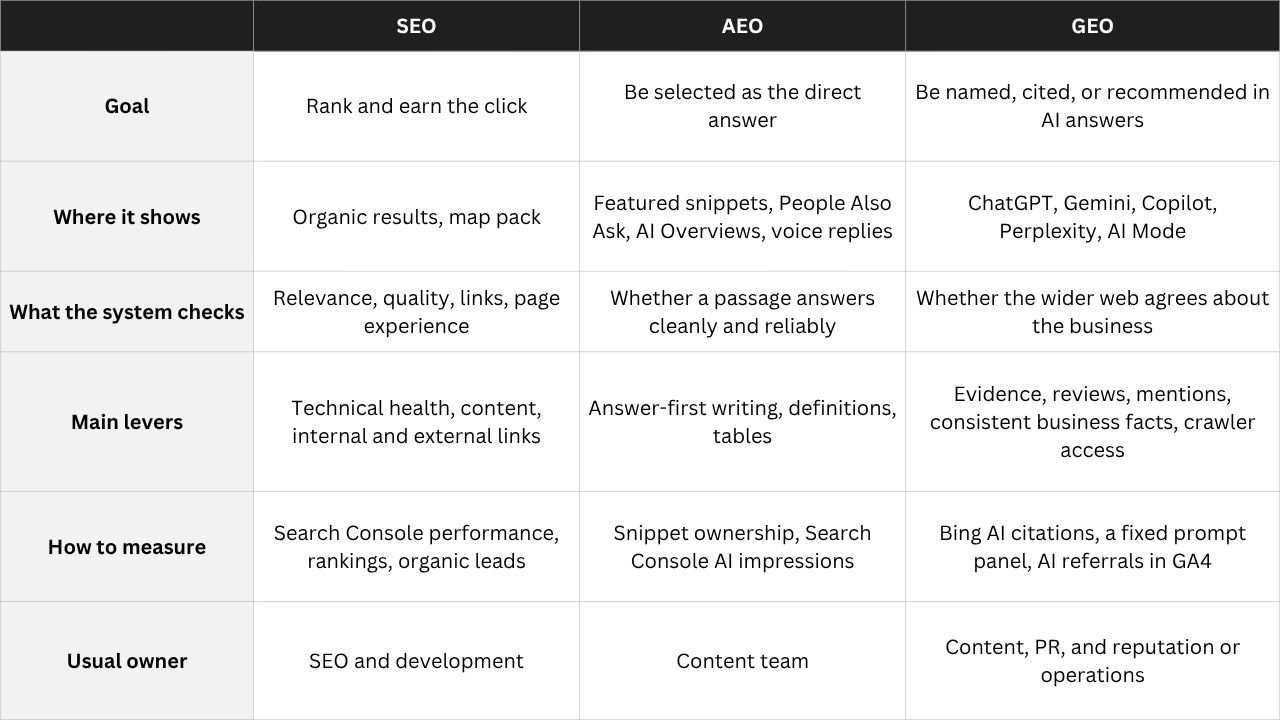
    AEO vs GEO vs SEO: the difference at a glance-image.jpg table

    The overlap is bigger than the differences. Treating them as three vendors or three projects is how businesses end up with conflicting changes on the same page.

    How AI Search Changes Customer Discovery
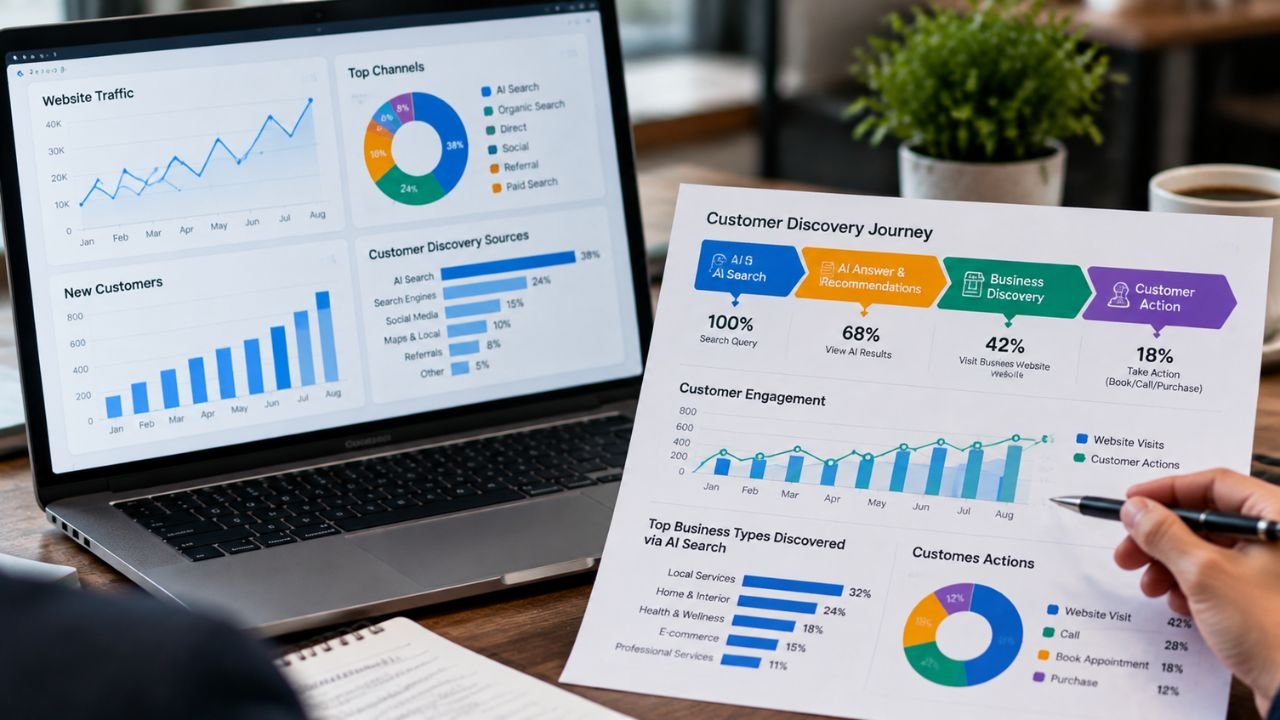
    How AI Search Changes Customer Discovery for thsi

    AI search turns discovery from browsing a list into approving a shortlist. More and more, a customer’s first impression of a business is a sentence written by an AI system, before they ever see the logo.

    Three things change along the way.

    • The question gets richer. People describe their situation instead of typing keywords, and follow-up questions carry context forward. Google now lets people move from an AI Overview straight into a conversation in AI Mode, so the research that used to span ten searches happens in one thread.
    • The system does the comparing. Through query fan-out and retrieval, the AI gathers reviews, listings, articles, and forum threads, then compresses them. Businesses that are described consistently across those sources are easier to summarize, and easier to recommend.
    • The click becomes a verification click. The customer still visits websites, but for a different reason. BrightLocal found that after reading positive reviews, 66% of consumers do further research while 34% are ready to buy, and 54% go on to check the business’s website. The same survey found 82% read AI-generated review summaries, and 23% would base a decision on that summary alone.

    Being cited appears to help even as total clicks fall. Seer Interactive found that brands cited inside AI Overviews earned 35% more organic clicks and 91% more paid clicks than when they were not cited. Seer is careful to say this is correlation. Stronger brands may simply be cited more. Either way, the cited business keeps more of a shrinking pool of clicks.

    The practical result is a quiet change in what a website is for. It used to introduce the business. Now it often confirms what an AI system already said about the business. If the site contradicts the answer, with different prices, a different service area, or no sign of the license the AI mentioned, the sale dies without anyone noticing.

    One further shift is still early. Google’s guide encourages site owners to explore agentic experiences, where AI agents visit websites to complete tasks such as booking. OpenAI is testing a “Get Quote” flow for local services inside ChatGPT, currently in beta with approved partner platforms that supply business listing data. Most small businesses cannot act on this directly yet. They can make sure their listings on major platforms are complete and their quote forms are simple enough for a person, or an agent, to finish.

    What AI Search Means for Local Businesses and Service Companies

    What AI Search Means for Local Businesses and Service Companies jpg

    For local businesses, AI search runs on the same fuel as local SEO: accurate business data, reviews, and independent mentions. What changed is how many places that fuel is read from, and how demanding customers have become.

    BrightLocal’s 2026 survey of 1,002 US adults puts numbers on both shifts:

    • 45% used AI tools such as ChatGPT for local recommendations, making AI the third most-used source after Google and Facebook.
    • Google’s share as a source for reviews fell from 83% to 71%, while Apple Maps nearly doubled from 14% to 27%.
    • The average consumer uses six different review sites when choosing a business.
    • 47% won’t use a business with fewer than 20 reviews.
    • 74% only care about reviews written in the last three months.
    • 31% will only use a business rated 4.5 stars or higher, up from 17% a year earlier.
    • 89% expect owners to respond to reviews, and templated replies put off 50%.

    Google confirms that local data feeds its AI features. Its guide notes that AI responses can include information about local businesses and that Google Business Profiles help services appear in both AI responses and regular results. Microsoft makes the same point for Copilot, recommending Bing Places for Business to keep address, hours, and contact details current for AI answers.

    Two local levers get far less attention than they deserve.

    • Top Places List. Google may show a rich result listing the “top places” lists that mention a business, such as a local publication’s roundup of the best movers in a city. The lists must be curated, genuine, independent, and not sponsored, and the feature only applies to businesses with a physical location. Earning a spot in real local roundups is no longer just PR. It is a visibility asset inside Google itself.
    • Review freshness. When three-quarters of consumers ignore reviews older than three months, a business with 400 reviews and nothing recent can look weaker than a competitor with 80 reviews and a steady weekly flow. AI summaries read the same timeline.

    The right priorities depend on the type of business:
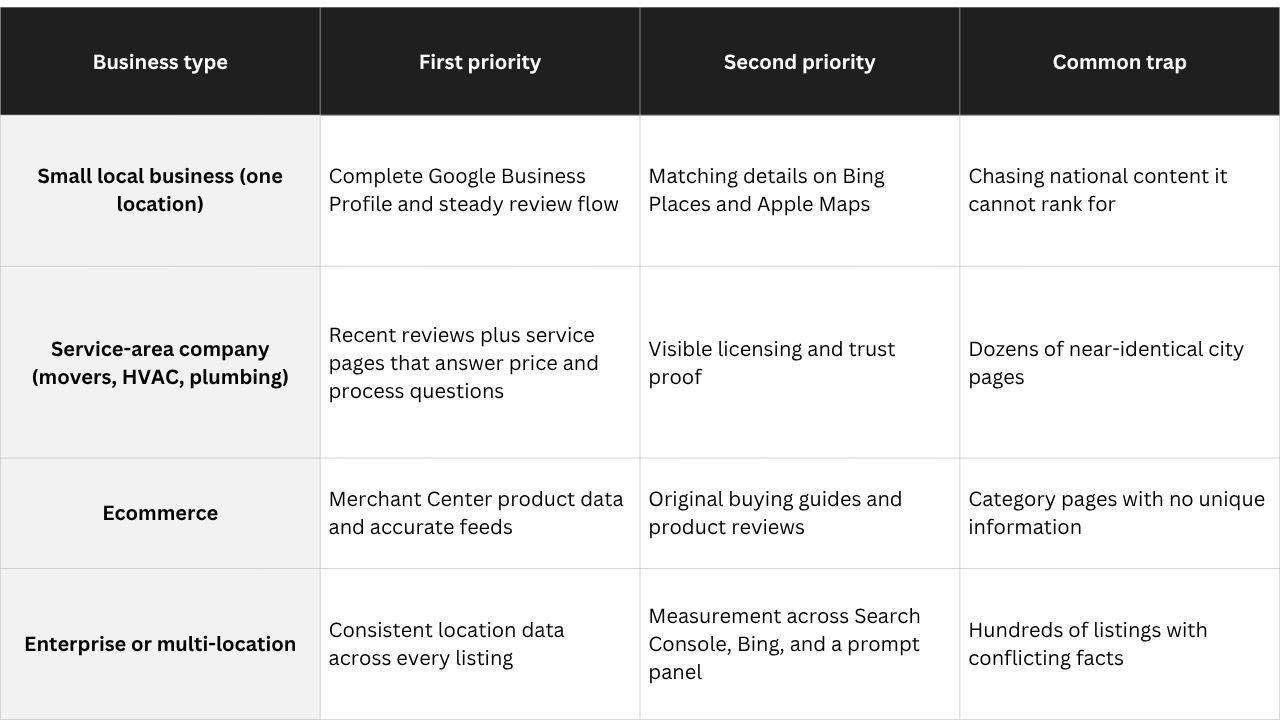
    The right priorities depend on the type of business image jpg

    For online stores, the same logic applies with product data standing in for review profiles. Clean feeds, category pages that answer real buying questions, and product pages with information no competitor has are the core of ecommerce SEO in an AI-first results page.

    How Moving Companies Can Benefit From Future Search Changes

    Moving is one of the clearest cases where AI search rewards honest operators. It is expensive, stressful, and trust-heavy, and customers already know scams exist. Both people and AI systems look for proof, and a legitimate mover has more of it than a fly-by-night operator.

    The trust problem is built into the industry. The Federal Motor Carrier Safety Administration runs Protect Your Move, a public database where anyone can look up interstate movers, their complaint history, and their safety records, along with guidance on spotting rogue movers. Customers are primed to verify. Every verifiable fact a mover publishes is a trust signal for a person and a retrieval signal for a machine.

    In moving, the scammer and the honest operator can write the same homepage. They cannot fake the same federal registration history, review timeline, and independent mentions. That asymmetry is exactly what AI systems are built to read.

    Moving customers ask three very different kinds of questions, and each one is answered in a different place:
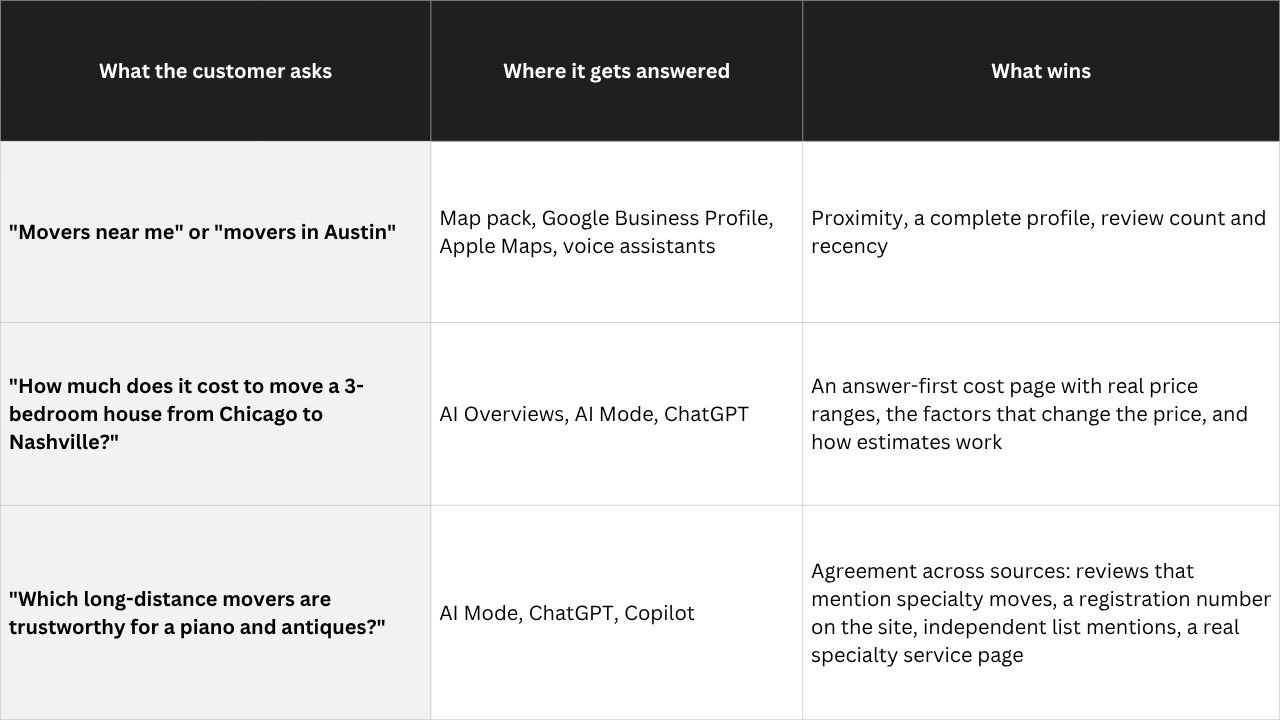
    Moving customers ask three very different kinds of questions, and each one is answered in a different place: image jpg

    That last question shows fan-out at work. An AI system might split it into searches about piano moving costs, how to check a mover’s registration, and mover reviews in the customer’s city. A mover with a genuine piano-moving page, a licensing page that links to the FMCSA lookup, and recent reviews from customers who describe moving a piano gives the system three separate reasons to include it.

    Practical moves for moving companies, in order of effort:

    • Publish registration numbers where customers look. Put the USDOT and MC numbers in the footer and on quote pages, and link to the FMCSA lookup. It costs nothing and answers the first question a cautious customer asks.
    • Build one honest cost page. Use real price ranges from completed jobs and explain what moves the number: distance, volume, stairs, season, specialty items, and the difference between binding and non-binding estimates. This is exactly the non-commodity content Google’s guide describes.
    • Ask for reviews the day after delivery. Invite customers to describe the move in their own words, including the route and anything unusual they moved. Keep requests steady through the slow season so the review timeline never goes quiet.
    • Reply to every review personally, within a week. Consumers notice silence and notice templates.
    • Keep business facts identical everywhere. Name, address, phone, hours, service area, and registration numbers should match across Google Business Profile, Bing Places, Apple Business Connect, Yelp, and the Better Business Bureau.
    • Earn real local mentions. Local news roundups, chamber of commerce listings, real estate agent partner pages, and moving association memberships all add independent agreement. Paid placements do not qualify for Google’s Top Places List.
    • Build pages for real services, not swapped city names. Long-distance moves, packing, storage, piano moving, and office relocation each deserve a genuine page. Two hundred near-duplicate city pages invite the scaled content problems Google warns about.
    • Design the quote flow for the verification visitor. Keep the form short, offer a video survey, show the registration number and recent reviews next to it, and track visits from chatgpt.com in GA4.

    Visibility is only half of the equation. The other half is what happens after the customer arrives: quote speed, follow-up, paid channels, and conversion. That side is covered in depth in the 2026 Guide: How Do Moving Companies Get More Leads, which pairs well with the search visibility steps above.

    The Four Gates Framework: A Practical Implementation Plan

    The Four Gates Framework treats AI-era search visibility as four questions every business must pass, in order, before search turns into leads. Each gate is a question an engine or a customer asks. Failing an early gate cannot be fixed by excelling at a later one.
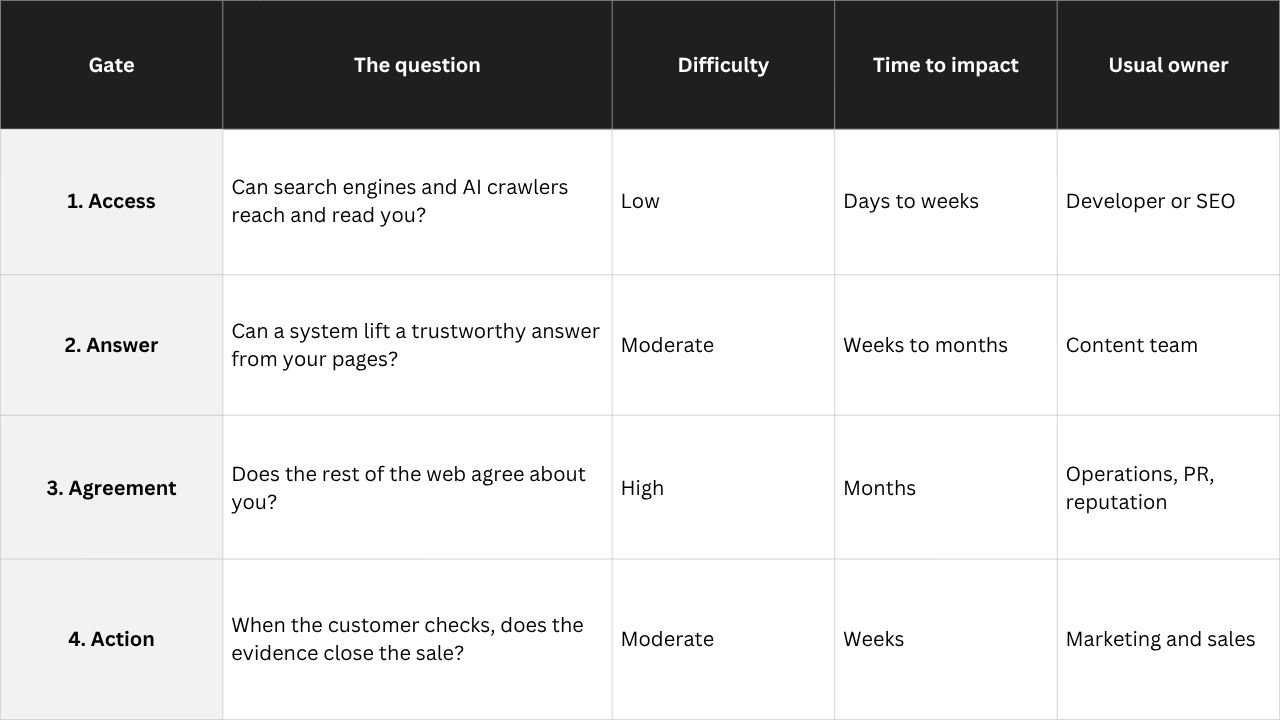
    The Four Gates Framework A Practical Implementation Plan jpg

    Gate 1: Access

    What to do: Confirm key pages are indexed and eligible for snippets, with no accidental noindex or nosnippet tags. Check the Search generative AI control in Search Console; including your site is the default, but it is worth confirming no one changed it. Allow Googlebot, Bingbot, and OAI-SearchBot in robots.txt, and make a separate, deliberate decision about training crawlers such as GPTBot. Verify the site in both Google Search Console and Bing Webmaster Tools, and claim Google Business Profile, Bing Places, and Apple Business Connect listings.

    Why it matters: Every AI answer starts with retrieval. A page that cannot be crawled cannot be cited.

    Common mistake: Security or firewall settings that block crawlers the business actually wants, discovered months later.

    Who needs it: Every business. This gate is a prerequisite, not an optimization.

    Gate 2: Answer

    What to do: Rebuild the five to ten pages that matter most for revenue so each opens with a direct answer, defines its terms, uses question-style headings, and puts numbers in tables. Add one piece of original information to each, such as real price ranges, timelines, or process details only this business can provide.

    Why it matters: AI systems extract passages. Original, specific passages give them a reason to choose one source over another.

    Common mistake: Rewriting everything “for AI” or publishing dozens of thin FAQ pages. Google’s guide says neither is needed, and mass production risks spam policies.

    Who needs it: Everyone, with the biggest gains for service businesses and ecommerce sites whose customers ask detailed questions before buying.

    Gate 3: Agreement

    What to do: Build a steady review flow on the platforms customers actually use, reply to every review, keep business facts consistent everywhere, and earn genuine mentions from local media, associations, partners, and industry directories.

    Why it matters: AI answers synthesize many sources. When those sources agree, the business becomes easy to summarize and safe to recommend.

    Common mistake: Manufacturing agreement. Google says inauthentic mentions are less helpful than they seem, and fake reviews are now illegal under the FTC’s rule on online reviews, as BrightLocal’s survey notes.

    Who needs it: Local and service businesses first, because AI recommendations for them lean heavily on reviews and listings.

    Gate 4: Action

    What to do: Make the pages a verifying customer lands on confirm the AI’s summary. Show pricing ranges, credentials, recent reviews, real photos of the team and equipment, and a fast way to get in touch. Make sure what the site says matches what the listings and reviews say.

    Why it matters: The customer who arrives from an AI answer is often close to deciding. Friction or contradiction at this stage wastes the visibility earned at the first three gates. This is where conversion rate optimization earns its place in a search strategy: fewer clicks means each one has to convert.

    Common mistake: Sending AI-referred visitors to a generic homepage with a long form and no proof.

    Who needs it: Any business that sells a considered purchase, from moving and home services to B2B software.

    How to measure the four gates

    Measurement is still imperfect, so combine several signals instead of trusting one:

    • Google Search Console: the Generative AI performance report for impressions in AI Overviews and AI Mode by page. It reports impressions, so pair it with lead data.
    • Bing Webmaster Tools: AI Performance for citation counts, cited pages, and grounding queries, which reveal the phrases Copilot used to find your content.
    • GA4: referral visits from chatgpt.com and other AI platforms, tied to form fills and calls.
    • A fixed prompt panel: 20 to 30 real customer questions asked monthly in ChatGPT, Google AI Mode, and Copilot, recording whether the business is named or cited and which competitors appear instead.

    Most businesses start at Gate 2 because new content feels like progress. The fastest wins often sit at Gate 1, where one blocked crawler or one mismatched phone number quietly cancels everything built on top of it.

    A 90-day rollout
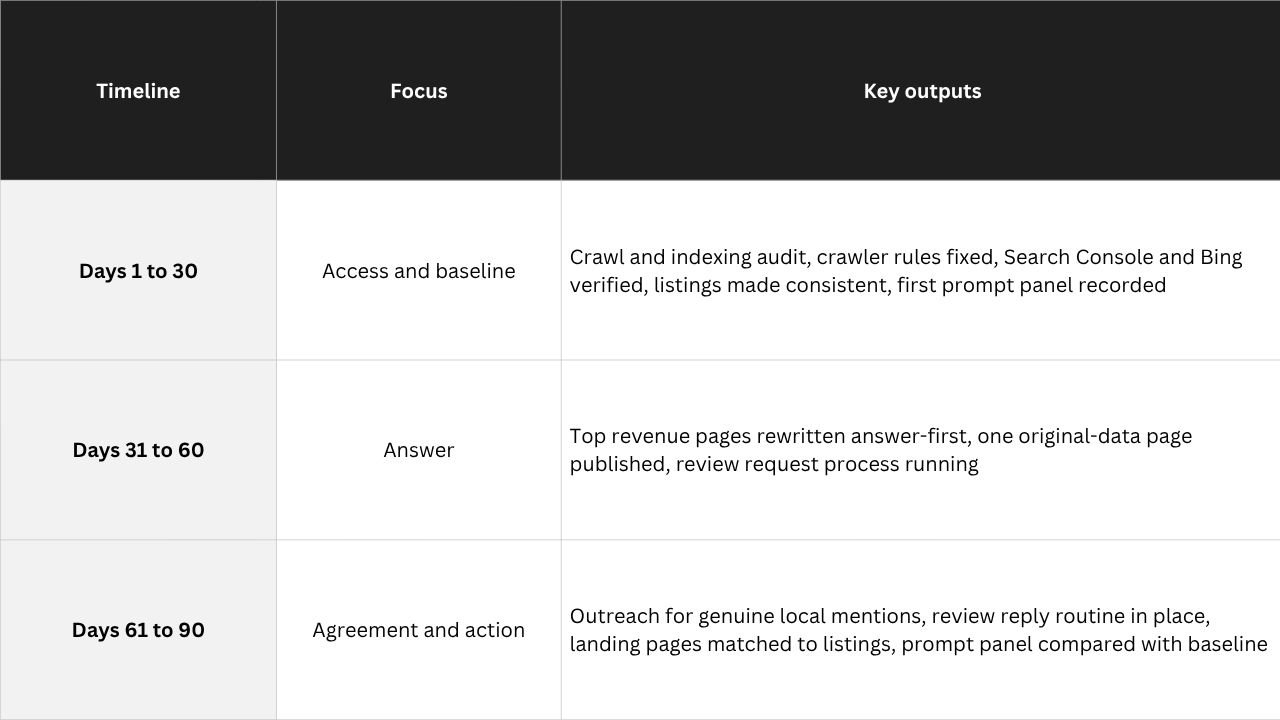
    A 90-day rollout jpg
    Smaller businesses often run this plan with one owner and no marketing team, which raises a fair question about what to handle in-house and what to hand off. This breakdown of what a digital marketing agency does for small businesses is a useful way to decide where that line falls.

    Common Mistakes That Waste AI Search Budgets

    • Treating AEO and GEO as separate from SEO. Google calls it all SEO, and splitting the work across vendors produces conflicting changes on the same pages.
    • Buying “AI files” as a fix. Google Search ignores llms.txt files. They do no harm and may serve other systems, but they are not a strategy.
    • Chopping pages into fragments. Google says its systems understand pages that cover several topics. Write for readers.
    • Mass-producing pages for every query variation. This is the scaled content pattern Google’s spam policies target.
    • Manufacturing mentions or reviews. It fails Google’s systems and, for reviews, breaks federal rules.
    • Reading the “40% GEO boost” as a promise. It was a relative gain measured in a research setup, not a guarantee for any website.
    • Blocking the wrong crawler. Blocking OAI-SearchBot to stop AI training removes the site from ChatGPT search. GPTBot is the training crawler.
    • Measuring clicks alone. Impressions, citations, and leads from AI referrals tell a truer story than click-through rate on its own.
    • Letting reviews go stale in the off-season. Consumers and AI summaries both weigh recent reviews heavily.
    • Ignoring Bing and Apple. Copilot draws on Bing, and Apple Maps usage for reviews nearly doubled in a year.

    Conclusion

    The future of search is not the end of SEO. It is a stricter version of it, where being found is only the first gate and being trusted by the rest of the web decides who gets recommended. SEO earns eligibility, AEO earns the answer, and GEO earns the recommendation. Businesses that connect all three to a website built for the verifying customer will turn AI search into leads while competitors are still arguing about acronyms.

    The most practical next step is a Four Gates audit this month, starting with Access, because nothing downstream works if engines cannot reach the pages. Moving companies ready to go further on the conversion side can find a complete lead generation playbook in the 2026 Guide: How Do Moving Companies Get More Leads.

    This guide is published by EcomOptix, an ecommerce marketing agency USA brands work with on SEO, AI search visibility, and conversion. More AI search playbooks are on the EcomOptix blog, and teams that want an outside review of their own four gates can request a free growth analysis.

    FAQs

    Yes. Google states that its AI Overviews and AI Mode are built on its core ranking systems, and a page must be indexed and eligible for a snippet to appear in them. Strong SEO is the entry ticket to AI visibility on Google.

    SEO helps pages rank in search results. AEO helps content get selected as a direct answer in snippets, People Also Ask, AI Overviews, and voice replies. GEO helps a business get named or cited inside AI-generated answers from tools like ChatGPT, Gemini, Copilot, and Perplexity.

    GEO optimization is the practice of improving how often and how accurately AI systems include your content or business in their generated answers. It focuses on crawler access, evidence-rich content, and consistent information across reviews, listings, and third-party sites.

    GEO marketing covers the off-site work that shapes AI answers: reviews, press coverage, expert mentions, directories, and consistent business data. It matters because AI systems build answers from many sources, not just your website.

    Allow OpenAI’s OAI-SearchBot in robots.txt, keep your site well indexed in Bing as well as Google, and publish specific, original, well-sourced information. Track results through visits tagged utm_source=chatgpt.com in your analytics. No method guarantees a citation.

    Not for Google. Google’s documentation says Google Search ignores llms.txt files and that they neither help nor hurt rankings. Some other AI services may read them, so they are optional rather than essential.

    Keep Google Business Profile, Bing Places, and Apple Maps listings complete and consistent, build a steady flow of recent reviews, reply to every review personally, and earn genuine mentions in local media and independent “best of” lists.

    AI search rewards movers who can prove trustworthiness. Customers increasingly ask AI tools which movers are reliable, and those answers draw on reviews, listings, and licensing signals. Movers who publish registration numbers, real pricing guidance, and recent reviews are more likely to be recommended.
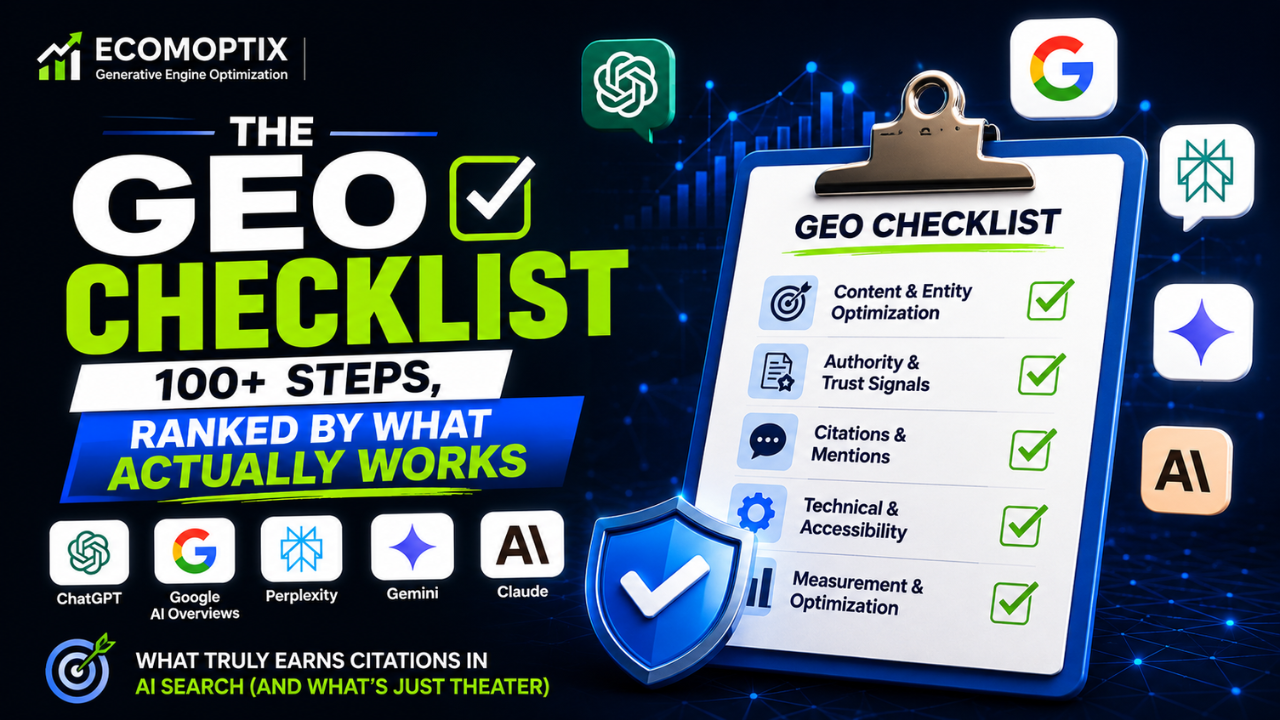
  • The GEO Checklist: 100+ Steps, Ranked by What Actually Works

    The GEO Checklist: 100+ Steps, Ranked by What Actually Works

    Geo Checklist

    What truly earns citations in ChatGPT, Google AI Overviews, Perplexity, Gemini, and Claude, and what is just theater you can stop paying for.

    You can rank on page one of Google and still be invisible the moment a buyer asks ChatGPT the same question. The link they would have clicked never gets shown. The answer gets written without you in it. And the checklist you have been working through to fix this is, for the most part, your old SEO checklist with the letters G, E, and O stapled to the front.

    That is the quiet problem with the entire category. Search GEO checklist right now and you get a wall of near-identical 100-point lists, many of them written by AI, most of them telling you to do the exact same things you were already doing in 2019. Add schema. Improve Core Web Vitals. Fix your canonicals. Useful housekeeping. Almost none of it is why an answer engine decides to repeat your sentence instead of a competitor’s.

    You do not optimize to rank inside an AI answer. You earn the right to be repeated.

    This is the checklist that tells you the truth. Every item is here, more than 100 of them, but they are ranked by leverage, not listed as equals. You will see which moves the research actually supports, which are basic hygiene, and which are the theater that GEO vendors love to sell because they are easy to deliver and impossible to disprove. Across the audits we run at EcomOptix, the gap between sites that get cited and sites that do not almost never comes down to the technical busywork. It comes down to four things, and most checklists barely mention three of them.

    Why The Old Playbook Stopped Being Enough

    AI search is no longer a side channel. It is becoming the layer between your customer and your website, and it answers most questions without sending a click.

    The behavioral shift is the part you cannot argue with. Zero-click searches climbed sharply after Google rolled out AI Overviews, which now appear on roughly a quarter of all Google searches according to Conductor’s 2026 query analysis. Gartner has projected traditional search volume will fall about 25 percent by 2026 as people move questions to chatbots and assistants. The average ChatGPT prompt runs around 23 words; the average Google search is three or four. Your content was built to match a three-word keyword. The question being asked now is a full sentence.

    Here is the part that should reframe your whole strategy. The overlap between the pages that rank in Google’s top results and the pages that AI engines actually cite has collapsed from around 70 percent to under 20 percent, per industry analysis summarized across the GEO research community. Translation: ranking and getting cited are now two different games with two different winners. Doing well at one no longer guarantees the other.

    Ranking and getting cited used to be the same job. They are not anymore.

    And before anyone tells you AI traffic is too small to matter, look at who is converting. Ahrefs found AI search visitors made up about 0.5 percent of traffic but generated roughly 12 percent of signups, a conversion ratio many times higher than organic. Vercel has reported around 10 percent of new signups coming from ChatGPT referrals. The volume is small. The intent is not. Someone arriving from an AI answer has already been pre-sold by a machine they trust. That is the highest-intent visitor on the internet right now.

    Most teams react to this by panic-installing schema and an llms.txt file, then wondering why nothing changes. That is the wrong end of the problem, and we will get to exactly why.

    What Is GEO (Generative Engine Optimization)?

    GEO is the practice of structuring your content, data, and brand presence so AI engines cite you as a source inside their generated answers. Where SEO earns a ranked link, GEO earns a mention in the answer itself.

    The term comes from a peer-reviewed study, not a marketing agency. Researchers from Princeton, Georgia Tech, IIT Delhi and the Allen Institute formalized it in the paper GEO: Generative Engine Optimization presented at ACM KDD 2024. They tested content strategies across thousands of queries and found that specific, evidence-led changes, adding statistics, quotations and cited sources, measurably lifted how often and how prominently content appeared in AI answers, with citation-related methods showing some of the largest gains. That single finding is the backbone of everything worth doing in GEO. Most checklists never mention it.

    GEO vs SEO vs AEO vs Content Marketing

    These terms get used interchangeably and they should not be. The distinctions decide where you spend your effort.

    Discipline Goal Wins when Primary lever
    SEO Rank a link in search results Your page is in the top 10 blue links Relevance, authority, technical health
    AEO Win the direct answer box / featured snippet Your passage is pulled as the one-line answer Answer-first formatting, FAQ and HowTo schema
    GEO Get cited inside a synthesized AI answer An AI names you as a source in its response Entity recognition, evidence density, third-party trust
    Content marketing Build audience and demand over time People read, share and remember you Story, value, distribution

    AEO and GEO overlap heavily in tactics; the difference is scope. AEO targets the snippet for one question. GEO targets being pulled into any synthesized answer, including long comparisons that draw on many sources at once. The mistake is treating GEO as a rebranded SEO. It is not. It is closer to a blend of structured content, PR and entity building.

    Most businesses do not fail at GEO because of technical gaps. They fail because no machine recognizes them as an entity worth citing.

    How AI Engines Actually Choose Their Sources

    AI engines answer a question by breaking it into smaller sub-questions, retrieving documents for each, then synthesizing a single answer and naming a few sources. You get cited when your content is the cleanest, most credible, most quotable match for one of those sub-questions.

    This is the mechanic almost no checklist explains, and it changes how you write. When someone asks a complex question, the engine does not run one search. It runs several, one for each fragment of the question. This is called query fan-out. Ask an AI for “the best email tool for a small ecommerce store under 10,000 subscribers” and it may quietly search for email platform comparisons, ecommerce email features, and small-business pricing separately, then stitch the answer together.

    So the unit of optimization is not the page. It is the passage. Each section of your content is evaluated on its own as a potential answer to one sub-question. A page that is brilliant as a whole but has no self-contained, quotable sections will lose to a page that answers each fragment cleanly in its own block.

    The Princeton study quantified the position effect too: a large share of citations come from the earliest part of a text. Lead with the answer in every section, or watch the engine pull a competitor who did.

    The page is no longer the unit. The passage is.

    What Each Engine Tends To Favor

    They are not identical. Optimizing blind to the differences wastes effort.

    Engine How it behaves What it rewards
    ChatGPT (Search) Synthesizes from retrieved web results; leans heavily on encyclopedic and high-authority sources Wikipedia and Wikidata presence, clear entity identity, structured definitions
    Google AI Overviews Built on Google’s index; appears on ~25% of searches Short direct answers, FAQ/HowTo schema, freshness, existing topical authority
    Perplexity Real-time search with numbered citations on almost every claim Authoritative, recent, well-structured sources; easy to track which page was cited
    Gemini Draws on Google’s ecosystem and knowledge graph Entity data, structured content, strong existing search presence
    Claude Synthesizes longer, coherent passages; values explanation and evidence Clear reasoning, well-supported claims, coherent self-contained sections

    Notice the pattern across all five: clear structure, evidence, and recognized identity. Nobody on that list is rewarding your llms.txt file. Hold that thought.

    The CITE Framework: The Four Levers That Actually Earn Citations

    Everything in this checklist maps to four levers. We call it the CITE Framework: Credible Entity, Ingestible Structure, Third-Party Trust, and Evidence Density. Get these four right and the technical details mostly take care of themselves. Obsess over the technical details and ignore these four, and you stay invisible.

    After enough audits, you stop seeing 100 separate ranking factors and start seeing four buckets. Most published checklists pour 70 percent of their items into one bucket, structure, because those items are easy to write, easy to deliver, and easy to charge for. The other three buckets are harder, slower, and far more decisive. That imbalance is the single biggest reason GEO checklists feel busy and produce nothing.

    Lever What it means Why it decides citations
    C — Credible Entity Be a thing the model recognizes Engines cite known entities. If your brand, founder and products are not understood as distinct entities, you are a stranger the model has no reason to name.
    I — Ingestible Structure Be accessible and easy to extract If AI crawlers cannot reach you, or your content has no self-contained, answer-first passages, there is nothing clean to lift. This is the hygiene layer.
    T — Third-Party Trust & Links Be referenced by others The strongest signal is not on your own site. Studies repeatedly find the large majority of AI citations trace back to earned media and third-party sources, not brand-owned pages.
    E — Evidence Density Be worth quoting The Princeton study’s core finding: original statistics, quotations and citations are what lift visibility. Opinion without evidence rarely gets repeated.

    Everyone optimizes structure. Almost no one fixes entity recognition and third-party trust. That is where the citations actually live.

    The checklist below is organized by these four levers, plus the vertical and operational sections you need (local, ecommerce, monitoring). Each item carries a leverage tag so you know where to spend first.

    The Honest Scoring System

    Score each item 0, 1, or 2, but weight by leverage. A perfect technical score with zero entity or trust work is not a 90 percent GEO setup. It is a well-built site nobody cites.

    Plenty of checklists hand you a tidy 0 to 200 score that treats all 100 items as equal. That number looks rigorous and means almost nothing, because there is no evidence that doing 100 equally-weighted things correlates with AI visibility. Equal weighting is the false-precision trap. We use a weighted version instead.

    Score per item Meaning How to judge
    0 Not implemented The item is absent or broken
    1 Partially implemented Started, inconsistent, or incomplete
    2 Fully implemented Done well and verified live

    Then apply leverage weights when you total it up:

    • High leverage (x3): Entity, evidence and third-party trust items. These move citations the most.
    • Medium leverage (x2): Answer-first structure, schema, freshness, AI crawler access.
    • Low leverage (x1): General technical hygiene that helps the whole site but rarely decides a citation on its own.

    Run the raw 0 to 2 score for a quick picture. Apply the weights when you decide what to fix first. The weighting is the strategy. The raw number is just inventory.

    Section 1: Ingestible Structure — Technical Access (Lever I)

    Technical GEO is table stakes, not strategy. If AI crawlers cannot reach and parse you, nothing else matters; but doing it perfectly does not make you citable on its own. Get it to ‘solid’ and move on.

    This is the section every other checklist inflates. We are keeping it tight on purpose. Most of this is standard technical SEO, which means if you have a competent SEO foundation, you are already most of the way there.

    Crawl, index and foundation (Low leverage hygiene)

    ☐  Crawlability: confirm key pages are reachable and not buried behind JavaScript that bots cannot render

    ☐  Indexability: no accidental noindex on pages you want cited

    ☐  XML sitemap: present, current, submitted in Search Console

    ☐  Robots.txt: allows your important content and the AI crawlers (covered below)

    ☐  Canonical tags: one clear canonical per page, no conflicting signals

    ☐  HTTPS: secure, valid certificate, no mixed content

    ☐  Mobile friendliness: responsive, readable, tap targets sized correctly

    ☐  Core Web Vitals: passing or close; slow pages get crawled less and trusted less

    ☐  Site speed: server response under control, images compressed

    Structured data / schema (Medium leverage)

    Schema does not guarantee citation, but it makes your content machine-legible, which helps engines understand what each entity and passage is. FAQ and HowTo schema in particular feed Google AI Overviews.

    ☐  Organization schema (ties your brand together as an entity, high value, see Section 3)

    ☐  Article schema with author and date

    ☐  FAQPage schema on genuine FAQ blocks

    ☐  HowTo schema on step-by-step content

    ☐  Product schema on ecommerce pages

    ☐  LocalBusiness schema for location-based businesses

    ☐  Review and AggregateRating schema where reviews are real and policy-compliant

    ☐  Breadcrumb schema for site structure clarity

    ☐  Author / Person schema linking to verifiable author identity

    AI crawler access (Medium leverage, often broken)

    This one matters and is frequently misconfigured. If you block the bots that feed the answer engines, you have opted out of GEO entirely. Across audits we see sites that blocked GPTBot during a privacy panic and never turned it back on, then wonder why ChatGPT never cites them. Check your robots.txt for each of these and decide deliberately:

    ☐  GPTBot (OpenAI / ChatGPT training and search)

    ☐  OAI-SearchBot (OpenAI’s search crawler, separate from GPTBot)

    ☐  ClaudeBot (Anthropic / Claude)

    ☐  PerplexityBot (Perplexity)

    ☐  Google-Extended (controls use of your content for Google’s AI, separate from Googlebot)

    ☐  CCBot (Common Crawl, an input to many models)

    ☐  Bingbot (feeds Copilot and other Microsoft AI surfaces)

    The decision is strategic, not automatic. Allowing them is the price of admission for visibility. If you have proprietary content you do not want used for training, that is a legitimate reason to block, but understand you are trading citation potential for protection.

    The llms.txt question (Be honest: very low leverage today)

    As of 2026, no major AI provider has confirmed it uses llms.txt to retrieve, rank or cite content. Independent studies found no correlation with AI visibility, and AI crawlers overwhelmingly skip the file and read your HTML directly. Ship it if you like; do not expect citations from it.

    This is the cleanest example of GEO theater in the wild. The pitch is seductive: drop a tidy Markdown file at your root, tell the AIs how to read your site, win visibility. The evidence does not support it. Semrush’s controlled research found no statistical correlation between implementing llms.txt and better AI performance. Google’s John Mueller has said major crawlers do not prioritize these files over standard HTML. Log analyses of hundreds of millions of bot events show AI crawlers fetching the file rarely, if at all.

    Here is the nuance worth keeping. llms.txt is genuinely useful as infrastructure for AI agents and coding tools, things like Cursor and Claude Code, that need a clean map of a site. That is a real and growing use case. It is just not a citation or ranking lever for search today. So:

    • What actually works: ship a short, curated llms.txt if it is cheap, purely as future-proofing and for agent tooling.
    • What does not: generating an llms-full.txt copy of every page, which can create duplicate-content problems, or paying anyone who promises citation lift from it. That is overselling.

    ☐  llms.txt: optional, short, curated; treat as infrastructure not visibility

    ☐  llms-full.txt: skip unless you understand the duplicate-content risk and have a specific agent use case

    Section 2: Ingestible Structure — Content Format (Lever I)

    Content GEO is about making every section independently quotable. Lead with the answer, keep passages self-contained, and write in the language people actually ask in. This is the highest-leverage part of the structure lever.

    Remember the fan-out mechanic. Each section is judged alone. So the way you format is not cosmetic; it determines whether there is anything cleanly extractable on your page. This is where good GEO writing diverges hardest from old SEO writing, which buried the answer under 300 words of throat-clearing to hit a word count.

    ☐  Answer-first sections: open every H2 and H3 with a complete, direct answer in the first one or two sentences

    ☐  Self-contained passages: each section makes sense lifted out on its own, no “as mentioned above”

    ☐  Question-style subheadings: phrase headings the way users ask (“How much does X cost?”) to match fan-out sub-queries

    ☐  Short paragraphs: two to three sentences; dense blocks are harder to extract

    ☐  Definition blocks: give a crisp one-sentence definition for key terms and concepts

    ☐  Summary or TL;DR block near the top for long pieces

    ☐  Genuine FAQ sections answering real questions in two to four sentences each

    ☐  Comparison tables for any “X vs Y” or “best tool for” topic

    ☐  Step-by-step instructions for processes, numbered and discrete

    ☐  Natural term variation: synonyms and related phrasing beat repeating one keyword

    ☐  Entity-rich language: name the people, products, places and concepts explicitly

    ☐  Cover subtopics on one page: broad, deep coverage gives engines more surface to cite

    Freshness (Medium leverage)

    Recency is a real signal in AI answers. Industry analysis from Seer Interactive found the large majority of AI Overview citations came from content published or updated within the last couple of years, and recently updated pages appeared far more often. Stale content quietly drops out of answers.

    ☐  Visible, accurate “last updated” dates on evergreen content

    ☐  A real update cadence: refresh stats, examples and claims, not just the date stamp

    ☐  Remove or merge outdated pages that contradict your current content

    The standard advice is “write comprehensive content.” In practice, comprehensive but unstructured loses to focused and extractable every time.

    Section 3: Credible Entity (Lever C) — High Leverage

    AI engines cite entities they recognize. If a model does not understand your brand, founder and products as distinct, well-connected entities, it has no confident reason to name you. Entity building is slow, unglamorous, and one of the two highest-leverage things in GEO.

    This is the section most checklists wave at and move past, because you cannot deliver it in a sprint. ChatGPT leans heavily on encyclopedic sources; Wikipedia and Wikidata sit near the center of how models understand the world. Being a recognized entity is what turns you from “a website” into “a known answer.”

    ☐  Organization schema with sameAs links to your official profiles (LinkedIn, Crunchbase, social, Wikipedia if present)

    ☐  Consistent brand name, spelling and description everywhere it appears online

    ☐  Founder and key-people entities: detailed, consistent bios; Person schema; LinkedIn presence

    ☐  Product and service entities: each named, described and given its own canonical page

    ☐  Wikidata entry for your organization if you qualify (more attainable than Wikipedia)

    ☐  Wikipedia presence only if genuinely notable; never fake notability, it backfires

    ☐  Knowledge Graph signals: claim and complete your Google Knowledge Panel where one exists

    ☐  Consistent NAP (name, address, phone) across every directory and citation

    ☐  About and author pages that establish who you are and why you are credible

    ☐  Entity associations: be mentioned alongside the other recognized names in your category

    ☐  Crunchbase, industry databases and reputable directories with consistent details

    The mechanism is association. Models build a web of relationships between entities. The more consistently your brand appears connected to your category, your people and your products across trusted sources, the more confidently an engine can place you in an answer. Inconsistent details, three spellings of your company name, a different address on every directory, actively weaken that web.

    The problem is not that AI does not know your content. It is that AI does not know you exist as an entity worth trusting.

    Section 4: Evidence Density (Lever E) — High Leverage

    Original data, statistics, quotations and citations are what the foundational GEO research found actually lifts visibility. Content that asserts gets skimmed. Content that proves gets quoted. This is the most controllable high-leverage lever you have.

    The Princeton KDD 2024 study is unambiguous here: adding statistics, quotations and cited sources produced the measurable gains, and citation-related methods were among the strongest. This is the rare GEO lever with peer-reviewed backing rather than vendor folklore. It is also the one you can act on this week without waiting for a knowledge panel to form.

    ☐  Original data or research: even a small survey or internal dataset you can publish

    ☐  Specific statistics with named sources and dates, not vague “studies show”

    ☐  Direct quotations from named experts or practitioners

    ☐  Citations to authoritative external sources within your content

    ☐  A named, ownable framework or methodology (this is one; name yours)

    ☐  Proprietary benchmarks or “state of” reports for your niche

    ☐  Concrete examples and mini case studies with real numbers and outcomes

    ☐  Visual assets: original charts, diagrams and data visualizations

    ☐  Referenceable definitions and concepts others can cite back to you

    ☐  Clear attribution so your data stays linked to your brand when repeated

    There is a strategic loop here most people miss. When you publish original data, other sites cite it. Those citations build your third-party trust (Lever T) and reinforce your entity (Lever C). Evidence density is the cheapest way to start all three flywheels at once. A single genuinely useful statistic, widely repeated, can do more for your AI visibility than a year of generic blog posts.

    Opinion is cheap and forgettable. A number with your name on it gets repeated for years.

    Section 5: Third-Party Trust & Links (Lever T) — High Leverage

    The strongest citation signal usually does not live on your own website. Repeated studies find the large majority of AI citations trace back to earned media and third-party sources. You cannot fully checklist your way to this; it is PR and reputation work, which is exactly why most GEO checklists avoid it.

    This is the uncomfortable truth the structure-heavy checklists dodge. If 80-plus percent of citations come from places you do not own, then most of your GEO leverage is off-site. ChatGPT’s heavy reliance on Wikipedia, the rise of Reddit and YouTube as cited sources, the dominance of earned media, all of it points the same way: get talked about by trusted third parties.

    Links and mentions that matter for AI

    ☐  Relevant, authoritative backlinks from sites in or adjacent to your niche

    ☐  Digital PR: earn coverage in publications your audience and the models trust

    ☐  Unlinked brand mentions: AI weighs mentions, not just hyperlinks, so being named matters

    ☐  Expert contributions: bylines, podcast appearances, quotes in journalist roundups

    ☐  Research-driven link acquisition: publish data, let others cite it (ties to Lever E)

    ☐  Presence on high-citation platforms: relevant Reddit threads, YouTube, industry forums, Wikipedia where appropriate

    ☐  Reviews and third-party validation on platforms the models read (G2, Trustpilot, industry sites)

    ☐  Entity-reinforcement links: profiles and directories that confirm who you are

    ☐  Consistent presence in “best of” and comparison content others publish about your category

    What actually works here: pick the two or three sources your category’s AI answers keep citing, find them by checking what Perplexity and ChatGPT name when you ask your money questions, and go earn a place in those specific sources. What does not work: buying generic links at volume. AI citation is about trusted, relevant mentions, not link count. A single mention in a source the model already trusts outperforms fifty directory links.

    If you are not in the sources the AI already trusts, you are not in the answer. Go to where the citations come from.

    Section 6: E-E-A-T For GEO

    E-E-A-T (Experience, Expertise, Authoritativeness, Trustworthiness) is not a GEO lever on its own; it is how the C and T levers express themselves. Strong E-E-A-T signals make your entity more trustworthy and your content more citable.

    Experience

    ☐  First-hand signals: “we tested,” “in the audits we run,” real screenshots and results

    ☐  Original photos, data and examples from actual work, not stock

    Expertise

    ☐  Named authors with verifiable credentials and Person schema

    ☐  Author bios linking to their broader body of work and profiles

    ☐  Depth that demonstrates genuine command of the topic

    Authoritativeness

    ☐  Third-party recognition: citations, awards, coverage (Lever T)

    ☐  A recognized brand entity across the web (Lever C)

    ☐  Topical authority: deep, interlinked coverage of your core subject

    Trustworthiness

    ☐  Clear contact, about, privacy and editorial information

    ☐  Accurate, sourced, regularly updated content

    ☐  Transparent authorship and data provenance

    Google’s helpful-content systems now actively devalue content that reads as machine-generated regardless of accuracy. The defense is the same as good GEO: real experience signals, named expertise, and evidence. The thing that protects you from AI-content penalties is the same thing that earns AI citations. That is not a coincidence.

    Section 7: Local GEO Checklist

    AI answers local queries by drawing on listings, reviews, citations and geo-specific pages, then applying the user’s location. Inconsistent local data is the fastest way to get left out of “near me” answers.

    When someone asks an assistant for a contractor, clinic or restaurant in their area, the engine builds its picture of local options from Google Business Profile data, review platforms, local citations and your location pages. Gaps and inconsistencies there translate directly into missed citations.

    ☐  Google Business Profile: claimed, complete, accurate categories and hours

    ☐  Reviews: steady volume, genuine, responded to; quantity and recency both count

    ☐  Local citations: consistent NAP across directories and local platforms

    ☐  Service-area pages: distinct, genuinely useful pages per area you serve

    ☐  Location pages: real local detail, not template spam with the town name swapped

    ☐  LocalBusiness schema with geo coordinates and service area

    ☐  Review schema where reviews are real and compliant

    ☐  Location mentions in content that match how locals describe the area

    ☐  Local authority links: chambers, local press, community sites

    ☐  Consistency between your site, GBP and every third-party listing

    Across local audits we run, thin location pages and inconsistent NAP are the two most common reasons a business is invisible in AI local answers despite ranking fine in the map pack. The map pack tolerates inconsistency better than the answer engines do.

    Section 8: Ecommerce GEO Checklist

    Ecommerce brands struggle in AI search because product pages are thin on the evidence and comparison content that engines cite, and because so much buying-decision content lives on third-party review sites the AI trusts more than the store. Win by becoming the source of the comparison, not just the listing.

    When a shopper asks an AI “what’s the best X for Y,” the engine rarely cites a raw product page. It cites the buying guide, the comparison, the review roundup. Most stores publish none of that, so they get summarized out of their own category. The fix is to own the decision content, not just the transaction page.

    ☐  Product schema: complete, accurate, with price and availability

    ☐  Review schema and genuine customer reviews on product pages

    ☐  Comparison content: “X vs Y,” “best X for Z” guides you publish yourself

    ☐  Buying guides that answer real pre-purchase questions

    ☐  Product and category FAQ content addressing objections and use cases

    ☐  Google Merchant Center feed accurate and current

    ☐  Product entities: each key product understood as a distinct entity

    ☐  Category page optimization with genuine descriptive content, not just a grid

    ☐  Trust signals: returns, shipping, guarantees stated clearly

    ☐  User-generated content: Q&A, reviews, photos that add unique detail

    ☐  Presence in third-party reviews and roundups for your products (Lever T)

    Stores optimize the product page and ignore the buying guide. The buying guide is what the AI actually cites.

    Section 9: GEO Monitoring Checklist

    You cannot manage what you cannot see, and traditional rank trackers do not show AI citations. Track two things: whether you are mentioned, and whether you are cited as a source. Citation is the stronger signal.

    AI answers are probabilistic; they shift between sessions and users, so monitoring means running consistent prompts over time rather than checking a fixed rank. Distinguish mentions (your brand appears in an answer) from citations (the AI uses your page as a named source). Citations are the scoreboard.

    Dedicated AI visibility tools

    Several platforms now track brand mentions and citations across ChatGPT, Perplexity, Google AI Overviews, Gemini and Claude. Commonly used options include Profound, Peec AI, Otterly.AI, Scrunch AI and ZipTie, with Semrush adding AI visibility into its broader toolkit. Pick based on whether you need simple mention tracking, deeper citation-source analysis, or enterprise reporting.

    ☐  Multi-engine visibility tracking with consistent prompt sets run on a schedule

    ☐  Citation-source tracking: which exact URLs the engines pull from

    ☐  Share-of-voice vs competitors on your category’s key prompts

    Free and first-party methods

    ☐  Server log / Cloudflare analysis: confirm AI crawlers are actually fetching your pages

    ☐  GA4 referral tracking: isolate traffic from chatgpt.com, perplexity.ai and similar

    ☐  Google Search Console: watch for impression and click pattern shifts as AI Overviews expand

    ☐  Manual prompt testing: ask the engines your money questions and record who they cite

    ☐  Brand mention monitoring across the web for unlinked references

    Start free before you buy a tool. Run your 10 most important buyer questions through each engine once a month and log who gets cited. That manual baseline tells you more than a dashboard until you have scale.

    The GEO Audit Worksheet

    Copy this structure into a spreadsheet. Score each lever, apply the weights, and let the weighted total tell you where to spend first. The point is not the number; it is the priority order it produces.

    Lever / Area Weight Score (0-2) Priority Action / Notes
    C — Credible Entity x3 High Schema, NAP, Wikidata, founder entities
    E — Evidence Density x3 High Original data, stats, quotes, framework
    T — Third-Party Trust x3 High Digital PR, mentions, high-citation sources
    I — Content structure x2 Medium Answer-first, self-contained passages, FAQ
    I — Schema & AI crawlers x2 Medium Crawler access, FAQ/HowTo/Org schema
    I — Freshness x2 Medium Update dates, refresh cadence
    Local (if applicable) x2 Medium GBP, reviews, location pages, NAP
    Ecommerce (if applicable) x2 Medium Buying guides, comparisons, product schema
    I — Technical hygiene x1 Low Crawl, index, speed, HTTPS, canonicals
    llms.txt x1 Low Optional infrastructure, not a citation lever
    Monitoring in place x1 Low Tooling or manual prompt baseline

    Weighted total = sum of (score x weight). Compare your three High-leverage rows first. If those are weak, fixing technical items is rearranging furniture in an empty house.

    25 Common GEO Mistakes That Keep You Invisible

    Most GEO failures are not exotic. They are the same handful of avoidable mistakes, and the biggest one is spending all your effort on the lowest-leverage lever.

    1. Blocking AI crawlers (GPTBot, ClaudeBot, PerplexityBot, Google-Extended) and forgetting you did it.
    2. Treating GEO as rebranded SEO and only doing technical work.
    3. Pouring all effort into structure while ignoring entity and third-party trust.
    4. Believing llms.txt will earn you citations. It will not, today.
    5. Generating an llms-full.txt copy of every page and creating duplicate content.
    6. Burying the answer below 300 words of intro, so there is nothing clean to extract.
    7. Writing for three-word keywords when AI prompts are full 23-word questions.
    8. Sections that are not self-contained, full of “as mentioned above.”
    9. No original data or statistics, just recycled opinion everyone else also published.
    10. Vague sourcing: “studies show” with no named source or date.
    11. No named author, no Person schema, no verifiable expertise.
    12. Inconsistent brand name, NAP and details across the web, weakening your entity.
    13. No Organization or sameAs schema tying your brand together as an entity.
    14. Ignoring earned media and third-party mentions, where most citations come from.
    15. Chasing link volume instead of relevant, trusted mentions.
    16. Letting content go stale; AI answers favor recent, updated sources.
    17. Thin, templated location pages for local businesses.
    18. Ecommerce stores optimizing product pages but publishing no buying guides or comparisons.
    19. No FAQ content answering the real questions buyers ask.
    20. Over-reliance on unedited AI-generated content that reads as machine output.
    21. No comparison tables on inherently comparative topics.
    22. Keyword stuffing instead of natural term and entity variation.
    23. No monitoring, so you have no idea whether you are cited or invisible.
    24. Measuring vanity rankings instead of AI citations and AI-referred conversions.
    25. Paying a vendor for “GEO” deliverables that are all low-leverage theater.

    If you only fix one thing: stop spending 70 percent of your time on the 10 percent of GEO that is technical hygiene.

    The Future Of GEO

    GEO is moving from getting cited toward getting transacted with. As agents start acting on behalf of users, the brands that are recognized entities with clean, machine-readable surfaces will win not just the citation but the purchase.

    A few directions worth preparing for, without overreacting to any single one:

    • Agentic search: assistants that do not just answer but act, booking, buying, comparing. This is where llms.txt and clean machine-readable product data finally earn their keep, as infrastructure for agents rather than as a ranking trick.
    • Citation-based ranking: as the overlap between blue-link rankings and AI citations keeps shrinking, citation share becomes its own KPI, tracked and optimized separately from rankings.
    • Entity-first SEO: the knowledge graph and entity recognition become more central than individual keywords. Being a recognized entity is the durable moat.
    • Earned media as the GEO frontline: PR and SEO converge, because the citations live in third-party coverage. The team that owns AI visibility will sit between content, PR and data.
    • Multi-engine fragmentation: different engines, different favored sources. Monitoring across all of them stops being optional.

    The through-line: every plausible future rewards the same three things this checklist weights highest, recognized entity, real evidence, and third-party trust. The tactics will churn. Those fundamentals will not. Build for them and you are hedged against whatever the engines do next.

    Where To Start

    Most businesses working on GEO are busy and invisible at the same time, grinding through technical checklists while the citations go to competitors who are recognized entities with real data behind them.

    The opportunity is that almost everyone is making the same mistake. If you shift your effort to the three high-leverage levers, entity, evidence and third-party trust, while everyone else polishes schema and ships llms.txt files, you get cited in answers your competitors cannot reach.

    Run the audit worksheet on your own site this week. Score the three High-leverage rows honestly. If they are weak, that is your entire roadmap, in priority order.

    If you want this done properly across a real site, with the entity, evidence and PR work that the checklists conveniently leave out, that is the work we do at EcomOptix. Book a Page 1 Blueprint Session and we will show you exactly where your AI visibility is leaking and what to fix first.

    Frequently Asked Questions

    SEO earns a ranked link in search results. GEO earns a mention inside the AI’s synthesized answer. They increasingly have different winners: the overlap between top Google results and AI-cited sources has dropped from around 70 percent to under 20 percent.

    No. They share technical foundations, but GEO’s decisive levers are entity recognition, evidence density and third-party trust, which are closer to PR and data work than to traditional on-page SEO.

    AEO (Answer Engine Optimization) targets the direct answer box or featured snippet for a specific question. GEO is broader: being pulled into any synthesized AI answer, including multi-source comparisons. The tactics overlap heavily.

    An AI citation is when an answer engine names your page or brand as a source for a claim in its response. It is stronger than a mention, because the engine is attributing information to you specifically.

    Yes. ChatGPT Search retrieves and synthesizes live web content, leaning heavily on authoritative and encyclopedic sources like Wikipedia. Allowing GPTBot and OAI-SearchBot is required to be eligible.

    llms.txt is an unofficial Markdown file proposing how AIs should read your site. As of 2026 no major provider confirms using it for citations, and studies find no visibility correlation. It is useful as infrastructure for AI agents, not as a ranking or citation lever. Ship a short one if cheap; do not expect citations from it.

    Indirectly. Schema makes your content machine-legible and helps engines understand your entities and passages. FAQ and HowTo schema in particular feed Google AI Overviews. It supports citation but does not guarantee it.

    Being a recognized entity, publishing original evidence (data, statistics, quotes), being referenced by trusted third parties, and formatting content into clear, self-contained, answer-first passages. Those four, in roughly that order of leverage.

    Yes. Use GA4 referral data to catch traffic from AI domains, server logs to confirm AI crawlers are fetching you, and dedicated tools (Profound, Peec AI, Otterly.AI, Scrunch AI, ZipTie) to track mentions and citations across engines.

    There is no single best tool. For citation-source detail, look at platforms built around that; for affordable monitoring, lighter tools work; for scale, enterprise platforms. Start with free manual prompt testing before buying anything.

    They break a question into sub-queries (fan-out), retrieve documents for each, then synthesize one answer and cite a few sources. You get cited when your passage is the cleanest, most credible match for a sub-query, and you appear early in your content.

    Because they are different games now. Ranking signals relevance and authority; citation also depends on entity recognition, evidence and third-party trust. A page can rank well and still have nothing cleanly quotable or no recognized entity behind it.

    Yes, and it is the best-evidenced lever. The Princeton KDD 2024 study found adding statistics, quotations and cited sources measurably lifted AI visibility, with citation-related methods among the strongest.

    Trusted, relevant mentions matter a lot, but quality beats volume. Most AI citations trace back to earned media and third-party sources, so a mention in a source the model already trusts outperforms many generic links.

    Yes. Unlinked mentions still contribute to how a model understands and trusts your brand as an entity, which is part of why PR and reputation work matter so much for GEO.

    Regularly enough to stay current. AI answers favor recently updated sources, so refresh stats, examples and claims on a real cadence, not just the visible date.

    Only deliberately. Blocking GPTBot, ClaudeBot, PerplexityBot or Google-Extended opts you out of citation in those engines. Block only if protecting proprietary content matters more than visibility.

    Keep Google Business Profile complete, earn genuine reviews, maintain consistent NAP everywhere, and build real location and service-area pages with LocalBusiness schema. Inconsistent local data is the top reason local businesses miss AI answers.

    Own the decision content. Publish buying guides and comparisons, add product and review schema, and earn placement in third-party review sites. AI rarely cites a raw product page; it cites the guide.

    The fast levers (answer-first structure, adding evidence, fixing crawler access) can show movement in weeks. The high-leverage entity and third-party trust work compounds over months. There is no overnight switch.

    Often yes, because of intent. AI-referred visitors convert at far higher rates than typical organic traffic, so small volume can produce outsized signups and sales.

    When an AI breaks a complex question into several smaller searches, answers each, then combines them. It is why each section of your content should independently answer one clear sub-question.

    No, and trying backfires. Fake notability, manufactured reviews and AI-spun filler are exactly what entity and helpful-content systems are built to catch. Real evidence and real third-party trust are the only durable path.

    Publish one piece of genuinely useful original data in your niche, then earn third-party coverage of it. That single move feeds evidence density, third-party trust and entity recognition at once.