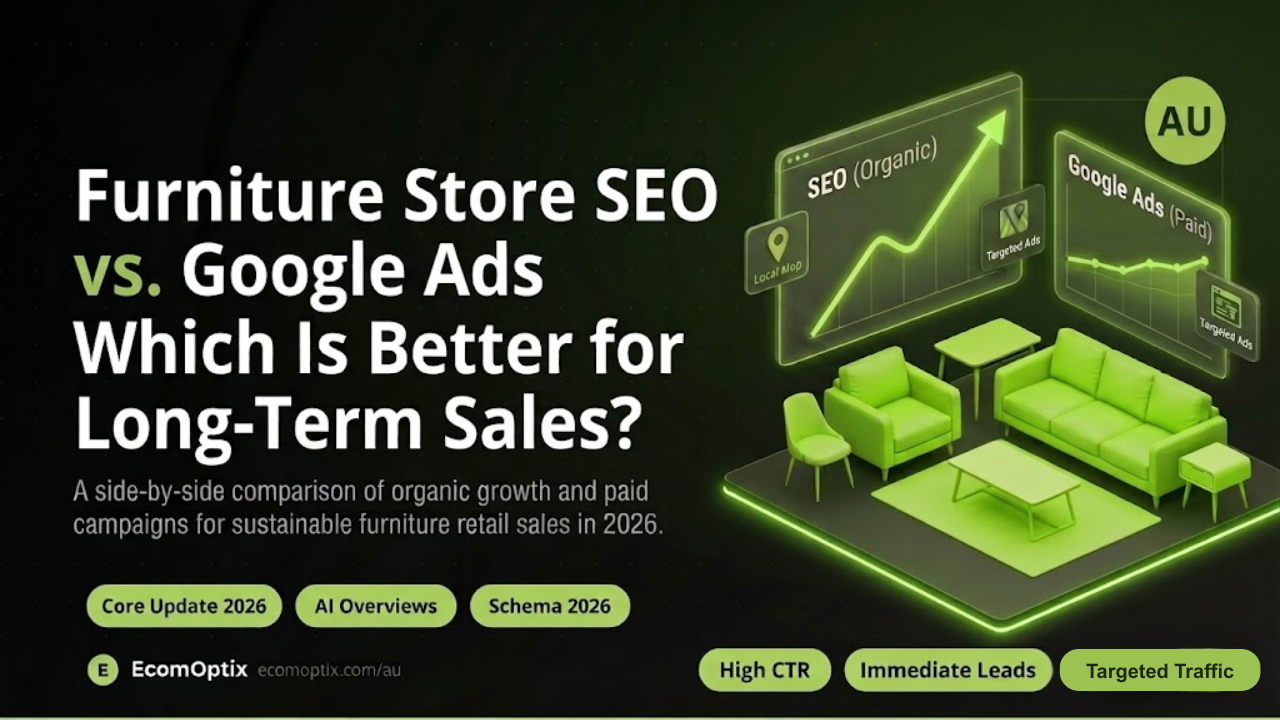
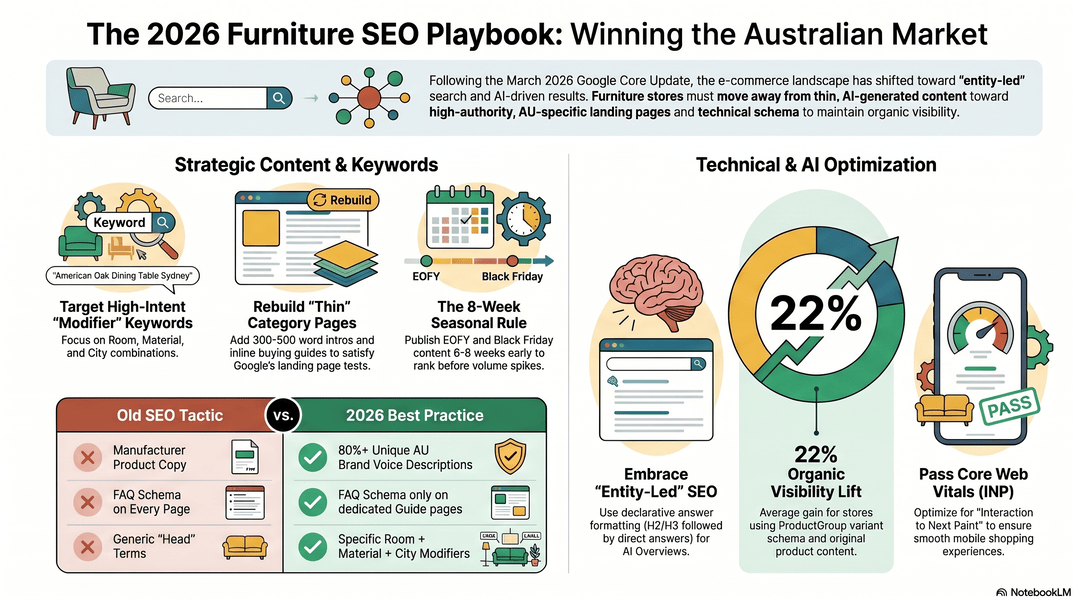
If your furniture store still relies on Google Ads to keep the lights on, the maths got worse this year. Average CPCs on “sofa Melbourne”, “dining table Sydney” and “boucle armchair Australia” rose again through Q1, while Google’s March 2026 Core Update — which began rolling out on March 10 and completed on April 8 — quietly redrew the SERP. Stores with original product content, real customer signals and clean schema gained an average 22% organic visibility. Stores running AI-generated product descriptions, thin category pages and templated guides slid backwards.
Layered on top of that, AI Overviews now appear on roughly 14% of shopping queries (a 5.6× jump in four months), and the format has completely rewritten what “ranking” means for furniture buyers in research mode. The store that still treats SEO like 2022 is bleeding share to one that treats it like 2026.
This is the practical playbook for Australian furniture retailers who want to win post-Core-Update SERPs, get cited in AI Overviews and ChatGPT Search, and convert mobile shoppers at 9 pm on a Sunday. Seventeen practices in the order most owners should tackle them, every one calibrated to what works in .com.au search and what Google itself has signalled in the last twelve months.
For the strategic context underneath all of this, the furniture store SEO guide for Australian store owners is the pillar piece this post sits beneath.
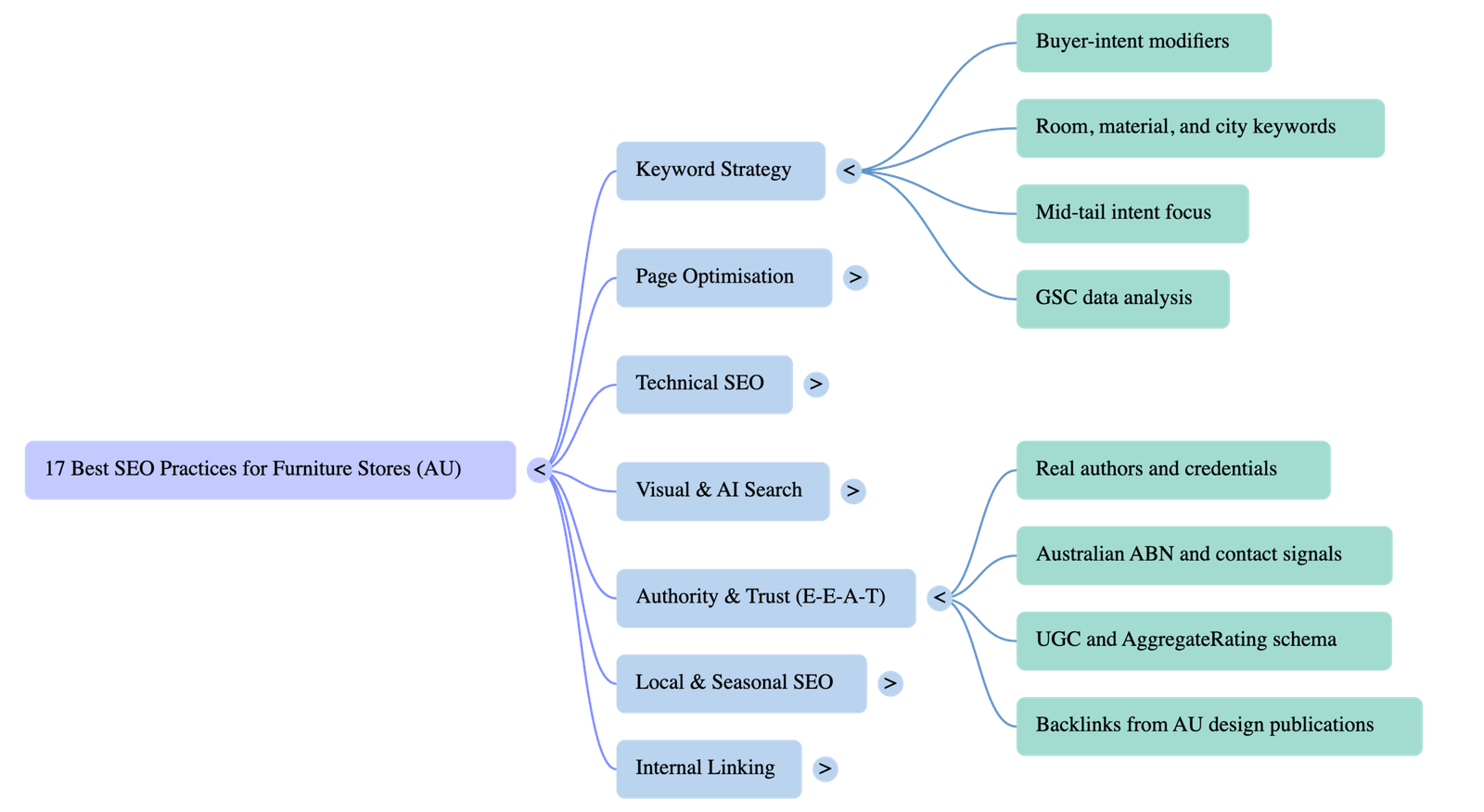
The 17 practices in one breath
- Buyer-intent keyword research with room, material and city modifiers
- Rebuild category pages — the biggest March 2026 Core Update casualty
- Product page SEO with ProductGroup variant schema (Google’s 2024-introduced spec)
- Image and visual search optimisation for Google Lens
- Pass Core Web Vitals 2026 — including INP, which replaced FID
- Treat your mobile page as your only page
- Use the schema types that survived the March 2026 update
- Internal linking direction: blog → category → product (never the reverse)
- Optimise for AI Overviews and AI Mode — entity-led, not keyword-led
- Win citations in ChatGPT Search, Perplexity and Bing Copilot
- Set AI crawler controls deliberately (llms.txt, GPTBot, ClaudeBot, PerplexityBot)
- Real local SEO if you have any AU physical footprint
- The Australian retail seasonal calendar (EOFY → Click Frenzy → Boxing Day → Aus Day)
- Earn backlinks from AU interior design and lifestyle publications
- Reviews and UGC are structured as AggregateRating and Review
- Build genuine E-E-A-T — real authors, real ABN, real photos
- Lock the technical baseline + avoid the site reputation abuse penalty
Let’s break this down 1 by 1
1. Buyer-intent keyword research with room, material and city modifiers
Most furniture stores still chase head terms — “sofas”, “dining tables”, “office chairs” — and lose. Those AU SERPs are owned by Temple & Webster, Fantastic Furniture, Coco Republic, King Living and the marketplaces. The win is in mid-tail intent that signals a buyer further down the funnel: “boucle armchair Melbourne”, “American oak dining table Sydney”, “L-shaped sofa under $2000 Australia”, “Hamptons coffee table Brisbane”.
Group your research around three modifier types. Room modifiers (“living room furniture Brisbane”) map to category pages. Material modifiers (“solid timber bedside tables Australia”) map to filtered category or sub-collection pages. Price/comparison modifiers (“best sofa under $1500 Sydney”) map to blog or buying-guide content. Use Search Console queries already filtered to Country = Australia as your truth source — third-party tools approximate; GSC reports what Australians actually clicked.
Do this today: export your last 90 days of GSC queries filtered to Australia, sort by impressions, and circle every query at position 11–25 with at least 50 impressions. Those are the fastest CTR-and-content wins available to you.
2. Rebuild your category pages – the biggest March 2026 Core Update casualty
This single section is worth more than the rest of this article combined. The March 2026 Core Update specifically punished thin, templated category pages – the kind that show 24 products and 30 words of intro copy. Stores that lost visibility on “living room furniture”, “dining tables Australia,” or “office chairs Sydney” almost universally had category pages that failed Google’s “is this a real landing page or a search results page” test.
A high-performing AU furniture category page in 2026 contains:
- A 300–500-word above-the-fold introduction including the target keyword and 4-6 semantic variants written in genuine AU brand voice (no AI templating)
- An H1 that exactly matches the commercial keyword, not a clever marketing line
- An inline buying guide of 200–300 words mid-page (between rows of products) — material differences, size guidance, Australian climate considerations
- Internal links to relevant sub-collections with descriptive anchors (e.g. “Living Room Furniture” linking to “L-shaped sofas”, “armchairs”, “coffee tables”)
- CollectionPage and ItemList schema declaring the page’s purpose
- An AU-specific FAQ section of 4–6 questions (delivery to regional NSW, AU stock vs pre-order, return windows, GST inclusion)
- Real customer reviews surfaced from products in the collection – fresh user content compounds trust signals.
If you only have time to fix one page type this quarter, fix category pages. Test it on a single category first; the lift is usually visible inside 4-6 weeks.
3. Product page SEO with ProductGroup variant schema
Product pages do four jobs at once: rank for long-tail queries, sell the product, signal trust, and feed AI search snippets. The biggest 2026 change here is structural — Google now supports ProductGroup structured data for product variants, and the stores using it are picking up rich result coverage on variant queries that competitors miss.
The 2026 minimum viable product page:
- Product schema with full property set — name, image, description, sku, gtin13 where available, brand, offers with price, priceCurrency: AUD, availability, priceValidUntil, shippingDetails (a major 2024 addition), and hasMerchantReturnPolicy. The shipping and return properties are now ranking factors for free product listings in Google Shopping.
- ProductGroup markup grouping all variants — particularly important for furniture sold in multiple fabrics, timbers, or sizes. This stops Google from treating each variant as a separate competing URL.
- Unique product descriptions in AU brand voice — never the manufacturer copy. Even rewriting 80% of a manufacturer description into your own voice puts you ahead of 90% of competitors using it raw. Original product content was a documented winner in the March 2026 Core Update.
- Real-image alt text that describes the product as a buyer would search (“three-seater linen lounge in oatmeal”, not “couch1.jpg”)
- Variant URL hygiene — set canonicals back to the parent product URL where colour/fabric variants share the same SKU family.
For the deeper version of product page execution, see our furniture product page SEO checklist.
4. Image and visual search optimisation — Google Lens is now a furniture search engine
Furniture is the canonical visual category, and Google Lens has quietly become a primary discovery surface for AU buyers. A shopper sees a sofa on a Pinterest pin or in a friend’s living room, holds up Lens, and the SERP that appears is increasingly populated by stores that did three things right.
The non-negotiables:
- Convert hero and product images to WebP or AVIF (40–60% smaller than JPEG at the same quality)
- Serve responsive srcset versions so mobile devices don’t download desktop-sized assets
- Lazy-load anything below the fold — but not the LCP image
- Descriptive filenames — boucle-armchair-oatmeal-melbourne.webp not IMG_4123.jpg
- Alt text written as a buyer would search — include style (“Hamptons”, “Mid-century”), material (“linen”, “American oak”), and where relevant the AU geo modifier
- Embed images in Product schema — at least three high-resolution images per product, square aspect ratio preferred for Lens parsing
Read Google’s Largest Contentful Paint documentation — your hero image is almost always the LCP element on a furniture product page, and optimising it has the highest direct impact on rankings.
If you’re on Shopify and image-heavy load times are still costing you, our Shopify speed optimisation service is built specifically for this problem.
5. Pass Core Web Vitals 2026 – INP replaced FID
Core Web Vitals quietly changed in March 2024: First Input Delay (FID) was retired and replaced with Interaction to Next Paint (INP). INP is harsher – it measures every interaction on a page, not just the first one. Many furniture sites that used to pass FID now fail INP because of slow filter, sort, and add-to-cart interactions on mobile.
The 2026 thresholds you need to hit:
- LCP (Largest Contentful Paint): under 2.5 seconds (good), under 4 seconds (needs improvement)
- INP (Interaction to Next Paint): under 200ms (good), under 500ms (needs improvement) – see web.dev’s INP documentation
- CLS (Cumulative Layout Shift): under 0.1 (good), under 0.25 (needs improvement)
Most AU furniture sites fail LCP because of unoptimised hero images (covered in practice 4) and CLS because product cards shift as images and review widgets load asynchronously. INP failures usually trace to heavy review apps, chat widgets, or filter logic that blocks the main thread.
Pull every important URL through PageSpeed Insights monthly and use the GSC Core Web Vitals report to see which URL groups are failing in the field, not just in the lab.
6. Treat your mobile page as your only page
The Australian Bureau of Statistics retail data shows AU online retail traffic is now over 70% mobile. Google’s mobile-first indexing – fully completed in October 2023 – means your mobile page is the page that gets ranked. If your mobile experience is degraded, your rankings are degraded.
Common mobile failures we see on AU furniture sites:
- Above-the-fold content hidden behind tabs or accordions (Google still indexes it, but weights it less)
- Different content served to mobile vs desktop
- Important internal links hidden inside hamburger menus rather than on the page
- Filter and sort controls that overlay the entire viewport, hurting INP
Test your top 10 commercial pages on a real mid-tier Android device (not just an emulator) on a throttled 4G connection. Australian buyers on suburban or regional connections see a slower experience than your CBD office wifi suggests.
7. Use the schema types that survived the March 2026 update
Google’s March 2026 update did something important and under-reported: it reduced rich result display for several schema types that had been widely abused — most visibly FAQPage and HowTo on non-primary content pages. Sites that bolted FAQ schema onto every product and category page saw rich result loss and modest ranking pressure.
The schema types that survived and strengthened in 2026:
- Product and ProductGroup — strongest performers, especially with full offers and shippingDetails
- AggregateRating and Review — but only with genuine first-party reviews
- LocalBusiness — for any store with a physical presence
- BreadcrumbList — universally helpful, low risk
- Organization — homepage-only, helps entity recognition for AI search
- FAQPage — only on dedicated FAQ or buying guide pages where a real FAQ section is the primary content. Strip it from product pages.
- HowTo — only on genuine how-to articles. Strip it from category and service pages.
This is one of the highest-leverage post-update fixes available right now. Audit your current schema deployment with the Schema Markup Validator and remove anything not aligned to genuine page intent.
8. Internal linking direction: blog → category → product
Most furniture stores link the wrong way. They write a blog post and link out to ten products. Authority flows out, not in. Reverse it.
The correct pattern: pillar service / category page sits at the top, blog content links up into it, and individual product pages link laterally to a relevant collection or category page. So a “How to choose a Hamptons-style coffee table” blog post links into your “Coffee Tables” category page (with the anchor “Hamptons coffee tables”) and into 2–3 related styling posts — not into 10 specific products. The foundational furniture store SEO strategy guide for Australian retailers walks through the full hub-and-spoke architecture if you want a deeper template to copy.
Internal links should be contextual (in the body, surrounded by relevant text), not bulk-dumped at the end of the article. Distribute them across the page: one in the introduction, one mid-body, one in a closing recommendation. That distribution is how Google’s link-graph algorithms read editorial intent.
For category-page linking specifically, the rule is to have at least three contextual blog or guide posts pointing into every major category page within six months of launching that category.
9. Optimise for AI Overviews and AI Mode — entity-led, not keyword-led
This is the biggest shift in 2026 and the one most furniture stores are getting wrong. AI Overviews now appear on 14% of shopping queries in Google AU, and “best of” / research-style queries (e.g. “best L-shaped sofa for small living rooms”) trigger them in 83% of cases. Google’s AI Mode (the conversational tab that launched in 2025 and went mainstream in 2026) is even more entity-driven.
AI Overviews and AI Mode do not consume HTML design elements — they read entities. Without clean structured data and clear entity signalling, you’re invisible to the AI layer.
The 2026 AI optimisation checklist:
- Declarative answer formatting — H2/H3 questions answered immediately in the next 1–2 sentences. “How does furniture store SEO work? Furniture store SEO works by ranking…” Not buried at paragraph 6.
- Entity consistency across the site — your brand name, address, founder name, products and services should appear in Organization schema, GBP, About page, and Wikipedia/Wikidata stub if you have one
- Topical depth, not keyword stuffing — AI engines reward sites that cover an entity (e.g. “Hamptons furniture”) across multiple pages with internal connections
- First-hand experience signals — phrases like “in our Melbourne showroom we measured…” or “we tested 14 boucle fabrics over six months” signal Experience, the first E in E-E-A-T
- Citable statistics with sources — AI Overviews cite specific numbers; vague generalities don’t get cited
- Author bylines with credentials and a real LinkedIn profile — AI engines weight expertise signals heavily
Do this and you’ll start seeing your URLs appear as citations in AI Overviews on furniture queries — which is the new “ranking” for the top of funnel.
10. Win citations in ChatGPT Search, Perplexity and Bing Copilot
Google AI Overviews are not the only generative engine sending furniture buyers your way. ChatGPT Search (which uses Bing’s index), Perplexity, and Bing Copilot are growing referral channels — small in absolute volume right now, high in buyer intent because the AI has already pre-qualified the query.
The same content principles in practice 9 apply, plus three Bing-specific moves:
- Submit your sitemap to Bing Webmaster Tools — most AU stores haven’t, and ChatGPT Search relies on Bing’s index
- Verify your Wikipedia / Wikidata entity — ChatGPT and Perplexity weight Wikipedia presence heavily for entity recognition
- Earn editorial mentions on sites the AI engines treat as authoritative — major AU retail publications (Inside Retail, Power Retail, SmartCompany, Marketing Mag), industry directories, and well-known agency lists. These get retrieved as “supporting sources” when AI engines cite a result.
Once a furniture brand starts appearing in Perplexity and ChatGPT answers, the compounding effect is fast — those tools surface your URL alongside the established competitors and effectively borrow their authority.
11. Set AI crawler controls deliberately – llms.txt, GPTBot, ClaudeBot, PerplexityBot
A new layer of control entered SEO in 2024 and matured in 2026: AI crawler bots that scrape content for training and retrieval. By default, your site is being read by GPTBot (OpenAI), ClaudeBot (Anthropic), PerplexityBot, Google-Extended (Google’s AI training crawler), CCBot (Common Crawl), Bytespider (TikTok/ByteDance) and others.
The strategic question for furniture retailers: do you want to be retrievable in AI answers (yes) or trained on (your call)?
Recommended robots.txt posture for an AU furniture store:
User-agent: GPTBot → Allow: /User-agent: ClaudeBot → Allow: /User-agent: PerplexityBot → Allow: /User-agent: Google-Extended → Allow: /User-agent: CCBot → Disallow: /User-agent: Bytespider → Disallow: /
Add an llms.txt file at your root with a curated index of your most important content for AI engines — this is an emerging standard that several large publishers and ecommerce sites have adopted in 2025–26. It tells generative engines which URLs you consider authoritative answers to common queries on your site’s topics.
This is not theoretical anymore. AI-driven traffic is showing up in GA4 reports under the chatgpt.com, perplexity.ai, gemini.google.com and copilot.microsoft.com referrers, and the stores that allowed retrieval are receiving it.
12. Run real local SEO if you have any AU physical footprint
If you have any verifiable Australian footprint – a Melbourne showroom, a Sydney warehouse with click-and-collect, a Brisbane delivery hub — local SEO is the lowest-competition, fastest-yielding lever available to you. Most furniture brands ignore it.
The 2026 minimum viable local SEO setup:
- Fully completed Google Business Profile with primary category “Furniture Store” + relevant secondary categories (Sofa Store, Bedroom Furniture Store, Office Furniture Store, etc.)
- Weekly GBP posts — sales, new arrivals, EOFY events, styling tips
- 30+ photos that are not stock — your real store, real team, real products in situ
- NAP consistency across at least 10 AU citation sources — True Local, Hotfrog, Yellow Pages, Yelp AU, Pure Local, StartLocal, Localsearch
- 20+ Google reviews collected via post-purchase email automation
- LocalBusiness schema on every page (not just the contact page) with address, geo, openingHoursSpecification, areaServed: AU
Once that foundation is in, build city-modifier landing pages: /sofas-melbourne/, /dining-tables-sydney/, /bedroom-furniture-brisbane/. Each is a real page (not a thin geo doorway), with locally relevant content, embedded GBP map, and city-specific delivery information.
The full execution playbook for this is in our local SEO guide for Australian furniture stores.
13. The Australian retail seasonal calendar – your unfair advantage
Australian retail runs on a calendar that US and UK competitors don’t fully understand. Used right, this is one of the strongest SEO levers for AU furniture stores. EOFY (June 30 sales), Click Frenzy (mid-November), Black Friday (late November), Boxing Day (December 26), Australia Day weekend, the back-to-school furniture rush in late January, Easter, and Mother’s Day all generate concentrated buyer intent – but only if your content is already ranking when search volume spikes.
The rule: publish 6–8 weeks ahead of every major Australian retail event. An “EOFY Furniture Sale Australia 2026” guide written in May ranks by mid-June; written in late June, it doesn’t rank in time.
The annual editorial calendar for an AU furniture store:
- Late April / early May: EOFY furniture buying guide, EOFY sale landing page draft
- Mid June: EOFY landing page goes live, internal links from homepage and top categories
- Late September: Click Frenzy + Black Friday + Boxing Day combined planning content
- Mid October: Holiday-season styling content (Christmas dining, entertaining furniture)
- Mid January: Australia Day + back-to-school furniture content
- Mid February: Easter dining furniture, Mother’s Day gifting
This kind of seasonal SEO is also one of the strongest plays for replacing paid ad spend with organic traffic. Google Ads CPCs on EOFY furniture queries can hit $8–$14 — a ranking page costs you nothing per click.
14. Earn backlinks from AU interior design and lifestyle publications
Furniture is one of the easiest verticals to earn editorial backlinks in, because lifestyle publications constantly need product imagery and styling content. They will link to you if you make it easy.
Three plays that consistently work for AU furniture brands:
- Pitch original styling pieces — “5 Australian Hamptons living rooms designed by ___” — to publications like Inside Out, Vogue Living AU, Real Living, HomeBeautiful, House & Garden AU. They accept guest contributions if the photography is genuinely high quality.
- Supply free product samples or showroom access to AU interior design bloggers (especially those active on Instagram and Pinterest) who will feature and link back. Look for AU bloggers with 10k–50k followers — they engage and link far more than the 200k+ tier.
- Get listed in AU furniture round-ups — best Sydney showrooms, best online furniture stores Australia, best sustainable furniture brands AU. These often update annually and a single inclusion can drive both link equity and direct referrals.’
Cold-pitching from a generic email rarely works. Building genuine relationships over 4–6 weeks consistently does. Track every relationship in a simple sheet – outreach is a sales process, not a one-shot send.
15. Reviews, UGC, and AggregateRating done correctly
Star ratings in Google’s search results are a CTR multiplier – a product result with 4.6 stars and 80 reviews shown directly in the SERP earns 30–50% more clicks than the same result without them, even at the same position.
Collect reviews through a tool that pushes them as structured data: Judge.me, Loox, Stamped, Yotpo all support this for Shopify; Reviews.io works across most platforms. Mark up aggregateRating and review schema on every product page, and aggregateRating on the brand homepage if you have collected enough cross-product Trustpilot or Google reviews.
Three critical 2026 caveats:
- Do not fake or buy reviews. Google’s product reviews update and the March 2026 Core Update specifically targeted manipulated review signals. Recovery is slow and uneven.
- Add review schema with reviewer names, dates, and bodies — not just ratings. Schema with content is read as legitimate; bare-rating schema increasingly is not.
- Encourage user-generated photos in reviews. Visual UGC compounds two ways: it strengthens the review’s weight, and it’s pulled into Google Lens and AI Overviews when the visual matches a query.
16. Build genuine E-E-A-T — real authors, real ABN, real photos
Google’s Helpful Content System — now integrated as a continuous signal in core ranking – has tightened around E-E-A-T since 2024. The first E (Experience) carries more weight than ever. For an Australian furniture store, this translates into specific deployable signals:
- Real author pages for blog and guide content, with byline, photo, role, and verifiable credentials (LinkedIn link, industry experience). Pseudonymous “Admin” or “Staff” bylines lose ranking weight.
- First-hand experience phrasing in content – “in our Melbourne showroom”, “we tested 14 fabrics”, “after delivering 200+ Sydney installations” – Google’s quality raters and AI engines both pattern-match on this.
- Trust signals in your footer – ABN, GST-registered statement, Australian phone number, physical AU address, links to Privacy Policy, Terms, Returns
- Real team photos on your About page – not stock. AI engines now perform basic image novelty checks against stock libraries.
- Credentials and partnerships – Shopify Partner badge, AU industry association memberships, awards (only if real)
This is also Mark’s distrust filter. He scans for these signals before he even reads your H1.
17. Lock the technical baseline — and avoid the site reputation abuse trap
Most agencies sell content and links because the margin is bigger. The reality is that on a furniture site running 2,000+ products and faceted navigation, the technical baseline is usually leaking 30–40% of crawl budget on URLs that should never be indexed.
The technical non-negotiables in 2026:
- An XML sitemap that contains only canonical, indexable URLs (no ?sort=, no ?colour=, no thank-you pages)
- A robots.txt that blocks search results pages, login flows, and faceted parameter URLs
- Canonical tags on every variant URL pointing back to the parent product
- Correct hreflang if you serve other regions (en-au, en-nz)
- Proper 301 redirects for any retired product or category
- Zero noindex tags on commercial pages (audit specifically for this — accidental noindex tags are the most common cause of disappearing rankings after a redesign)
- No duplicate “-new” or “-test” pages indexed during redesigns (a common source of self-cannibalisation)
One 2024-introduced policy worth flagging specifically: Google’s site reputation abuse policy. If you publish third-party content on your domain that’s loosely related to your business (sponsored coupon pages, off-topic guest posts, syndicated content), Google now treats this as spam, and the domain-wide ranking impact can be severe. Audit any guest content you’ve allowed on your subfolders – it’s a silent ranking killer.
If you’ve recently redesigned, an e-commerce SEO audit typically pays for itself in the same quarter you run it.
What to do if the March 2026 Core Update knocked you down
If your AU furniture store lost 15–30% organic visibility between March 10 and April 8, you were not unlucky – you were diagnosed. The recovery framework, in order:
- Audit category pages first – thin content, manufacturer-templated copy, no buying guidance. Rebuild them per practice 2.
- Audit product descriptions – anywhere you used AI generation at scale, rewrite. Originality is now the strongest ranking signal at the product page level.
- Strip schema bloat – remove FAQPage and HowTo from non-primary content pages.
- Audit guest / syndicated content on your domain – site reputation abuse is the most overlooked recovery item.
- Strengthen author E-E-A-T — real bylines, credentials, photos.
- Wait for the next core update to re-evaluate. Recovery is rarely instant; it lands on the next algorithmic refresh.
Most stores that did this work in the four weeks after the update saw partial or full recovery by the next minor update wave.

| Common mistake | What works in 2026 |
|---|---|
| Targeting head terms (“sofas Australia”) | Targeting room + material + city modifiers |
| Manufacturer product copy | 80%+ rewritten descriptions in AU brand voice |
| FAQPage schema on every product page | FAQPage only on genuine FAQ/guide pages |
| Stock photography | Real product photography with descriptive alt text |
| Bulk dumping 10 internal links at the end of a blog | 3 contextual links distributed through the body |
| US spelling on AU pages | AU spelling throughout (organisation, optimisation, colour, behaviour) |
| GBP set up and forgotten | Weekly posts + 20+ reviews + 30+ photos |
| Reporting traffic & rankings | Reporting organic revenue per landing page |
| Pseudonymous “Admin” blog bylines | Real authors with credentials and photos |
| AI-generated product descriptions at scale | Hand-written, brand-voice product content |
| Allowing every AI crawler by default | Deliberate robots.txt + llms.txt posture |
If your store is still relying primarily on paid traffic, start with the case for the shift: how furniture store SEO replaces paid ad revenue. For the deeper strategic context covering everything in this post, the furniture store SEO guide for Australia is the pillar piece.
When you are ready to translate this into work on your own store, the fastest path forward is a quick conversation. We work specifically with furniture store SEO across Australia – Shopify, Shopify Plus, WooCommerce and Magento – and we will tell you, in 15 minutes and without a sales pitch, the three highest-impact actions we would take on your store first.