Quick Answer
Local SEO is how your furniture showroom shows up when someone nearby searches “furniture store near me” on Google or Google Maps. For Australian stores, four things decide whether you appear: a website with clear location signals, a fully set up Google Business Profile, your store listed consistently across Australian directories, and a steady flow of real customer reviews. Get these right and your showroom earns a spot in the local map results – where most nearby buyers click first.
Suppose you added a new sofa product to your store. The product images look great. The description is in place. The Buy Now button works. Stock is live. You shared it on Instagram. And then – nothing. A trickle of traffic, the occasional add-to-cart, and a conversion rate that would make your accountant nervous.
You already know product pages are where the sale happens. The problem is not knowing – it is attention. Product pages (we can also call them money pages) carry the highest buying intent and sit closest to the sale, but they get less care than almost any other page on your store. Homepages get redesigned. Categories get rebuilt. Product pages get a photo swap when new stock arrives, and that is it.
Homepages get rebuilt. Category pages get updated every season. Product pages? A photo swap when new stock comes in, and that is the full extent of the attention they get.
That imbalance is where your revenue is leaking. A furniture buyer has already spent days or months researching before landing on your page – They are not just having a quick look. They are reading every word, checking every photo, and measuring every spec before they commit. With cart abandonment averaging 70% globally – and running higher in high-consideration categories like furniture – the product page is where the money quietly disappears.
To learn the importance of product pages, here you can find the guide: Furniture Store SEO Guide for Australian Store Owners, which covers the “R” – Revenue Pages – in the F.O.R.M. framework. But this post shows you exactly how to fix, optimise, and rank product pages on search engines.
Why Furniture Product Pages Are Different From Everything Else in E-commerce
A shopper buying $60 earbuds decides in minutes. A shopper buying a $3,200 modular sofa for a home takes months. They will visit your product page several times, compare it against two or three other stores, measure their living room twice, show the photo to their partner, and then sit on it for another fortnight before committing.
That behaviour changes what your product page has to do. It has to:
- Show up in Google for the exact search the buyer types (“timber dining table 8 seater Australia”).
- Survive repeat visits without losing its persuasive weight.
- Answer every question a hesitant buyer can come up with – without you or your team being there to answer them.
Most furniture stores optimise their pages for the first click. Furniture actually sells on the third or fourth visit. If your page cannot earn that second look, your conversion rate is being decided by the buyer’s patience, not your copy.
The other reality is that furniture is expensive, visual, heavy, breakable, and difficult to ship. Every one of those factors creates a reason for a buyer to hesitate. Your product page has to answer each one. A generic product page template – the kind built for phone cases and skincare – simply cannot carry that load for furniture as well.
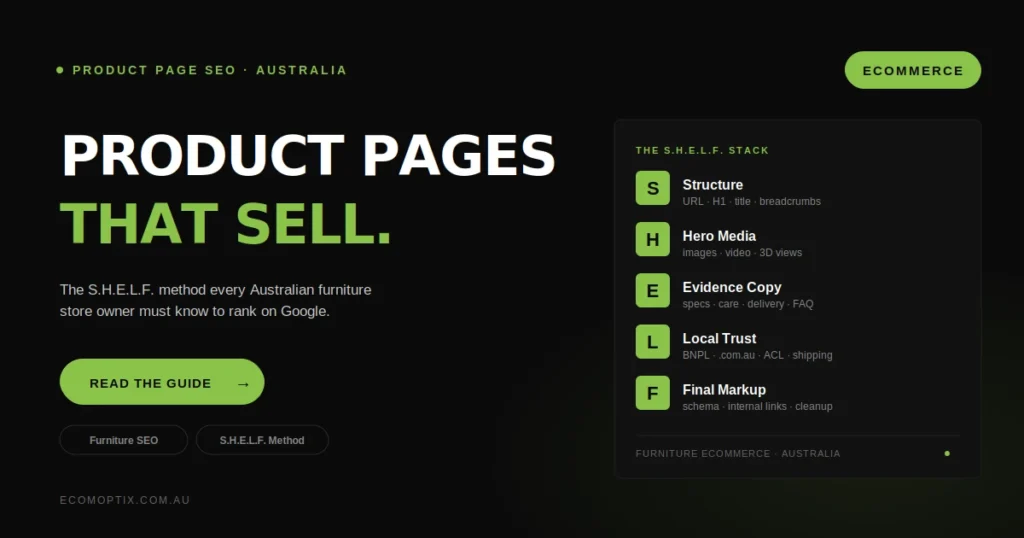
The S.H.E.L.F. Method: Five Layers Every Furniture Store Owner Must Get Right
While there are various factors, we have categorised them into the following five layers to decide whether a furniture product page ranks and sells. We have found that stores that consistently grow have all five working together. Stores that struggle usually have two or three in place and wonder why nothing improves.
- S — Structure: The basic technical setup Google reads – your URL, your headline, your title tag, your breadcrumbs.
- H — Hero Media or Hero Section: The images, video, and 3D views that sell the product and keep the page fast.
- E — Evidence Copy: The description, specs, care, delivery, and FAQs that answer every buyer’s question.
- L — Local Trust: The Australian signals – BNPL, .com.au, consumer law, state shipping – that tell a local buyer you are a real local store.
- F — Final Markup: The Google code, internal links, and clean-up work that help the page earn rich results in search.
So the order of information matters on product pages. Adding fancy Google markup to a page with a messy URL is like putting a showroom sign on a warehouse with a cracked foundation. It will not fix the underlying problem.
Most furniture stores do not have a product page problem. They have a problem with how the five parts work together.
S — Structure: The Basics Google Reads First
Before a single buyer sees your page, Google has already read four signals to decide whether the page deserves to rank. These signals live in the “structure” layer, and most furniture stores get all four wrong on autopilot.
Your URL. This is the web address of your product page – the part after your domain name. A good URL is short, clean, and reads like the product name itself. For example, yourstore.com/products/montauk-3-seater-linen-sofa works. Something like yourstore.com/products/copy-of-copy-of-montauk-sofa-update-2026 does not – Google struggles to read it, and it tells buyers nothing.
On Shopify (and most platforms), your URL is automatically created from your product title. So if you name your product properly when you add it, the URL takes care of itself.
The problem usually starts when someone duplicates a product, renames it halfway, or lets the system add a number to the end, and then no one cleans it up. In the audits we run, it is common to find furniture stores carrying dozens of these messy URLs across their catalogue, quietly holding back their rankings.
Your headline (H1). One main headline per page, matching the exact product name plus a natural detail buyers actually search for. “Montauk 3 Seater Linen Sofa – Natural” is stronger than “Montauk 3 Seater Sofa” because it naturally includes the colour and material shoppers are typing into Google.
Your title tag and meta description. The title tag is the blue link buyers see in Google results. It should lead with the product name, include the main material or feature, and end with a trust element – something like “Free Delivery Australia-Wide” or “Handcrafted in Melbourne.” Keep it under 60 characters so it doesn’t get cut off. The meta description doesn’t directly affect rankings, but it does determine how many people click your listing, and those clicks feed back into rankings over time.
Your breadcrumbs. The little trail that reads Home > Living Room > Sofas > Montauk 3 Seater. This one small element tells Google exactly where this product sits inside your store and helps it understand the page as part of a larger catalogue, not a random URL floating on its own.
The most common mistake we see: store owners treat every product page as a standalone asset instead of a part of a hierarchy. A product page that is not clearly connected to its parent category, and not linked to related products, is a page Google sees as isolated and isolated pages do not rank.
Fix your URL, headline, title tag, and breadcrumbs on your top 20 products before you touch anything else. The rest of the work compounds on this foundation.
H — Hero Media: Fast Images That Actually Sell
Furniture sells based on how it looks. But most furniture product pages use photos so large that they take too long to load on a phone, and the buyer is gone before the page even finishes.
Here is why this matters: Google tracks how fast your pages load and how responsive they feel. These are part of what Google calls Core Web Vitals. You do not need to memorise the acronyms – you just need to know that if your product page takes more than a couple of seconds to load on a phone, Google will rank it lower, and buyers will leave before they see your beautiful photos.
The fix is straightforward:
- Convert every product image to a modern format (WebP or AVIF). Your web developer or AI can do this in bulk.
- Keep product tile images under 250KB. Keep hero images under 500KB.
- Make sure images below the fold load only when the buyer scrolls to them (“lazy loading”).
- Aim for your main image to load in under 2.5 seconds on a phone.
That handles the technical side. The bigger opportunity lies in what images you actually show.
Furniture product pages that consistently outperform include:
- Six or more images – not three.
- At least two lifestyle shots showing the product in a real Australian room. This is the most powerful thing that impacts the decision-making of modern buyers.
- One scale reference image (a person sitting on it, or next to a standard-sized object) so buyers can judge the size.
- A 360-degree view for upholstered items.
- A short video for anything that folds, reclines, extends, or assembles.
- 3D or AR viewing tools if your platform supports them — which Shopify, WooCommerce, and BigCommerce now all do.
Here is the part most store owners get wrong: if you spend hours picking the perfect homepage hero image and use whatever JPEG the supplier sent for the product page. That is not the best practice. Homepage photos do not convert. Product page photos do. Put the effort where the revenue is.
Every image needs descriptive alt text (a short written description behind each image).
This helps vision-impaired users, and it also helps Google understand what the image shows. “Montauk 3 seater linen sofa in natural, styled in a coastal Australian living room” beats “sofa1.jpg” on every measure of accessibility, image SEO, and context.
E — Evidence Copy: Answer Every Question a Hesitant Buyer Has
Your product descriptions are probably the weakest part of your page – and they are almost certainly copied from your supplier.
This is not a small issue. Google has already indexed that exact description on dozens or hundreds of other furniture stores. You will not rank for it. You never will. Duplicate descriptions across your whole catalogue also act as a quiet tax on your entire store’s ability to rank.
Original descriptions are non-negotiable. But “original” is not the same as “good.” Most furniture descriptions are marketing copy trying to hype the product. Buyers who have researched for six months do not want hype. They want evidence.
Here is what actually converts a hesitant furniture buyer:
A clear specifications block. Every measurable fact a buyer can check. Exact dimensions (width × depth × height × seat height). Weight. Weight capacity. Materials and origin (FSC-certified Australian hardwood is a selling signal, not just a spec).
Frame construction. Cushion fill type and density. Fabric composition. Everything included. Assembly time and difficulty.
Care content written specifically for this piece. Leather sofas, rattan, outdoor timber, and upholstered fabric all need different care. Generic “wipe with a damp cloth” instructions do not build confidence. Specific care content for the actual material does.
Delivery information that reflects Australian reality. Metro Sydney, metro Melbourne, metro Brisbane, metro Perth, regional NSW, regional Victoria, Tasmania, Northern Territory – your delivery times and costs are different for each.
Put them on the product page itself. Not buried in a shipping policy three clicks away. Shipping surprises at checkout are one of the biggest causes of Australian furniture cart abandonment you can actually prevent.
A product-specific FAQ — not a site-wide one. Six to ten real questions pulled from your actual customer support emails and chat logs.
“Will this sofa fit through a 750mm doorway?” “Is the fabric suitable for pets?” “How long until my pre-order arrives?” These are the questions that kill a sale. Answer them on the page where the buyer is making the decision.
Reviews, displayed clearly. Average star rating visible above the fold. Review count visible. Full reviews readable without leaving the page.
Sorting by recency and rating. Reviews are the single most-read thing on a furniture product page by a hesitant buyer and they are also one of the biggest trust signals Google uses to decide what to rank.
The common advice is “write unique product descriptions.” In practice, a beautifully written 150-word description is worth less than the same page with full specs, care content, state-level delivery, an FAQ, and reviews. The description helps. The evidence block converts.
L — Local Trust: The Australian Layer Most Generic SEO Advice Skips
Almost every furniture SEO article you will find online was written for the US or UK market. Australia is a different market, and the trust signals that matter here barely show up in international content.
.com.au domain. Australian shoppers quietly prefer .com.au URLs for local purchases, because .com.au registration requires a valid Australian Business Number. At identical prices on identical products, .com.au domains tend to win. If your store runs on a .com, you are paying a hidden conversion tax.
BNPL visible on the page itself. Afterpay, Zip, Humm, and PayPal Pay in 4 are major conversion drivers for high-AOV furniture. Do not hide them until checkout. “4 interest-free payments of $225 with Afterpay” should sit directly under the price. Australian furniture retailers that put BNPL front and centre on the product page consistently convert better than those that wait until the cart to reveal it.
Australian Consumer Law referenced as a trust signal. The ACL gives Australian buyers guaranteed rights on major and minor faults, regardless of what your return policy says.
Australian buyers know this. Adding “Covered by Australian Consumer Law statutory guarantees” to your product page is a trust signal no overseas competitor can legitimately claim. It costs you nothing and it measurably lifts conversion.
Postcode-level shipping transparency. Delivery to regional NSW, regional Victoria, Tasmania, and the NT is where furniture purchases most commonly fall over. A shipping calculator on the product page — one that shows cost and lead time once the buyer enters their postcode — removes the biggest single cause of Australian furniture cart abandonment.
Showroom and local business signals. If you have a physical showroom, mention it on the product page. “Also on display at our Alexandria showroom” plus a link to your Google Business Profile, is a signal Google and the buyer both weigh heavily.
You do not need better SEO. You need Australian SEO.
F — Final Markup: What Makes Your Listing Stand Out in Google
This last layer is where you take a product page that is already doing the right things and help it earn a better-looking result in Google. There are three parts to it: schema markup, internal linking, and cleaning up old pages. None of it is glamorous. All of it matters.
Schema markup — what makes stars show up in Google search
Schema is a hidden piece of code on your product pages that tells Google exactly what the page is. You do not write it yourself. Shopify, WooCommerce, BigCommerce, and most review apps either include it automatically or offer it as a plugin.
The schema types that matter for a furniture product page:
- Product schema — required. Includes the product name, description, price, availability, brand, and most importantly, the review rating. Without this, your Google listing is plain text. With it, Google can show star ratings in the search results, which typically lifts click-through meaningfully on commercial searches.
- Breadcrumb schema — reinforces the site structure you set up earlier. Easy to deploy, consistent benefit.
- FAQ schema — attached to the product-specific FAQ you built in the Evidence layer. It can show your FAQ answers directly in Google, which visibly pushes competitor listings further down the page.
- Review schema — if you display individual customer reviews with names, this marks them up properly.
After you add the schema, always check that it works using Google’s free Rich Results Test tool or in Google Search Console. An incorrect schema can actually hurt you – it is worth the five minutes of validation.
Internal linking — helping every product page feed the next
Internal links are simply links between pages on your own website. On a furniture product page, they should flow in two directions:
- Links going out from your product page. Add links like “Browse more from the Montauk Collection” or “Shop all 3-seater sofas” on every product page. These links send traffic and ranking strength back up to your category pages, and your category pages are usually the ones Google ranks for the big search terms that bring in the most buyers.
- Links are coming into your product page. Every blog post, style guide, or buying guide on your store should link to your best product pages. If you write a guide called “Best Modular Sofas for Small Australian Apartments” and your own Montauk sofa is not one of the examples with a link straight to the product page, you are handing that ranking value to other websites for no reason.
Cleaning up old product pages
Out-of-stock, discontinued, and dead SKUs are a problem most store owners ignore. They should not. Permanently discontinued products should redirect (a 301 redirect) to the parent category or the closest replacement. Temporary out-of-stock products should stay live, but with the right schema marker that tells Google they are currently unavailable and when they will be back.
Leaving thousands of dead, discontinued, or empty product pages live on your store is one of the quietest ways to quietly cap the ranking ceiling of your whole domain. Clean them up on a quarterly basis.
Our Shopify SEO service and WooCommerce SEO service cover the complete implementation details for each platform specific to the products and niches.
A Worked Example: What Happens When You Stack All Five Layers
To make this concrete, here is an illustrative walkthrough of how the five layers stack on one product page. The numbers below are illustrative of the shape of change you can expect, not a reported client result.
Starting point. A $2,400 leather lounge product page. Organic sessions from Google in the low hundreds each month – call it 100. Conversion rate under 1%. Hero image at 3MB and slow on mobile. Description copied from the supplier. No schema in place. No product-specific FAQ. Shipping policy is buried three clicks away.
Structure fixed. URL cleaned up from a messy system-generated string to /products/barrington-3-seater-leather-lounge. Headline rewritten to match how buyers actually search. Title tag rebuilt with the product name first and the trust element at the close. Breadcrumbs added: Home > Living Room > Sofas > Leather > Barrington.
Hero Media fixed. Hero image compressed to 380KB and converted to WebP. Total images on the page expanded from three to eight — two lifestyle shots in Australian rooms, one scale reference, one 360-view, and one close-up of the leather grain. Page speed on mobile has improved significantly.
Evidence Copy fixed. Description rewritten from scratch. Full specifications block built with 14 measurable attributes. Care content written specifically for aniline leather. State-by-state delivery table added above the fold on mobile. Product-specific FAQ added with eight questions from real customer support tickets.
Local Trust fixed. Afterpay and Zip widgets are added directly under the price. Australian Consumer Law callout added as a trust badge. The showroom is mentioned and linked to the Google Business Profile.
Final Markup fixed. Product, Breadcrumb, and FAQ schema deployed and validated using Google’s Rich Results Test. Review schema activated through the existing reviews app. Internal links added to three related products and the parent category page.
The shape of what changes. Across a rollout window of three to six months, the pattern on pages like this is clear: ranking moves from page three or four into the top half of page one for the primary commercial search.
Organic sessions grow several-fold, from the low hundreds into the high hundreds or low thousands, which is a common outcome when all five layers are properly in place.
Conversion rate moves from under 1% into the low-to-mid single digits. Cart abandonment drops once BNPL and state-level shipping are visible on the page, because the two biggest last-minute reasons buyers walk away from high-AOV furniture – “can I afford the instalments“ and “what does shipping cost to my postcode” are now answered before they reach the cart.
No new traffic source. No paid ads. Same product, same price. Just the five layers, stacked correctly.
The exact result depends on your starting point, how competitive your category is, your price point, and most importantly, how faithfully you actually implement all five layers. Three out of five is not a partial win. It is a mostly unchanged page.
The Only Metrics Worth Tracking on Product Pages
Most furniture stores track the wrong things on their product pages. Traffic and rankings tell you what your page attracted. They do not tell you whether the page did its job.
Here are the four metrics that actually matter:
Organic revenue per product page, per month. Pulled from GA4 with a filter for organic search traffic and landing page. This is the only number that answers the question that matters — is this page making money?
Conversion rate on organic traffic specifically. Paid traffic converts differently. Direct traffic converts differently. The organic-specific conversion rate is one of the five layers that actually moves.
Click-through rate from Google Search Console. If your page is ranking in the top 10 but pulling a CTR under 2%, your title tag and meta description are not earning the click. That is a Structure and Final layer problem, not a ranking problem.
Time on page and bounce rate. A product page where most visitors leave within 30 seconds is usually a Hero Media or Evidence Copy problem — the images are slow or the copy is not holding them.
Ranking #1 for a commercial furniture search while converting at 0.3% is not a win. It is a page that earned the rank and then structurally failed to capitalise on it. Measure revenue, not rankings.
So if you are running a furniture ecommerce store in Australia and your product pages are either ranking but not converting, or converting but not ranking, the issue is almost never the product itself. It is the layers.
Start with Structure. Get the URL, headline, title tag, and breadcrumbs right on your top 20 products before touching anything else. Every other layer compounds on that foundation.
If you want a second opinion on where your product pages are leaking revenue, request a free S.H.E.L.F. audit – we will review three of your top-selling product pages and come back with a prioritised list of exactly what to fix, in what order, aligned to the five layers.
This post is part of our Furniture Store SEO Guide for Australian Store Owners, covering the “R” – Revenue Pages – component of the F.O.R.M. framework. Companion posts on Foundation, Organic Authority, and Measurement sit alongside this one under the same pillar.
Frequently Asked Questions
How long does it take to see results from product page optimisation?
Do I need to fix every product page, or just the top sellers?
Does this work on Shopify, WooCommerce, BigCommerce, and Magento?
Is BNPL really worth the transaction fees on expensive furniture?
Do I need a .com.au domain to rank in Australia?
What happens if I get schema markup wrong?
How does this connect to Google Shopping?
Stop Losing Furniture Sales
Your product pages decide whether you rank, sell, or quietly leak revenue.
Most Australian furniture stores have three of the five S.H.E.L.F. layers right and wonder why nothing moves. We will find the two that are broken — and the revenue they are costing you.