If you run a furniture store in Australia and you’re deciding where your next marketing dollar goes in 2026, the landscape looks nothing like it did three years ago.
Australian online home furnishing sales are now a $2.1 billion market, growing at 8.5% CAGR through 2030, according to IBISWorld.
That’s the opportunity. The challenge is how customers discover your store. Adobe’s 2025 research shows that 39% of shoppers now use AI for online shopping, and 72% rely on it as their primary tool for product and brand research.
At the same time, Seer Interactive’s September 2025 study found organic click-through rates dropped by 61% on queries with Google AI Overviews – yet brands featured inside those Overviews saw a 35% increase in organic clicks.
This is the new playing field. Meta still drives cost-efficient discovery with the right creative. YouTube Shorts ads reach audiences that traditional channels miss.
Google Ads continues to capture high-intent buyers at the bottom of the funnel. Each of these channels has a clear role in a furniture retailer’s growth strategy.
What most furniture stores are missing isn’t more ad spend. It’s the foundation beneath it – the organic layer that makes every channel perform better, convert higher, and cost less over time.
That layer is SEO.
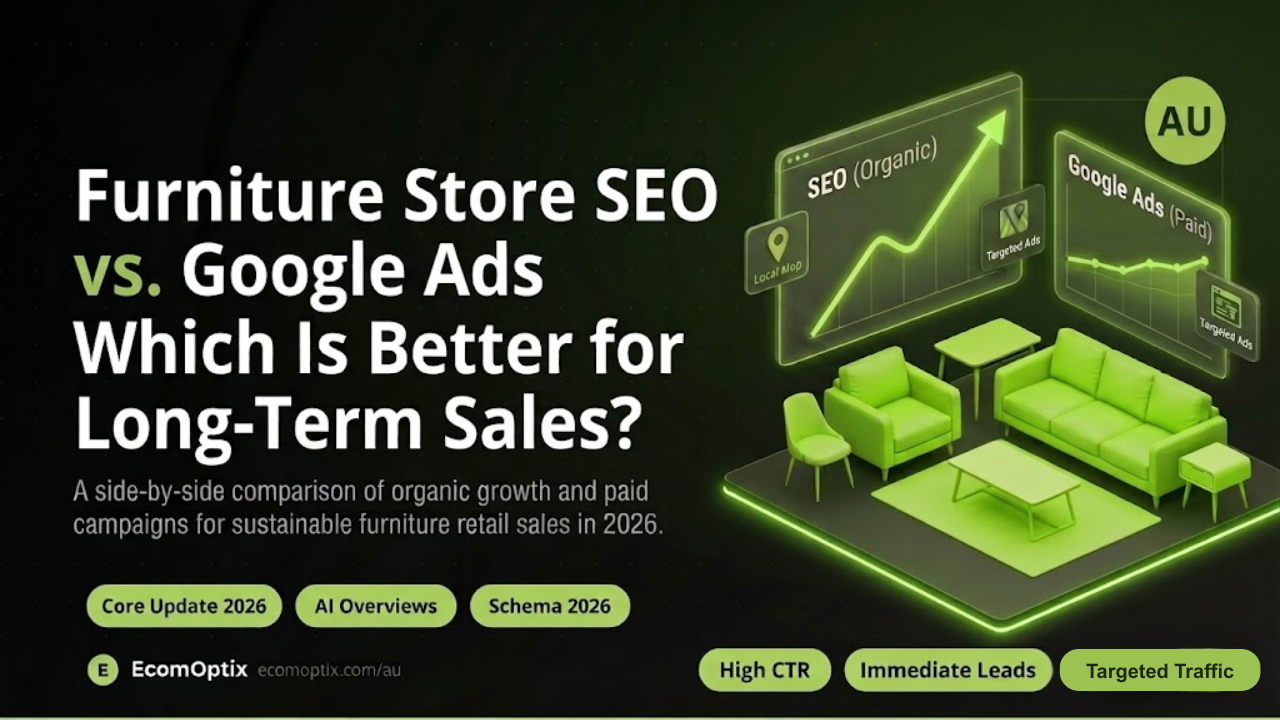
SEO doesn’t replace Meta, Google, YouTube, or social. It amplifies them. Landing pages convert better. Retargeting audiences are warmer. Google Ads Quality Scores improve, reducing cost per click. Brand searches increase across channels. And AI search citations create credibility that paid ads alone can’t replicate.
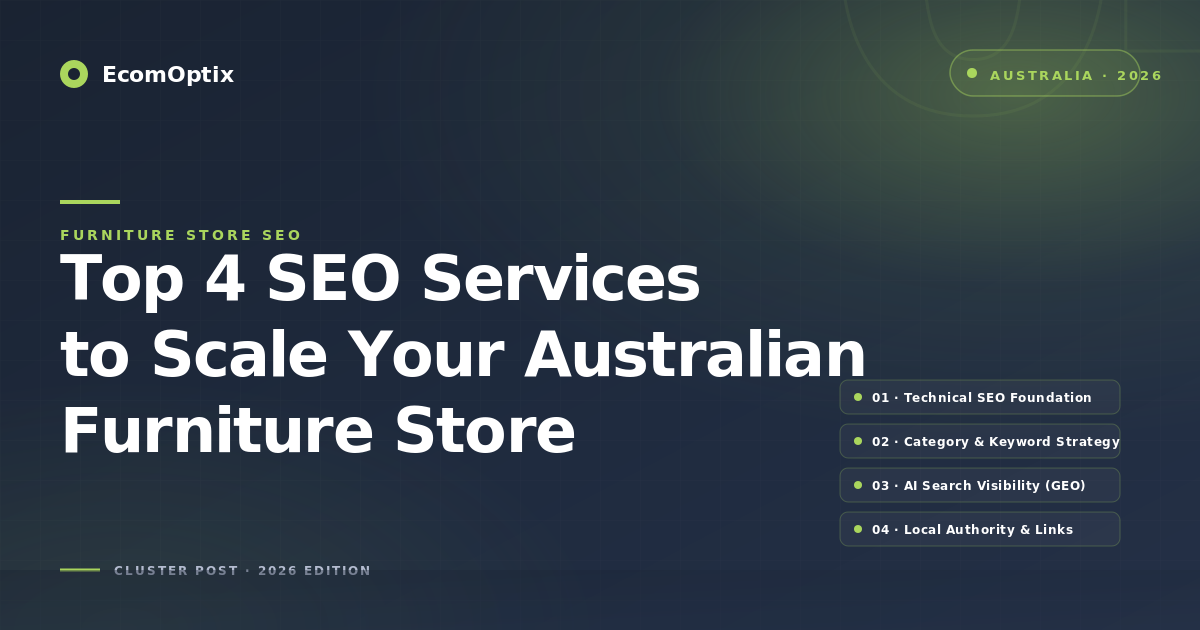
This post breaks down the four SEO services that actually scale a furniture store in 2026 – what they are, how they work together, and how each one strengthens your entire marketing system instead of competing with it.
What AI Actually Changed About SEO
Before getting into the services, let’s address the biggest misconception: “AI is killing SEO.”
It isn’t. AI is changing what wins in SEO – not whether SEO matters.
Here’s what actually changed. ChatGPT, Perplexity, Gemini, and Google’s AI Overviews now answer a large share of product research queries before users click anything. But these systems still rely on source content to generate answers – and that source is your website, if it’s built correctly. The pages that get cited are those with deep, original content, structured data, strong topical authority, and credible backlinks. In other words, pages built with proper SEO.
Seer Interactive’s data reports make it clear that brands featured inside Google AI Overviews see 35% more organic clicks than those that aren’t.
SEO is no longer just about rankings – it’s the input layer for AI search. If your furniture store isn’t visible in traditional search, it won’t appear in ChatGPT, Perplexity, or AI Overview responses either. Both systems are built on the same foundation.
Service 1 — Technical SEO Foundation
The first service every Australian furniture store needs to get right is its technical SEO foundation.
If your store isn’t technically sound, it won’t perform well in search engines, AI results, paid ads, or anywhere else.
Just like a strong foundation supports everything built on top, your website’s technical health determines how well every marketing channel performs. Speed, crawlability, structure, and usability directly impact visibility, rankings, and conversions.
That’s why your store needs to be technically fit before anything else.
So what does that actually mean?
The unglamorous, behind-the-scenes engineering that determines whether Google can crawl, understand, and rank your store.
For furniture retailers, the technical layer is also where the most damage is hidden – because furniture stores generate more URL bloat than almost any other ecommerce vertical.
What’s Actually Included in a Technical SEO Service?
1. Faceted navigation URL management
Every colour, fabric, size, and price filter can create a new URL. On a mid-size Australian furniture site, that can mean 3,000 to 10,000 near-duplicate pages.
Google tries to crawl them all, wastes resources, and your key pages get under-ranked. Fixing this alone is why some stores see ranking improvements within weeks.
2. Core Web Vitals optimisation for image-heavy pages
Furniture is a visual category. A category page with 30+ lifestyle images often takes 6+ seconds to load on mobile. Google’s research via Think with Google shows that as page load time goes from 1 second to 3 seconds, the probability of bounce increases by 32%; at 6 seconds, bounce probability climbs by 106%, and a one-second delay can drop conversion rates by 7%.
For a furniture store with $1,800 average order values, that 7% is meaningful revenue.
As load time increases, so does the risk of losing customers. Even a one-second delay can reduce conversions significantly. For stores with high average order values, this directly impacts revenue.
Product schema markup. Price, availability, dimensions, materials, reviews, and delivery zones – all eligible for rich results in Google and structured data ingestion by AI search engines.
Pages with schema receive up to 40% higher click-through rates than pages without, according to Search Engine Journal. Almost no Australian furniture stores implement it fully.
4. Crawl budget optimisation
Cleaning up redirect chains, fixing 404 errors, and resolving orphan pages ensures Google focuses on the pages that matter – your collections and products – instead of wasting time on broken or low-value URLs.
5. Local business schema
If you have a showroom, this helps Google understand your business location, opening hours, service areas, and local availability. It strengthens your visibility for nearby searches and improves trust signals.
How do these top 5 things in Technical SEO service strengthen your other marketing channels?
Technical SEO’s first job is organic. Fast, crawlable pages with proper schema rank higher in Google, get cited more often inside AI Overviews and ChatGPT answers, earn higher click-through rates from organic search results, and pick up more featured snippets.
That alone is the primary payoff. But the same fixes silently power your paid and social campaigns too. Every Google Ads click lands on a page – and Google’s Quality Score, which directly determines your cost per click, is heavily influenced by page speed, mobile usability, and technical health. Google’s official Ads documentation states that higher Quality Scores can cut CPC by up to 50%, while lower scores can raise CPC by up to 400%. Faster, cleaner pages mean lower CPCs and higher ad ranks.
The same applies to Meta and TikTok ad landing pages – slow load times tank conversion rates regardless of how good the creative is.
Better schema also means your products surface correctly in Google Shopping (both organic and paid listings), Pinterest rich pins, and product feeds across every channel. One technical foundation lifts every channel that touches your site – organic, paid, and social.
In 2026, AI search engines will be even less forgiving of bad technical SEO than Google. They scrape, parse, and structure your data on the fly, and if your schema is missing or your pages are slow to render, you’re skipped entirely.
Technical SEO is now the price of entry to AI visibility, not just Google rankings.
Related reading: Product Page SEO Every Furniture Store Owner Must Know
Service 2 – Category Architecture & Keyword Strategy
The strategic blueprint that decides which keywords your furniture store targets, how your category structure is built to capture them, and how each page in your site links to the next. This is where furniture stores make or lose the most revenue — and most get it wrong.
The Australian online furniture market sits at $2.1 billion in 2025, growing at 8.5% CAGR through 2030 per IBISWorld. Capturing a meaningful share of that growth depends almost entirely on whether your category architecture is built to match how buyers actually search.
What’s actually included
Buyer-intent keyword universe mapping.
Generic agencies target “sofa.” That puts you in a fight with IKEA, Harvey Norman, and Temple & Webster. Buyer-intent agencies target “3 seater fabric sofa Melbourne,” “grey corner sofa with chaise Australia,” “outdoor lounge setting with fire pit.” These are winnable. They convert. They’re how a smaller retailer beats the giants.
Deep category tree architecture.
A flat structure (/sofas) cannot rank for the long tail. The right architecture is layered: /sofas → /fabric-sofas → /3-seater-fabric-sofas → /3-seater-fabric-sofas-melbourne. Each level captures a different buyer intent and links upward to consolidate authority.
Local + national keyword strategy.
“Furniture store Melbourne” and “buy sofa online Australia” are two completely different intents. Most stores accidentally optimise for one and lose the other.
Competitor gap analysis.
Identifying the keywords your competitors rank for that you don’t, then building a deliberate plan to take them.
Seasonal demand mapping.
Furniture demand spikes around January, EOFY (June), tax time, and October–November. Architecture and content need to be in place 60 days before each peak – not during it.
How does this strengthen your other marketing channels, grow traffic, and increase conversions?
Your category structure becomes the keyword foundation your paid team should already be using.
The same high-intent terms targeted in SEO – like “3 seater fabric sofa Melbourne” or “outdoor lounge setting with fire pit” – are the ones that drive the highest-converting Google Ads campaigns.
When SEO and SEM align on keyword strategy instead of operating in silos, you stop wasting budget on low-intent traffic and start owning the terms that generate revenue.
A well-built category structure also sharpens your paid social strategy. Instead of running generic creatives like “shop sofas,” your Meta and TikTok ads can become highly targeted, for example, “3-seater fabric sofas delivered in Melbourne within 7 days” and send users to pages designed to convert that exact intent.
Same spend, stronger alignment, and significantly higher return on ad spend.
AI search engines in 2026 reward semantic depth. They prioritise sites that cover a topic comprehensively, not just with a single page.
A well-structured category architecture signals that your store has real authority in its space. It also increases your chances of being cited when someone asks tools like Perplexity, “What’s the best fabric sofa under $2,000 in Melbourne?”
Related reading: 17 Best SEO Practices for Furniture Stores in Australia
Service 3 — AI Search Visibility & Buyer Journey Content (GEO)
What it is and why it matters for every furniture store owner in 2026?
Content engineered to be discovered, ranked, and cited across both traditional search (Google) and generative AI search (ChatGPT, Perplexity, Google AI Overviews, Claude, Gemini). This is Generative Engine Optimisation – GEO, and it’s the single fastest-growing area of ecommerce SEO in 2026.
The data driving the urgency: furniture buyers spend anywhere from 4 to 14 months researching before they purchase, with multiple research and consideration touchpoints (Cylindo industry research).
With 39% of online shoppers already using AI for product research and 72% relying on it as their primary research tool (Adobe, 2025), every month a furniture store is invisible in AI answers is a month of $1,800+ AOV buyers being routed to competitors.
What’s actually included in AI/GE Optimisation
AI search visibility (GEO).
Structuring content with explicit answers, comparison tables, and citation-friendly formatting that AI search engines lift directly into their responses. This includes optimising for “answer box” queries like “how do I clean a velvet sofa?” and ensuring your store is the source AI cites. Brands cited inside AI Overviews earn 35% more organic clicks than uncited competitors (Seer Interactive, 2025).
Buying guide content.
Long-form research content that captures buyers in the early phase (“fabric vs leather sofa,” “bed frame sizes Australia explained”). These pages don’t sell directly; they build trust and pre-qualify the visitor for when they’re ready.
Comparison content.
Mid-funnel content that helps buyers choose between options (“West Elm vs Castlery: which suits an Australian home?”). High commercial intent, lower competition than category pages.
Category and sub-category page copy.
Most furniture category pages are a heading and a product grid. They rank nothing. Optimised category copy 300 – 600 words of original, buyer-focused content per page — moves rankings dramatically.
Unique product description rewrites.
Google’s John Mueller has confirmed that while supplier-duplicated product descriptions aren’t directly penalised, intentional reliance on duplicate content significantly limits your store’s ability to rank against competitors using the same supplier feeds. Original product copy isn’t optional – it’s the only way your products are uniquely findable.
Service 4 — Local Authority & Link Building
This is one of the most essential SEO services that every store owner should prioritise.
The off-page signals – local trust markers and external backlinks – that tell Google and AI engines your store is a credible, authoritative source worth ranking and citing. For Australian furniture stores with showrooms, this is also where local pack visibility (the Google Maps results) lives.
The local opportunity is substantial. BrightLocal’s 2026 local consumer search data shows customers are 70% more likely to visit and 50% more likely to consider purchasing from businesses with a complete Google Business Profile.
That’s great numbers and optimization. “near me” mobile search queries have grown 136% year-over-year, and 88% of consumers who run a local search on mobile call or visit the business within 24 hours.
For showroom-based furniture retailers, that’s not a marginal gain; it’s the difference between being in the consideration set and being invisible.
What’s actually included and why it’s important?
Local SEO for showroom locations.
Optimised Google Business Profile, location-specific landing pages for each showroom (Sydney, Melbourne, Brisbane, Perth, Adelaide), local schema, NAP (Name/Address/Phone) consistency across directories, and review acquisition strategy.
Local pack ranking.
Appearing in the map-based “3-pack” results for searches like “furniture store Melbourne” and “sofa showroom Sydney” — which drive both online research and physical foot traffic.
AU-niche link outreach.
Editorial links from Australian interior design publications, home and lifestyle blogs, regional media, and complementary AU brands. Low volume, high quality – the only kind of link building that survives Google’s spam algorithms.
Interior design and lifestyle PR.
Getting your store featured in articles, room reveals, and product roundups across AU design media. These links carry brand-building weight in addition to SEO authority.
Category page link building.
Most agencies build links to homepages. The links that move the needle for e-commerce point to category pages — because those are the pages that capture buying-intent traffic.
How does this strengthen your other marketing channels
Brand recognition is the multiplier on every channel you run. The Meta ad they scroll past today gets clicked tomorrow because they saw your store mentioned in House & Garden last week. Local pack visibility lifts trust in the same way: a customer who’s already seen you in the Google Maps results is far more likely to convert on a paid ad later.
Editorial PR coverage and a strong local presence also give your social team genuine content to amplify. “As featured in [publication]” social posts, showroom-based video content, and review-driven UGC all become possible when you’ve built the authority underneath.
In 2026, AI search engines will weigh authority signals heavily when deciding which sources to cite. A store with strong editorial links and a well-developed local presence gets cited; a store without them doesn’t – even if their product is identical. Local + link authority is no longer just about SERP rankings; it’s about which brands AI considers worthy of mention.
Related reading: How to Implement Local SEO for Your Furniture Store
Where SEO Fits in Your Full Marketing Mix
Most furniture retailers in 2026 already run a mix of paid and social channels. The real question isn’t which one to choose – it’s how to make them work together more efficiently. That’s where SEO comes in.
SEO isn’t just another channel. It’s the layer that improves how every other channel performs.
How SEO Strengthens Each Channel
| Channel | What it does best | How SEO amplifies it |
|---|---|---|
| Google Ads | Captures high-intent buyers at the bottom of the funnel | Optimised landing pages improve Quality Scores, reducing CPC and increasing conversion rates |
| Meta Ads | Drives visual discovery and retargeting at scale | SEO content builds high-intent audiences. Strong product and category pages improve conversion from ad traffic |
| YouTube Ads | Builds awareness through video at the top of the funnel | SEO insights shape content topics. AI citations increase brand familiarity, improving video CTR |
| Organic Social (IG, TikTok, Pinterest) | Builds brand presence and engagement | SEO content provides a steady stream of ideas. Structured data helps products appear in platforms like Pinterest |
| Email Marketing | Drives repeat purchases and retention | SEO traffic fuels list growth through content and lead capture |
| SEO (All 4 Services) | Builds long-term, compounding organic growth | Acts as the infrastructure layer supporting every other channel |
A widely-cited 2025 industry analysis shows organic SEO traffic delivers a cost-per-acquisition of around $31 versus $181 for paid search roughly a 5.8x efficiency advantage at scale, with SEO-driven ecommerce visitors converting at nearly double the rate of PPC traffic. Most successful furniture retailers don’t pick one. They run paid for short-term sales while SEO builds the asset that makes paid more efficient and eventually optional for parts of the funnel.
You don’t choose SEO instead of paid and social. You add SEO, so the paid and social you’re already running perform better.
What this looks like in practice for a $50K–$500K/month furniture store
If you’re an Australian furniture retailer in this revenue band, here’s a realistic 12-month picture of what investing in all four services delivers:
- Months 1–3: Technical foundation cleaned, category architecture rebuilt, first content batch live. Early ranking movements visible.
- Months 4–6: Category and sub-category pages reach page 1–3 for buying-intent terms. Organic revenue becomes attributable in your reporting. AI search citations begin appearing.
- Months 7–12: Compounding kicks in. Organic share of revenue grows month over month. Paid ad dependency starts reducing. Category expansion begins (new product lines, new showroom locations).
With $1,800+ average order values typical in Australian furniture retail, a handful of additional organic transactions per month covers the entire SEO investment. From there, every additional sale is margin.
The Honest Answer to “Should I Invest in SEO?”
If you’re already running paid ads and social, not ranking on page 1 for your main category terms, relying on supplier product descriptions, and starting to question where AI search fits, then yes, SEO is the highest-leverage investment you can make in 2026.
Not as a replacement for what you’re doing, but as the layer that makes everything you’re doing perform better.
If you need revenue this week, your store is under $20K/month, or you expect results in 30 days, SEO isn’t the right lever. It’s a 90+ day asset build. Keep your paid channels running while SEO compounds underneath.
The four services above aren’t optional add-ons. They’re a system. Running one without the others is how stores spend $30K on SEO and see no return because the foundation is broken, the structure can’t support growth, or the content has no authority behind it.
The furniture stores that win in 2026 are the ones running all four together alongside paid and social and turning every channel into a more efficient, profitable growth engine as SEO builds momentum underneath.
Ready to see what your furniture store could be ranking for?
EcomOptix specialises in SEO for Australian furniture retailers doing $50K–$500K/month. We audit your store first — and if the maths don't work, we'll tell you. No lock-in contracts, no $50,000 retainers, no generic agency checklists.
What you'll receive
- Prioritised technical SEO report
- Category ranking opportunity map
- Duplicate content exposure analysis
- Competitor gap report