

Quick Answer
Local SEO for a furniture store is the process of optimising your online presence so your showroom appears in Google Maps and local search results when nearby buyers are searching for furniture.
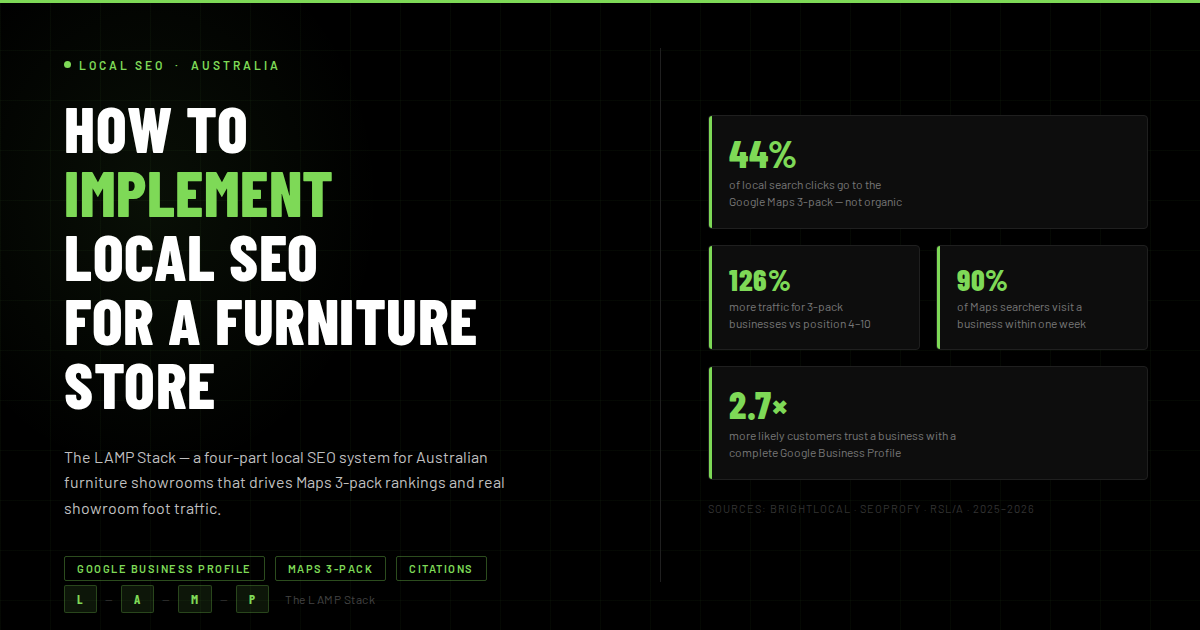
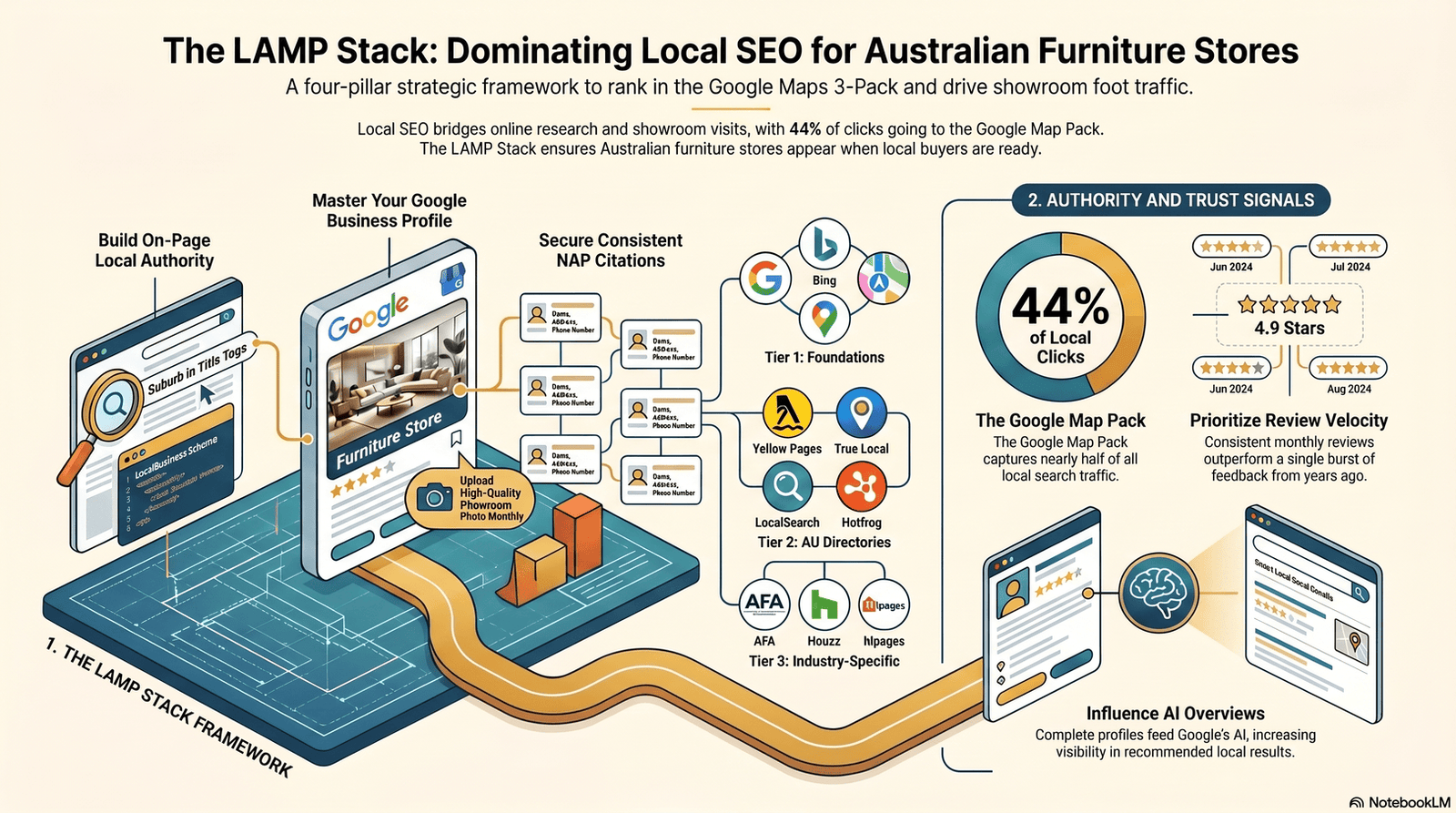
For Australian stores, this involves four components: building location signals on your website with suburb-specific content and LocalBusiness schema, optimising your Google Business Profile with the correct primary category and recent photos, building consistent NAP citations across Australian directories, including Yellow Pages AU, True Local, and the Australian Furniture Association, and maintaining a steady flow of customer reviews. Done together, these signals determine whether your store earns a spot in the Google Maps 3-pack – which captures 44% of all local search clicks and converts directly into showroom foot traffic.
Here is a reality check. By the time a customer walks through your showroom door, they have already made most of the decision. Research from the Home Furnishings Association finds that salespeople are now engaging buyers who are already 80% or more through the purchasing process. The research, the shortlisting, the brand comparisons — all of it happened online before they ever touched the display sofa.
The 2025 3D Cloud Furniture Shopping Trends Study found that 45% of furniture shoppers now use a hybrid online-plus-in-store path to purchase, and the motivation to shop in-store first, then finalise online has increased 40% year on year. Customers are not arriving at your showroom to start their decision. They are arriving to finish it.
That shift changes what being visible online actually means for a furniture store. The question is not whether buyers are searching for furniture stores in Australia. They are. The question is whether your store appears when they do and whether it appears where it counts.
That is what local SEO is for. This guide walks you through how to implement it, from your website foundation through to Google Maps, Australian citations, and review strategy.
Why Local SEO Hits Different for Furniture Showrooms
Furniture is not an impulse purchase. Buyers research for weeks, compare stores, read reviews, and want to experience the product before committing. That long buying cycle is actually an advantage for stores that understand it from an SEO perspective.
Local SEO sits at the exact intersection of that cycle. The buyer who types “furniture stores near me” into Google on a Saturday morning is not browsing — they are ready. And the map pack at the top of those results captures 44% of all local search clicks, compared to just 29% for the organic results listed below it.
The map pack appears in 93% of local searches. And businesses in the top 3 receive 126% more traffic and 93% more actions – calls, website visits, direction requests – than those ranked below position three. 90% of people who search for a local business on Google Maps visit within a week. That is not traffic data. That is showroom foot traffic.
The other dynamic worth understanding is the hybrid shopper. Most furniture stores treat their online presence and physical showroom as separate concerns. They are not. The same local search presence that drives showroom visits also determines which store a buyer finalises an online order with. Local SEO serves both.
The LAMP Stack — A Local SEO System for Australian Furniture Retailers
Most local SEO advice for furniture stores reads like a checklist assembled by glancing at ten other checklists. Set up your GBP. Get citations. Ask for reviews. Not wrong – just incomplete.
What is missing is the system that connects those pieces. There are four components that, when working together, consistently move furniture stores into the Google Maps 3-pack and keep them there. We call it the LAMP Stack:
- L — Local Authority built on your own website
- A — Appearing in the Maps Pack through the right ranking signals
- M — Mastering your Google Business Profile
- P — Publications and citations that validate your location
Each component matters. None of them works in isolation. Here is how to build each one.
L — Local Authority Starts on Your Own Website
On-page signals account for 36% of local search ranking and influence more than any other single factor category. Before you touch your GBP or start building citations, your own website needs to clearly signal where you are and what you do.
Most furniture stores make a version of the same mistake. The homepage reads “Quality Furniture for Australian Homes” and the contact page has an address buried in the footer. Google has to guess at the geography. It mostly guesses wrong, or not at all.
For single-location stores, the homepage is the most important local page. Your title tag should include your suburb or city. Your H1 should reference the location. Body copy should name the service area naturally – not crammed in, but as part of describing who you serve.
For multi-location stores, each location needs its own dedicated page with genuinely unique content. Not a template with different addresses swapped in – actual content about that showroom, its product range, and the specific suburbs it serves. Thin location pages that share near-identical content are a known Google penalty trigger.
Both setups should have LocalBusiness schema markup implemented correctly. This is the structured data that tells Google your business name, address, phone number, and trading hours in a format it reads without ambiguity. On its own, it is not a ranking factor, but it removes friction from how Google understands your site’s geographic relevance — and it feeds directly into how AI Overviews pull local business information.
NAP consistency matters across all of this. Your name, address, and phone number should appear on your website exactly as they appear on your Google Business Profile. A different phone format or an abbreviated street name between the two introduces doubt into the signals you are trying to send.
The most common finding in our furniture store audits is a site that reads perfectly to a human visitor but gives Google almost zero geographic signal. The store wonders why it does not appear locally. The answer is usually on the homepage.
A — Appearing in the Maps Pack (and Staying There)
Google’s local ranking algorithm runs on three variables: relevance, distance, and prominence. Distance you cannot change. Relevance and prominence are where the work is.
Relevance is how well your profile and website match what someone is searching for. Category selection is the primary lever here – covered in the next section.
Prominence is essentially authority. It includes your review count and recency, the quality of local citations pointing to your business, and the engagement your GBP generates – clicks, calls, and direction requests. Behavioural signals like these account for around 9% of local ranking influence, which sounds small until you are in a competitive market where most stores have similar on-page optimisation and behavioural signals determine who makes the 3-pack.
Review velocity matters more than review volume. A store earning four to five reviews per month consistently outperforms one that collected 80 reviews in a burst two years ago and has had almost nothing since. Google reads recency as active business relevance.
The distinction between the Local Pack and Google Maps is also worth understanding. The Pack prioritises reputation and authority for searchers in the discovery phase, while Maps prioritises proximity for users ready to navigate. You can rank well in one while being invisible in the other. Most rank tracking tools only show one view, which means most furniture stores have a gap in their local visibility data they are not aware of.
Almost no furniture store we audit is tracking both Local Pack and Maps visibility separately. That gap makes it impossible to know which signal to fix.
M — Mastering Your Google Business Profile for a Furniture Store
Customers are 2.7 times more likely to consider a business reputable when they find a complete Business Profile on Google. Businesses with a complete profile are 70% more likely to get a showroom visit and 50% more likely to receive purchase consideration. GBP optimisation is the single highest-leverage local SEO activity available to a furniture store.
Primary category
Choose “Furniture Store” as your primary category. This sounds obvious, but a meaningful proportion of stores we audit have something broader – “Home Goods Store” or “Interior Design Studio” – listed as their primary. That dilutes the relevance signal for the searches that matter most. Your primary category is Google’s main instruction for when to show your listing.
Secondary categories
Add secondary categories that reflect your actual range: “Sofa Store”, “Bedroom Furniture Store”, “Office Furniture Store”, “Mattress Store” where accurate. These expand the queries you can appear for without touching the primary category signal. Only add what genuinely applies to your range.
Business description
You have 750 characters. Most stores leave this blank or fill it with generic marketing copy. Write a natural description that includes your primary search term in the first sentence, names your service area, describes what makes your range or service different, and mentions your key product categories. Write for the customer and the algorithm handles itself.
Images
Businesses that upload photos to their GBP listing see 35% higher website click-through rates. For a furniture showroom, this compounds significantly. Upload exterior shots so customers can find and identify you, interior shots from multiple angles and lighting conditions, and product imagery across your key categories. Google prioritises recently added photos – upload new images monthly rather than setting the profile once and leaving it static.
Posts
Weekly Google Posts signal to Google that the business is active and current. Use them to promote new arrivals, seasonal ranges, sale events, or upcoming trading hour changes. A profile with no Posts in the past 90 days reads as dormant, and the algorithm treats dormant profiles accordingly.
Products tab
Add key product categories with descriptions and pricing where applicable. This creates additional relevance signals for category-level searches and gives potential customers a preview of your range before they click through to your site.
Q&A section
Populate this proactively with the questions your sales team actually receives. “Do you offer interest-free finance?”, “Is there parking at the showroom?”, “Do you deliver to [suburb]?” Left empty, the public fills this section with answers you cannot control. Get in first.
Attributes
Enable every relevant attribute – “In-store shopping”, “Wheelchair accessible”, “Free parking”, and appointment availability if applicable. These feed the filter options customers use when comparing local results in Maps.
Approximately 40% of local business queries now trigger a Google AI Overview. Those AI-generated answers pull primarily from Google Business Profile data. A complete, well-maintained GBP is no longer just about appearing in the map pack; it is about appearing in AI-recommended results before the map pack even loads. This is one reason why a complete furniture store SEO strategy treats GBP as the anchor for everything else.
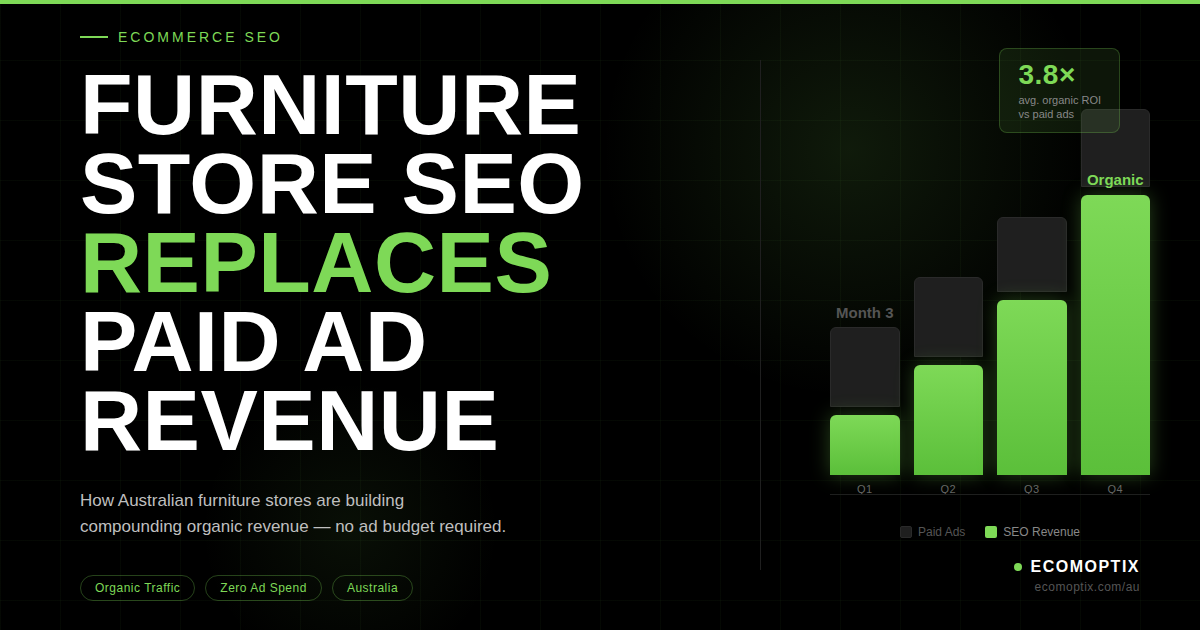
Organic local results are competing for less screen space. Strong organic local signals become more important in that environment, not less. If you are already thinking about how local SEO fits into reducing paid dependency, how furniture store SEO replaces paid ad revenue covers that dynamic in detail.
P — Citations That Actually Matter for Australian Furniture Retailers
A citation is any online mention of your business name, address, and phone number. Google uses them to validate that your business exists at the location you claim. The more consistent and authoritative the sources, the stronger the trust signal.
Not all citations carry equal weight. Here is how to prioritise for an Australian furniture store.
Tier 1 — Non-negotiable foundations
Get these three right before anything else.
- Google Business Profile
- Bing Places for Business
- Apple Maps
Tier 2 — High-priority Australian directories
- Yellow Pages Australia — one of the most authoritative Australian business directories
- True Local — widely referenced for local service discovery
- LocalSearch.com.au — strong coverage across metro and regional markets
- AussieWeb — one of Australia’s oldest directories, consistently referenced as a local citation signal
- Hotfrog — well-established globally with solid Australian visibility
Tier 3 — Furniture-specific directories
This is where most generic local SEO guides stop being useful. For furniture retailers, industry-relevant sources carry topical signals that general directories cannot replicate.
- Australian Furniture Association (AFA) supplier directory — the peak industry body for Australian furniture businesses. A listing here carries relevance signals that no broad directory can match.
- Houzz — the dominant home design and renovation platform in Australia, with significant local search presence
- hipages — relevant for stores that offer delivery, assembly, or installation services
Research on how AI search systems use local business data confirms that Google AI Overviews, Bing Copilot, and Perplexity reference structured local business data in more than half of the generated local recommendations.
Industry-specific directories are increasingly part of that data ecosystem. Getting listed in the right furniture channels is not just about local SEO signals — it is about being in the data pool these AI systems draw from when recommending businesses to Australian consumers.
How to Build Local Citations for Your Furniture Store in Australia
The process matters as much as the target list. Here is a practical sequence.
Audit what you already have.
Before submitting anywhere, check what is currently listed. Inconsistent NAP across existing directories does more damage than having fewer citations. Use a tool like BrightLocal or simply Google your business name and phone number to surface existing mentions.
Compile a master NAP record.
Decide exactly how your business name, address, and phone number appear — including punctuation, abbreviations, and street name formatting. “Level 1, 45 Smith St” and “45 Smith Street Level 1” are different to a search engine. Pick one format and use it everywhere.
Claim before you create.
Search each directory for an existing unclaimed listing before submitting a new one. Duplicate listings fragment your citation signals.
Work through tiers in priority order.
Complete the Tier 1 platforms first, then Tier 2, then the industry-specific directories. Do not spread effort across 30 directories before the foundational ones are accurate.
Document everything.
Keep a spreadsheet with each directory, your listing URL, login credentials, and last-updated date. Business details change – addresses, phone numbers, trading hours – and you need to be able to update all listings when they do.
The most common mistake in citation building is choosing the wrong directories. It is an inconsistent NAP.
Research on how AI tools process local business data confirms that search engines and AI systems struggle to recognise a business as a single entity when the name, address, or phone number differs across sources.
That fragmentation directly suppresses local rankings. Thirty directories with inconsistent data are worse than ten that are perfectly maintained.
Reviews — The Ranking Signal Most Showrooms Underestimate
Reviews are a ranking factor, a conversion factor, and a trust signal simultaneously. Getting this right is not about hitting a number – it is about building a consistent, sustainable habit.
Send a direct review request with your Google review link to every customer within 48 hours of purchase or delivery. Do not rely on customers to find your profile themselves. A direct link removes friction and significantly increases completion rates. Your GBP dashboard generates a shareable review link under “Ask for reviews”.
Two things to be precise about: offering incentives for reviews violates Google’s guidelines and risks profile suspension. Asking specifically for positive reviews is also prohibited. The correct ask is simply requesting honest feedback through a direct link.
Responding to every review – positive and negative – within 24 hours signals to Google that the business is actively managed. For negative reviews, the response is not really for the reviewer. It is for every future customer reading it. A composed, constructive response to a complaint does more for conversion than a page of five-star ratings with no owner engagement.
Almost no furniture store does this: weave relevant detail into responses to positive reviews. Mention the product category they purchased, their suburb, or something specific about their experience. It adds keyword-relevant context to your profile in a completely natural way.
Local SEO Mistakes Furniture Showrooms Keep Making
In the audits we run across furniture retailers, the same patterns appear again and again.
The GBP set up once and abandoned.
Initial setup is not optimisation. Profiles without recent photos, Posts, or review responses are algorithmically deprioritised.
A monthly GBP review – new photos, at least one Post, responses current – takes under an hour and compounds significantly over time.
NAP that does not match across platforms.
The business name on the website, GBP, Facebook, and Yellow Pages are all slightly different versions. None are technically wrong, but the inconsistency dilutes citation authority across all of them.
Treating local SEO and ecommerce SEO as separate strategies.
They are not. A strong local presence reinforces broader ecommerce authority – the reviews, citations, and GBP engagement all contribute to how Google assesses brand trustworthiness across the full domain.
The Furniture Store SEO Guide for Australian Store Owners covers how local and e-commerce signals work together as part of a complete strategy.
Chasing citation volume over citation accuracy.
Thirty directories with inconsistent NAP are worse than ten that are perfectly maintained. Fix accuracy first, then expand.
Ignoring the paid ads shift in local search.
With local pack ads surging 733% between November 2025 and January 2026, organic local results are competing for less visible screen space than they were a year ago. That makes getting the foundational signals right – GBP, citations, reviews – more important, not something you can defer.