Your furniture store has a website. It loads. It has product photos. Maybe even a blog post from 2023 about “choosing the right sofa.” And yet, when someone in Sydney searches outdoor dining table delivery, your store does not appear. Not on page one. Not in the map pack. Not in Google’s AI Overview. The customer clicks a competitor, buys a $3,200 table, and you never knew they existed.
That is the cost of treating your website like a digital brochure instead of a sales channel. And it is a cost most Australian furniture retailers pay every single day without realising it.
We know this because we see it constantly. At EcomOptix, we manage SEO for ecommerce stores across verticals – from Aura Vinyl (15,100 monthly organic visitors and 6,500 ranking keywords) to Glass Railing Store (174 keywords in Google’s top 10 across three countries). The patterns that drive organic revenue for these stores apply directly to furniture retail – and most furniture businesses are not using any of them.
This article breaks down exactly how SEO turns search visibility into furniture sales, backed by real performance data from stores we work with. If you are building a broader SEO strategy for your furniture business, start with our Furniture Store SEO Guide for Australian Store Owners – it covers the full picture.
The Furniture SEO Revenue Engine – How Search Becomes Showroom Sales
Struggling With SEO? Watch This Client’s Results First
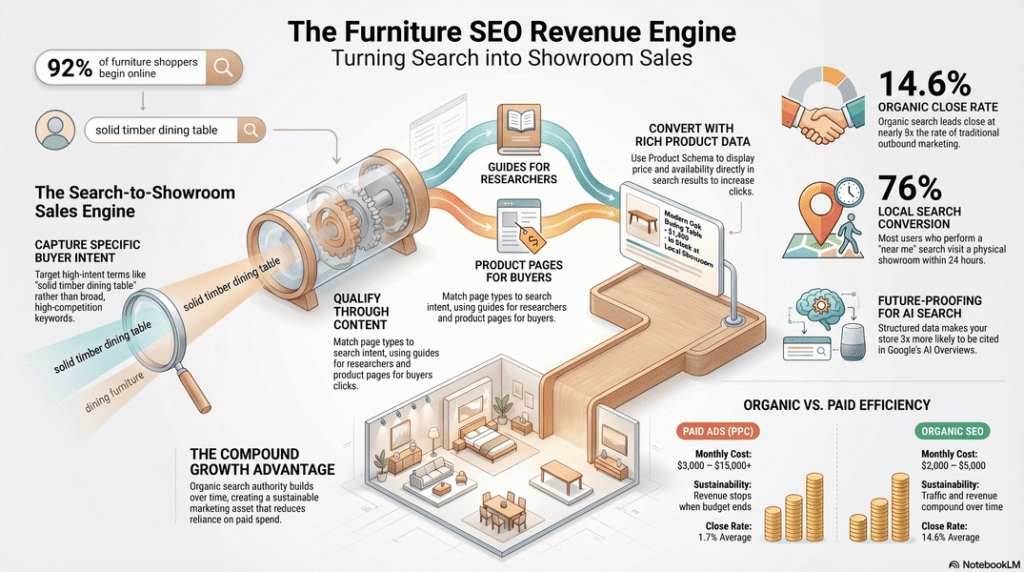
The Search-to-Showroom Sales Engine: How SEO Actually Drives Furniture Revenue
Most guides will tell you SEO “increases traffic.” That is like saying a shopfront “increases foot traffic.” True, but useless without context. The question is not whether SEO brings visitors. It is whether it brings buyers.
Across every ecommerce store audit we run – from vinyl product retailers generating 35,000 monthly users to niche glass railing brands ranking #1 in three countries – we see the same revenue pattern. We call it the Search-to-Showroom Sales Engine, and it has four stages:
- Capture Appear where buyers are already searching
- Qualify– Attract visitors with genuine purchase intent, not tyre-kickers
- Convert – Turn page views into enquiries, bookings, or transactions
- Compound – Build organic authority that reduces acquisition cost over time
Every store that grows revenue through SEO runs on these four stages. Miss one, and the whole engine stalls.
Stage 1: Capture – Owning the Searches That Lead to Sales
Ninety-two per cent of furniture shoppers begin their journey with an online search. Not social media. Not an ad. A Google search. That number comes from IMARC Group’s Australian furniture market analysis, and it aligns with the Search Console data we monitor across our ecommerce clients every week.
But here is where most stores get it wrong: they optimise for broad terms like “furniture store” or “buy sofa online” and wonder why they rank nowhere. Those terms are dominated by Temple & Webster, IKEA, and Fantastic Furniture – brands with domain authority scores above 60.
What actually works is specificity.
Consider what happened with Glass Railing Store. Instead of chasing the generic term “glass railings,” we built SEO campaigns around specific, high-intent keywords: glass railing systems Rancho Mirage CA, custom glass railing, frameless glass railing. The result? Position #1 for their core commercial keyword. Position #2 for “custom glass railing.” Position #4 for “frameless glass railing” and “glass deck railings.” And 174 keywords sitting in Google’s top 10 for the US market alone – with parallel campaigns running across Canada and France.
The same logic applies to furniture. The searches that drive sales are not generic. They are layered with intent: solid timber dining table Melbourne, custom modular sofa Sydney delivery, Australian-made bedroom furniture under $5000. Lower competition. Dramatically higher conversion rates. The person searching already knows what they want.
Most furniture stores chase the keywords with the biggest numbers. The ones making money chase the keywords with the clearest intent.
Stage 2: Qualify – Attracting Buyers, Not Browsers
Traffic without intent is just noise. This is the line that separates stores generating revenue from SEO and stores generating vanity metrics.
Take one of our clients in a completely different vertical — the principle holds regardless of what you sell. When we moved their content strategy from broad informational terms to specific buyer-intent queries, the pattern was unmistakable: position lifted from double digits to 7.9, impressions grew to 145,000 monthly, and clicks climbed from 290 to 386 in a single reporting period. More importantly, the conversion rate on that qualified traffic outperformed their old “high-traffic” pages by a significant margin.
For furniture stores, this means matching page type to search intent. A buyer searching for how to choose a dining table size needs a guide, not a product page. A buyer searching for a 6-seater oak dining table price needs a product page, not a blog post. Get this wrong, and Google will not rank you regardless of how good your content is.
According to Anchor Group’s ecommerce conversion data, organic search delivers a 14.6% close rate compared to 1.7% for traditional outbound marketing. That is not a marginal difference. That is an entirely different economic model – but only if you are attracting qualified visitors in the first place.
This is where optimising your furniture product pages becomes critical – matching page type to buyer intent is half the ranking battle.
Stage 3: Convert – Turning Organic Visitors into Revenue
Getting a furniture buyer to your site is step one. Converting them is where the money lives.
Look at what Aura Vinyl achieved. This ecommerce store now pulls 15,100 monthly organic visitors across 6,500 ranking keywords. In a single week, they recorded 4,360 clicks from organic search alone – with 35,000 total users and 309,000 event interactions on the site per month. Those are not accidental numbers. They are the result of product pages built to convert: unique descriptions, structured specifications, proper schema markup, and internal linking that keeps buyers moving toward checkout.
The conversion gap is almost never design or pricing. It is missing information.
Across most store audits we run, the single biggest conversion killer on furniture product pages is unanswered questions. Dimensions left out. Delivery costs hidden until checkout. No customer reviews visible. Materials described in one word instead of a paragraph. According to Envive’s ecommerce research, 87% of customers say product content is the most important factor in their purchase decision. For furniture, where the average order value often exceeds $1,000, that content needs to answer every question the buyer would ask in a showroom.
Schema markup amplifies this further. Pages with properly implemented Product schema achieve 20-40% higher click-through rates because Google displays price, availability, and star ratings directly in the SERP. The buyer clicks with higher confidence and converts at a higher rate. Schema-compliant pages are also cited 3.1x more frequently in AI Overviews – which matters enormously as AI search reshapes how buyers discover products.
Stage 4: Compound – The Revenue Flywheel Most Furniture Stores Never Build
Paid ads stop the moment you stop paying. SEO compounds. This is the most important financial difference between the two channels.
The clearest example of this compounding effect across our client portfolio is ClearPoint HCO. This B2B services company now ranks for 13,600 organic keywords, draws 4,700 monthly organic visitors (+6.5% growth), and recorded 8,500 page views in a single week – a 53.8% increase. The engine behind those numbers? A systematic content build: 100 optimised service pages created over several months, each strengthening the site’s topical authority and pushing existing pages higher.
The same compounding principle applies to furniture. You publish a well-optimised category page for Australian-made timber furniture. In month one, it ranks on page three. By month four, with internal links from supporting blog content and quality backlinks, it moves to page one. By month eight, it ranks in the top five and generates 200 visitors per month at zero cost per click.
Those 200 visitors are not a one-off campaign. They arrive every month. And every new page you publish strengthens the entire site.
How I Helped a Website Grow from 1.5K to 4.4K Visitors in 3 Months
The Australian online furniture market reached USD 5.84 billion in 2025 and is projected to grow at 19.48% CAGR through 2034. That is not a market where you want to be paying $3-8 per click on Google Ads when the same buyers could find you organically.
Everyone optimises for this month’s traffic. Almost no one builds for next year’s revenue. That is the gap SEO fills.
What the Numbers Actually Look Like for Australian Furniture Stores
Let us ground this in specifics, because vague promises about “more traffic” help nobody.
A mid-size Australian furniture retailer ranking in the top 3 for 30-50 high-intent local keywords can realistically expect 1,500-3,000 organic visitors per month. At a 2.5% conversion rate and $1,200 average order value, that is $45,000-$90,000 in monthly revenue attributed directly to organic search.
We see these patterns play out at scale across our portfolio. Aura Vinyl generates 15,100 organic visitors monthly. ClearPoint HCO grew to 13,600 ranking keywords through disciplined page creation. Cloture en Verre – a French-language glass railing brand – went from 617 to 955 organic clicks in a single reporting period after consistent SEO work, with views up 40.2% and sessions up 23.3%. Different industries, identical mechanics.
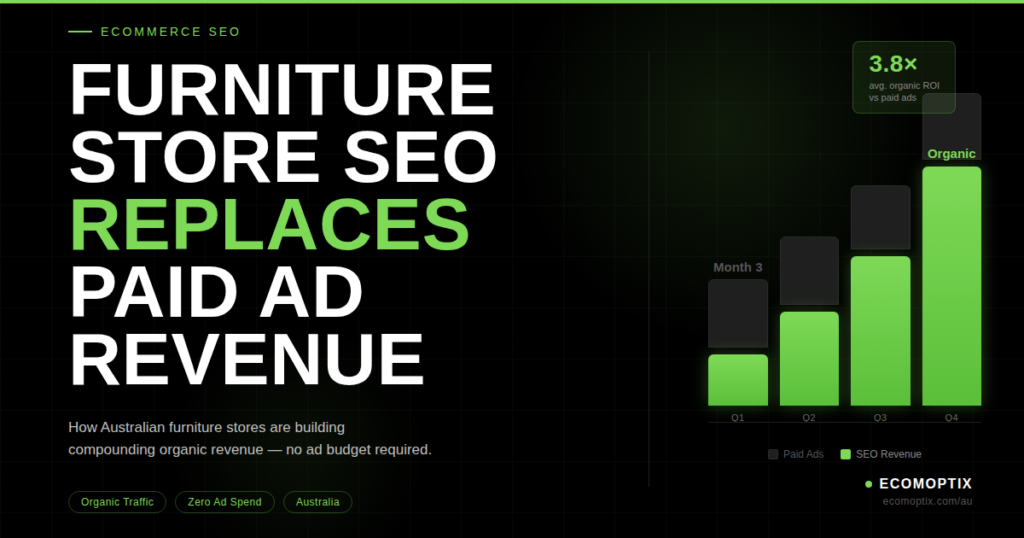
Compare the cost. A quality SEO campaign for a furniture store runs $2,000-$5,000 per month. Google Ads for the same traffic volume – with furniture CPCs averaging $2-5 in Australia – would cost $3,000-$15,000 monthly. And the moment you pause ads, revenue drops to zero. Pause SEO, and the traffic continues for months.
That is the F.O.R.M. framework in action: Foundation, Organic Authority, Revenue Pages, Measurement. We break this down step by step in the complete Furniture Store SEO Guide.
The Showroom Effect: How Local SEO Bridges Online Search and In-Store Sales
Furniture is not like buying a phone case. People want to sit on the sofa. Touch the timber. See the colour in real light. That is why local SEO is not optional for furniture stores – it is the bridge between search and showroom revenue.
BrightLocal’s local search data shows that 76% of people who search for something “near me” visit a business within 24 hours. For furniture stores, this is the single highest-intent traffic source available.
We have seen the power of Google Business Profile optimisation first-hand with Premier Luxury Club, an exotic car rental company in Arizona. Through consistent GBP posting, review management, and local page optimisation, their Business Profile now receives 5,941 views per period with 1,433 search appearances.
Individual location pages exploded: Scottsdale clicks up 28%, Phoenix up 171%, Tempe went from zero clicks to measurable traffic, and Mesa grew 200%. When we applied the same local SEO methodology across their city-level pages, the compounding effect was immediate.
Page 1 Ranking in 40 Days — Full Case Study Walkthrough
For furniture stores with showrooms, the playbook is the same: optimise your GBP with current photos, product categories, and regular posts. Build location-specific landing pages. Earn reviews consistently. Stores in the Google 3-pack receive 126% more traffic and 93% more actions than those ranked below it.
We cover the full tactical playbook in our guide on implementing local SEO for furniture stores.
AI Search Is Changing How Furniture Buyers Find Stores
This is the shift most furniture retailers are not paying attention to yet. Google AI Overviews now appear for over 40% of local business queries. When a buyer asks Google best furniture stores in Melbourne for mid-century modern, an AI-generated summary appears above all organic results – and it cites specific websites as sources.
We are already tracking AI visibility for our clients and seeing measurable results. Premier Luxury Club has achieved an AI Visibility score of 19, with 25 mentions and 46 cited pages across major AI search platforms. Seattle Exotic Rentals – a newer, smaller brand – already has an AI Visibility score of 20 with 5 mentions and 7 cited pages. These are not accidental outcomes. They are the direct result of structured content, schema markup, and topical depth – the same SEO fundamentals that drive traditional rankings, now pulling double duty.
If your furniture store is not being cited in AI Overviews, you have been pushed below the fold before the buyer even scrolls. This is not a future problem. It is happening now, in April 2026, across furniture-related searches in every Australian metro area.
SEO does not fail. Execution does. The furniture stores losing ground right now are not losing because SEO stopped working. They are losing because the search landscape evolved and their strategy did not.
Measuring What Matters: SEO Revenue, Not Vanity Metrics
Impressions look good in a report. Rankings feel good in a meeting. But neither pays your rent. The only SEO metric that matters for a furniture store is revenue attributed to organic search.
GA4 makes this measurable. You can track exactly how many transactions, enquiries, or showroom bookings came from organic visitors, broken down by landing page, keyword cluster, and device. If your SEO provider is reporting traffic without tying it to revenue, they are giving you a weather report instead of a financial statement.
We go deep on this in our guide to tracking SEO performance for furniture stores – including which reports to run, which metrics to ignore, and how to build a dashboard that tells you whether SEO is actually making you money.
Where to Start
Most Australian furniture stores are leaving six figures in annual revenue on the table because their website is invisible to the buyers already searching for what they sell. The $5.84 billion Australian online furniture market is growing at nearly 20% per year, and the stores capturing that demand are the ones showing up in search.
The results we have delivered for brands like Aura Vinyl (15.1K monthly organic traffic), Glass Railing Store (174 top-10 keywords across 3 countries), and ClearPoint HCO (13,600 ranking keywords) are not outliers. They are repeatable systems built on the same Search-to-Showroom Sales Engine that works for furniture retail.
From Agency Frustration to 18 Months of Growth | Real Client Testimonial
If your store generates $30K or more per month and you are ready to turn organic search into a consistent sales channel, start with our complete Furniture Store SEO Guide. Or, if you want a team that has built this engine across Australian ecommerce stores, talk to EcomOptix. We will show you exactly where your organic revenue is hiding.
Ready to Build Furniture Store SEO Structure That Actually Drives Revenue?
Furniture store SEO in 2026 is a structured system – and when all four parts of F.O.R.M. are working together, it becomes your most scalable and cost-efficient revenue channel.
EcomOptix works exclusively with established Australian ecommerce stores generating $30K+ per month who want organic search to become a predictable, growing revenue stream – not a constant question mark.
If that’s where you are, we’d like to show you exactly where your furniture store’s SEO is leaving revenue on the table.