Furniture store SEO is the process of optimising your website’s pages, structure, and content so that your store shows up in Google, Bing and AI when people search for furniture online.
For Australian stores, this means getting your technical foundation right, building content that matches how buyers actually research furniture, and keeping up with how Google’s ranking systems work in 2026.
If you sell furniture online in Australia, getting found on Google is no longer optional. Organic search drives over 43% of all traffic to Australian furniture and homeware websites – more than twice what paid search delivers. And with Google’s March 2026 Core Update completing its rollout on April 8, the rules just changed in ways that hit furniture stores particularly hard.
This guide walks you through exactly how furniture store SEO works in 2026, what to focus on first, and the Australian-specific factors that make a real difference to rankings and revenue.
1. Why Furniture SEO Is Different From Other E-commerce
Furniture isn’t an impulse buy. People don’t add a sofa to their cart the first time they see it. They browse for weeks, compare options, visit showrooms, and then commit. That entire journey now starts on Google.
Research into furniture buyer behaviour shows the path to purchase spans anywhere from 4 to 14 months. Buyers search an average of 14.2 times before making a decision. And 74% of furniture shoppers start by searching a category – not a brand name. They’re typing “outdoor dining settings Australia” long before they’re thinking about a specific store.
That completely changes how your SEO needs to work. If your only strategy is ranking for “buy sofa online Australia,” you’re invisible during the 90% of the research journey that happens before someone is ready to purchase.
The Revenue Math
Here’s a concrete example. Say the keyword “timber dining table Australia” gets 1,200 searches per month. Ranking #1 returns roughly 27% of those clicks — about 324 visitors. At a 1.5% conversion rate and a $1,100 average order value, that’s around $5,400 per month in organic revenue from a single category term. Scale that across 8 to 10 well-targeted category pages, and organic search becomes your most cost-efficient acquisition channel. No cost per click. No budget to pause.
The Market You’re Playing In
The Australian furniture market reached USD 19.7 billion in 2025 and is projected to reach USD 32.9 billion by 2034, growing at a CAGR of 5.68% through 2026–2034. Online channels now account for 30–35% of total furniture sales, and that share keeps rising. The stores that build strong organic infrastructure now will own significant market share as the channel matures.
Most furniture stores are ranking for the wrong stage of the buyer journey — and quietly handing customers to competitors who aren’t.
2. The F.O.R.M. System — Your Furniture SEO Framework
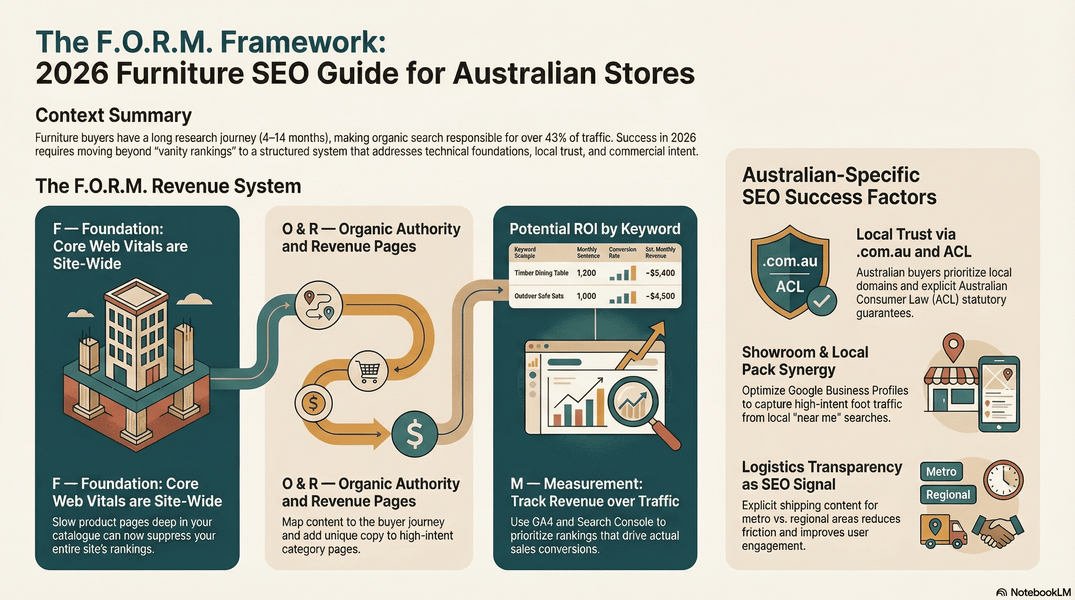
There are four things that determine whether your furniture store generates real organic revenue or just traffic that disappears without buying. We call it the F.O.R.M. System:
- F — Foundation: Your technical setup — everything Google needs to crawl, index, and understand your store correctly.
- O — Organic Authority: Content that appears during the long research phase and keeps your store in the buyer’s mind.
- R — Revenue Pages: Your category and product pages, built to rank for buying-intent searches and actually convert.
- M — Measurement: Tracking the numbers that connect to revenue — not vanity metrics that look good in reports but don’t drive sales.
3. F — Foundation: Fix the Technical Stuff First
Before any content or keyword work pays off, Google needs to be able to crawl your store without hitting roadblocks. For furniture sites, three technical issues come up again and again.
 March 2026 Core Update — what changed for furniture stores:
Google’s March 2026 Core Update, which completed its rollout on April 8, 2026, made Core Web Vitals a site-level ranking signal – not just per-page. Previously, fixing your top 50 landing pages was enough. Now, slow pages anywhere on your domain can drag down rankings across your entire site. For furniture stores with hundreds or thousands of product pages, this is significant. Read the full breakdown here.
Your Images Are Probably Too Heavy
Furniture is a visual category. Product pages need multiple high-quality images – that’s unavoidable. But those same images are likely hurting your page speed. Google’s Core Web Vitals – specifically Largest Contentful Paint (LCP) – uses page load speed as a direct ranking signal. In 2026, Google also measures Interaction to Next Paint (INP), which replaced the old First Input Delay metric and tracks how quickly your pages respond to every tap and click a user makes.
Furniture sites consistently fail these thresholds because product hero images often exceed 1–3MB. The fix: convert all images to WebP or AVIF format, enable lazy loading for below-the-fold images, and set explicit width and height attributes to prevent layout shift. Target an LCP under 2.5 seconds on mobile. On Shopify, the CDN handles delivery – but image compression is still your responsibility.
Filter URLs Are Creating Duplicate Content at Scale
If your store has product filters – colour, material, size, price range – you almost certainly have thousands of auto-generated URLs Google is crawling. “Timber sofas” is one page. “Timber sofas, grey” is a new URL. “Timber sofas, grey, under $1,500” is another. At the catalogue scale, this creates duplicate content, wastes crawl budget, and dilutes your site’s authority.
Fix: implement canonical tags pointing filter variant URLs back to the parent category page. On Shopify, configure your theme to add noindex tags to filter-generated URLs that don’t represent distinct product groups.
Monitor what’s being indexed via the Index Coverage report in Google Search Console. After the March 2026 update, widespread thin or duplicate pages can suppress domain-level rankings – not just the affected pages.
Your Category Architecture Might Be Working Against You
How you organise your catalogue needs to match how buyers actually search – not how your supplier catalogued their stock. Stores that rank well structure their navigation around:
- Room type (Living Room, Bedroom, Dining Room, Outdoor)
- Style (Scandinavian, Industrial, Hampton’s, Japandi, Coastal)
- Material (Solid Timber, Upholstered, Rattan, Powder-Coated Steel)
- Product type (Sofas, Dining Tables, Bed Frames, Outdoor Settings)
4. O — Organic Authority: Content That Builds Trust Over Time
This is the layer most furniture stores skip – and the one that builds brand preference before a buyer is ready to spend.
Because furniture buyers take months to decide, they engage with multiple websites during their research. If all the helpful content they encounter lives on competitor sites, your store isn’t in the conversation when it matters.
Map Your Content to Three Stages of the Buyer Journey
Stage 1 — Inspiration: The buyer is browsing and dreaming. They’re searching “living room ideas Australia,” “Japandi bedroom design,” or “best outdoor furniture for coastal homes.” They’re not ready to buy – they’re exploring. Content that shows up at this stage builds awareness and keeps your brand top of mind.
Stage 2 — Comparison: The buyer has narrowed their options. Now they’re searching “teak vs aluminium outdoor furniture,” “sofa vs sectional for small spaces,” or “best dining table materials Australia 2026.” Detailed guides and buying comparisons earn trust and get your store onto the shortlist.
Stage 3 — Purchase intent: The buyer knows what they want. They’re searching “buy timber dining table Australia” or “outdoor sofa sets online.” This is where well-optimised category and product pages close the sale.
Connect the Stages With Internal Links
Every inspiration article should link through to relevant category pages. Every comparison guide should point to the products being compared. This flow of authority from content to revenue pages is what helps those category pages rank for buying-intent searches.
This content-to-category linking structure is part of a broader ecommerce SEO approach that works across all verticals, not just furniture.
Ranking for “living room ideas” won’t pay the bills directly. But it’s what makes the buyer choose your store when they’re finally ready to spend.
5. R — Revenue Pages: Category and Product SEO That Sells
Your category and product pages are where sales happen – and they’re almost always the most underinvested part of furniture store SEO.
Category Pages: More Than a Product Grid
A category page with only a product grid and filters won’t rank. Google needs content to understand the page and who it’s for. A well-optimised furniture category page includes:
- A keyword-targeted H1 that reflects exactly what buyers are searching for
- 150–300 words of original introductory copy above or below the product grid – written for real people, not just Google
- An FAQ section at the bottom answering common questions about that product type
- BreadcrumbList schema so Google understands your site structure
- Links to related categories and supporting blog content
For example, an “Outdoor Timber Furniture” category page should rank for “outdoor timber furniture Australia,” “timber outdoor settings,” and “teak outdoor furniture Australia.” The right heading, copy, and structure make that achievable.
Product Pages: Answer the Questions Before They Ask Them
Furniture buyers need a lot of reassurance before they commit. Your product pages should clearly cover: multiple lifestyle and detail images, exact dimensions, material specifications, care instructions, delivery timeframes by state, and returns policy.
Never use your supplier’s product descriptions. Google has seen that copy on dozens or hundreds of other sites. Write original descriptions for every significant product – or at a minimum, your highest-traffic ones. This is covered as part of our furniture store SEO service as a core on -page deliverable.
One more number worth knowing: cart abandonment in Australian furniture ecommerce sits at 80–81%. Four out of five shoppers who add something to cart don’t complete the purchase. Product pages that answer every question upfront — before the buyer has a reason to leave – directly move that number.
Schema Markup: Make Your Listings Stand Out
Schema markup helps Google display your content in richer ways — star ratings, price ranges, FAQ answers — directly in search results before anyone clicks. For furniture stores, implement at a minimum:
- Product schema on all product pages — price, availability, review ratings
- BreadcrumbList schema on category and product pages
- FAQPage schema on category pages where you’ve added FAQ sections
- LocalBusiness schema if you have physical showrooms
6. M — Measurement: Track Revenue, Not Just Traffic
The most common mistake in furniture store SEO reporting is optimising for traffic. Traffic tells you people visited. It doesn’t tell you what they were worth. A store with 50,000 monthly organic visitors and near-zero organic revenue has a measurement problem – not a traffic problem.
The Numbers That Actually Matter
- Organic revenue attributed to organic search – tracked in GA4 by source/medium
- Organic clicks and impressions on buying-intent keywords – tracked in Google Search Console
- Conversion rate from organic traffic on category pages – tracked in GA4
- Position movement on target commercial keywords – tracked monthly
How to Set This Up Properly
In GA4, build an Exploration report filtered to Organic Search as the traffic source, segmented by landing page. This shows which pages generate sessions that end in purchases — those are your highest-priority pages to keep improving.
In Google Search Console, filter your Performance report to your category page URLs and exclude your brand name from the query filter. The commercial keywords remaining are the terms Google is already connecting to your store – your best optimisation opportunities right now.
7. Australian-Specific SEO Factors
Australian furniture buyers have specific trust signals they look for — and specific friction points that quietly kill conversions. Your SEO strategy needs to account for both.
.com.au Domain Trust
Australian shoppers strongly prefer .com.au domains for local purchases. A .com.au registration requires an Australian Business Number (ABN), which tells buyers your business is legitimately operating here. If your store is on a .com domain, that trust gap can quietly suppress conversion rates compared to local competitors — even when your product and price are identical.
Google Business Profile and the Local Pack
If you have a showroom, the Google Maps Local Pack — the map with three business listings appearing above organic results — often drives more qualified foot traffic than organic rankings alone. A fully optimised Google Business Profile means accurate address, opening hours, product categories, quality interior and product photos, and an active approach to getting customer reviews.
Stores with showrooms in multiple areas should build location-specific landing pages to capture local searches like “furniture store Parramatta,” “bedroom furniture Melbourne,” or “outdoor furniture Brisbane.”
Australian Consumer Law as a Trust Signal
Australian buyers are protected by the Australian Consumer Law (ACL), which guarantees product quality, fitness for purpose, and return rights regardless of what a retailer’s own policy says.
Furniture stores that reference these guarantees explicitly – in product pages, FAQ sections, and delivery copy – build measurably more trust with local shoppers than stores that bury this in fine print. “ACL statutory guarantee” is a trust signal no overseas competitor can credibly claim. Surface it prominently.
Buy-Now-Pay-Later as a Conversion and SEO Signal
Afterpay, Zip Pay, and Humm are meaningful conversion drivers for high-AOV furniture items. Temple & Webster reported a 21% sales increase in 2025, with BNPL featured prominently across product pages.
Feature payment options in category page copy and product descriptions – not just at checkout. Better engagement metrics from reduced friction feed positively back into Google’s ranking signals.
Shipping and Delivery Content
Australian geography creates real buyer anxiety around furniture delivery. Metro vs. regional vs. remote shipping costs, lead times, and white-glove assembly options need to be explicitly addressed in your content. A thorough delivery page:
- Ranks for delivery-related queries (“furniture delivery Queensland,” “does [store] deliver to Perth”)
- Reduces pre-purchase calls and emails from anxious buyers
- Directly reduces cart abandonment driven by shipping uncertainty
8. What This Looks Like in Practice
Here’s a realistic example of how this plays out for an Australian furniture store selling outdoor settings — a competitive category where Temple & Webster, IKEA, and several niche online stores compete aggressively.
Starting Point
Good product range, solid site design, minimal organic traffic. Google Business Profile is unclaimed. Category pages have no copy. Product images average 1.9MB. No schema markup deployed. Filter URLs generating 2,800+ crawlable pages across the catalogue.
Phase 1 — Foundation (Months 1–2)
Technical audit flags the filter URL issue. Canonical tags are deployed across all filter-generated pages. All images converted to WebP — average file size drops from 1.9MB to under 350KB.
Core Web Vitals LCP improves from 4.2 seconds to under 2.0 seconds on mobile. INP score brought under 200ms across the site. Product and BreadcrumbList schema deployed sitewide. Google Business Profile claimed and fully completed.
Phase 2 — Authority and Revenue Pages (Months 2–4)
Category pages rebuilt with keyword-targeted H1S and 200–250 words of original introductory copy. The FAQPage schema was added to the six highest-traffic category pages.
Six new content pieces published targeting Stage 1 and Stage 2 queries: “best outdoor furniture materials for the Australian climate,” “teak vs aluminium outdoor settings,” “how to choose outdoor furniture for a coastal home.” Internal links connect every piece to relevant category pages.
Phase 3 — Measurement (Month 3 Onward)
GA4 and GSC are configured with category-page revenue tracking. Baseline established for organic revenue contribution. Weekly rank tracking on 15 target commercial keywords. Monthly reporting focused on category page impression growth, click-through rate, and direct organic revenue attribution — not raw traffic numbers.
Typical outcome pattern: meaningful organic impression growth appears in months 2–4 as Google re-indexes corrected pages. Category keyword rankings start improving around months 3–5. Revenue from organic search becomes trackable and reportable around months 4–6.
9. Common Mistakes to Avoid
Ranking for the wrong intent. Investing heavily in informational content without building commercial category page authority. Traffic grows; revenue doesn’t.
Treating category pages as navigation. Category pages carry the highest purchase-intent search volume in furniture. A product grid with no copy doesn’t rank in 2026.
Copying supplier descriptions. Google has seen that copy on dozens of other sites. Write original descriptions for every key product, always.
Unoptimised images. Beautiful photography is essential. 3MB JPEGs tanking your Core Web Vitals are not. After the March 2026 update, this can hurt your entire domain – not just the slow pages.
Fixing only your top pages for Core Web Vitals. Post March 2026, Google evaluates CWV site-wide. Slow product pages deep in your catalogue can now suppress rankings on your best category pages.
Chasing rankings instead of revenue. Ranking #1 for a low-intent keyword converting 0.2% of visitors is not a win. Know which rankings actually drive purchases.
No measurement baseline. Running an SEO campaign without GA4 and GSC configured for revenue reporting means you can’t optimise intelligently and can’t prove what’s working.